Finished reading on: April 19, 2026
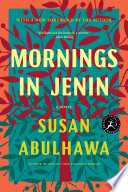
Morning in Jenin (every morning in Jenin)
Title of the original version reviewed: «Morning in Jenin (ogni mattina a Jenin)»
AI Translation Notice: This review was translated from the original Italian using artificial intelligence. Book quotes and excerpts are translated interpretations and will not match the author's original English phrasing or official published translations.
"I wonder: is there, in the listener, / a place where my voice may rest? / A harpoon, / tiny and concealed, / to hold memory fast before it scatters." (from Francesca Mannocchi, “The Harpoon of Memory,” from the collection Crescere, La Guerra, 2026). Is it possible to anchor ourselves to something within, so as not to forget "the particles of blood-soaked dust and the sickly-sweet smell of decay exhaled by unravelling lives and desertified soils"? Is it right to "live within the serene depths of the sea, where cries and weapons cannot be heard, and the stench of death does not reach"? Amal, the protagonist, lives between these two sides of consciousness: a dilemma not of her choosing, yet one that ensnares her entire life. She was born into a happy family, in a Palestine glowing with olive trees and vibrant hues: an ancient society that weathered the various empires that dominated it, forever anchoring itself to the land, its genealogies, and its sweet, centuries-old narratives. "Amal with the long vowel means hopes, dreams, (...) we place all our hopes in you." So her father told her when Amal was still a child, but he added: "we come from the land, we give our love and toil for it, and it feeds us in return. When we die, we return to the land. In a sense, it owns us. Palestine owns us and we belong to it." Amal's life is punctuated by the tragic milestones of post-WWII Palestinian history: the Nakba (the catastrophe) of 1948, with the forced exodus of 700,000 Palestinians and the Jenin refugee camp, where up to 50,000 people were interned, and where Amal’s family was forced to live in the narrative; the Sabra and Shatila massacre of 1982, when several thousand Palestinians were slaughtered by Lebanese Phalangists under the compliant gaze of the Israelis, and where Amal lost her husband and her brother's family; the Second Intifada in 2002, when Israeli troops assaulted Jenin, massacring hundreds of civilians, and where Amal met her death. After the Nakba, Amal had the opportunity to go to the United States on a scholarship, resigning herself to being called "'Amy', Amal without the hope, (...) a word drained of all meaning. A woman hollowed out of her past." In her heart dwell the profound sentiments of longing and abandonment: longing for "the sun that embraced everything it touched while the sumptuous aroma of lamb and cumin dispelled anguish, (...) the air filled with joyous sounds from people drunk on the fruit of trees that had survived across centuries, piercing the fog of exile"; abandonment, through the estrangement from her brother Yousef and her childhood friend Huba, the inability to understand why her mother had never embraced her as other mothers did, and the yearning to see her missing father once more: "I closed my eyes and kept them that way for as long as I could, opening them only as much as was necessary to banish the images from my mind." Amal returns to Palestine, reunites with her brother, and reclaims the familiar sights, sounds, and colors of her people. She falls in love with Majid, marries him, and becomes pregnant. Everything is suffused with Love and a serene anticipation. This is mere months before the 1982 massacre, preceded by the Israeli army's siege of Beirut. As an American citizen, Amal can return to the United States, while her husband remains behind in Lebanon to lend his medical skills to hospitals in critical need; and it is there that Majid meets his death. Amal, once again "Amy," gives birth to a daughter. The Palestinian tragedy recedes once more into memory, yet it seeps deep into Amal's heart, barring her from bestowing Love upon her child. "God forgive me, the more she grew, the more I feared being close to her, touching her. I was afraid of passing on to her my icy hardness, that my touch might have hardened her, that it would be the wrong complement to her soft, unconditional tenderness. So, I fulfilled the duties of motherhood, containing the ardor of my love behind the cold walls of fear and long hours of work." Only a feminine sensibility could grasp the sheer depth of pain inflicted upon a refugee's heart by the loss of what is gone: one's homeland, one's culture, and one's loved ones. It is no coincidence that the author titles the final section Nihaya and Bidaya, with the seemingly contradictory subtitle "an end and a beginning." In Arabic, Nihaya means "end," and Amal knows that in returning to Jenin in 2002 she is going to meet her death, for this is her destiny, foretold by her father. Bidaya in Arabic means "the beginning of a story." During the Israeli siege of Jenin, "I kept my daughter sheltered in a dream entirely my own, falling in love with her as though I had just given birth to her anew. We spoke for nine days, dismantling the unspoken words of a lifetime. As death rained from the sky and bullets struck the outer walls of the house, Sara and I laid bare the grief and bitterness each of us held so dear, finding our shared sorrow for Majid despite, or perhaps because of, the terror we felt." And so, as the poet sang: "if in the twilight of memory we / should meet once more, / we shall speak together again / and you shall sing / to me a deeper song. / And if our hands should meet / in another dream, we / shall build another tower in the sky."
The writer has struck a difficult balance between Grand History and the "small" stories of the human beings who are simultaneously its protagonists and its victims. We traverse the tragic fate of the Palestinian people, horrified and at once embarrassed as Europeans. The author does not shrink when forced to delve into the horrors of persecution; she does so almost like a historian, albeit an engaged one, and when she fears losing composure, she relies on the pen of a great journalist like Robert Fisk, who penned monumental reportage in his Pity the Nation (The Martyrdom of a Nation). Beside the dramatic events of "Grand History" lies the world of emotion: on one hand, that which is universal and eternal (such as the bond between mother and daughter); on the other, how such emotions are shattered by events unfolding beyond the pale of fundamental human relationships. Horror induces indifference in those who can keep their distance; for those trapped within it, however, grief leads to emotional desiccation, to a feeling of incapacity to bestow Love, to the dread of passing on one's own barrenness—the necessary armor—to someone untainted by it. And yet, one cannot withhold the truth from those one loves, for sparing the beloved means betraying them. In the relationship between Amal and Sara, one senses the author's own fraught experience, confronted with the dilemma of whether to shelter her daughter or make her part of her people's destiny. Within such an intense narrative, the father's friendship with an Israeli and Amal's reunion with her brother—abducted as a young boy and adopted by a Jewish family—feel redundant. Did the author wish to grant humanity to the "enemy"? Eighty years of war have inflicted suffering upon the Israeli people as well: one need only think of David Grossman's To the End of the Land (see the review on this site), but let each people bear the duty of mourning their own fate.
The prose reflects the balance of the narrative. Shifting deftly from passages of intense lyricism to analyses of remarkable psychological depth, the language is rich in cadence, interweaving the musicality of Arabic with the resonance of English. The lexicon is played like a piano keyboard, with a harmonious and evocative command of words, particularly verbs—words consistently woven into elegant, fluid grammatical structures. It would be fascinating to know the linguistic gestation of this novel, especially considering the author's scientific background and how she came to write this book spurred by a surge of indignation—a cry that lends vigor to the entire narrative. If one truly feels something within, one can become a great writer without being one by profession. It is a welcome sign of hope, and a lesson for many Western—and Italian—authors!
Why read it? It is a masterpiece, a stinging slap in the face to our timid and hypocritical selves.