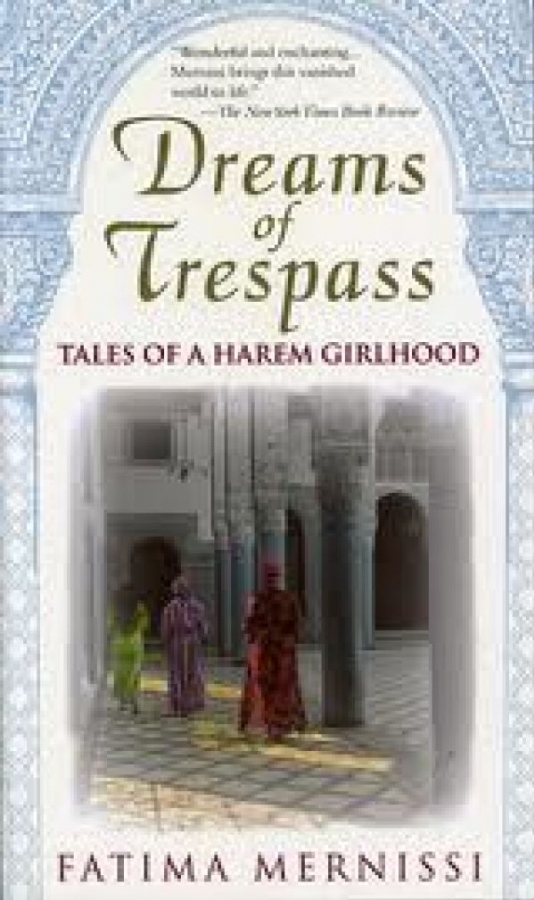
The Forbidden Terrace
As the author explains, there are two types of harems. Imperial harems are the ones best known to us Westerners: lascivious and indolent women, guarded by eunuchs, and ever-ready to satisfy their master’s desires. Domestic harems, on the other hand, are extended families in which women are confined within a physical boundary (generally the walls of a palace or townhouse when living in the city) or a virtual barrier in the countryside, where a woman could theoretically go outside but is prevented from doing so by social codes and customs. This novel concerns the domestic harem. We are in Fez, Morocco, during the 1940s, probably during the Second World War. The novel chronicles the author’s childhood within the extended family of her father and uncle. In several chapters, the narrative shifts to the countryside, to the sprawling house of her maternal grandfather—a polygamist, unlike the paternal household, which comprises solely monogamous couples. Three narrative threads can be identified in the book. The first, and most compelling, is the story of a young girl coming of age. The recited—never read—tales of the house’s many women, the discovery of the grand palace, the taste for the forbidden, and the play and solidarity among cousins fill Fatema’s life with joy and wonder. Fascinated by the adult women, their vitality, and their dreams, the young girl yearns for freedom, more out of affinity than a sense of deprivation. Indeed, she confesses > my childhood was happy because the boundaries were of a crystalline clarity . > Looking for frontiers became my life’s occupation.... everything seems easy looking at you (women of the harem)..... fragile, you, in the dead of night, on the distant terrace, yet so full of life, nurturers and guardians of wonders. I will become a magician. I will chisel words that give body to dreams, that will render borders vain . This wondrous childhood comes to an abrupt halt at the age of nine, when her cousin Samir, her peer and partner in games and mischief, confronts her with a choice: play with him or devote herself to making herself pretty. Still a child, Fatema chooses the latter path and breaks off her friendship with her cousin. The second narrative thread addresses the condition of women, deprived of freedom within the harem. Enclosed within the palace walls, even nature is replaced by > geometric and floral designs reproduced on the tiles... all the windows opened onto the courtyard . This physical deprivation becomes an existential sorrow, which only dreaming makes it possible to combat: > oh, yes, I would tell them of the impossible of a new Arab world, where men and women, locked in an embrace, dance away, with no more borders between them, nor fears... trust is the new game to learn..... they move forward, putting one foot in front of the other, their eyes fixed on the new, almost unimaginable horizon, unknown yet devoid of menace . For the intellectual Mernissi, the harem was a reality lived as a child, but it is also a metaphor for all the barriers erected against the potential of women—and of men. The third strand is sociological rather than narrative. The author describes harem life and, along with it, the customs of traditional Moroccan society. It is a particularly interesting aspect for Western readers. Indeed, what emerges is a North African and Muslim society previously unknown to us: culturally rich, tolerant, and open to changing customs and values. These are three narrative threads, yet the most spontaneous—Fatema’s childhood—is stifled by the other two, in which the adult woman takes over. Is it plausible that such a young girl could perceive the unease and yearning for freedom of the harem women with such philosophical clarity? Or is it Mernissi rereading the characters and events of the harem through the lens of her consciousness as an adult, intellectual, and politically engaged woman? Furthermore, the narrative thread tied to the condition of women is itself weighed down by the book’s obvious intention to document the harem and the Moroccan world: an undertaking in which the sociologist overshadows the creative writer. The layering of themes, the digressions on female emancipation, and the primacy given to social inquiry render the narrative verbose and redundant, stripping away the freshness and naivety that occasionally shimmer through the experiences of the young Fatema. The author fails to let political and social themes organically emerge from the novel—and thus from imaginative storytelling—relying all too often on the prose style and framing typical of an essay. Why read it? It is deeply interesting as an insight into the Muslim world. In certain passages, a strong poetic resonance makes itself felt.
The Lands of Sacramento
The novel is set in Molise between 1921 and 1922. It is our South: peasant-bound, archaic, and motionless for centuries. The lands of Sacramento are a fiefdom, left fallow because of a divine curse upheld by the Church, from which the estate had been expropriated by a wealthy family, the Cannavales. Paradoxically, the abandonment of this land places it at the disposal of the peasants. Some, the wealthiest and most unscrupulous, have shifted boundaries, effectively seizing the most fertile tracts; the majority, instead, turn to the fields to gather firewood, graze their few beasts, and forage for fruit and roots. On the other hand, the owner, the lawyer Enrico—sole heir of the Cannavales—is the quintessential apathetic Southern proprietor, squandering his vast inheritance on gambling, women, and travel, surrounded by a brood of petty parasites and exploiters. Luca, a twenty-year-old youth, tall, sturdy, and intelligent, is the son of impoverished peasants. He was destined to become a priest; then, restless and wavering, he abandoned the seminary to his mother’s deep sorrow, only to find himself a law student, penniless and without prospects. It would seem the classic destiny of so many Southern youths whose families made enormous sacrifices to have an educated son, however poor. What upends Luca’s life, and the future of the Sacramento lands, is the sudden intrusion of Laura. Raised in Naples and accustomed to the brilliant high society of the Parthenopean city, Laura was forced to relocate to Molise upon the death of her brother. Ambitious, she refuses to resign herself to the dullness of provincial life. She marries Lawyer Cannavale and resolves to develop the lands of Sacramento. She needs an intermediary between her designs and the peasantry. She finds him in Luca: who better than he—educated, driven, and respected by his people—can convince the farmhands to clear and till the Sacramento lands with the promise of holding them under emphyteusis? And Luca, naive and captivated by the woman, labors with vigor and success, placing his utmost trust in Laura. For many pages, the reader too indulges the illusion that Laura genuinely wishes to bring progress to these desolate Molise wastes. At last, a Southern proprietor who aspires to be an entrepreneur! Who loves her land! In reality, the peasants, and Luca with them, have been duped: the land has become the property of a Neapolitan corporation in which Laura is a shareholder. The peasants must resign themselves to remaining mere impoverished day laborers, doomed to destitution. They were used to break the ground, to dispel the curse, to inflate the sale value of the estate. And as has always happened in our South, the peasants’ protest ends in violent, tragic repression, with Luca himself paying the ultimate price, cut down and killed. The book is, first and foremost, a social novel, steeped in an intense realism. The author depicts, with grim fatalism, an affair that could have repeated itself across the centuries, ever identical to itself: the yearning for the land, the figure of a young man turned intellectual who naively fails to grasp the machinations of power, and an indifferent, selfish, and rapacious ruling class. After all, why trouble oneself over the lives of people who grow up, age, and die through the unfolding of physical existence, yet in a state of total mental inertia? This reading of the novel holds true for most of the events and characters, the latter serving as stereotypes of a social function rather than beings endowed with a rich inner life. Yet this becomes less tenable when confronted with the figure of Laura. Who is this woman? Cold, ambitious, amenable to a marriage of convenience, yet often affectionate, gentle, attentive to human relationships. Is she truly a manipulator, or is she herself a victim? > Laura stretched out her free hand toward Luca, smiling at him affectionately.... (then) Laura’s smile faded . Why not read it? It is slow and monotonous, failing to engage the reader.
Female Terrorists
The author is an American writer, but I read the book in its French translation. A young man, the son of an Irish woman and an Egyptian father who abandoned him, lives in sharp conflict with American society—a conflict that also reflects his troubled relationship with his mother, a free-spirited woman full of artistic ideas, and an idealized vision of his father’s society: the Muslim world. He develops a profound faith in this religion by attending the Quranic study classes of an imam by whom he is deeply influenced. Meanwhile, another narrative unfolds: a Jewish high school teacher—at the school where the boy is, in fact, a brilliant student—leads a drab existence steeped in disillusionment and existential weariness. In his role as guidance counselor, he approaches the boy to persuade him to go to university, but meets with an outright refusal, as the young man has decided to obtain a truck driver’s license. Indeed, he goes to work at a furniture store whose owner, a Lebanese man, is a friend of the sheikh. In reality, it is a terrorist front, and the young man is persuaded to drive a truck laden with explosives into a congested city tunnel in order to perpetrate a massacre. The Jewish teacher, having learned that the police suspect an impending attack and that the Lebanese merchant has been killed by fellow Lebanese because he was an undercover police informant, pursues him to convince him to desist. He then climbs into the truck, seemingly deciding to meet his death as well, and the book ultimately concludes leaving the reader in uncertainty regarding the explosion: it remains unclear whether the young man resolved to carry out the attack after all, or if he desisted, persuaded by the teacher. The fundamental theme of the novel is the young man’s innocence set against an American society in the throes of moral and spiritual decay, and an adult world that is both hypocritical and resigned. Even the figures the boy regarded as role models, such as the imam and the Lebanese merchant, ultimately prove to be frauds who exploit the youth and abandon him to his fate. The girl he ideally loves is, in reality, a prostitute paid by the Lebanese merchant to sleep with him. His mother loves her son, but her “head” is always on other things; she does not listen to him even at the most difficult moment of his life, as he heads toward a suicide bombing. Only the Jewish teacher stands close to the boy and understands his motivations. And here we find a juxtaposition of powerful political resonance: adherents of two religions that today seem worlds apart prove instead to be kindred spirits, perhaps because the Torah shares so many affinities with the Quran, and perhaps because the Jewish teacher is so repulsed by American society that he understands the young man’s suicidal impulse. The underlying premise of the book is thus very strong and echoes, if you will, Dostoevsky’s *The Idiot*: the young man is an idiot, an anti-hero, because he does not understand the rules of the world. The trouble is that the pacing remains persistently sluggish, often verbose and redundant, only acquiring at the very end, in the final chapter, a velocity that would have been far better encountered earlier. By contrast, the characters are thinly sketched; they remain flat, at times inscrutable. Even the surrounding environment is stereotypical and predictable, rendering its depiction largely ineffective.
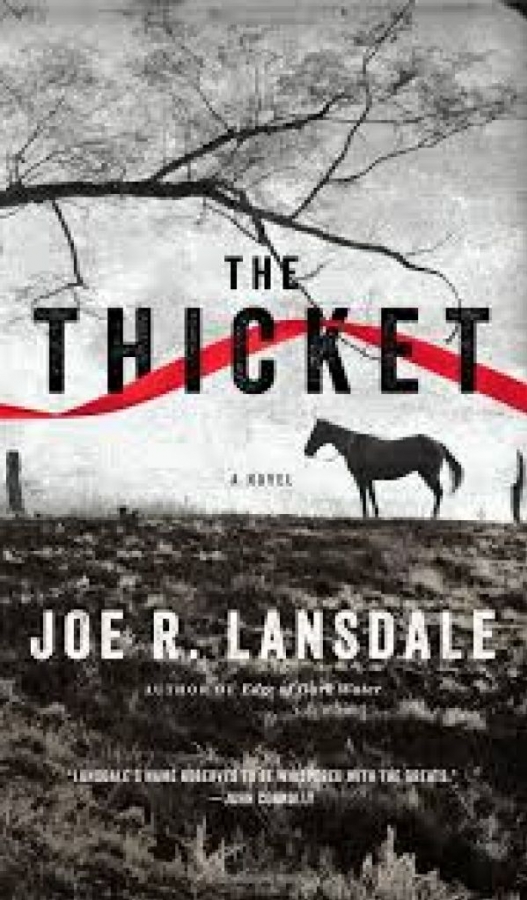
The Thicket (the forest)
In the face of evil, violence, countless innocent victims, genocides, and mass exterminations, we often wonder whether God exists or, if He does, whether He is an indifferent Being unmoved by the human condition. And often we are inclined to reply with the words of Shorty, one of the novel’s characters: > God is an idea, and the devil is us. (...) Life ain't black and white, here and there. There's some mud in it, and we are part of the mud . This novel tackles the question of good and evil, doing so through a tale that is adventurous, terrifying, and cynical. A smallpox epidemic has orphaned two adolescents, Jack and Lula. They are taken in by their grandfather: a paragon of virtue and steadfast values, at least in the eyes of the children. > He was a religious man and was always convinced that he would see everyone in heaven. It was a firm and solid thing in him, and it comforted him in every situation, and he had taught me that this was the way one had to deal with the world . They set out on a journey that was meant to bring the youngsters to live with an aunt; however, while crossing a river on a small ferry, the grandfather is murdered by a rogue, the boat capsizes, and Lula is abducted by bandits. Jack is terrified and immediately resolves to set out in search of his sister. Arriving in the nearest town, he runs into a dwarf, the aforementioned Shorty, and Eustace, a Black giant who is never without his hog. The two agree to help Jack, won over by the boy’s promise of an inherited property as a reward. They are ne'er-do-wells, or so it seems; but Jack’s misgivings lie elsewhere: > We might not have to kill anyone. Shorty and Eustace looked at me as if my pants had just fallen down and I’d dropped a big turd right there in the room. Might not have to kill anyone? Eustace said. You had a drink or two without me noticing? Jack loses his virginity to a young prostitute, from whom he learns that his grandfather had been one of her frequent patrons. He witnesses the torture of one of the outlaws at the hands of Eustace and Shorty; the latter recounts the chilling backstory of the sheriff, whose family was gruesomely slaughtered by Indians. Jack tries not to give in, turning to God, > but prayers felt meaningless to me, unlike when I was at home and my family was in the house with me and everything was in order. Prayers seemed real back then, but now they felt empty . They learn that the outlaws have holed up in a thicket—an impenetrable tract under bandit control. Thus begins “a noble rescue expedition”; pity that the party consists of such improbable figures: an inept tracker (Eustace), a pig that acts almost like a dog, a dwarf far too wise to be real, a prostitute partly infatuated and partly on the run, a desperate sheriff, and a wretched janitor who tags along out of fear or sheer lack of alternatives. Is this a metaphor for the wretched of the earth? Be that as it may, Jack plunges into the thicket alongside this bizarre entourage: he encounters gruesomely disfigured corpses and survivors still traumatized by the ruthless cutthroats; he hears harrowing tales of atrocious crimes and finds himself entangled in shootouts and killings, in which his companions display the very same disregard for human life as the bandits. It is like a descent into the underworld; human wickedness knows no bounds. Until, in a high-tension climax, the heroes—whom we would wish to be righteous—slaughter their enemies and rescue Lula. During the clash, Jack harbors no qualms; he has become a determined killer, stripped of moral restraint, no longer seeking Justice, expecting nothing from the law, devoid of any reverence for human life: > I felt further from Jesus and closer to Satan than I had ever been before . It is best not to disclose the novel’s ending: it lapses into a disappointing sentimentality of the “happily ever after” sort—a narrative stumble following a tale that leaves nothing to the imagination, so detailed and repetitively tedious are its gruesome acts of cruelty. One is left wondering about the author's purpose: an ode to violence, a portrait of modern society disguised as the American West, or, worse still, an attempt to convince us that coming of age requires accepting evil as the defining element of human existence across all eras. If this is the case, we counter with the words of a great Confucian philosopher (Wang Yang-ming, who lived between 1472 and 1529): the Mind, also known as Heart/Spirit (the unifying principle of the universe), > shares the very essence of human nature, and since human nature is fundamentally good, an equal perfection must be attributed to the Mind . It is pointless to ask whether God is good, evil, or indifferent, for He is nothing more than a projection of human nature: it is up to us to cultivate ourselves through knowledge, conduct, compassion, and sincerity, so as to act righteously and banish evil from our midst. The primary virtue of the novel lies in its narrative style. It is not an easy English, steeped as it is in slang and an apparently convoluted syntactic structure; yet it is precisely the writing that lends originality to the tale, intriguing and mesmerizing the reader. It is a pity that such skill was placed at the service of so misguided a message. Why read it? At times tedious, redundant in its cruelty, marred by too many digressions: what captivates is the prose.
This side of Brightness
In seeking meaning in this intense, tangled novel, *Gerusalemme Liberata* came to mind, a metaphor for a collective and individual purification that ought to lead to resurrection. For McCann too, the tunnel—the true protagonist of the narrative—evokes a journey at the end of which there should be light. Yet just as Torquato Tasso’s knights cannot attain sanctity because of themselves (“I shall live amid my torments, [...] raving, wandering: I shall fear myself”), so for the author every shadow of ourselves leads to another shadow, every tunnel to another tunnel. As Amelia Rosselli writes, > stationary before a destiny ever self-propelling or unrecognizable, among the tall stunted pines, among the many other things we do not write of so long as we manage to live them, among the tents of the campsite were indeed the usual traitors: myself disguised as a poor emperor, (...) I have undone all the tunnels of the sultry afternoon lull (from *Documenti*): there is no way out of depression, there is no hope. The trouble is that McCann attempts to tackle this existential theme within a traditional narrative structure. And indeed, the story sets out from the construction of the great underwater tunnel required to build the New York City subway. We are at the turn of the twentieth century: the undertaking is titanic, technical means rudimentary, working conditions punishing and arduous, the risks staggering. Working in the tunnel is Nathan Walker: a powerfully built black man, > the great arms, the thick chest, the knot of muscle, (...) happy and unhappy enough, sufficiently solitary, predominantly alone, Walker is capable, like a man who spends much time with himself, of laughing out loud for no apparent reason . The man takes care of the newborn daughter of a friend killed in a severe workplace accident. Over the years, affection for the girl turns into love; an aging man marries a very young woman, a black man joins with a white woman. This theme is then abandoned by the author (why introduce it, then?), or perhaps it hints at the mingling of different ages and races as a sin that lies at the root of a cascade of misfortunes: the wife is struck and killed by a car, the son takes revenge by murdering the driver and is subsequently shot dead by the police, the daughter-in-law turns to drugs and dies of an overdose, the grandson, Clarence Walker, lapses into depression after witnessing the death or suicide of his grandfather. It is truly too much! Alongside this honestly implausible storyline, the true theme of the novel slowly surfaces: Clarence Walker (referred to for many pages as “Treefrog,” a frog that lives in trees) has hidden himself in a tunnel among the homeless, carving out a lair in an inaccessible spot, reached only by a perilous catwalk. > Everything is in the purest darkness so that he can hardly see even the palm of his hand in front of his face. And then there is a slow coming of an array of tunnels and flashes of light and he can see through the shadows. He listens to the movements and fear drops down into his belly and settles in his liver : memories, evanescent portraits, a past no longer real, merely dreamed with nostalgia, in a ruthless indifference. And what is love like in the tunnel, this metaphor for our lives? > Angela’s nails scraped along his back, leaving marks in the skin, and the rhythm of their breath quick quick quick quick, a wild thrusting from them both, until everything unraveled into long gasps of breath, slow slow slow slow, and then the two of them could lie there waiting for something more . Like any good American novel there must be a happy ending: yet it feels too tacked-on to offer relief, after the strain of doggedly reaching the story’s conclusion. The writing is the book's redeeming virtue and what holds it aloft. Amid a messy plot, with superficially drawn characters and never a deep dive into the narrative’s countless turns, the reader must surrender to the grip of the prose, the syntax, the capacity to summon feelings, images, human conditions. One cannot help admiring certain subtle references, such as the phrase “funhouse darkness,” echoing the song by American singer-songwriter P!nk: “dancing through this empty house it tears us down throws you out screaming in the halls spinning all around and now we fall..... Why read it? It is strenuous, but the writing is fascinating.
A thousand splendid suns
Female friendship lies at the core of this novel. The author chronicles the condition of women in Afghanistan across an extensive span of time, from the 1960s to the present day—from the monarchy to the invasion by Western forces, spanning the “Soviet” period, the civil war, and the Taliban regime. He portrays the harsh reality of women's lives through the trajectories of two female figures: Mariam and Laila. Mariam is fifteen years old in 1974 when her father gives her in marriage to a much older man: Rasheed. The marriage is intended to remedy a scandalous situation. Mariam is an illegitimate child and thus, following her mother's suicide, cannot be taken into her father's household. For the young girl, this marks the end of a relatively happy adolescence, nourished by the myth of her father and the dream of being recognized as a daughter in her own right, of no longer being a bastard. Yet, though betrayed by her father—a weakling and a coward—Mariam bravely confronts her new life in the metropolis of Kabul. Yet Rasheed proves to be a despotic and violent man, particularly after Mariam fails to bear him a son, miscarrying the baby girl she was carrying instead. The monarchy is supplanted by the communist regime, and the status of women improves, at least in official rhetoric and for a narrow stratum of the population. Yet for Mariam, nothing changes: she lives cloistered at home, subjected to her husband’s brutal dominion. The narrative then turns to the adolescence of Laila: a lively, restless, educated girl, in love since childhood with a playmate: Tariq. War among tribal factions fosters a mounting climate of violence, killings, abductions, and rapes, driving many families—including Tariq's—to flee to Pakistan. A bomb destroys Laila's house, killing her parents. The girl is rescued and taken in by Rasheed and Mariam. In truth, the man aims to marry her and succeeds, partly through deception (with the false news of Tariq's death) and partly because Laila is pregnant with Tariq's child and sees marriage as a solution for herself and, above all, for her unborn baby. At first, Mariam treats Laila with hostility, viewing her as an interloper who has usurped her role as sole wife; yet Rasheed’s sheer cruelty, the birth of two children, and the harshness of life under the Taliban regime gradually forge a growing solidarity between the two women that blossoms into a profound friendship. It is a distinctly feminine bond, arising from the care of the children and the resolve to resist—with steadfastness and stubborn determination—the unprecedented violence inflicted upon them by Rasheed. And it is Mariam herself—the meek, submissive Mariam—who strikes down her husband with an axe as he attempts to murder Laila. Mariam thereby enables Laila’s escape while condemning herself to death at the hands of the Taliban: an ultimate sacrifice for the future happiness of her friend and her children. The finest sections of the novel are those devoted to depicting the childhood and adolescence of Mariam and Laila: the representation of the rural world—Mariam's—contrasted with the Kabul setting where Laila grew up; the innocence and dreams of the two girls, so disparate yet so akin, typical of youth; their affection for their fathers—mythologized for Mariam, tangible for Laila; the emotional detachment of the mothers, and the deeply rooted bond between Laila and Tariq, unquestionably the redeeming facet of an otherwise grim and somber novel. When the narrative moves on to depict the vicissitudes of the two marriages, however, one senses an air of abstraction and contrivance. The author relies in vain on the literary device of alternating perspectives between the two women: both personalities remain relegated to the background, flattened by scenes of violence and Afghan life that are themselves repetitive and precisely as we in the West imagine them to be. In particular, the friendship between the two women is never explored in depth; instead, it surfaces superficially, its underlying motivations and contradictions left unexamined. Mariam’s extreme decision to kill her husband and liberate Laila feels abrupt, devoid of any perceptible maturation, with the result that Mariam herself is reduced to a secondary figure compared to Laila, when in fact she bears all the hallmarks of a heroine of Greek tragedy. Why not read it? It is overly long and at times redundant.

Please let me hate you
Welcome back, superficiality! The novel is a modern love fable, complete with all its ingredients: the little Cinderella, in the guise of an angry, progressive young woman; Prince Charming, albeit independent and career-driven; the clash between bourgeois values and the aristocratic sphere, all set in the modern London of investment banking. The protagonist, who also serves as the narrator of the tale, is Jenny. Born into a vegan, animal-rights, pacifist, and anti-capitalist family, Jenny pursued a career as a tax attorney—not entirely betraying her native values (she is merely a vegetarian!), but choosing to forge her own life, one that does not simply mirror the family tradition. She has fashioned a self-image as a strong, “all brains” woman, drifting through failed romances with cultured, “left-wing” men adored by her family, but not by her. At the investment bank where she works and is held in high esteem, she has been waging a years-long “war” with Jan, the scion of a highborn lineage—brilliant, yet vain, arrogant, and obnoxious. Jenny must concede that he is a charming man, yet Jan’s background, his demeanor, and the competitive streak driving the young woman fuel a genuine hostility toward the handsome aristocrat. In an altercation that has since become notorious, Jenny, impetuous by nature, went so far as to break Jan’s noble nose. Working together is therefore out of the question. Yet a high-profile client insists on being represented by both, forcing them, much to their dismay, to “be a team.” Predictably, the “magical attraction” Goethe speaks of in *Elective Affinities* triumphs over differences in temperament, ideology, and social standing, as well as over their mutual competitiveness. Jenny and Jan find themselves in situations of escalating physical proximity: an accidental touch that nonetheless sends strange vibrations, a staged kiss (to spite Jan’s admirers), a kiss that is no longer staged, culminating in physical intimacy. > It is like eating something you know will upset your stomach, but which you simply cannot resist . The “armor” the girl has forged for herself dissolves like a wave in Jan’s arms. But if she did not want to be won over by her Prince Charming, why, when going out with Jan, does she let her friends convince her to dress provocatively and sensually? The ending is a foregone conclusion: the two marry in a lavish ceremony (500 guests). The young woman asserts her “proletarian” spirit by foregoing the veil, yet agrees to wear her husband’s splendid family jewels. A fitting compromise between socialist ideals and aristocratic ones! The novel’s primary virtue lies in its style: delicate, ironic, understated. The narrative relies fundamentally on dialogue, punctuated by Jenny’s sensations rather than reflections. And it is precisely the lightness and elegance with which the author depicts the young woman’s gradual surrender to the allure of the senses that constitutes the novel’s pleasantly engaging element. A pity there is no suspense: everything is entirely predictable, devoid of twists or genuine moments of rupture in a narrative plot far too weak to captivate. Another missed opportunity is the setting. The world of investment banking, with its ruthless rules of career advancement and competition, remains relegated to the background; indeed, at times, it verges on the implausible—one need only consider the boss, far too understanding to be real. Why read it? If one is in need of lightness, it makes for a pleasurable read.