John Updike
Books by this author (3)

Rabbit Redux
It is the 1960s in a provincial American town. The Vietnam War and profound changes—cultural, social, and sexual—serve as the backdrop to the novel, whose central thread is aptly summarized by what the protagonist says at the end of the narrative: > confusion is just a local view of things working out in general . Can one remain oneself, as if nothing were wrong, in a “terrible period, of profound confusion,” such as the one America was going through in the 1960s? Henry works as a typesetter and leads a seemingly peaceful life with his wife Janice and Nelson, their only child. Their marital relationship has been deeply shattered by the death of their other daughter, raising a wall between the two spouses that inevitably affects their sex life as well. Henry can be defined as a conservative: he believes in American values, the righteousness of the Vietnam War, and the idea that Blacks should stay in their place. This precarious balance is overturned by Janice’s affair with a colleague, a Greek man, with whom Henry has a furious argument specifically over the Vietnam War. Janice abandons the family to move in with her lover, leaving Henry to shoulder the burden of the house and their son. On the surface, he appears to be a solid man; in reality, beneath an apparent observance of the roles and conventions imposed by a respectable society, Henry is deeply restless. One evening, he is invited to dinner by a female friend who has just been left by her husband, and everything suggests the evening ought to end in bed, as tradition would have it. Instead, Henry ignores the woman’s overt signals and finishes the evening in a bar frequented primarily by Blacks. Here he meets Jill, an eccentric runaway girl, and Skeeter, a sort of visionary Black man. He takes them into his home and begins a relationship with Jill. A long portion of the novel, rendered verbose and tedious by its heavy ideological imprint, chronicles the life of the four (Henry, Jill, Skeeter, and Nelson) and the increasingly complex and ambiguous entanglement among them. From joints, they move on to hard drugs. Jill also sleeps with Skeeter and perhaps with Nelson, but what dominates above all is the figure of Skeeter and the reading of Black revolution texts. Somehow, Henry reconstructs his cognitive world to the point of defending Skeeter to his neighbors. Then, a terrible fire, perhaps set by the neighbors themselves, destroys the house and kills Jill. Henry, who helps Skeeter—the police’s prime suspect—flee, loses everything, including his job. The novel draws to a weary close: Janice wants to get back together with Henry and persuades him to stay at a hotel. Yet too many things have happened, and the burden of guilt weighs heavily on Henry in particular: “I feel so guilty.” “About what?”, Janice replies. “About everything.” “Relax, not everything is your fault.” “I can't accept that.” “He lets her breasts drop, lets them float away, lovely debris.” Updike’s chief virtue is his narrative style and, above all, his ability to bring characters and events to life through a rich and skillful use of adjectives. This novel lacks precisely that touch, dominated instead by the author’s urge to voice his own perspective—conservative and nostalgic for 1950s America—on the monumental events that convulsed the United States. The character of Skeeter, the glorification of revolutionary principles, and the political arguments are banal and predictable. They make the novel long-winded and, above all, overshadow Henry’s complex transformation and his fundamentally existential suffering. Why not read it? It is verbose and deeply dated.

Villages
Owen, the novel’s protagonist, grew up in a small town, where > sex and religion had distinct, antique smells; families were balanced like frail nests on knobby branches of preceding history . It is a world of vague certainties, which Owen leaves behind to study computer science at university. There he marries Phyllis, a brilliant mathematics student. Owen is captivated by his wife’s intellect and erudition, yet subconsciously senses a kind of detachment, as though she lived in a world of her own, populated by mathematicians and poets, while the real world were a “tedious and insignificant place of exile.” The couple moves to a small town, where Owen, together with a partner, launches a software company that proves to be a major success. Four children follow, Phyllis devotes herself to the family, and with the nineteen-sixties American customs shift, not least as a result of the sexual revolution; computer technology evolves rapidly, confronting Owen with a relentless technological challenge. The couple takes part in local high society, and in this gossipy, hypocritical milieu, Owen begins a succession of affairs—the first ones more emotionally involving, the later ones progressively confined to purely sexual encounters. Owen is an attractive, obliging man, yet scandal and gossip fail to destroy the marriage thanks to Phyllis’s determination to safeguard the family, and above all because she forgives her husband out of love. The marriage unravels when Owen, by now weary of these flings, meets Julia and asks for a divorce. In a confrontation—the only true argument of their marriage—Owen justifies this decision by claiming that Julia, a deeply religious woman, will save him from his own weaknesses. Phyllis rebels, but, disgusted by her husband’s hypocrisy, flees. Whether by accident or suicide, she dies in a car crash, and once again Owen is spared from having to make his life’s choices alone. One of the book’s central themes is undoubtedly the evolution of American society, observed from two distinct vantage points: the revolution in sexual mores (with Owen’s escapades becoming increasingly explicit) and the computer revolution, from mainframes to the personal computer. Another theme is the depiction of small-town American life, which in many respects recalls episodes of the television series *Desperate Housewives*. Then there is the figure of Owen himself—pliable, fragile, yet opportunistic—who merely drifts along with events while taking advantage of a protective cocoon (his mother, his two wives, and his business partner) that allows him to remain an adolescent all his life. It is no coincidence that the novel concludes with a description of Owen’s dreams, reminiscing nostalgically about his mother and the village of his childhood. Updike’s style is lush with adjectives and baroque constructions that lend musicality and expressive vitality to the narrative. Although the book is scarce in incident, it is the prose style that sustains the narrative rhythm, making for an enjoyable read. Yet such verbal redundancy does not favor economy, and the reader easily gets lost amid “so many fireworks.” Why read it? It is a thoroughly enjoyable read, especially in the original language.
Female Terrorists
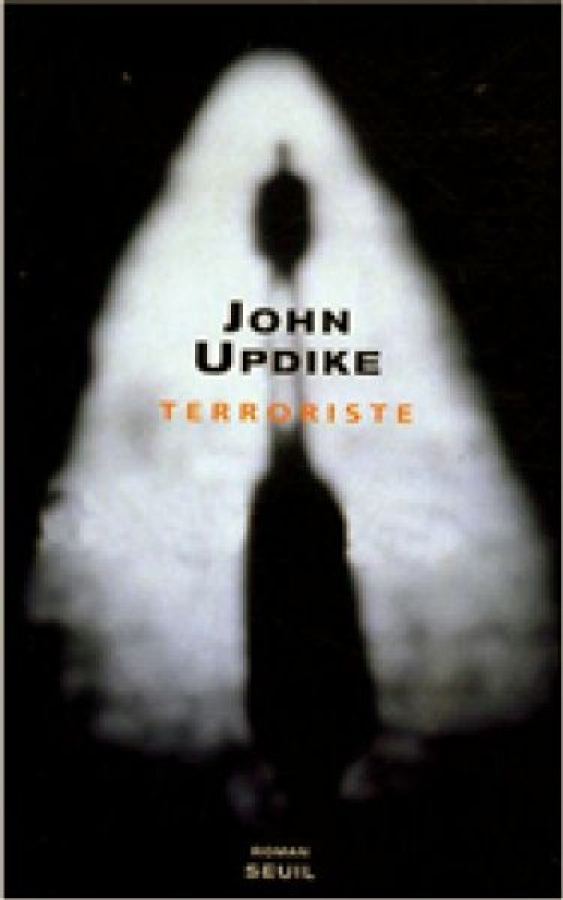
The author is an American writer, but I read the book in its French translation. A young man, the son of an Irish woman and an Egyptian father who abandoned him, lives in sharp conflict with American society—a conflict that also reflects his troubled relationship with his mother, a free-spirited woman full of artistic ideas, and an idealized vision of his father’s society: the Muslim world. He develops a profound faith in this religion by attending the Quranic study classes of an imam by whom he is deeply influenced. Meanwhile, another narrative unfolds: a Jewish high school teacher—at the school where the boy is, in fact, a brilliant student—leads a drab existence steeped in disillusionment and existential weariness. In his role as guidance counselor, he approaches the boy to persuade him to go to university, but meets with an outright refusal, as the young man has decided to obtain a truck driver’s license. Indeed, he goes to work at a furniture store whose owner, a Lebanese man, is a friend of the sheikh. In reality, it is a terrorist front, and the young man is persuaded to drive a truck laden with explosives into a congested city tunnel in order to perpetrate a massacre. The Jewish teacher, having learned that the police suspect an impending attack and that the Lebanese merchant has been killed by fellow Lebanese because he was an undercover police informant, pursues him to convince him to desist. He then climbs into the truck, seemingly deciding to meet his death as well, and the book ultimately concludes leaving the reader in uncertainty regarding the explosion: it remains unclear whether the young man resolved to carry out the attack after all, or if he desisted, persuaded by the teacher. The fundamental theme of the novel is the young man’s innocence set against an American society in the throes of moral and spiritual decay, and an adult world that is both hypocritical and resigned. Even the figures the boy regarded as role models, such as the imam and the Lebanese merchant, ultimately prove to be frauds who exploit the youth and abandon him to his fate. The girl he ideally loves is, in reality, a prostitute paid by the Lebanese merchant to sleep with him. His mother loves her son, but her “head” is always on other things; she does not listen to him even at the most difficult moment of his life, as he heads toward a suicide bombing. Only the Jewish teacher stands close to the boy and understands his motivations. And here we find a juxtaposition of powerful political resonance: adherents of two religions that today seem worlds apart prove instead to be kindred spirits, perhaps because the Torah shares so many affinities with the Quran, and perhaps because the Jewish teacher is so repulsed by American society that he understands the young man’s suicidal impulse. The underlying premise of the book is thus very strong and echoes, if you will, Dostoevsky’s *The Idiot*: the young man is an idiot, an anti-hero, because he does not understand the rules of the world. The trouble is that the pacing remains persistently sluggish, often verbose and redundant, only acquiring at the very end, in the final chapter, a velocity that would have been far better encountered earlier. By contrast, the characters are thinly sketched; they remain flat, at times inscrutable. Even the surrounding environment is stereotypical and predictable, rendering its depiction largely ineffective.