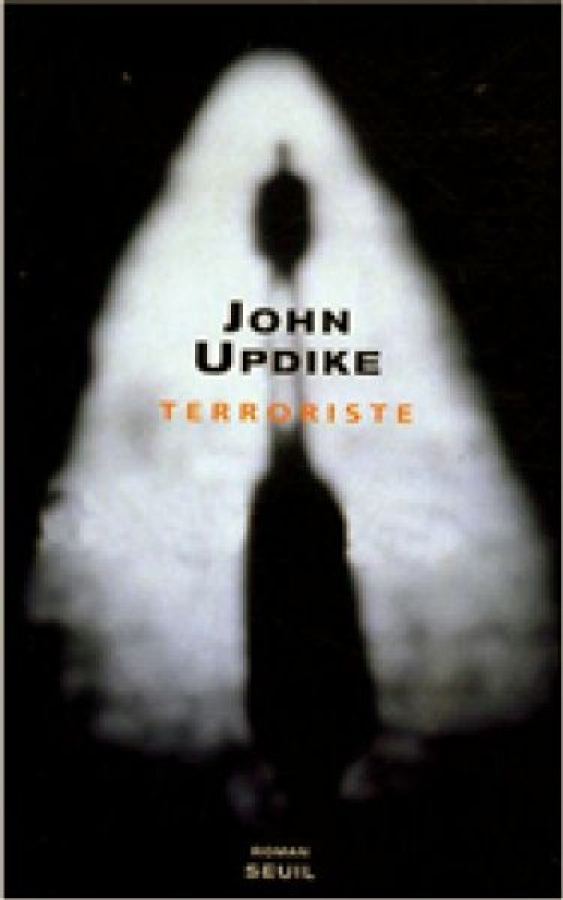
Finished reading on: July 24, 2008
Female Terrorists
Title of the original version reviewed: «Terroriste»
AI Translation Notice: This review was translated from the original Italian using artificial intelligence. Book quotes and excerpts are translated interpretations and will not match the author's original English phrasing or official published translations.
The author is an American writer, but I read the book in its French translation.
A young man, the son of an Irish woman and an Egyptian father who abandoned him, lives in sharp conflict with American society—a conflict that also reflects his troubled relationship with his mother, a free-spirited woman full of artistic ideas, and an idealized vision of his father’s society: the Muslim world.
He develops a profound faith in this religion by attending the Quranic study classes of an imam by whom he is deeply influenced.
Meanwhile, another narrative unfolds: a Jewish high school teacher—at the school where the boy is, in fact, a brilliant student—leads a drab existence steeped in disillusionment and existential weariness.
In his role as guidance counselor, he approaches the boy to persuade him to go to university, but meets with an outright refusal, as the young man has decided to obtain a truck driver’s license.
Indeed, he goes to work at a furniture store whose owner, a Lebanese man, is a friend of the sheikh.
In reality, it is a terrorist front, and the young man is persuaded to drive a truck laden with explosives into a congested city tunnel in order to perpetrate a massacre.
The Jewish teacher, having learned that the police suspect an impending attack and that the Lebanese merchant has been killed by fellow Lebanese because he was an undercover police informant, pursues him to convince him to desist.
He then climbs into the truck, seemingly deciding to meet his death as well, and the book ultimately concludes leaving the reader in uncertainty regarding the explosion: it remains unclear whether the young man resolved to carry out the attack after all, or if he desisted, persuaded by the teacher.
The fundamental theme of the novel is the young man’s innocence set against an American society in the throes of moral and spiritual decay, and an adult world that is both hypocritical and resigned.
Even the figures the boy regarded as role models, such as the imam and the Lebanese merchant, ultimately prove to be frauds who exploit the youth and abandon him to his fate.
The girl he ideally loves is, in reality, a prostitute paid by the Lebanese merchant to sleep with him.
His mother loves her son, but her “head” is always on other things; she does not listen to him even at the most difficult moment of his life, as he heads toward a suicide bombing.
Only the Jewish teacher stands close to the boy and understands his motivations.
And here we find a juxtaposition of powerful political resonance: adherents of two religions that today seem worlds apart prove instead to be kindred spirits, perhaps because the Torah shares so many affinities with the Quran, and perhaps because the Jewish teacher is so repulsed by American society that he understands the young man’s suicidal impulse.
The underlying premise of the book is thus very strong and echoes, if you will, Dostoevsky’s The Idiot: the young man is an idiot, an anti-hero, because he does not understand the rules of the world.
The trouble is that the pacing remains persistently sluggish, often verbose and redundant, only acquiring at the very end, in the final chapter, a velocity that would have been far better encountered earlier.
By contrast, the characters are thinly sketched; they remain flat, at times inscrutable.
Even the surrounding environment is stereotypical and predictable, rendering its depiction largely ineffective.