
The Short Stories of Franz Kafka
Kafka’s stories are generally brief writings, characterized by a paradoxical plot and cryptic, scarcely accessible content. Undoubtedly his most important story is *The Metamorphosis*, which can be regarded as a masterpiece both from a strictly literary perspective and in terms of its thematic substance. Gregor, a model employee, awakens transformed into a large insect, likely a cockroach. At first, the family is stunned; then they feel a stir of pity and compassion toward him (particularly the sister), and finally indifference and contempt set in. Ultimately, Gregor lets himself die, and his parents and sister do not even care where his body has been discarded. The story lends itself to multiple interpretations. First of all, what is the cause of this transformation? Is it, perhaps, the revolt of a young man compelled, at an early age, to support his family (the debt-ridden, idle father; the sister who aspires to be a violinist) under the rigid, oppressive control of an office manager? Following the night of the transformation, in the morning Gregor ought to depart early as usual, and the fact that he remains in his room is regarded by all as a display of indolence—itself already a defiance of social rules. > "Chief Clerk," Gregor cried out, "be patient for just a moment! Yet I am already feeling much better. How can such a thing happen!" . It is the theme of a bureaucratic, oppressive society that in no way tolerates the breach of rules. Yet there is, for me, another theme that is even more universal. What happens when a person falls prey to a serious illness? At first, everyone stands by him, full of compassion and kindness; then, little by little, people begin to alienate the patient, altering his habits and his furniture because he is no longer needed, until abandoning him to indifference. This is what happens to Gregor. At first, his sister cares for him, unlike his father, who from the very beginning rejects him to the point of grievously wounding him. Then the mother and sister decide to clear the room of furniture so as to make it easier for Gregor to crawl along the walls (a clear demonstration of a kindness that disregards the patient’s wishes). Gregor does not want this, because it signifies relinquishing his nature as a man, as a healthy person, and he reacts to the point of clinging to a picture to prevent them from taking it away. Then one day, as his sister plays the violin, Gregor, the large insect, is entranced by the sound and longs to draw near to his sister, to embrace her and have her play for him alone. Instead, he is cruelly repelled because he is a monster. Nothing remains but solitude and death. Alongside Gregor’s transformation, a change takes place within his relatives. The father goes back to work and struts around in his uniform, the sister works as a shop assistant and wears open collars, and the mother works as well. When Gregor is gone, a new life begins, wholly forgetful of the kinsman who had nonetheless helped them so much.
The Tales of Rainwater Pond
We are in Wexford, a county located in the north-eastern part of Ireland and depicted by Billy Roche across numerous theatrical works. The setting common to all the stories is the Rainwater pond: > a dark and treacherous place. You could drop a coin in and watch it enter the murky water, go home, have your tea, go to the cinema, return home a second time, (...) and that coin was still sinking as you walked back in for dinner . The dark allure of the pond led the protagonist of one of the most evocative stories, *One Is Not a Number*, a poor cripple marginalized and tormented by the other boys, to believe that “the place had magical properties that could somehow cure him,” if only he dipped his poor foot in the water. And lingering further on this splendid tale, magical indeed this pond must be if at a certain point a doppelgänger appears—the boy the wretched cripple wished he could have been: > he was the other me, the real me, the one who lived inside me, (...) handsome, strong, and healthy, with wheat-coloured hair and not a single freckle, (...) an elegant bearing, I thought, and he possessed a deep voice he never overused . And Evelyn, the girl loved in vain by the cripple, “walked home, floating an inch or two off the ground,” looking like a fairy. Has the ugly toad transformed into a graceful white swan? As in all the stories, the individual lives fade away, at times without a definitive conclusion, into the banality of existence—as though we were all trapped in our fate, in a prosaic, narrow, and stagnant everyday life; and Rainwater Pond is simultaneously a physical place and a metaphor for our suffering consciousness, powerless to break free. As the protagonist reflects in the final story, tellingly titled *A Quiet Place*, all that fretful striving to have a life of one’s own had merely been > a mysterious twist of fate that had ultimately worked for his own good; and at that moment it was all over, the actors had packed their costumes back into their suitcases and returned to everyday life . Across the sequence of stories, a rupture emerges, dividing the collection into two parts. Up to the tale of the cripple and his desperate loneliness—a long, intricate story—an ancestral magic realism holds sway, recalling Elsa Morante’s *Menzogna e Sortilegio* and Anna Maria Ortese’s *Il mare non bagna Napoli* and *Il Cardillo addolorato* (see the reviews on this site); at times, a yearning for love emerges that is meant to compensate for physical flaws (as with fat Maggie) or to help escape an unhappy condition: consider the splendid ending of *The Northern Lights*, where the protagonist returns home to find her husband disappointed to see her, without a trace of suspicion or jealousy: > she sighed to herself. Everything was clearer to her now. That night, after tea, she would go upstairs to paint a portrait of him: a solitary man seated at the window, before a silvery night sky . Incidentally, this is a very different reaction from that of Alba de Céspedes’ protagonist in *Da parte di lei*, who kills her husband because he is indifferent and bored (see the review on this site). In the second part, the narrative pace becomes brisk; the characters seem to be on a stage performing a play; the reading flows swiftly, intriguing and effortless, but the fantastical atmosphere of the earlier stories slowly disperses, and even the pond dissolves into the background, losing the uncanny and mysterious presence that lent the narrative its charm. We are far removed here from other Irish writers, with their captivating, evocative, at times impenetrable vocabulary, characterized by an intricate, often challenging syntax: neologisms, cadences that seem to stem from languages other than standard English, long sentences, digressions, and parenthetical clauses. Here, the sentences are short, with extensive punctuation, as is often the case in contemporary American fiction. The translation succeeds in conveying the deeper meaning of the stories, though one wonders whether it might have simplified the diction, as so frequently happens. Perhaps the prose and narrative structure reflect the author’s predominantly theatrical background. Why read it? A meditation on the human condition, viewed through a microcosm.
The Boys of the Massacre
It is chilling to read this novel in light of a recent news story, in which a boy stabbed his French teacher, unleashing upon her a hatred and violence one would never wish to see harbored in an adolescent. We are in the 1960s, in an “old and poor Milan,” yet already convulsed by traffic that was “unpleasant, irritating; drivers glared at one another with hatred, the traffic lights were always red, (...) and outside nothing could be seen, only the fog.” In this city so different from today's, a heinous crime has been committed: eleven boys have raped, beaten, tortured, and ultimately murdered a frail night-school teacher. True, they are already petty criminals: some the children of “honest parents,” others with fathers in prison and mothers working as prostitutes, but all of them known to the police for acts of violence, petty theft, and alcohol abuse. For the chief inspector, it is a straightforward case: they are all guilty, and the essential thing is to get rid of this “rabble” as quickly as possible, handing the matter over to the investigating magistrate, the reformatory, and prison. Not so for Duca Lamberti, the protagonist of Scerbanenco’s detective novels (see the review of *Venere Privata* on this site): an unusual policeman for whom “truth was the only thing that mattered (...), even if, in the end, it was of no use.” It arouses his suspicion that they all say the exact same thing: “namely, that they hadn't done anything, that they had been forced to stand in a corner while the others did everything.” It is too clever a defense, and maintained by all of them, as though prearranged. “This line of defense was concocted before the crime, and by someone smarter and not drunk like those boys,” Duca Lamberti concludes. From here unfolds a police investigation made not of deft, subtle reconstructions designed to trap the suspects and force them into confession; nor does the inquiry dissolve into sociological analyses or excuses to narrate the protagonist's life. Everything remains in the background. Only occasionally are there brief brushstrokes of a Milan that longed to remain that of the late nineteenth century, with its taverns, still *trani* and not yet bars, where the drunkards “still fell asleep, as in the days of Porta, their heads resting on their arms, and there were the aging prostitutes, (...) and there was the tired, kind flower seller, limping gently. (...) The row of parked cars stretching the entire length of the street took nothing away from this innocence: they were the intruders.” And feelings appear fleetingly, timid, conveyed through small gestures: “‘Sleep,’ she said, ‘and keep me warm.’ They would make love another time, she knew. He warmed her, but did not sleep; he tickled her neck with his stubbly, unshaven cheek, and his breath was a warm whisper on her breast that kept her from sleeping.” Duca Lamberti’s approach stems from the empathy he feels for these boys, or at least for some of them. He attempts to forge a relationship of care with them, encouraging them to open up not out of fear of the police, but so that they might understand the evil they have committed—an evil devastating first and foremost to themselves. Not that he fully succeeds: the first boy, frail and young, a homosexual, kills himself, destroyed by guilt; the other, fourteen-year-old Carolino Marassi, an orphan and petty thief, comes close to being killed. Duca Lamberti makes mistakes; he is often depressed when confronted with such cruelty, and dispirited when Carolino runs away, betraying the trust placed in him. “‘He’s a good boy,’ Duca said, ‘but you’ve never been in a reformatory or in prison or an orphanage, and you cannot understand what freedom means to a boy like that.’” Confined to a literary genre, Noir, traditionally regarded as second-rate, Scerbanenco is rarely counted among the great Italian writers of the second half of the twentieth century. Perhaps his dry, concise, unadorned style, often mistaken for literary poverty, contributed to this as well. Far from it: Scerbanenco’s style is the result of a deliberate pursuit of essentiality, mirrored in a plot admirably stripped of redundancy, as well as in his prose and vocabulary. There is no need for distractions or idle digressions: the story and the “boys of the massacre” speak for themselves. They reveal more about our society, and about abandonment, than any number of sociological analyses or moralistic reflections. The writer’s sole task is to recount their despair, shouldering its weight. Why read it? A splendid noir, an intense social novel.
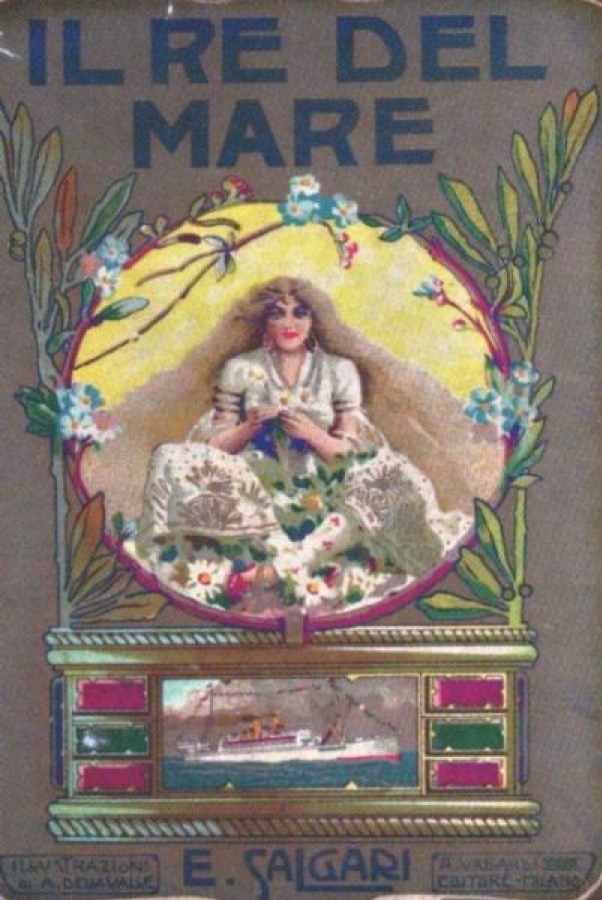
The King of the Sea
The book is structured in two parts. The first part recounts the adventure of Yanes, who sets out to rescue Tremal-Naik and his daughter Darma. The setting is Borneo, rich in strange fauna and an exotic atmosphere. Plot twists follow one after another, yet a certain artificiality and repetitiveness emerge, rendering the reading tedious. This section of the book closes with yet another surprise: the terrible leader of the Thugs had a son, who now seeks to avenge his father’s death and has allied himself with the British to defeat Sandokan. The island of Mompracem has been conquered, and the pirates of Malaysia decide to declare war on England. In the second part, the true protagonist emerges: the cruiser *Re del Mare*, aboard which the Tigers roam, fight, and conquer. Seascapes return—a tempestuous sea and rugged, inaccessible coastlines. And an impossible love story unfolds, between Darma and the son of the terrible Thug. The narrative becomes more intricate, as combat episodes alternate with conversational interludes, gradually forging a kind of friendship between the son of the Terrible Thug and the pirate chieftains. As in *The Black Corsair*, one would expect an unhappy ending; indeed, here matters reach the point where Sandokan and Yanes could well be defeated, killed, or taken prisoner. Sandokan, in particular, is weary; he is no longer the man he once was, far less marmoreal than he appeared in the other novels. Yet in the end comes the plot twist: love triumphs, and out of love, the son of the terrible Thug realizes that vengeance is pointless, not least because by pursuing it he would lose his beloved. The pirate chieftains are freed. Unlike the other books in the Malaysian cycle, here one faces a flagging narrative momentum (so much so that the author leans heavily on his well-worn techniques without any innovation), and even the depiction of the setting (the sea and the jungle) seems marginal to the tale. What does emerge, however, is a theme absent from the other novels: technology, embodied in the cruiser's sheer power and the introduction of an inventor capable of triggering remote explosions. Technology renders Sandokan and Yanes obsolete: their life cycle has ended because the world has changed; it is no coincidence that they are defeated by four cruisers, likewise powerful and swift. Yet technology has its frailties: the *Re del Mare* sails under the constant dread of finding no coal to feed its boilers, and the inventor perishes, struck down by a mere shell. The age of sail fades away, but the new technologies grant the "heroes" far less autonomy and independence.
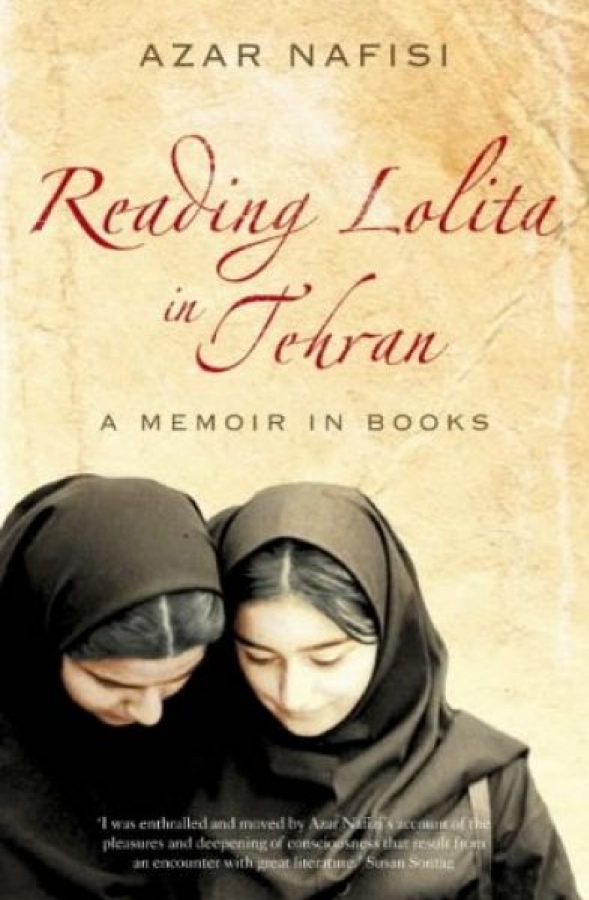
Reading Lolita in Tehran
A very fine book, especially the first chapter, in which the writer achieves a density of prose and depth of concept reminiscent of Nadine Gordimer. The book is structured around four periods in the writer's life: each is in some way symbolized by four great authors of literature in English: Nabokov with *Lolita*, Fitzgerald with *The Great Gatsby*, James, and Austen. The narrative does not follow a chronological path. In the first chapter, the author has already left the university and established a reading group in her home. The young women, her former students, arrive at the gathering clad in veil and chador, rendered impersonal by the attire and posture they must adopt to walk the streets; they undress and thereby assume their true personalities. The character of Lolita, a twelve-year-old girl who becomes the lover of an older man, lies at the center of their conversation as a symbol of their existential condition, forced to behave and even think as men dictate. Alongside the literary theme, their personal stories emerge and their interpersonal relationships intertwine, forged of rivalries but also of profound understanding and tenderness. The synthesis of this chapter, and of the entire book, is encapsulated in a profound phrase: "not to be a fragment of someone else's imagination." Lolita possesses no personality of her own; rather, she is forged by the old man, who desires her precisely because he can mold her to his will. In much the same way, Iranian women are expected to conform to the dictates of religious society, unable to genuinely express their individuality or live their own lives. And so literature is not "a luxury, but a necessity"; the realm of the imagination allows one to reclaim the freedom that society seeks to suppress. At this point, the writer introduces the theme of beauty, emphasizing how the younger generations are indifferent to ideology and political stances. > I still find it in the letters from my students when, despite their fears and anxieties about a future without work or security and a fragile, uncertain present, they write about their search for beauty . > I think that somehow our readings and discussions of novels in that class became our respite, our link to another world of tenderness, brilliance, and beauty . In the second chapter, the context is the revolutionary phase, during which it is unclear who will take power, the clerics or the leftist forces. It is thus a transitional phase, yet one characterized by a conviction shared by fundamentalists and leftist revolutionaries alike: individual liberties and the role of women must be subordinated to a massifying ideology. The writer's critique is therefore directed at the Left, which fails to grasp the importance of civil rights and reasons, in effect, no differently than the religious factions. The most interesting episode, from a narrative standpoint as well, is the trial of *The Great Gatsby*, singled out by some as an emblematic figure of Western individualism. The dynamic of the trial sets in motion a dialectic within the classroom, revealing more clearly that the true subject of Fitzgerald's novel is the dream of self-realization in a society that tends to homogenize the individual: > Dreams... are perfect ideals, complete in themselves. How can you impose them on a reality constantly changing, imperfect, and incomplete? You could become a Humbert, destroying the object of your dream: or a Gatsby, destroying yourself. When I left the class that day, I did not tell the students what I myself was beginning to discover: how similar our fate was to Gatsby’s. He wanted to fulfill a dream by retracing the past, and in the end he discovered that the past was dead, the present a shame, and there was no future. Was this not like our revolution, which had imposed itself in the name of our collective past and had destroyed our lives in the name of a dream? . The third chapter is set during the Iran–Iraq War. The revolution has by now firmly imposed itself, women's freedom has been eradicated, and the country lives suspended within a nightmare (the casualties, the bombings, etc. ), gripped by a fierce nationalism and without any hope that this war might come to an end. These are terrible years, in which one cannot help but retreat into feeling. The writer quotes a passage by James, the master of feminine ambiguity, > I cannot tell you not to grieve and not to rebel, writes James, because I have such an imagination of all things and because I am unable to tell you not to feel. To feel, I say, to feel for what is worth it, and even if it kills you, for this is the only way to live, especially living under this terrible pressure, and it is the only way to celebrate and honor this admirable being who is our pride and our inspiration . And the writer adds, > feeling creates empathy and reminds us that life is worth living . It is a profoundly feminine sentiment, harboring that solidarity based on care and relationships that underpins feminine thought. The fourth chapter returns to the context of the first. The war is over, and it becomes fully apparent that there is no genuine possibility of evolution within a regime structurally opposed to civil liberties and the feminine dimension. Nothing remains but flight into intimacy and exile abroad. In a world where religion has become ideology, there seems to be no room left for the individual dimension. In this sense, Austen is hated by the regime. > Austen's women, gentle and beautiful, are the rebels who say no to the choices of foolish mothers, incompetent fathers, and a rigid, orthodox society. They risk ostracism and poverty to win love and friendship (to assert the importance of love and understanding in marriage, and not the importance of marriage itself) in order to embrace that unattainable goal of democracy: the right to choose . Beyond Iranian society, the book addresses universal themes (freedom of choice, the primacy of affection over rigid dogmas, the power of literature and the imagination, etc. ) that can be traced back to the statement: not to be a fragment of someone else's imagination. Yet how is this possible in an increasingly oppressive and homogenizing society, even if ostensibly democratic? How can one defend oneself against the invasion of images, of clichéd commonplaces broadcast by television, of clamorous debates, and so on? It seems to me that the true perspective lies in the rediscovery of literature and culture in general—both as a return to the individual sphere and as a revival of the imagination, and thus as an instrument of resistance and redemption for tomorrow: thinking and feeling are, perhaps, the keystones to conceiving and ultimately realizing a better society.

The Queen of the Caribbean
The novel is the continuation of *The Black Corsair*. The pirate is still in pursuit of the hated Duke Wan Gould, and the book unfolds across a series of combats and adventures, interspersed with long, captivating descriptions of the Caribbean forest. The Duke perishes with his ship, and in the end the pirate is reunited with his beloved Honorata, who has become queen of the cannibals. The book displays a highly complex structure and develops across several planes, with the introduction of new characters. At the center of the novel lies the fatalism of the Black Corsair, now convinced that he is condemned to unhappiness and destined to bring grief to others as well. In a conversation with Yara, the young Indian woman who will be killed by the Spaniards, the pirate confesses his conviction of being predestined to bring misfortune to women: > One cannot love the Black Corsair, maiden. I bring misfortune to the women who draw near me. You have seen it! and again, after Yara's death, > I am fatal to all – he said in a somber voice – take care of this maiden, Marchioness . On the other hand, the thirst for vengeance overwhelms the Black Corsair, constituting a destiny from which he cannot escape, even should he wish to. In his conversation with the Marchioness of Bermejo (a splendid new character of Salgari’s), when asked what he would do with the Duke if Honorata were alive, the Black Corsair replies > do you believe, Madame, that the souls of my brothers have been appeased? When the sea turns phosphorescent, the Red Corsair and the Green, the Duke's victims, resurface: they demand vengeance. When the hurricane sweeps in from the East, amidst the howling of the wind, I hear a voice that comes from the shores of Flanders: it is that of my elder brother, treacherously murdered by the Duke, and that voice demands vengeance as well . Even at the moment he meets Honorata, whom he is finally free to love since the Duke is dead, the Black Corsair yearns for death ("Yes, death, oblivion!") and his dark despair is such that he seems to see the dead calling to him ( > Look at them, Honorata, look at them... There is the Green Corsair... there is the Red... there is your father... and my other brother, too, slain on the lands of Flanders... ) and the pirate wishes to join them ("I am coming!... Brothers!... I am coming!"). Only love saves him, and to the Black Corsair's question of whether to choose between life and death, Honorata whispers, "Your love." Alongside this struggle between hatred and love move the secondary characters surrounding the Black Corsair, who are in fact central to the novel: in particular, his companions, Carmaux, Wan Stiller, and Moko, who tend to the Black Corsair with fraternal devotion and lend the novel a sense of brio by tempering its dramatic intensity: an extraordinarily modern device, essential in giving the book rhythm and reading pleasure. Nature, too, emerges as a major protagonist: a lush nature, teeming with fantastic fauna, especially birds and reptiles, which Salgari describes with meticulous precision and a desire to seek distraction and forget the despair that dominates the figure of the Black Corsair. To claim that this is merely an appetite for exoticism is to overlook the contrast between the surrounding setting and the pirate’s emotions: the description of the environment carries the tone of escape and repose. The final theme of the novel consists of combat, particularly naval battles and shipwrecks; the sea is yet another protagonist, and splendid are the pages depicting the clash between the *Folgore* (the beloved *Folgore*!) and the Duke’s ships. The book is flawless, both in terms of its rhythm and with respect to its characters and plot.
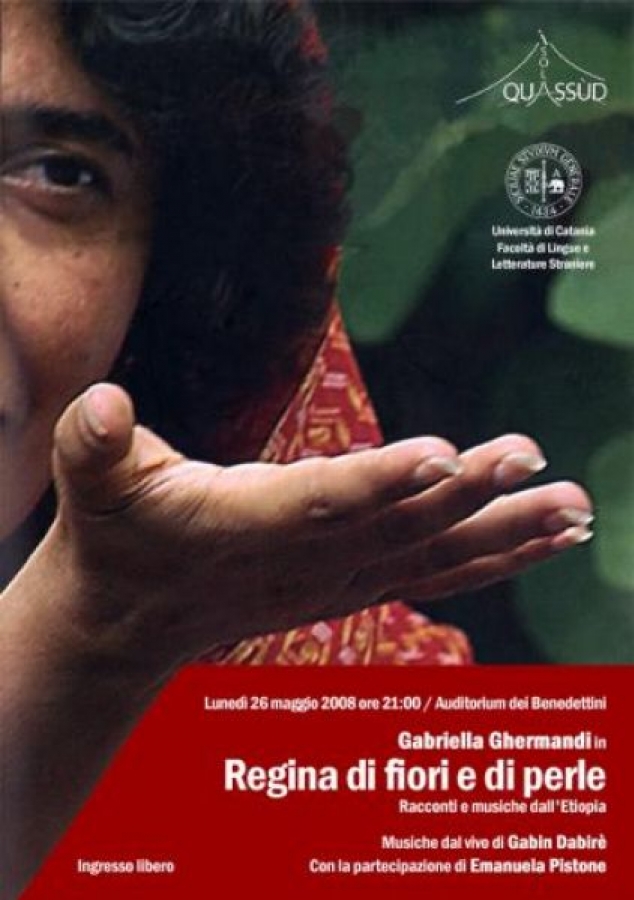
Queen of Flowers and Pearls
The first-person narrator is a young girl, then an adolescent, and finally a young woman, who recounts how she became the “cantora” of the history of her people (Ethiopia) and of the Italians, when the latter conquered her country. The book opens with the great-grandfather’s account of the birth of the girl’s grandmother during the resistance against the Italians and the violent death of her parents, an Italian man and an Ethiopian woman. The book thus takes as its starting point an act of great love that binds the two peoples together, yet the cruelty of the racial laws, which forbade an Italian from marrying an Ethiopian woman, surfaces from the very beginning. The old man makes the girl promise that she will tell these stories, so that a memory may endure for the future. The girl grows into an adolescent, forgets her promise, and decides to go study in Italy, in Bologna. Now twenty-three, she returns to Ethiopia upon hearing news of the old man’s death, but arrives too late to take part in the collective mourning that traditionally accompanies a funeral. She is thus left suspended in an unspoken, internal grief, and with a sense of estrangement from the others, who now perceive her as an outsider. The great-great-grandfather had left as a dying wish that the girl go pray at an important sanctuary. The central section of the book unfolds, then, over six days during which the young woman travels to the monastery, meets an elderly hermit, and above all, as she waits, listens to the stories of women—tales concerning the tragic and complex encounter between Ethiopia and Italy. Gradually, she manages to process her grief and realize that her destiny is to fulfill what her elders had asked of her: “you shall be our cantora.” One of the central themes of the book is undeniably Italian colonialism, its cruelties and aberrations: particularly tragic are the pages recounting the massacre perpetrated by the Italians in the wake of the assassination attempt on Graziani. It would be reductive, however, to limit the book to this theme alone. In reality, the narrative structure of the work is remarkably complex, revealing at least three distinctive features: its choral nature, derived from the collection of stories that form the heart of the book. The narrator says little about herself (even though she is the first-person narrator), for what matters is neither emotional introspection nor existential anguish; rather, the book aspires to be a progressive point of accumulation for the history of two peoples; the richness of its themes, which span from the processing of grief to the loss of roots experienced by those caught between two cultures, to the opposition of communal values against the loneliness of modern man. In this sense, the true setting of the story is Italy, interpreted through the vantage point of someone who comes from another culture: what emerges is a country defined by autumn colors, greyness, soliloquy and abandonment, and regret for the past; the narrative style, lean despite its rich vocabulary, which stands out favorably against the verbosity of many Italian writers.

The road to Los Angeles
It is the second book of the Bandini saga. While the first book still revolves around the theme of the Italian family, rendered in a realistic style lacking in evocative resonance, this novel effectively abandons ethnic and folkloric references to chronicle the coming of age of an eighteen-year-old youth who reads voraciously and lives primarily through imagination and fantasy. The Italian family context is indeed present (the deeply religious mother and sister, an uncle who expects his nephew to shoulder his responsibilities), yet Arturo’s experiences are fundamentally those of any young man his age, compelled to reconcile labor—often grueling and alienating—with his own aspirations and dreams. The book’s first theme is rage, the urge to rebel against an unjust society, frequently expressed through acts of violence (superb is the scene where Arturo slaughters crabs, imagining himself an ancient knight), through diatribes against the Catholic religion, and in allusions to the great nineteenth-century philosophers. The second theme is the erotic realm, the pursuit of a connection with women, which inevitably passes through pornographic magazines and the solitude of his room. Truly extraordinary from a stylistic standpoint is the chapter in which the author recounts Arturo’s destruction of the photographs of the women he loves! The final theme, and perhaps the most important, is that of imagination—the dreams and fantasies bound up with Arturo’s ambitions, with his desire to feel like a great writer. And it is precisely the disappointment resulting from the reading of his first story that drives Arturo to flee his family and journey toward Los Angeles, and thus toward his own independence and maturity. Fante abandons the cold, realistic style that had characterized the first book, moving toward increasingly intense expressions and syntactic constructions, rich in evocative power. To the meaning of the word are added increasingly rich and nuanced "signs," generated by rhythm, phonetics, and the deployment of adjectives, often heightened by neologisms.

The Red and the Black
The novel chronicles the fortunes of Julien Sorel: the son of a carpenter, he manages through his own drive and intellect to climb the social ladder, first within the provincial bourgeoisie and subsequently among the Parisian aristocracy. He is engaged as a tutor to the Mayor’s children, and soon embarks on an affair with the Mayor’s wife. He then pursues his studies in a seminary and, through a series of fortuitous circumstances, becomes secretary to a powerful nobleman, with whose daughter he enters into another love affair. The young noblewoman, haughty and proud, falls madly in love with Julien, by whom she is soon expecting a child. The Mayor’s wife, persuaded by her confessor, sends the girl’s father a letter that slanders Julien’s character. Consumed by rage at his injured honor and by the betrayal of his former lover, he attempts to kill her; he is subsequently imprisoned, tried, and sentenced to death. During his imprisonment he realizes that he is truly in love with his first mistress, but by then it is too late. The plot of the book appears to correspond to an actual real-life incident; yet beyond mere verisimilitude, the narrative may be interpreted from three distinct perspectives. From the standpoint of historical context, the novel depicts the social ascent of a representative of the common people, rising through the bourgeoisie and up to the aristocracy. In Julien there is neither submissiveness nor the slightest humility: he is convinced that he is equal to, if not worthier than, the members of the bourgeoisie and aristocracy he encounters along his path. As he comes to know them better, an initial phase of admiration gives way to disillusionment with the narrow-mindedness of the provincial bourgeoisie and the vacuity of the aristocracy. In this sense, Stendhal’s novel resembles Proust’s, even if it totally lacks the philosophical underpinnings that characterize *In Search of Lost Time*. The portrait that emerges of the clergy is likewise profoundly negative. In this light, the title *The Red and the Black* would seem to signify the conflict between the progressive, democratic spirit and the reactionary conservatism of the ruling classes in the first half of the nineteenth century. The title, however, appears to mirror deeper and, to some extent, universal peculiarities and contrasts. The novel’s characters all operate within an atmosphere of falsehood and hypocrisy, which equally marks Julien’s behavior. One need only consider the subterfuges he employs to conquer and dominate the beautiful Mathilde, or the fact that until the very last moment he maintains an ambiguous posture toward her, showing her affection at the very moment he is in love with his former mistress, the Mayor's wife. Underlying these sentiments, a pervasive superficiality and a logic dictated by mere expediency hold sway. This ambiguity dissolves only in Julien’s revolutionary act—at this point a "true hero"—as he seeks to avenge the false accusations leveled against him and accepts death with courage and dignity. Confronted with injustice and death, Julien casts aside hypocrisy and expediency to act with integrity, even if in a manner baffling to his contemporaries. The third perspective is embodied by the two women, the Mayor’s wife and Mathilde, who constitute the novel’s true heroines. From the outset, their feelings are profoundly genuine: the Mayor’s wife endures an unhappy marriage and confronts her new lover with astonishment yet immense courage; Mathilde, so haughty and aristocratic, is nonetheless willing to forfeit everything, with passionate abandon, for the man she loves. One need only recall the pages describing the rapprochement between Mathilde and Julien. On the young woman’s part, a profound struggle unfolds between her aristocratic pride and her burgeoning love; on Julien’s, what predominates is merely the fear of being "made a fool of" and the drive to dominate, even through deceit. Julien fails to grasp the true stature of these two women; he suspects ulterior motives and snares, only to later indulge in fantasies of their devotion after his demise. In truth, the end of both women will be tragic and profoundly genuine, just like their love: the Mayor’s wife will die of a broken heart, while Mathilde, seized by madness, will bear away her lover’s severed head.