Gabriella Ghermandi
Books by this author (1)
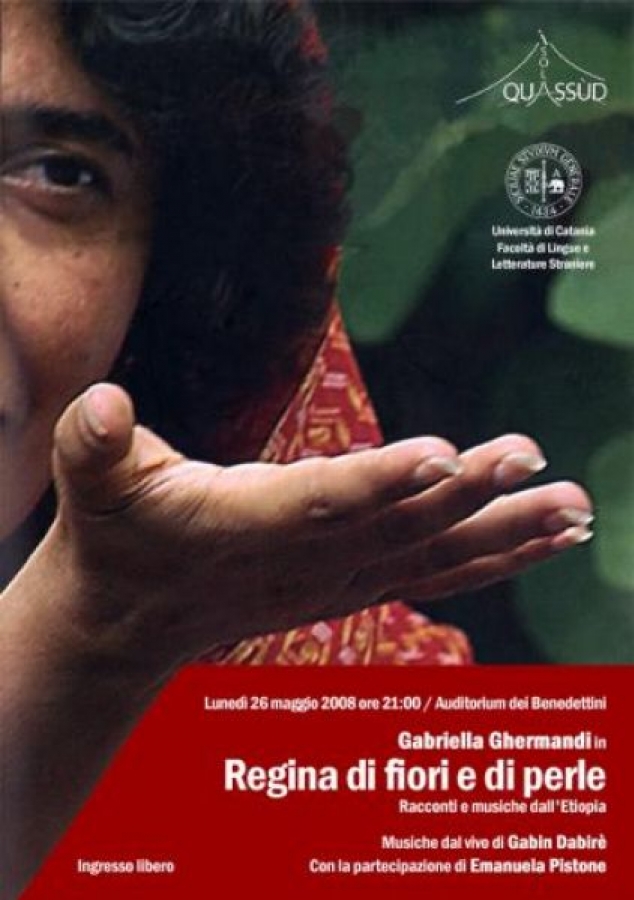
Queen of Flowers and Pearls
The first-person narrator is a young girl, then an adolescent, and finally a young woman, who recounts how she became the “cantora” of the history of her people (Ethiopia) and of the Italians, when the latter conquered her country. The book opens with the great-grandfather’s account of the birth of the girl’s grandmother during the resistance against the Italians and the violent death of her parents, an Italian man and an Ethiopian woman. The book thus takes as its starting point an act of great love that binds the two peoples together, yet the cruelty of the racial laws, which forbade an Italian from marrying an Ethiopian woman, surfaces from the very beginning. The old man makes the girl promise that she will tell these stories, so that a memory may endure for the future. The girl grows into an adolescent, forgets her promise, and decides to go study in Italy, in Bologna. Now twenty-three, she returns to Ethiopia upon hearing news of the old man’s death, but arrives too late to take part in the collective mourning that traditionally accompanies a funeral. She is thus left suspended in an unspoken, internal grief, and with a sense of estrangement from the others, who now perceive her as an outsider. The great-great-grandfather had left as a dying wish that the girl go pray at an important sanctuary. The central section of the book unfolds, then, over six days during which the young woman travels to the monastery, meets an elderly hermit, and above all, as she waits, listens to the stories of women—tales concerning the tragic and complex encounter between Ethiopia and Italy. Gradually, she manages to process her grief and realize that her destiny is to fulfill what her elders had asked of her: “you shall be our cantora.” One of the central themes of the book is undeniably Italian colonialism, its cruelties and aberrations: particularly tragic are the pages recounting the massacre perpetrated by the Italians in the wake of the assassination attempt on Graziani. It would be reductive, however, to limit the book to this theme alone. In reality, the narrative structure of the work is remarkably complex, revealing at least three distinctive features: its choral nature, derived from the collection of stories that form the heart of the book. The narrator says little about herself (even though she is the first-person narrator), for what matters is neither emotional introspection nor existential anguish; rather, the book aspires to be a progressive point of accumulation for the history of two peoples; the richness of its themes, which span from the processing of grief to the loss of roots experienced by those caught between two cultures, to the opposition of communal values against the loneliness of modern man. In this sense, the true setting of the story is Italy, interpreted through the vantage point of someone who comes from another culture: what emerges is a country defined by autumn colors, greyness, soliloquy and abandonment, and regret for the past; the narrative style, lean despite its rich vocabulary, which stands out favorably against the verbosity of many Italian writers.