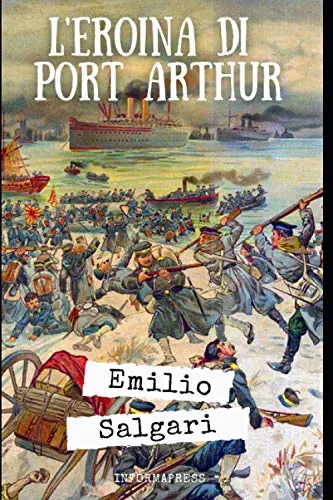
The Heroine of Port Arthur
Emilio Salgari was exceptionally swift at fashioning stories around events that gripped the public imagination; he did so by blending a certain exoticism with wars and romantic intrigues. Such had been the case with *La capitana del Yucatan* and *Le Stragi delle Filippine* (see the reviews on this site), and so it is in this novel, published under a pseudonym in 1904. The backdrop is the Russo-Japanese War of 1904–1905, in which > "little Japan," as the Russians contemptuously called it, confronted and defeated the vast Russian Empire. The setting is Port Arthur, the gateway to the conquest of Korea and at the time in Russian hands. The narrative opens with a scene of simultaneous splendor and decay: a *daimyo* (that is, a feudal lord) passes through the crowd alongside his stunning daughter, Shima. > She was barely sixteen, (...) not tall, exquisitely proportioned, with deep black eyes that bore no trace of slant, (...) skin with alabaster hues, (...) with a lovely little mouth, its somewhat thin lips hinting at an extraordinary resolve. A lavish reception is set to take place at the daimyo’s residence to celebrate Shima's betrothal to Boris, a Russian officer. The prospective groom fails to appear: he is having an affair with a geisha and knows that war with Japan is imminent, rendering marriage to a Japanese woman impossible. The city is steeped in an atmosphere of tense anticipation, which allows the two women to face one another: Shima, > with blazing eyes and an inflamed countenance, demands to know whether the geisha truly loves Boris; the other implores her to let her keep her love, > why wrest from me, a poor geisha, the love of a single man—the only one who has ever truly loved me, and whom I love? I am a wretched flower cast to the mercy of the wind, destined to wither unless someone gathers me and exposes me to the dew and the sun. Never in his numerous novels had Salgari chronicled a conflict of such passion and social resonance, pitting a beautiful, wealthy aristocrat against a destitute prostitute in love. In a writer so attuned to public sentiment, one detects echoes of Gabriele D'Annunzio, Guido Gozzano, Gian Pietro Lucini, and French *poètes maudits* such as Paul Verlaine and Charles Baudelaire. Regrettably, this social and romantic conflict fails to evolve, cut short by the outbreak of war; upon both women falls a single, overriding duty: to serve the homeland, Japan. > The homeland!, exclaimed the geisha, in a sudden burst of fervor, (...) The danger facing our homeland in this solemn hour unites the common people and the nobility for the supreme defense of the country, bridging the abysses that divide them, Shima said in a solemn voice. She drew her into her arms and kissed her on the forehead, saying: for the homeland! And we are no longer in distant Port Arthur; it is as if we were commemorating the martyrs of Dogali and Adwa, the heroes who defended the Nation against the fierce Ethiopians! Salgari extols a nationalist, colonialist, and irredentist Italy, which would march exultantly into Libya and later to liberate Trento and Trieste in the catastrophic slaughter of the First World War. "Little" Japan becomes the mirror of modern Italy: its war dead the future martyrs, the two women the archetypes of all the mothers, wives, and daughters who will sacrifice their personal affections for the Motherland. A keen reader of war correspondence, Salgari displays a remarkable grasp of the dynamics of the naval clash unfolding at Port Arthur, where the formidable Japanese fleet, deftly commanded and equipped, pinned the Russian vessels inside the harbor before closing the city in a pincer movement from sea and land. Yet it is precisely the sheer scale and protracted duration of the battle that make it difficult for Salgari to provide overall clarity and highlight the dramatic turns of events. The author operates far better when only a few ships clash, making it easy to focus the reader’s gaze on the pivotal locations of the action. In the same vein, Salgari abandons his customary narrative blueprint of a central figure supported by secondary characters. Here that role might have belonged to Shima, but the "heroine" is overwhelmed by events, struggling to coexist with the minor figures. And where is the enemy, the traitor Boris? This incomplete and ill-defined system of characters stands as the novel's primary weakness. Why read it? For a fleeting spell, one conjures up the Salgari of *Il Corsaro Nero* (see the review on this site).

The Sentimental Man
An opera singer recounts a dream in which he relived a love affair: several years earlier, in Madrid, he had met and spent time with a couple—the wife of a prominent businessman and her male companion. The singer had fallen in love with the woman, whose husband later killed himself out of despair. While writing down the contents of the dream, news reaches him of the accidental death of his former girlfriend. The device of the recounted dream seems intended to recreate that atmosphere of enchantment, present with greater force in the author's other novel, recently reviewed. In truth, the author intended to tell a love story to demonstrate how that feeling > always requires something fictitious beyond what reality affords it. Love is based to a great extent on its anticipation and its memory . From this point of view, the true protagonist is the husband, who did not opt for reality but lives in yearning and thus in an expectation of love, constituted by his wife's acceptance of his affection and passion. I do not know why, but the book recalls a Pirandellian plot, insofar as the impression emerges that reality is not what it appears to be, but rather what one would wish it were, and despair is born precisely at the moment one realizes the profound divergence between reality and imagination. The various protagonists—the wife, the companion, the husband, and the former girlfriend herself (who held no importance while alive, yet acquires it through her death)—are analogous to Pirandello’s *Six Characters in Search of an Author*. They are attempting to escape unreality through the opera singer, who appears to be a passive subject in the affair, enduring events that he actually sets in motion. Does the passivity with which the singer accepts being abandoned by the woman perhaps intend to signal the prosaic nature of reality compared to the depth and vitality of the imagination? The book is very well written, but it possesses less depth, stylistically as well, compared to the previous one.
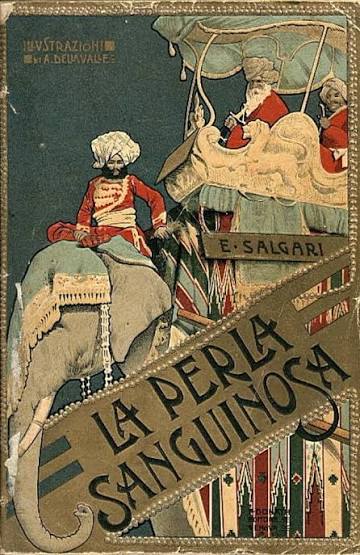
The Bloody Pearl
Although he went by the moniker "Captain Salgari," the Veronese writer never actually traveled; for his novels, he relied on the numerous accounts of explorers and geographers who brought back to Europe tales of hitherto unknown worlds—accounts that blended reliable reports with fanciful inventions, steeped in a burgeoning racism. Our author was always deft at promptly seizing upon "the trend," chasing the public’s appetite for strange and exotic novelties. Right from the mysterious and evocative title, one enters the atmosphere: *La perla sanguinosa* (*The Bloody Pearl*) is a pearl of rare beauty, stolen from a sacred temple in Ceylon (modern-day Sri Lanka) and steeped in the color of the blood of the thief who took it, only to drown later in the great shoal of Manaar, an extensive shallow reef situated between southern India and Ceylon. Behind the pearl lies a love story: a maiden has been forced to become a Buddhist nun and can only be redeemed through the delivery of the bloody pearl; vying for both pearl and maiden are a humble pearl diver and the One-Eyed, a villainous impostor. Both are held in the prison of Port Cornwallis, a British penal colony located in the Andaman archipelago, a group of islands in the center of the Bay of Bengal. It is from this prison that the novel sets forth: three inmates (our diver, an English sailor, and an Indian machinist, all wrongfully imprisoned) manage to escape the colony and head toward Ceylon in a fragile boat to recover the bloody pearl and redeem the beloved maiden. Not only are they pursued by the One-Eyed, but they must also confront a series of ordeals: from the assault of a sea vampire—perhaps a "lamprey," a fish with a sucker mouth that feeds on blood—to a terrible storm with gigantic waves, culminating in their capture by the Queen of Nicobar, who wishes to take the handsome Englishman as her husband, much like Circe with Odysseus. Salgari’s imagination knows no bounds, conjuring up the Vadassi, whose valiant chieftain Adikar—fascinated by Napoleon—sought to emulate his deeds and lead his people to triumph, a sort of feral Sandokan; and what of the "crucified dolphins," in reality a small cetacean that inhabits Antarctic waters, far removed from the Bay of Bengal. To this muddled wealth of geographical, zoological, and anthropological references corresponds an equally muddled plot, packed with adventures that are all too often repetitive and prolix. Salgari’s narrative formula hinges on a central protagonist flanked by supporting characters who leaven the narration and throw the hero into sharp relief. When he departed from this model successfully, as in *Capitan Tempesta* and *La stella dell'Araucania* (see the reviews on this site), it was because he proved capable of constructing a compelling, intense love story. The setting, while ever-present, always remained in the background, instrumental in evoking an exotic and mysterious atmosphere. Here, the narrative functions are inverted: setting takes center stage; the band of fleeing prisoners is flat, devoid of a true leader (the Englishman predictably emerges, yet remains a faded figure), and lacks any clear hierarchy of roles; the love story remains suspended and remote, and the villain is easily defeated. Layering adventure upon harrowing description fails to impart rhythm to the narrative or captivate the reader. One finds solace only in a few isolated descriptions, as in the recounting of the struggle with the vampire: > it had wrapped itself around my body with all its tentacles, and the monster’s eyes—those huge, glaucous eyes—were fixed upon me, motionless, as if relishing my torment; and through that nearly transparent body, I watched the transfusion of my own blood flowing from the suckers into its mouth and passing thence into the ventricle. Why read it? As a testament to how the world was viewed in nineteenth-century Italy.
The Lantern of Diogenes
This is a narrative that can be divided into two parts. In the first, the author recounts his bicycle journey from Milan to the Romagna coast, although, in reality, he stops in the mountains of Modena. The second part depicts his stay in Bellaria. The first part is very fine and lively. One senses a feeling of escapism, of flight from the city and industrial society; the landscape, the inns, and the people encountered are described in a style that is ironic yet affectionate. In these pages, there also prevails a literary self-indulgence, in both diction and references, which comes at the expense of the narrative’s spontaneity. In the second part, this characteristic becomes more pronounced, accompanied by a lyricism that seeks effect for its own sake and remains redundant in relation to the story’s content. The subject, indeed, is Romagna at the beginning of the twentieth century, with the harshness of its life, its poverty, and its squalor. The journey to Comacchio is remarkable: the arduous bicycle route, the town in the evening, the overnight stay, and so forth. The depiction of the family living in a shack on the beach takes on almost Verist undertones: the man’s ravenous meal, the children’s curiosity, and the woman’s ragged clothes. Yet the powerful character of these pages is lost in a generic, conservative moralism, when the writer reminds us that misfortunes can strike any social class: his companion suffers from a serious illness that forces him onto a strict diet! As the 1935 Treccani Encyclopedia writes (an era beyond suspicion from a political standpoint), Panzini’s work tends, > despite its classicist premises and its intentions of objectivity, of composure... , toward lyrical confession, impressionistic notation, an interior soliloquy varied by melodic cadences and veritable flights of song ; all traits that made reading another work, *Viaggio di un povero letterato*, unbearable.

White Nights
> I am a Dreamer... I have so little real life! In reality, I have lived moments such as these so rarely that I hope to make them live again in my dreams. I will dream of you all night, every week, every month, all year round.... This is how the first-person narrator expresses himself when, one night, he meets a weeping girl who also describes herself as a "dreamer." We will never learn his name; hers we discover is Nasten'ka, and she lives with her grandmother, who keeps her pinned to her skirt with a safety pin to prevent her from wandering off. It is a peculiar sort of cloistering, given that Nasten'ka slips out into the night without trouble and has embarked on a relationship with a young neighbor who promised to marry her—an improbable, "tear-jerking" tale that would have seduced no one but our naive Dreamer. On the other hand, he is a young man disillusioned with life, possessing *a fantasy sick with anguish*, waiting for a > spark from which to flare up a fire to warm the frozen heart, from which to revive that which was once so dear, which touched the soul and made the blood boil, which drew tears from the eyes and deceived so majestically. And if for Nasten'ka the encounter is a way to console herself and, if you will, a coquettish, self-victimizing pose to win admiration and toy with feelings, for the Dreamer the young woman is the continuation of the Dream, of a fantasy of Love. > Oh Nasten'ka, Nasten'ka, if only you knew how alone I am. the Dreamer cries out, as though the girl could, or wished to, fill his void. Poor Dreamer! The subtle game of seduction is carried to the point where our Dreamer is ready to marry her, given that Nasten'ka's betrothed has failed to show up to honor his promise of taking her to the altar. Better a Dreamer than an old maid pinned to her grandmother's skirts! > I had looked at her... She had leaned against me more heavily. At that moment a young man passed us by. (...) God, what a cry! What a shudder! How she tore herself from my arms to run toward him. (...) I remained there, for a long time, watching them... In the end, both had vanished from my sight. In her fine introduction, Sarah Tardino evokes the distant love of the Provençal poet Jaufré Rudel; in this light, Nasten'ka would be a Fantasy of Love, a figure both idealized and real who, as Giosuè Carducci sang, "three times the trembling mouth / with love’s kiss did kiss." Far too much grace for the wretched Dreamer! This interpretation focuses attention on the relationship between the two youths, losing sight of the core of the tale: the Dream. Within a narrative structure hinged upon dialogue, the story is actually a long soliloquy, in which the part recounted by Nasten'ka is merely the distorted mirror of the Dreamer's suffering and of his need to construct a narrative wherein he is the protagonist, the savior of the sorrowful maiden. In this dialogue born of the Dreamer's fantasy, Nasten'ka asks herself > why can we not all be like brothers? (...) Why can one not speak plainly what is in one's heart...? Why can the Dream not become real, I would add? Why can one not meet someone to confide in, and fall in love with, with whom to escape from loneliness? Or perhaps, it is better to go on dreaming. Why read it? A fragile tale, difficult to grasp, yet admirably written.


The Vanished Reader
Vince, an eternally precarious literature teacher, has invented a new profession for himself: bibliotherapy—dispensing reading advice to help people resolve their existential and psychological issues. But do books truly possess this therapeutic power, which «wards off the pull of emptiness and black bile» as the ancient Greeks believed? Or does reading fiction merely and humbly lead us to daydream about another life, with a different ending? Hampered by a tenuous plot and flimsy characters, the novel attempts—perhaps—to answer these questions through two parallel narrative strands. In the first, we witness Vince’s sessions with his patients: women who come to recount their stories to a penniless, inexperienced therapist, sitting on the sofa bed of a squalid studio apartment. Some leave in indignation without paying; others accept his reading recommendations, though we will never know if they actually read the suggested titles. One might anticipate amusing or paradoxical scenes, but in truth, these consultations serve merely as a pretext for the author to flaunt his bookish erudition. Coupled with the French epigraphs opening each chapter, beyond the narrative void, one's mind turns not to Italo Calvino’s *Six Memos for the Next Millennium*, but rather to Matei Vișniec’s *Panic Syndrome in the City of Lights*, in which a chaotic succession of characters and authors overwhelms the reader in the absence of narrative unity (see the review on this site). Whence this compelling urge to foist a disguised bibliography upon us, much like in another tedious and futile book, that of Alba Donati (*The Bookshop on the Hill*, reviewed on this site)? The second strand concerns the disappearance of an elderly female neighbor, who left behind as her only trace a list of books borrowed from a local bookshop. What do all these authors have in common: from Paul Auster to Raymond Chandler and John Updike (several reviews of this author can be found on this site: *Rabbit Redux*, *Terrorist*, *Villages*) all the way to John Fante (on this site you can read reviews of *1933 Was a Bad Year*, *The Brotherhood of the Grape*, *Wait Until Spring, Bandini*), among still others? > Inevitably, I wondered about them too: what relational dilemmas might they illuminate, and to what paths of self-awareness and reconstruction of the personality did they lead? I was terrified by this. Would I ever again read solely for pure, childlike pleasure? It is difficult to find an interpretive key to the novel, beyond the flimsy investigative inquiry, tacked on merely to inject some semblance of pace into the storytelling. Certainly, the grand theme of the interplay between literature and life remains present, along with the yearning or hope of turning our dreams into reality. Perhaps meaning can be wrested from this deluge of cited books by returning to the author's locus: Rome. > Down below, Stassi notes, the city had once again become an anagram to be solved, a charade of streets heading in confusing directions. (...) Walking in Rome means moving toward something without any specific destination. At certain hours, this involuntary commuting becomes the space of a perfect solitude, one that brings neither pain nor sorrow. Lacking any distinct personality, the prose flows smoothly within a skillful syntactic construction, the sentences gliding along effortlessly, unhindered and without friction. What emerges is the impression of an artificial narrative, lifelessly engineered at the desk: «literary emotions», as the author himself admits. Why skip it? Pointless and prolix.
The love of a good woman
This is a series of short stories exploring the lives of women. The narratives unfold delicately, pivoting entirely on emotion, the depiction of context, and interpersonal relationships. The stories have no definitive conclusion, imparting a sense of how life, seen through the eyes of women, is somehow more attuned to the “process” than to the results. The prose contributes admirably to creating this sense of suspension: it is delicate, elegant, rich both in its vocabulary and syntactic construction, yet without excess—hitting precisely the right note. It would be interesting to read a novel by the author.
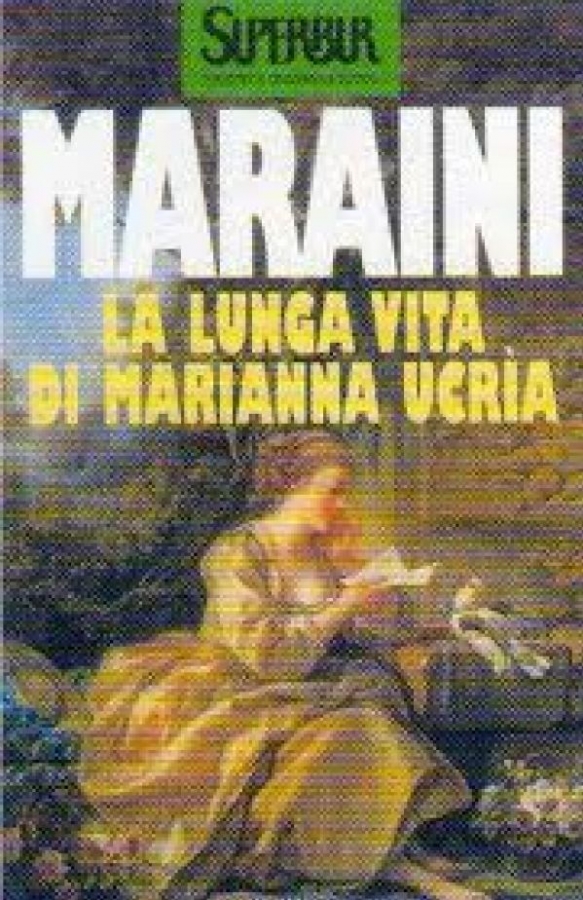
The Silent Duchess
We are in eighteenth-century Sicily. Marianna belongs to a wealthy aristocratic family from Palermo. She is deaf and mute, but her impairment has not prevented her from becoming a resolute, cultured, courted, and ultimately independent woman, capable of disregarding the rules and customs of her contemporary society. Indeed, > her impairment has made her more attentive to herself and to others, so much so that she at times succeeds in gleaning the thoughts of those beside her . She would like to > shake her head to rid herself of those inopportune thoughts, sticky as carob juice... in the end she falls right into them, into people, drawn by a certain lively fluttering of their thoughts that promise who knows what surprises . Marianna’s life unfolds precisely within the cage wrought by her disability: on the one hand, she must force others to write to her in little notes to which she replies with slips of paper of her own—a filtered relationship, therefore, hindered by her interlocutors’ poor grasp of the written word (the aristocracy itself being largely semi-illiterate); on the other hand, Marianna possesses a sort of telepathic power, which is simultaneously lip-reading, sensory acuity, and the imagination of a melancholic and solitary soul. It is, nonetheless, an invasive form of communication, devoid of respect for personal privacy. Outwardly, Marianna’s life holds nothing exceptional for the era: married while still a child to an uncle, who becomes “the uncle-husband,” she bears many children, devotes herself to managing her vast estates, and prefers the reading of books to high society, in which she partakes merely out of duty. The marriage is consummated in a series of loveless couplings, yet she harbors no particular rancor toward the uncle-husband, even when she discovers that it was he who raped her when she was five years old. Yet it is to her father—loved and admired—that Marianna, now a widow and a mature woman, attributes her mutilation; for it is to him that she owes the silence surrounding what happened to her as a child, and a gruesome marriage to her own violator. > She understands with adamantine clarity that he, her father, is responsible for her mutilation... it is he who cut out her tongue and it is he who filled her ears with molten lead so that she would hear no sound and turn perpetually upon herself in the realms of silence and apprehension . And it is at the end of her long life, once she has discovered both sensual and literary love, that Marianna abandons Palermo, alone with a mad servant girl. Wandering through Italy, she travels with a troupe of actors, and at last Marianna > tasted freedom: the past was a tail she had curled up beneath her skirts... the future was a nebula inside of which one could glimpse the lights of a carousel. And there she stood, half fox and half siren, for once unburdened by mental weights, in the company of people who did not give a damn about her deafness and spoke to her merrily, contorting themselves into generous, irresistible grimaces . Enzo Siciliano, a prominent literary critic, places the book within the tradition of Verga, De Roberto, and Lampedusa. It is a misguided comparison. The historical backdrop, much like the family saga, serves merely as a pretext to recount something else: the woman’s solitude, exacerbated by deafness and muteness; the struggle to break free, to carve out a space of her own within a petty, coarse, and hypocritical society. It is an intimate, contemporary novel, not least in the role—both redemptive and insular—entrusted to fantasy. At one point, Marianna “reads with her chin resting on her hand” a sentence by David Hume in a notebook, perhaps left behind by a traveler in her library: > the intellect, says the English philosopher, entirely subverts itself... we are saved from this skepticism by means of that singular and seemingly vulgar property of the imagination (to penetrate) into the most recondite aspects of things . Imagination is the key to comprehending reality, and the novel can be interpreted—through its baroque style and precious, timeless descriptions—as a continuous escape from the harshness of everyday life, within which one would find oneself imprisoned were one to rely on reason alone. A philosophical novel, then, beneath the guise of a family chronicle and historical narrative? Such an interpretation is also prompted by the narrative structure, composed of sketches and episodes, and by the prose, which is at times bombastic, imagistic, and affected. And it is these very traits that make the narrative wordy, sluggish, and tedious. Why not read it? It is boring.