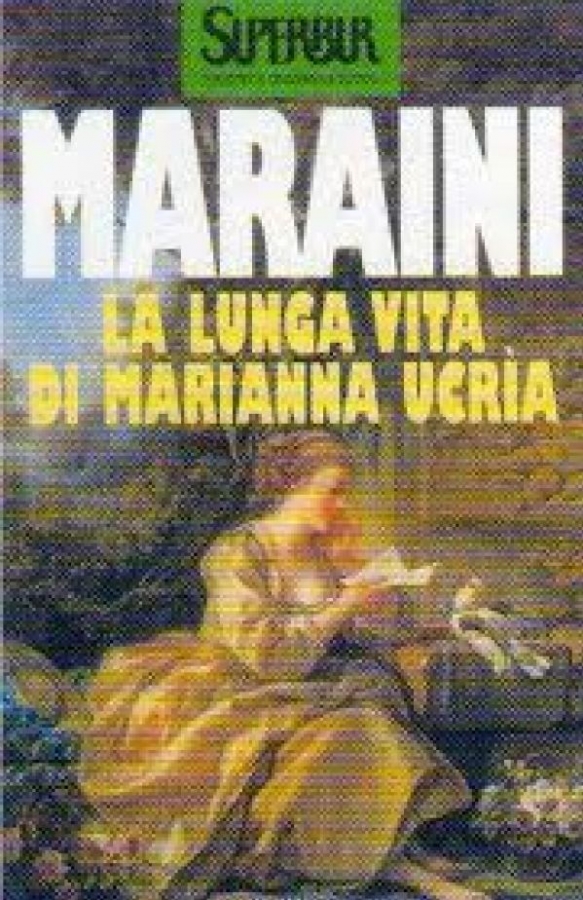
Finished reading on: April 29, 2012
The Silent Duchess
Title of the original version reviewed: «La lunga vita di Marianna Ucrìa»
AI Translation Notice: This review was translated from the original Italian using artificial intelligence. Book quotes and excerpts are translated interpretations and will not match the author's original English phrasing or official published translations.
We are in eighteenth-century Sicily.
Marianna belongs to a wealthy aristocratic family from Palermo.
She is deaf and mute, but her impairment has not prevented her from becoming a resolute, cultured, courted, and ultimately independent woman, capable of disregarding the rules and customs of her contemporary society.
Indeed,
her impairment has made her more attentive to herself and to others, so much so that she at times succeeds in gleaning the thoughts of those beside her
.
She would like to
shake her head to rid herself of those inopportune thoughts, sticky as carob juice...
in the end she falls right into them, into people, drawn by a certain lively fluttering of their thoughts that promise who knows what surprises
.
Marianna’s life unfolds precisely within the cage wrought by her disability: on the one hand, she must force others to write to her in little notes to which she replies with slips of paper of her own—a filtered relationship, therefore, hindered by her interlocutors’ poor grasp of the written word (the aristocracy itself being largely semi-illiterate); on the other hand, Marianna possesses a sort of telepathic power, which is simultaneously lip-reading, sensory acuity, and the imagination of a melancholic and solitary soul.
It is, nonetheless, an invasive form of communication, devoid of respect for personal privacy.
Outwardly, Marianna’s life holds nothing exceptional for the era: married while still a child to an uncle, who becomes “the uncle-husband,” she bears many children, devotes herself to managing her vast estates, and prefers the reading of books to high society, in which she partakes merely out of duty.
The marriage is consummated in a series of loveless couplings, yet she harbors no particular rancor toward the uncle-husband, even when she discovers that it was he who raped her when she was five years old.
Yet it is to her father—loved and admired—that Marianna, now a widow and a mature woman, attributes her mutilation; for it is to him that she owes the silence surrounding what happened to her as a child, and a gruesome marriage to her own violator.
She understands with adamantine clarity that he, her father, is responsible for her mutilation...
it is he who cut out her tongue and it is he who filled her ears with molten lead so that she would hear no sound and turn perpetually upon herself in the realms of silence and apprehension
.
And it is at the end of her long life, once she has discovered both sensual and literary love, that Marianna abandons Palermo, alone with a mad servant girl.
Wandering through Italy, she travels with a troupe of actors, and at last Marianna
tasted freedom: the past was a tail she had curled up beneath her skirts...
the future was a nebula inside of which one could glimpse the lights of a carousel.
And there she stood, half fox and half siren, for once unburdened by mental weights, in the company of people who did not give a damn about her deafness and spoke to her merrily, contorting themselves into generous, irresistible grimaces
.
Enzo Siciliano, a prominent literary critic, places the book within the tradition of Verga, De Roberto, and Lampedusa.
It is a misguided comparison.
The historical backdrop, much like the family saga, serves merely as a pretext to recount something else: the woman’s solitude, exacerbated by deafness and muteness; the struggle to break free, to carve out a space of her own within a petty, coarse, and hypocritical society.
It is an intimate, contemporary novel, not least in the role—both redemptive and insular—entrusted to fantasy.
At one point, Marianna “reads with her chin resting on her hand” a sentence by David Hume in a notebook, perhaps left behind by a traveler in her library:
the intellect, says the English philosopher, entirely subverts itself...
we are saved from this skepticism by means of that singular and seemingly vulgar property of the imagination (to penetrate) into the most recondite aspects of things
.
Imagination is the key to comprehending reality, and the novel can be interpreted—through its baroque style and precious, timeless descriptions—as a continuous escape from the harshness of everyday life, within which one would find oneself imprisoned were one to rely on reason alone.
A philosophical novel, then, beneath the guise of a family chronicle and historical narrative? Such an interpretation is also prompted by the narrative structure, composed of sketches and episodes, and by the prose, which is at times bombastic, imagistic, and affected.
And it is these very traits that make the narrative wordy, sluggish, and tedious.
Why not read it? It is boring.