
Tarabas
We find ourselves in the eastern lands (Ukraine?) during the years of the First World War and the Russian Revolution. It is a period of violence and upheaval, yet the author also depicts these times with nostalgia, because vagabonds > can (still) live on the mercy of men. Although machines have begun, with punctual steel tread, their sinister march toward Eastern Europe, men still look kindly upon the misery of others . A communal spirit still prevails, but Tarabas, a brilliant and violent man, leads a life of his own, while the men of the eastern lands endure one in common. The novel unfolds in two parts, with a significant caesura marked by an anti-Jewish pogrom. In the first part, Tarabas, cast out by his family, lives in war, which is > his great, bloody homeland. He would arrive in peaceful regions, set villages ablaze, leave behind the ruins of towns large and small, weeping women, orphaned children, men beaten, hanged, and butchered . He cares nothing for history or the motives behind this endless war; what matters is continuing his soldierly existence. He is tasked with forming a regiment in the town of Koropta, home to a significant Jewish settlement. All fear him: the poor peasants, the Jews, and his own soldiers and officers, who > did not speak, they whispered. For in their midst, as on an island of silence, as though surrounded by a wall of mute and gleaming ice, sat the feared Colonel Tarabas alone at his table. He drank . And it is precisely during a massive drinking bout that, in a Jewish inn in the small town, the soldiers begin shooting at the courtyard wall, knocking down the plaster: the image of a Madonna emerges, which everyone believes to have been desecrated and hidden by the Jews. “They climbed down from the wagons, armed with whips and clubs,” and fell upon the Jews coming out of the synagogue, and precisely > in the dark solemnity of their long open caftans... the peasants believed they recognized the truly infernal origin of that people who fed on commerce, arson, robbery, and theft . A Jew hunt breaks out, which Tarabas’s men are unable to stop. It is the novel’s finest moment; the author renders in epic fashion, as if it were a phenomenon of nature, the murderous and senseless fury of the mob against the Jews. Perhaps the author shares Pascal’s view that the survival and the misery of the Jewish people “are equally necessary to prove the truth of Christ.” What occurred is ineluctable (“it was God’s will,” a Jewish man tells Tarabas), but it is also Tarabas’s fault, having drunk the night before and lingered too long in the barracks without keeping his soldiers in check. To this guilt he reacts in the only way a violent man knows: with further brutalities. One evening he comes across a poor Jew attempting to hide the sacred books of the Torah. In a fit of rage, Tarabas beats the man and rips out tufts of his red beard. It is an act of gratuitous brutality toward a wretched man. This marks rock bottom for Tarabas, who deep within his conscience has always sensed that he was a violent man, while simultaneously yearning for his childhood and harboring a desire to “flee from the present; backward into the past did the mighty Tarabas find refuge.” He resolves to abandon everything to atone, embarking on a kind of pilgrimage, a descent into destitution and solitude. His long wandering brings him back to Koropta to seek, somehow, forgiveness from the poor Jew. Only thus can he die in peace. Critics dwell on the figure of Tarabas as emblematic of a rootless man, “a guest on this earth,” as the novel’s subtitle puts it. I believe, rather, that the book pivots on a profoundly timely theme: how war can transform men, habituating them to cruelty and indifference—as though evil begat evil—in a descent into the underworld. What, after all, is the devastation of this small, harmless Jewish community if not an abandonment to evil, a release of the fury that ignorance and oppression suppress yet continually fuel? Tarabas’s atonement is ultimately a reaction against all this, a refusal to accept what appears ineluctable. The narrative style, essentially epic in character, transforms the tale into a legend; while highly effective in individual passages, it renders the overall narrative architecture fragile, leaving it, truth be told, frequently superficial and predictable. Why read it? It reads very smoothly, albeit with little emotional engagement.

The thin man
*The Thin Man* (generally translated into Italian as *l’uomo ombra*) is a wealthy inventor who disappeared a few days ago, just as his secretary is murdered. These two events set in motion the classic detective story: a famous former detective (Nick, the first-person narrator) is in New York with his wife, Nora, and finds himself reluctantly drawn in by the inventor's family (his ex-wife and two children, a spoiled girl and an eccentric young man) and the missing man's lawyer. One cannot recount the plot of a mystery novel, nor its ending, of course. The story unfolds, light and shrewd, around Nick and Nora—the latter seemingly a minor character, but in reality an exceptional foil: willfully detached, ironic, and patient. Her view is that a detective should be able to find anything, even a piece of duck in an overcrowded plate of food. Then there are the inventor’s relatives: greedy, selfish, indifferent to the fate of the missing husband and father; “Aren’t they perhaps the first of a new breed of monsters?” Nora wonders. The detective story and its characters also serve as a pretext for a portrait of 1930s America, battered by the stock market crash that is not yet perceived as the profound societal upheaval it would eventually become: people continue to drink heavily, frequent nightclubs, and believe that the money can just keep circulating. The strength of Hammett’s novel is undoubtedly its narrative style. It is crafted from tight dialogue and concise sentences, all relying on a masterful use of verbs—often phrasal—characteristic of colloquial speech, though they never slide into slang. One gets the impression that Nick is in a rush, that the action moves too fast to afford lingering over descriptions and in-depth character exploration. Or is it boredom that pervades the protagonist, driving him to race through life? Why read it? It is a great classic of the detective genre, but it is also an incisive depiction of a society in crisis—one in which, however, people still manage not to be sloppy.
The Thing Around Your Neck
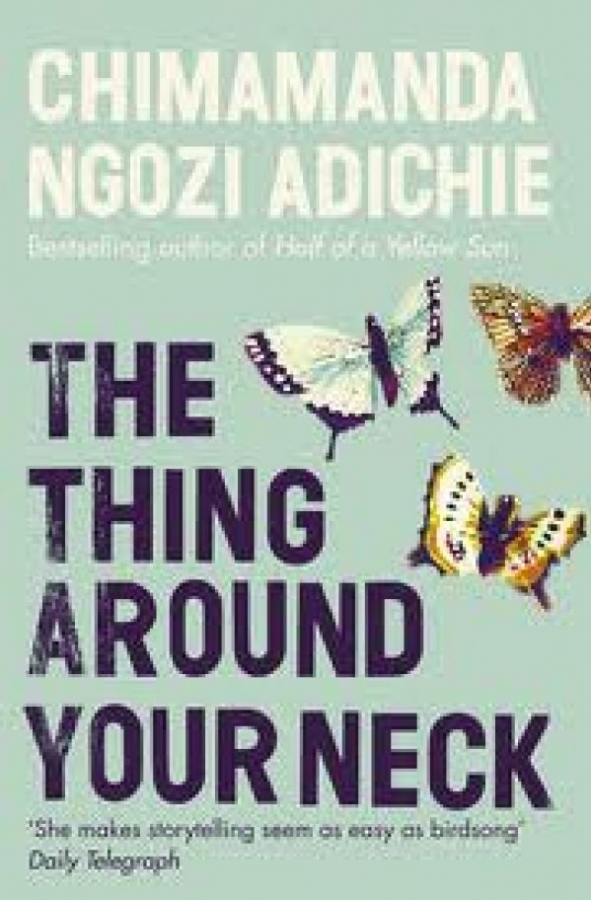
The book is a collection of short stories that center on the solitude of women. In the title story, the protagonist has left Nigeria to live in the United States with an uncle who attempts to molest her. The young woman flees her relatives’ home, and her American dream is shattered in an underpaid job as a waitress. She would like to write to her parents, but > there was nothing to write about... Nobody knew where you were, because you told no one. Sometimes you felt invisible..... At night, something wrapped around your neck, something that almost choked you before you fell asleep . A woman’s freedom is possible only in solitude, as only then is her destiny not determined by a man—be he husband, father, or brother. In *Tomorrow Is Too Far* (a story reminiscent of Morrison’s *Beloved*), the narrative skillfully unfolds through an alternation between present and past. The protagonist, now an adult, lives in the United States. She returns after many years to Nigeria, where, as a child, she had pushed her brother to climb a tree and then screamed that there was a venomous snake that might bite him. The boy, terrified, fell to his death. This episode will condemn the girl to remorse and exclusion, yet it was the only way, cruel and reckless, to rebel against the privileges tradition bestowed upon males: > you knew that something had to happen to Nonso (the brother) so that you could survive . Solitude also stems from fleeing a violent, yet beloved country: Nigeria. *The American Embassy* is the narrative, poised between journalistic chronicle and psychological suspension, of a long wait on “a palpitating pavement” before the American Embassy to secure an exit visa. The protagonist, with her grief “somewhere between the eyes,” seeks to leave Nigeria because the Nigerian police killed her son, still a young child. When she finds herself before the American official, the woman realizes that she cannot abandon her country, where her child is buried: she “wanted to return to their ancestral home,” to the flowers of her land, to dishes cooked with palm oil, and so “she turned slowly and walked toward the exit.” The uprooting between the bond to one’s native land and expatriation to the United States is present throughout all the stories; it does not, however, depend on a woman’s free choice, but on the will of husband and family. The primary virtue of the stories lies in their narrative structure and writing. The author makes masterly use of the second-person singular (the “you”) to keep the narration suspended between autobiography and the impersonal form. The result is a sense of inevitability, as though events could not possibly be otherwise, as though no alternative resolutions were possible, since the facts unfold beyond the will and agency of the protagonists. Life is what it is, and there are no alternatives. The prose is elegant, simple, and measured, never indulging in neologisms or national and local idioms. Indeed, with subtle malice, the writer often underscores the differing uses of vocabulary, contrasting the typically British terms the female protagonists would prefer to use (all belonging to the educated Nigerian elite) with American vernacular—as if estrangement, flight, and solitude were reflected even in the abandonment of customary forms of English. The limitation of the book lies precisely in the narrative structure of the stories, which the author fails to resolve, leaving them perpetually unfinished and suspended. What emerges is a fragmentation that makes it difficult to draw together the narrative thread and its meanings. Why read it? It is an enjoyable and interesting read.
The Tigers of Mompracem
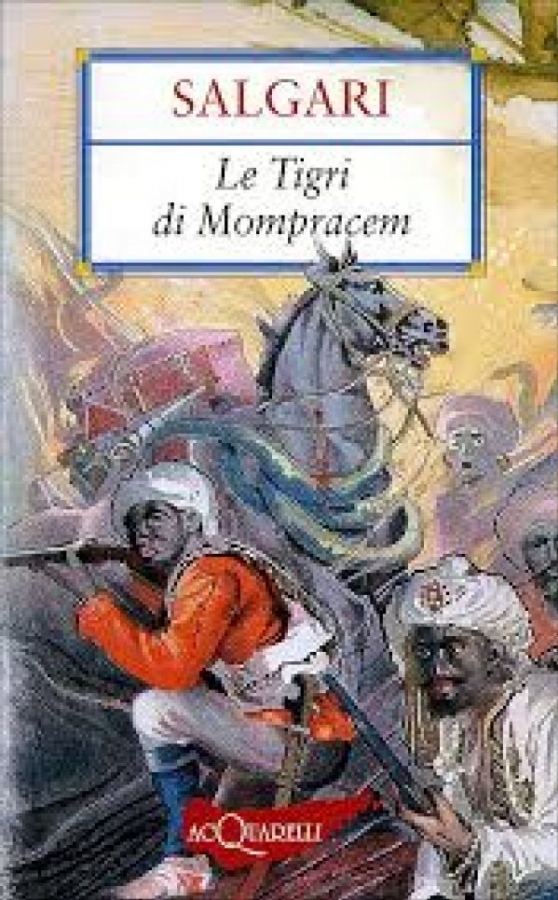
Sandokan > has a broad forehead, shaded by magnificent, boldly arched eyebrows, a small mouth that reveals teeth as sharp as those of wild beasts and gleaming like pearls; two pitch-black eyes, possessing a brilliance that fascinates, that burns, that forces any other gaze to drop . He is the "Tiger of Malaysia", "leader of the fierce pirates of Mompracem", sworn enemy of the British, avenger of oppressed peoples, but also an assassin, cruel, ferocious, terrifying. And so he would have remained, had word not reached him of a woman of great beauty, known as the Pearl of Labuan. An "irresistible force" drives him toward this maiden. He sets out with a few ships and encounters a British cruiser; his fleet is destroyed, his men are killed or drown, and he himself, gravely wounded, barely manages to survive. > I will recover (...) and he uttered that word with such energy as to make one believe he was the absolute arbiter of his own existence , then fear ( > the darkness (...) I do not want to die!...) and finally madness. Completely beside himself, he rushed forward frantically. (...) He believed he saw enemies everywhere. (...) Human beings rose from the ground groaning, screaming, some with bleeding heads, others with severed limbs and torn flanks. All were laughing, sneering, as if mocking the powerlessness of the terrible Tiger of Malaysia > . Sandokan’s delirium is the product of fever and physical exhaustion; the nightmares also arise from the resurfacing in his conscience of all the evil he has done, his ruthlessness, the many dead of his existence. What prevents him from descending into the depths of the earth > is love. After losing consciousness, he comes to in Lord James’s house, where he is cared for by Marianna, the Pearl of Labuan, with whom he falls madly in love: a passion immediately reciprocated. The novel, which seemed to be sliding down the slope of interior soul-searching, regains the typical rhythm of Salgari’s great books: discovered, Sandokan flees, only to return later to free Marianna and take her away; he succeeds thanks to his friend Yanez, who tricks Lord James into undertaking a journey, thereby exposing him to the pirates’ assault. Together at last, Sandokan and Marianna take refuge on Mompracem; to win back the young woman, the powerful Lord James gathers a formidable fleet, which attacks and captures the pirate stronghold after a great battle. It is true that for that heavenly creature, for her I shall have to lose everything, everything, even this sea that I called mine and considered as the blood in my veins. (...) Everything is dead or about to die here > . Marianna asks Sandokan whether he regrets his past power and whether she herself should wield the scimitar", the pirate answers her plainly: "You! You!, he exclaimed, No, I do not want you to become such a woman. It would be a monstrosity". A choice must be made, also because "two happinesses (Marianna and Mompracem) would be too much and I do not want them, (...) and that man, who had never wept in his life, burst into sobs, murmuring: The Tiger is dead, and forever!" The book went through five versions, from the first edition in 1883 to the last in 1891, testifying to a troubled writing process: the author could not find the right register for an audience largely composed of young readers. In particular, it lacks those narrative devices that give pace and surprise to Salgari’s tales. There are some amusing episodes (for instance, when Sandokan and Yanez hide inside a large stove and by pure luck go undiscovered), others seem somewhat contrived and far-fetched, such as the clash between an ape and a panther, while still others recall Salgari’s intense naval battles without the tension and plot twists that typically distinguish them. The author fails to engage the reader because the narrative focuses too heavily on the figure of Sandokan—fascinating, to be sure, but rigid and roughly hewn; nor is he leavened by other characters, as would happen later, when Yanez takes on an expanded, almost protagonist role. Salgari’s craft is not yet fully mastered, and to achieve this the author would have to conceal his own existential anxieties more thoroughly, moving only within a more superficial yet more captivating realm: that of adventure. Why read it? Despite its limitations, the hero Sandokan possesses a powerful appeal.

Tokyo Soundtrack
The book recounts the environmental and social unraveling of Tokyo from the perspective of two adolescents. Were this story told by a Western writer, it would be steeped in violent realism or intense subjectivism. Consider the *Berlin* saga (see the review on this site), in which a city abandoned to an epidemic becomes the stage for struggles and romance within a dystopian setting, yet rendered in distinctly naturalistic tones. Hideo, however, is a Japanese writer, and he does not escape that magical realism that makes us love the literature of the Land of the Rising Sun so dearly (see the numerous reviews of Japanese novels on this site). Surprisingly, the sprawling narrative sets out from an island where two children have been shipwrecked: little Hitsujiko and the slightly older Touta. The pair must survive in a savage environment, overrun by feral goats. > Their world was there, on the island; there was no other place to go and, after all, what trust could they possibly place in human beings: Hitsujiko having survived by chance a mother who drowned herself, dragging the girl along to end her daughter's life as well; Touta dragged along by his father in a madly speeding motorboat to display the courage and strength of a true Japanese. It is with hatred that they receive the expedition dispatched to cull the goats, which discovers the two children in utter astonishment. > Yes, they were ready to challenge everyone, down to the very last one. From the top of the promontory, they hurled their scornful defiance at the Tokyo official, at the men with rifles, and at all the rest. And something gleamed in the right hand of one of them. A blade. There is in these two children a destructive fury that transcends a rebellious spirit: they are deeply convinced that "good and orderly Japanese society" is hostile, and that only an apocalyptic upheaval can save them, preventing them from slipping back into abandonment. This feeling will bind them forever, even when the two are separated. Hitsujiko is adopted by a couple who take her to Tokyo, to one of the city's most elegant neighborhoods, Nishi-Ogikubo; she is enrolled in an exclusive school and is able to study dance, an art in which she excels. Touta, on the other hand, now of age, goes to live in the Kagurazaka district, teeming with red-light establishments, prostitution, and an underworld interwoven with growing illegal immigration. One does not need to know Tokyo to appreciate the novel: the complex topography, with its meticulously detailed clustering of neighborhoods, the maze of highways, viaducts, subways, elevated and subterranean, aims to give us a tentacular image of the great metropolis—imaginative, mesmerizing, and terrifying. Tokyo is all the more dreadful because its tropicalization is underway: the magnificent cherry trees are vanishing, giving way to exotic plants that harbor unknown and lethal bacteria and viruses; the carp have died in the poisoned canals, wild animals roam the streets—in some cases, dogs abandoned by their owners. The stifling heat, air conditioners blasted to the maximum, torrential rains, and finally an epidemic overwhelm the tenuous coexistence of the different Tokyos: that of the "true > Japanese, like the inhabitants of Nishi-Ogikubo, who defend themselves against immigrants with private militias; the non-Japanese > who came from outside, having settled primarily in Okubo and Kagurazaka; and the subterranean city, populated by the Korpokkur, the first inhabitants of northern Japan before the arrival of the Ainu, the modern-day Japanese. The government relocates the purely > Japanese population to the mountains, where the water is still pure and untainted by the effects of tropicalization: did Hideo prophetically foresee the ideology of the tech oligarchs close to Trump? Specialized troops will disperse DDT and mutant insects underground, while the poor, the infected, and the immigrants are abandoned to their lethal fate. In this scenario, the author's concern is not to delve into the personal dramas of the two protagonists: they are embedded within an apocalyptic upheaval, in which ancient nightmares and new fears resurface. The two adolescents serve merely as the detonator of this upheaval: Hitsujiko with her captivating, mysterious dance, which leads the well-behaved schoolgirls into revolt; Touta with his warrior strength, cunning, and destructive will. Numerous other characters crowd the novel—a crow and a boy-girl lead us into the underground tunnels; countless episodes unfold without the reader always being able to trace the thread; unthinkable weapons are deployed, such as dance and cinema. Within this chaotic kaleidoscope, the reader catches a glimmer of hope that does not require fleeing to another, still-unspoiled planet: it is possible to rebel, to generate a chaos from which a new world might be born; yet this undertaking is entrusted to the humble and to the animals. As the author states in the afterword to the Italian edition: "I will never stop believing that singing all together is the best way to bless this century of ours and rejoice." And in this new harmony, perhaps Hitsujiko and Touta will find each other again on the island of their childhood. The novel develops in a traditional manner in its first part, up until the two youths are separated: the shipwreck, life on the wild island, the understandably difficult integration into the small school and community of one of the Ogasawara Islands. One seems to glimpse a coming-of-age story, albeit with distinctly Japanese idiosyncrasies. The relocation to greater Tokyo could have been the continuation of a tale of growth, and even of love. Instead, the plot veers in another direction: the political and environmental backdrop takes over, and the dark monsters of Japan, veiled beneath a shroud of cultural respectability, emerge with devastating force. The mind turns to the great novels of Kenzaburo Oe, such as *The Silent Heart* and *The Water Forest* (see the reviews on this site). Everything spirals into confusion, almost delirious, and the reader is better off simply getting lost, rather than wondering why a crow understands human speech, why diminutive beings dwell underground, or why dance and silent cinema can serve as lethal weapons, instruments of a revolution. It is fascinating, yet the lengthy digressions, the multitude of characters, and the surreal environments certainly contribute to our disorientation, making for a demanding read. Perhaps a touch of the solid nineteenth-century European novel would have brought order to a narrative that is all too often disjointed. What remains etched in memory is the prophecy of modern times—a prophecy startling in its prescience, considering the novel was written in 2003. Why read it? It is another face of Japan.

The Children's Train
Between 1945 and 1952, approximately 70,000 children, mostly from the South, were taken in by peasant families in the Centre-North; this was made possible by the Communist Party, local Liberation Committees, the National Association of Italian Partisans, municipal administrations, and the local populations. It was a remarkable demonstration of national solidarity, which came to be known as the "Trains of Happiness." As Maddalena—a fighter in the Four Days of Naples—says in the novel to convince mothers to let their children go, > when we had to drive out the Germans, we women did our part. Mothers, daughters, wives, young and old: we took to the streets and we fought. You were there, and I was there too. This is like another battle, but against the most dangerous enemies: hunger and poverty. And if you fight, your children will win! The social and political theme of this glorious, often forgotten experience remains in the background, allowing the author to develop a different subject. Toward the end of the narrative, the protagonist and narrator articulates the overall meaning of his story: "I let time slip away, and now it is too late." To understand this sentence, we must retrace the journey of Amerigo Speranza, son of Antonietta Speranza and an unknown father, officially gone to America to seek his fortune. > My mother in front and me behind. Through the alleyways of the Spanish Quarters my mother walks fast: for every step of hers, two of mine. I look at people's shoes. Intact shoe: one point; shoe with a hole: I lose a point. No shoes: zero points. New shoes: bonus star. I've never had shoes of my own; I wear other people's, and they always hurt my feet . Amerigo accepts the squalor of the *bassi* and Antonietta's apparent coldness—she is too consumed by making ends meet to show affection to her son—as a natural state of affairs. Then, unbidden, the "Train of Happiness" bursts in. Along with so many other children, Amerigo leaves Naples for the North. > My mother Antonietta remains in a corner of the station that grows ever more distant, her arms crossed over my coat. As if she were holding me tight through the bombardments. (...) I look out the window, I think of my spot in Mama's bed. (...) I think of the streets where I used to wander all day collecting rags, rain or shine. I think of Pachiochia, who by now has gone to bed in her *basso* with the picture of the mustachioed king on the nightstand. I think of Zabagliona, and I seem to catch the smell of her onion frittata. I think of the alleyways where I lived, narrower and shorter than this train . These images are too distant from the lovely fairy tale awaiting Amerigo in the North: a room of his own, new clothes, plenty of food, the affection of Derna—the woman who took him in—and above all, the discovery of the violin and of music. "By now we are split in two." For Amerigo, piecing the two halves back together proves impossible, as Antonietta does everything in her power to obliterate anything pertaining to life in the North, even going so far as to sell the violin. > she does something she has never done before: she steps even closer and holds me with both arms. (...) You have to wake up from that dream, Amerì; your life is here. (...) I did it for your own good. (...) I tear myself from her embrace, I get out of bed . Amerigo would like to say so much, but can only voice his bitterness over the loss of his violin. "You're a liar," and he flees, catching the train back North. Many years later, Amerigo returns to Naples for his mother's funeral: he bears a different surname, he is a renowned musician, a stranger to his mother and to his city. Or at least he wishes he were, because > the cries from the markets, the endless gossiping of the women on the doorsteps of the *bassi*, the children chasing one another through the streets, and then a voice preserved in the deepest core of memory. Amerigo, Amerì! Come down, hurry, go ask Pachiochia for two lire... He would like to reclaim his life, but it is too late. > Gone. Destroyed by ruthless fevers,/consumed by an unknown affliction, far away, I cannot tell./Nor do I know if they will return, or when, or how,/the friends, the days, the brightest season,/if the life lost through inattention/will ever return. (Luciano Erba, "Lo svagato" from *Il nastro di Moebius*). Reading the novel leaves a singular, almost incomprehensible impression. The book tackles a great theme, the plot unfolds linearly, and the prose is fluid, if at times pedestrian. And yet, one cannot help but remain uninvolved, as though its many threads (the Trains of Happiness, the maternal bond, the *napoletanità*, the bittersweet and somewhat petty-bourgeois ending) blended so superficially as to leave the reader detached, cold, and even baffled. The truth is that the characters lack psychological depth, just as the settings—particularly the northern peasant world—feel purely literary, contrived at a desk rather than lived. Why read it? It is well written.