Chimamanda Ngozi Adichie,
Books by this author (2)
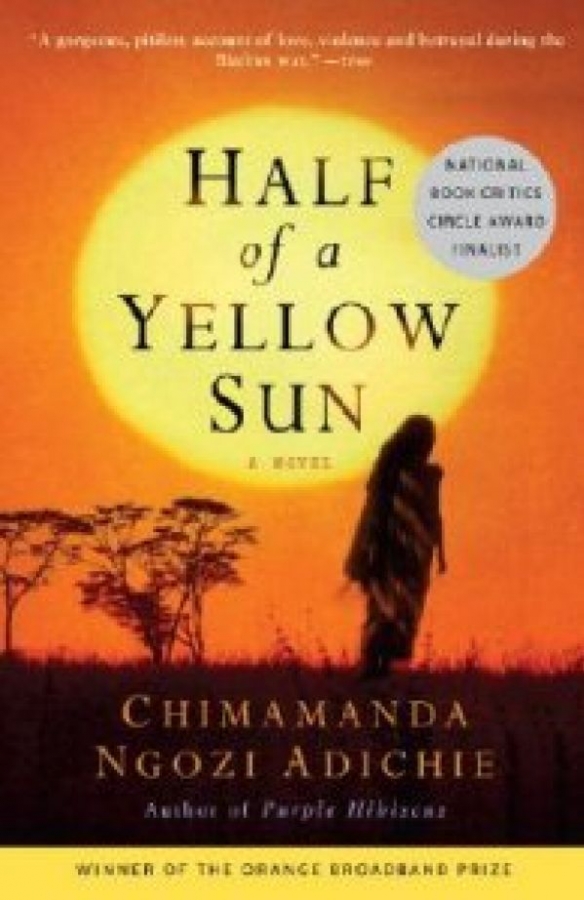
Half of a yellow sun
The book is set in Nigeria between 1960 and 1970 and is divided into two parts: the early 1960s in a Nigeria newly emerged from British colonial rule, marked by an apparent social tranquility; the late 1960s in Biafra (in southeastern Nigeria), where the predominantly Catholic Igbo fought an ill-fated war of independence against northern Nigeria, dominated by other ethnic groups that were predominantly Muslim. The narrative opens with the arrival of one of the protagonists, Ugwu, at the home of Odenigbo, a mathematics professor harboring fiery revolutionary ideas, anti-Western sentiments, and an impassioned defense of African identity. Ugwu is still a boy, yet he displays a keen intellectual ambition and deep devotion to his master. Two sisters then enter the scene, Olanna and Kainene, daughters of a wealthy and powerful family, strikingly different from one another: the former gorgeous, educated, and irremediably in love with Odenigbo, captivated by his intellect and culture; the latter pragmatic and entrepreneurial, who soon falls in love with Richard, a young Englishman who has arrived in Nigeria to write a book on African society. The novel is skillfully constructed around the impact of dramatic events (war, violence, and famine) on the relationships among the various characters and on their struggle to survive and salvage a sense of normalcy in their lives. The first part of the novel frames the characters' experiences within a society intensely stratified in social terms and still dominated by British culture. The two sisters, educated in London, react differently to the corruption of their milieu. Olanna moves in with Odenigbo into the academic world, brimming with ideals and often inconclusive debates about the country's future and its independence from the Western world. Kainene, on the other hand, embraces the rules of the business world, embarking on an entrepreneurial career with cynical boldness. A severe rift opens between the two sisters. Olanna discovers that Odenigbo has slept with another woman, fathering a daughter with her, and out of fury has a brief affair with Richard. The estrangement between the sisters is subsequently accompanied by Olanna's decision—both incomprehensible and courageous—to adopt the child born of the union between her husband and the other woman. The second part of the novel follows the protagonists amidst a war that grows more cruel and violent with each passing day. Gradually, poverty and destitution take hold, family structures shatter, the baseline of respect that ought to govern human relations dissolves, and everything—even body and soul—becomes currency for sheer survival. The protagonists themselves take part in episodes of extreme violence: Olanna is caught in a massacre, narrowly escaping only to discover during her flight that a woman is carrying her own daughter's severed head; Ugwu, conscripted into the army, is drawn into a gang rape; Odenigbo collapses psychologically, turning to alcohol and betraying his wife. Kainene and Richard, who seem more insulated from the terror of the war, watch powerlessly as one of their servants is slaughtered: the decapitated body stumbles forward before collapsing to the ground. The protagonists do not truly live; rather, life sweeps them along, and in the end they find themselves as though > in a candlelit room, where things are seen in shadow, only by half-glimmers of light . It is difficult to summarize the events of the book's second half, as the narrative often seems to lose its central thread, fracturing into distinct episodes and a multitude of characters. What remains striking, however, is the contrast between the dramatic gravity of the events and the serenity of the narration. It is as though the protagonists were moving through a dream, a nightmare from which they are certain they will awaken, returning to the world that dissolved with the war. The violence that engulfed them leads them to repress the horrific episodes they experienced, driving them to forgive even transgressions, mutual betrayals, abandonments, and acts of cowardice. “There are some things that are so unforgivable that they make other things easily forgivable.” Bonds are formed that shatter traditional social stratifications, such as the deep friendship between Olanna and Ugwu. Certainties dissolve, as do Odenigbo's; new allegiances are forged, such as Richard's devotion to the Igbo people; the struggle persists through entrepreneurial drive placed at the service of the community, as in the case of Kainene, who meets her death trying to secure vital food and medicine for her refugee camp. This sense of impermanence, of incredulity, stems not so much from the plot and dialogue as from the prose itself—never overwrought or emphatic, but consistently quiet, composed, and measured. The author's gaze is fundamentally introspective, reflecting how the protagonists witness and experience external events. In this light, the tragedy of Biafra becomes a universal one, which could be set anywhere people are overtaken by war and violence: Bosnia, Rwanda, and today the Horn of Africa and Pakistan. Can one remain oneself in the face of collective catastrophe? The novel offers no simple affirmative answer, but points instead to the resilience of each individual and the conditions in which each must endure the tragedy. Despite its length, the book is a deeply compelling read, both for its prose style and the emotional depth it explores: there is no forced psychological inquiry or striving for dramatic effect; the author simply describes, leaving it to the words, the characters, and the events to convey the tragedy of an entire people. A certain fragmentation nonetheless emerges, stemming from the overlapping of events and characters. Why read it? Because it depicts a tragedy that could unfold anywhere in the world: it portrays how easily one can be consumed by violence.
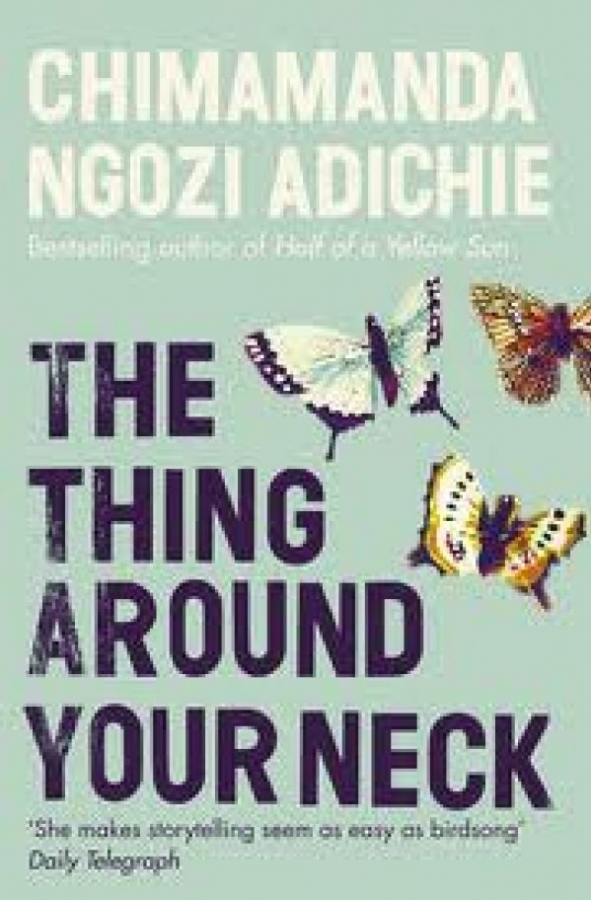
The Thing Around Your Neck
The book is a collection of short stories that center on the solitude of women. In the title story, the protagonist has left Nigeria to live in the United States with an uncle who attempts to molest her. The young woman flees her relatives’ home, and her American dream is shattered in an underpaid job as a waitress. She would like to write to her parents, but > there was nothing to write about... Nobody knew where you were, because you told no one. Sometimes you felt invisible..... At night, something wrapped around your neck, something that almost choked you before you fell asleep . A woman’s freedom is possible only in solitude, as only then is her destiny not determined by a man—be he husband, father, or brother. In *Tomorrow Is Too Far* (a story reminiscent of Morrison’s *Beloved*), the narrative skillfully unfolds through an alternation between present and past. The protagonist, now an adult, lives in the United States. She returns after many years to Nigeria, where, as a child, she had pushed her brother to climb a tree and then screamed that there was a venomous snake that might bite him. The boy, terrified, fell to his death. This episode will condemn the girl to remorse and exclusion, yet it was the only way, cruel and reckless, to rebel against the privileges tradition bestowed upon males: > you knew that something had to happen to Nonso (the brother) so that you could survive . Solitude also stems from fleeing a violent, yet beloved country: Nigeria. *The American Embassy* is the narrative, poised between journalistic chronicle and psychological suspension, of a long wait on “a palpitating pavement” before the American Embassy to secure an exit visa. The protagonist, with her grief “somewhere between the eyes,” seeks to leave Nigeria because the Nigerian police killed her son, still a young child. When she finds herself before the American official, the woman realizes that she cannot abandon her country, where her child is buried: she “wanted to return to their ancestral home,” to the flowers of her land, to dishes cooked with palm oil, and so “she turned slowly and walked toward the exit.” The uprooting between the bond to one’s native land and expatriation to the United States is present throughout all the stories; it does not, however, depend on a woman’s free choice, but on the will of husband and family. The primary virtue of the stories lies in their narrative structure and writing. The author makes masterly use of the second-person singular (the “you”) to keep the narration suspended between autobiography and the impersonal form. The result is a sense of inevitability, as though events could not possibly be otherwise, as though no alternative resolutions were possible, since the facts unfold beyond the will and agency of the protagonists. Life is what it is, and there are no alternatives. The prose is elegant, simple, and measured, never indulging in neologisms or national and local idioms. Indeed, with subtle malice, the writer often underscores the differing uses of vocabulary, contrasting the typically British terms the female protagonists would prefer to use (all belonging to the educated Nigerian elite) with American vernacular—as if estrangement, flight, and solitude were reflected even in the abandonment of customary forms of English. The limitation of the book lies precisely in the narrative structure of the stories, which the author fails to resolve, leaving them perpetually unfinished and suspended. What emerges is a fragmentation that makes it difficult to draw together the narrative thread and its meanings. Why read it? It is an enjoyable and interesting read.