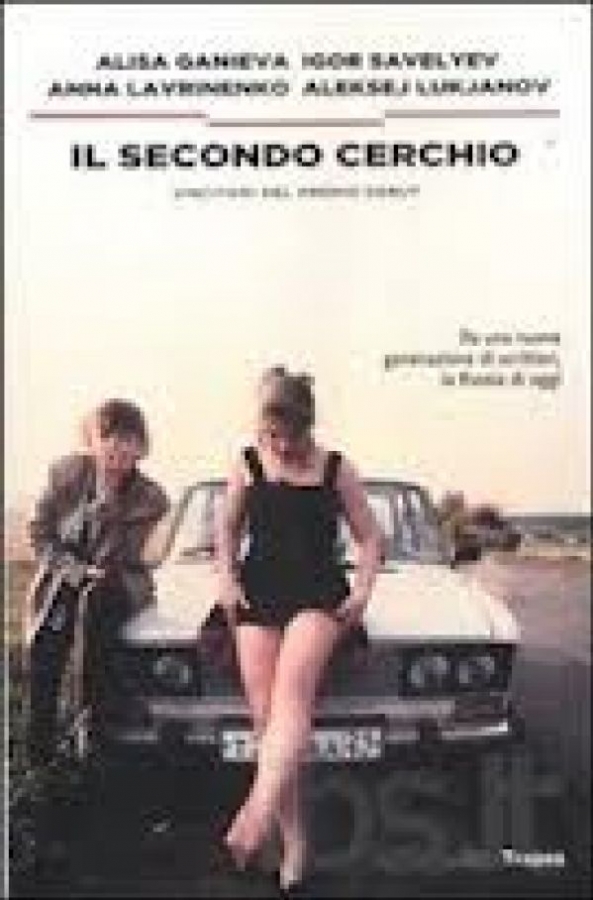
The Second Circle
The book brings together four short stories by young Russian writers who were children when the Soviet Union collapsed and are therefore utterly detached from the themes inherited from the fall of the empire. The stories exhibit entirely different styles and subjects, yet share a common motif: “the search for something we lack,” as concluded by Vladim, the protagonist of Savelyev’s short story, the most accomplished of the four. Alisa Ganieva’s *Salam Dalgat* is set in a city in the Caucasus. Dalgat, a young student “thin as a stick,” is searching for a relative, a quest that leads him across the city: through the bazaar, into squalid outskirts, to a wedding. Everywhere he encounters desolation, gratuitous violence, and the enduring clash between tradition and modernity. How far removed all this is from the official rhetoric that seeks to project a radiant, virtuous image of the lands and people of the Caucasus! In his wanderings, Dalgat meets a man who wants him to read a book about how the Caucasian nation was destroyed, along with its languages, songs, and secular poetry. Yet when the young man asks what the book is about, the man replies with a smile: “nothing special, nonsense.” While Ganieva’s style remains profoundly Russian, that of Igor Savelyev is minimalist, spare. His *Pale City* explores the world of hitchhiking. The protagonists are youths roaming across vast Russia with no real aim other than fleeing their parents and escaping bourgeois existence. Vladim, in his wanderings, finds lodging for the night in Ufa, one of the many cities bordering the Urals, staying with a chronically delayed university student. Here he meets a girl, Nastya, also a hitchhiker. A brief romance begins, which the young man wishes to pursue, but Nastya > grew heated.... I don’t care where I go (she says), as long as it’s far from home... I need new places to stay for just a short while.... casual acquaintances, people who appear and vanish . And so nothing remains but to hit the road again, in search of that “acute sense of loneliness that cannot be found in normal life.” Anna Lavrinenko’s *The Lost Child* is a delicate, sentimental, even psychological story, yet behind its apparent narrative normalcy lies a paradox: the protagonist, a call-center operator, is convinced he was abandoned by his mother at the age of five. This thought—was he truly abandoned?—has haunted him for thirty years, yet perhaps an event of such magnitude is not required to give meaning to life. > Perhaps it is enough simply to forget one’s keys, to sit down in a deserted stairwell . Finally, Aleksei Lukyanov’s *High Pressure* returns us, in a surreal manner, to the squalor of contemporary political life. A few laborers work wearily in a railway depot when they realize, day by day, that phones, the internet, and all means of communication have ceased to function. The government attempts to remedy this with an absurd scheme: steam-powered radio broadcasting. Yet this does not halt the decay; even important (“sacramental”) words begin to go missing. Everyone wants to escape to the West, but the trains are overcrowded. The future might well be one of desolation, poverty, and loneliness, were it not for the continuing cycle of the seasons. > The green had returned and some retail chains had liquidated themselves in great haste.... and so famine did not arrive . At one point, the government announces via steam radio broadcasting that it has grown weary of its citizens, who are far too ignorant to comprehend it, and has decided to abandon them to their fate. The steam broadcasting explodes, but words return, and freedom is finally attained. Yet are we in Italy or in Russia? The stories are finely written and address overarching themes typical of contemporary society: the disorientation of youth, but also the resolve to forge one’s own future independently and by one’s own means. The stories do not reach closure; they remain suspended and uncertain—yet this is precisely what lies before us: there are no longer any certainties. Why read it? It makes for an enjoyable read, with compelling and intriguing themes.
Sense and Sensibility
Jane Austen’s novels appear detached from their historical setting, the years between 1790 and 1815 marked by the onset of the Industrial Revolution and the protracted Napoleonic Wars. This “timeless” profile is corroborated by what Austen herself wrote to her niece: > three or four families in a country village is the very thing to work on (*Austen’s Letters*, page 275, quotation cited by Katie Halsey in the introduction). The author’s statement is at once contradictory and revealing; it is precisely by immersing oneself in provincial society that one can understand how and why “a man changes his manners and a young woman changes her mind,” and thus grasp the impact of the profound transformations in English society at the turn of the century. (Tony Tanner, introduction to *Pride and Prejudice*, page 368, cited by Katie Halsey). Elinor and Marianne are the daughters of the widowed Mrs Dashwood, forced to leave their beautiful home and comfortable life following the death of her husband and the succession to the estate of Henry, born of a previous marriage of the deceased husband. Setting up with incisive efficacy the inheritance issues that serve as a backdrop to the entire narrative is a long, cynical exchange between the stepson and his wife; before dying, the father had extracted a promise from Henry that he would secure an annuity for his sisters; > it is certainly not pleasant to have a yearly drain upon one’s income, (...) a present of fifty pounds (...) will free me, I think, from my promise to my father. Elinor and Marianne must survive by their own resources, pursuing a difficult balance between sentiment and realism. Elinor > possessed a strength of understanding, and coolness of judgment, which qualified her, though only nineteen, to be the counsellor of her mother. (...) had an affectionate heart, a generous nature, strong feelings; but she knew how to govern them. Marianne, still only seventeen, > was in many respects quite equal to Elinor. She was sensible and clever but eager in everything; in her sorrows, as in her joys, she could have no moderation. Elinor has fallen in love with Edward. The young man > was not handsome, and his manners required intimacy to make them pleasing; (...) but when his natural shyness was overcome, his character gave every indication of an open, affectionate heart, (...) all his wishes centered in domestic comfort and the quiet of private life. In a conversation with her mother, Marianne declares what she understands by love, and she does so precisely while discussing Edward and her sister’s incomprehensible attraction to this young man. > Oh! Mama, how spiritless, how tame was Edward’s manner in reading to us last night! I felt for my sister most severely. Yet she bore it with so much composure, she seemed scarcely to notice it. (...) Elinor has not my feelings. (...) Mama, the more I know of the world, the more am I convinced that I shall never see a man whom I can really love. I have been open and sincere where I ought to have been reserved, spiritless, dull, and deceitful. A bitter disappointment strikes both girls. The handsome gentleman who had trifled with Marianne’s affections suddenly marries a wealthy heiress, accustomed as he is to a life of pleasure and money. Marianne retreats into herself, devastated by grief and scandal, almost to the point of death. Elinor also discovers that Edward is already engaged to the sly Lucy, with whom, moreover, she is obliged to associate out of social propriety. The narrative of his betrayal, of Edward’s lie, > was plain and simple; and though it could not be related without emotion, was unaccompanied by violent agitation or uncontrollable sorrow. (...) Elinor was to be the comforter of others regarding her own suffering, no less than in what concerned theirs; and all the comfort that could be afforded relied on her own clear-headedness and self-command. The pledge of confidentiality made to Lucy, who had opened her heart to her, and her affection for Edward, despite everything, compelled her to silence, preventing her from confessing her misery. In a provincial society, bound by rigid social conventions and dominated by pecuniary interests, amidst fragile and hypocritical men and women, Elinor emerges as a heroine through her moral steadfastness, her determination to be of service to others before herself. Austen seeks to provide a happy ending for both girls, yet the novel could well conclude when the mother and Marianne recognize, with surprise and remorse, Elinor’s concealed vulnerability: an epiphany that forms the foundation of deeper familial bonds. The narrative plot unfolds like a musical variation, in which the original theme repeats through constant modulations; Elinor’s and Marianne’s sentiments are charted in their most minute fluctuations, as the social milieu and the secondary characters impinge, often painfully, upon the two girls’ affections and certainties. Only a woman could have executed such an incisive psychological analysis of the feminine emotional landscape, rich in the sensibility and good sense so frequently lacking in men. Consider the figure of Edward—as for the other, he is such a scoundrel that he barely warrants discussion; Edward is a decent youth, but what does he do? He lacks the courage to tell Elinor the truth, namely that he is already engaged; he resurfaces only after Lucy has chosen another man. One might wonder why Elinor welcomed him back, but that is part of good sense and sensibility: Edward is a decent man, fragile yet fundamentally honest, and, after all, it is time to marry. Elinor is neither Emma nor Fanny of *Mansfield Park*, figures of strength and self-possession (see the review of both novels on this site); she is still a tender girl, and perhaps also a victim of the social structure. She recalls the protagonist of Alba De Céspedes’s *Dalla parte di lei* (see review on this site); today, Elinor might perhaps have killed Edward. The enduring appeal of Austen’s novels derives in substantial measure from her prose, particularly the grammatical contours of her English—perhaps slightly archaic, yet so enveloping and finely articulated as to immerse the reader in a seamless flow of subtle narrative developments, psychological insights, and social observations, all delicate yet sharp. Why read it? Sublime in its writing, profound in its analysis of its female protagonists.

Dreams at dawn of the urban cyclist
The novel opens in its initial chapters with two seemingly parallel storylines. On the one hand, it recounts the most pivotal episodes in the life of an adolescent, his circle of friends, and his neighborhood in Porto Alegre. The boy perpetually courts risk, yet fails to display genuine courage: thus, he does not come to the aid of a friend who is murdered by a rival gang. There emerges in the boy a propensity to pursue adventure and a superhero’s existence within the realm of fantasy, to the point of inflicting wounds on himself and causing self-harm merely to prove that he is capable of enduring pain and that he has lived through extraordinary trials. On the other hand, there is a successful plastic surgeon about to set off to conquer an unclimbed peak with a mountaineering friend. On his way to pick up his friend, he returns to his old neighborhood, and we come to realize that the surgeon is none other than that same adolescent grown into adulthood. Adolescent memories then resurface: he gets involved in a street fight to save a boy, encounters once again a female friend with whom he had shared his childhood fantasies, and realizes that “living, on the other hand, had nothing heroic about it.” He had lived > in a permanent limbo between innocence and heroism, inhabited by phantasmagoric projections of himself, slightly distorted by what he would have liked to have been in the past or become in the future . He has finally become an adult. The novel tackles several themes. The first of these is the pursuit of life’s authenticity—that is, of a life genuinely lived—solely through extraordinary feats meant to highlight one's courage and virility. One does not truly live unless one is a superhero. > They are boys living at the pinnacle of the human illusion of invincibility, seduced by the opportunity to put their physical vigor to the test and avenge the cosmic injustice of being born . The blatant falsity of this worldview surfaces only when the protagonist lacks the courage to help his friend, thus failing to demonstrate the true capacity to be a man. The dominant theme of the book, however, is the relationship with one’s own body and the process of alienation through which, from being protagonists, we become spectators of ourselves, as if at the cinema. The protagonist perceives the reality of his own feelings only if they translate into a physical alteration of the body. This initiation begins in childhood when, standing before the bathroom mirror at home, he uses felt-tip pens to simulate blood and wounds on his body; it unfolds through genuine accidents, sought out precisely to hurt himself, and culminates in his professional calling: becoming a plastic surgeon. Just as at the moment of initiation, the protagonist sees himself as a spectator watching a film. > C’è sangue sul suo volto, una ferita terribile all’occhio, un’altra al braccio, e lui che si trascina fuori dal veicolo sulla sabbia bollente, la sabbia che si incolla al suo sangue, gli spettatori correvano a prestare soccorso all’eroe del film. Il suo film. La scena rasentava la perfezione. Il trucco non avrebbe potuto essere più realistico. Che bella cosa il sangue, pensò prima di svenire . > Lui iniziò a vedere la cosa dall’esterno, come una telecamera piazzata sul soffitto. La maledetta telecamera che era la sua unica amante. A volte la telecamera spuntava fuori negli istanti cruciali della sua esistenza: era come se lui stesso, si staccasse dal corpo per diventare l’osservatore. C’era lui dietro alla telecamera, che usciva di scena, attraversava la membrana tra realtà e fantasia e sceglieva una sedia nella platea vuota di un cinema buio . The novel is thoroughly engaging. The prose ranges from a neo-modernist style (long, winding periods, bordering on soliloquies) to succinct, remarkably effective dialogue. The depiction of the settings and characters proves equally incisive.
Arturo's Island
> One of my earliest boasts had been my name. I had soon learned (it was he, I think, who first informed me of it) that Arturo is a star: the swiftest and most radiant in the figure of Boötes, in the northern sky!. Thus begins Arturo Gerace’s long quest for Love: > an indecipherable dilemma, without the solace of hope, or of revenge ; a quest that, to unfold, required an enchanted place like Procida: > a land of adventure, a blessed garden! , but also > a bewitched and voluptuous mansion. The novel encompasses three distinct natures, profoundly intertwined: the narrative, the fantastic, and the oneiric. Orphaned at birth, Arturo was nursed on goat’s milk by the foster-nurse Silvestro. He grows up alone in a ruined Castle. His father is perpetually traveling, and the boy roams across the island and along the shores. Arturo lives freely yet melancholically, fulfilled only when his father is at home. > My childhood is like a happy land, of which he is the absolute ruler! (...He who strode resolutely forward, like a sail in the wind, with his blond, foreign head, swollen lips, and hard eyes, looking no one in the face. And I followed behind him, proudly casting my dark eyes to the right and to the left, as if to say: “Men of Procida, my father is passing!”. This adoration is unmarred by the brusque and severe manner the father displays toward Arturo, nor is it broken by the arrival of the stepmother, a girl barely older than Arturo (who was then fourteen), perhaps married on a whim. The boy’s relationship with his stepmother wavers between jealousy and attraction, typical of an adolescent undergoing his first stirrings of love and perpetually searching for a maternal figure. One day, the father returns to Procida accompanied by a convict, who is locked up in the island's penitentiary. The man grows taciturn, no longer wanting to walk or sail with his son; instead, he frequently vanishes to sing a love serenade beneath the convict's cell. Arturo's infatuation with his father dissolves painfully, especially when he overhears him being dubbed a “Parody” by the malicious convict: a pitiful imitation of a man of the world, of a great traveler, when > it will be a stretch if he even made it as far as Benevento, or Rome-Viterbo!. Arturo enters adulthood because he sees his father in his true nature, selfish and petty: he must also leave the marvelous island, overly steeped in joyful roaming and anxious anticipation. Adolescence has ended; Arturo sets out to discover the world and resolves to go to war. Thus far, we are faced with a coming-of-age novel, at times verbose and banal. What renders it original and compelling are the narrative’s fantastic and oneiric dimensions. Consider the ascent toward the Penitentiary, trailing behind the father: the alleyways of the ancient village, the narrow, climbing streets, the walls plunging sheer over the island's high cliffs made the Penal Colony look like the > Castle of the Knights of Syria; fairy-tale adventurers (...) crowded that walled palace , and Arturo became > a funereal Knight Errant, (...) and the voices of the village not far off (...) seemed to me the voices of a childish race. A central episode of the novel takes on fairy-tale suggestions, evocative of distant, fabulous worlds and spoken tales. Consider, on the other hand, the image of the seashell, a dreamy naturalism applied to a celestial phenomenon. > Outside the midnight window, (...) a tiny cloud could be seen which, drifting across the turquoise of the sky, within moments took first the shape of a seashell, then of a small hot-air balloon, then of an ice cream cone, then of an old man's beard, then of a ballerina. Reality, fantasy, and dream hybridize, and the narrative tones blur; the novel bears less and less resemblance to a coming-of-age tale (a sort of Neapolitan *Treasure Island*, see the review of *Treasure Island* on this site) and increasingly assumes the imagery and cadence of *The Thousand and One Nights* (see the review on this site). Morante makes no attempt to impart a traditional stamp to the novel, as she had attempted in *Menzogna e Sortilegio* in 1948 (see review on this site); imagination soars from the opening pages, from that singularly starlit incipit. Even within a meticulous and ostensibly naturalistic style, the narration is so oneiric and fairy-tale-like that it suggests a journey deep into consciousness. An early clue lies in the choice of Arturo as narrator, and hence the first-person perspective; then, the disordered, invasive succession of images, bordering on dreams and visions; finally, the characters, who resemble archetypes of different facets of the psyche: the stepmother, an animalistic figure obstinately faithful; the father, stubbornly selfish and hostile; the foster-nurse Silvestro, embodying the Mother figure and returning to rescue him; the wicked malice of the convict, destroyer of Absolute Love. It is as though the protagonist (Morante herself?) hung in the balance, poised before divergent paths, ultimately choosing detachment: a separation also from the yearned-for place where one was born and raised. The narrative proceeds at a leisurely pace, intent as it is on plumbing the depths of the narrator-protagonist’s soul when faced with the diverse situations that unfold before him. It is a continual excavation, marked by detailed descriptions that would border on tedious were they not sustained by grammatically exquisite prose, an airy and elegant lexicon, and a pervading atmosphere of pleasure. Why read it? Fascinating, even if at times verbose.

The Story of a New Name
Elena continues the story of her friendship with Lila. The first book, *My Brilliant Friend*, had ended with Lila’s marriage to Stefano, the wealthy grocer. > I wanted to sink back into the neighborhood, to be as I had been. I wanted to throw away studying, the notebooks crammed with exercises. (...) What I could become outside Lila’s shadow counted for nothing. What was I compared to her in her wedding dress, to her in the convertible, the blue pillbox hat and the pastel suit? This reflection of Elena’s does not halt a trajectory that leads the two young women to drift apart and continually seek each other out. What is life without Lila for Elena? > Time settles down and the salient facts slip along the thread of the years like suitcases on an airport conveyor belt; you take them, you put them on the page, and it’s done. (...) With her I didn't want to have real relations, just hello, generic phrases. (...) On the one hand I said enough, on the other I grew depressed at the thought of not being part of her life, of her way of inventing it . Elena continues her studies, passes her classical high school exit exams with flying colors, attends the Scuola Normale in Pisa, graduates, writes a novel, becomes an author. All this culture is nothing more than a mask: > I learned to control my voice and gestures. (...) I brought my Neapolitan accent under control as much as possible. (...) At school I had learned to make people believe that I knew a great deal . And above all, Elena found herself “sterilized by study,” bringing under control her feelings, anxieties, and her very boldness. In search of the “best disguise,” upon reading some of Lila’s notebooks she realizes that > the mask worn so well (...) was almost face. Suddenly I became aware of that almost . (...) Behind the almost I seemed to see how things stood. I was afraid > . Beneath the apparent conquest of freedom lies hidden, for Elena, the loss of an authentic life. For Lila, however, her unhappy marital and romantic tribulations lead to a life full of diverse and reckless adventures > , to an effective conquest of her autonomy as an individual and a woman. Lila realizes immediately that the marriage was a mistake: Stefano turns out to be an insensitive, vulgar, and even violent man. The young woman tries desperately to rebel and then to accept married life, even though it is so false and devoid of love. During a summer vacation she encounters Nino, the young intellectual with whom Elena is also infatuated. If for the latter her love for the young man is still an adolescent crush, for Lila it is an overwhelming affair in which physical attraction is intertwined with the desire for cultural elevation. She gets pregnant, is abandoned by Nino, and commits what is madness in the eyes of the neighborhood: running away, living on her own with her child, and working—she, once wealthy and pampered—as a laborer in a sausage factory. Elena visits her friend at the factory, sees the sordid work environment, and is disgusted by the stench of fat that (her friend) carried on her > . She would like to tell her about her own success; instead, she discovers that in the evening, after putting the child to sleep, Lila studies programming languages: they did exercises with flowcharts, they trained to strip the world of the superfluous, they schematized everyday actions according to only two values: zero and one. Obscure words in the squalid room, whispered so as not to wake Rinuccio. I understood that I had arrived there full of pride (...) but she (...) was reacting by effectively explaining to me that I had won nothing, that in the world there was nothing to win, (...) and that time simply slipped away meaningless, and it was good only to see each other from time to time to hear the mad sound of one's brain echoing inside the mad sound of the other's brain". Elena’s cultural ascent, her cultivated and artificial Italian that suppresses the dishonorable dialect of childhood, her educated and sophisticated friends act as a sort of solvent that distills the narrative; the Neapolitan milieu, the vitality of the neighborhood, the authenticity of life disappear gradually yet decisively. It is a net loss for the narrative, all the more so because the author lingers for about 100 pages in a meticulous and long-winded account of the two girls’ summer vacation and the story of falling in love with Nino. It is an adolescent regression, unredeemed by the final part of the book: Elena’s integration into university life in Pisa and, more broadly, into the upper-middle class; Lila’s struggle to live her love for Nino fully; Lila’s resignation and subsequent escape; and, finally, the intense closing pages. The writing—elegant, fluid, flawless—sustains the entire narrative, which is all too often verbose and redundant. Substance and originality are lent by the implied yet potent critique of formal education as a site of normalization and masking. Why read it? The two protagonists captivate; the narrative style redeems a plot that is slow and at times sluggish.
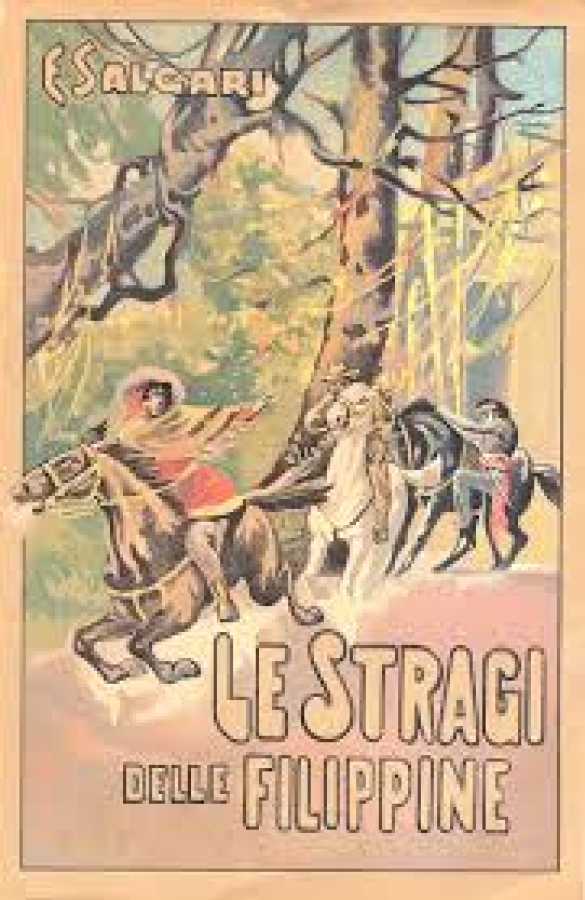
The Philippine Massacres
With exceptional timing, in 1897 Salgari published a novel "of adventure and love" that recounts the Philippine Revolution between 1896 and 1898: a conflict between the Philippine independence movement and Spain, which would ultimately lead the latter to lose its colony. As had already occurred with Cuba during the Spanish-American War of 1898, recounted by Salgari in another novel (see the review of *La capitana del Yucatan* on this site), the ambiguous American support for the Filipino patriots would culminate in the annexation of the Philippines by the United States. While in the novel set in Cuba Salgari squarely sides with Spain against the perfidious American imperialists, here the author's stance is ambiguous; he is bound to be anti-colonialist, and thus against Spain, yet a growing vein of racism shines through: the insurgents are heroic yet bloodthirsty and cruel, devoid of genuine military competence when matched against the valiant and skilled Spanish officers. Consider the description of the insurgent camp: > it was a chaos of haphazardly pitched tents, improvised huts, hovels of every shape and size, simple lean-tos, absolutely primitive shelters. And what of the > diverse races of the Far East: from the mestizos, a cross between European blood and Asian peoples, and therefore > of lively character, exceptionally quick-witted, who formed the backbone of the insurrection , to the Chinese, > with their faces the color of ripe lemons , down to the Malays ( > with wide mouths armed with sharp teeth like those of wild beasts ), to the Tagalogs, > with almost rhomboidal, bony but pleasant faces. It reads like a treatise by Cesare Lombroso; on the other hand, in 1885 we occupied Eritrea, Italy's colonial venture had begun, and Salgari captures the spirit of the times—nationalistic, imperialist, and racist. The historical and ideological framing risks diminishing the novel: beyond the traditional adventures and plot twists typical of Salgari's tales, here we are faced with an anguished love story that recalls *Il Corsaro Nero* (see the review on this site). The novel opens with a shocking scene in which a mob of opium-intoxicated men, drugged by treacherous Mohammedan priests to take revenge on the infidels, wreak havoc among the population of Manila and are about to butcher Teresita, a seventeen-year-old girl ( > two eyes of a deep black (...) two lips as red as coral ), when two valiant men intervene to save her: the mestizo Romero Ruiz and the Chinese Hang Tu. Romero is in love with the girl, the daughter of one of the chief commanders of the Spanish army. How can one love an enemy's daughter? Making the dilemma even more intriguing, Than Kiù, a heroine of the revolution and Hang Tu's sister, is also in love with Romero. We are faced with a web of sentiments, from Hang Tu's friendship for Romero to the young Chinese woman's passion for the mestizo. Beloved to excess, the mestizo fails to grasp the suffering, even when Hang Tu saves the life of Teresita's father—doing so for Romero's sake—and when Hang Tu nurses the gravely wounded mestizo with devotion. For Romero, only the beautiful Spanish girl exists; besides, how could he fall in love with a Chinese woman, he who is nearly European? Than Kiù and Hang Tù, sister and brother, march toward the same fatal destiny. > Look instead, says Than Kiù to Romero, at my star following that of the white woman. Its pale light constantly flickers as though it might go out from one moment to the next. When it has arrived above my country it will die, and on that day the daughter of the land of the sun will die as well. (...) Hang Tu, ever motionless, watched the black mass vanish into the darkness. When the lanterns disappeared behind the lighthouse, he bowed his head upon his chest and sat beside Than Kiù, murmuring: - I loved you so much, Romero, but you did not love my sister. - A dark, romantically sorrowful thread runs through the entire narrative. We find ourselves before the familiar Salgari, with a plot constructed around desperate clashes, flights through the jungle, and moments of intense suspense. The setting is exotic, almost dreamlike, inhabited by evil spirits: > high above circled legions of those hideous and enormous bats, (...) with bodies roughly forty centimeters long, and membranous wings over a meter wide, (...) in the fruit-bearing trees quite a few of those small quadrumana could be seen stirring (...) with their rich, soft, brownish fur , and then macaques, snakes, crocodiles, quicksand. It is a fantastically grim world, reflecting, perhaps, the torments and nightmares of Salgari the man. Ostensibly an adventure story, the novel is disquieting, a harbinger of the author's horrific suicide. Salgari's limitations also emerge: the characters are stereotypes; the writer fails to delve into the protagonists' inner depths; the adventures feel repetitive to anyone who has read the author's other works, carrying a sense of the predictable, of the déjà vu. Why read it? It is among Salgari's most complex novels, from both a historical and personal perspective.

Super Sad True Love Story
> Privatization, nationalization, savings incentives, spending stimulus, regulation, deregulation, fixed exchange rates, floating exchange rates, exchange controls, free currency exchange, more tariffs, fewer tariffs. And the net result: bankruptcy . We find ourselves in an imaginary America, governed by an authoritarian, police-state "bipartisan" regime in the throes of full economic and political decline: > zero for our economy, zero for military power, zero for everything that made us proud of ourselves . In a technological world where books are no longer read, but where one endlessly consults one's tablet (with the result that > you know every filthy detail of the world, while my books know only the minds of their authors ), Lenny Abramov is a forty-year-old Russian-Jewish man who works for a genetics firm specializing in extending the lives of its wealthy clientele. The novel opens during the protagonist's final days in Rome, where he has lived for a year drinking, having sex, and indulging in the Italian *dolce vita*, blithely squandering company money with meager commercial results. Just the day before his departure, he meets an American woman of Korean descent, Eunice, and falls madly in love with her. "How can I bring her to reconcile her youth with my decrepitude?" Lenny wonders: > we are such an improbable couple, so implausible because she is gorgeous and I am the ugliest forty-year-old in this place... I know we are living in Rubenstein’s America (the President of the United States)... but doesn’t that make us even more responsible for each other’s destiny? And it is precisely this attentive care and affectionate protection that allow Lenny to win over, step by step, Eunice’s otherwise eccentric and capricious heart. A love story unfolds against the backdrop of a devastated and decadent New York. For Lenny, loving Eunice is also loving his city—a desperate longing to lead a normal life amid the rubble of an empire. > Is it still my city? (Lenny asks himself) I have a ready answer, cloaked in obstinate despair: it is. And if it weren’t, I will love it even more. I will love it to the point that it will become mine again . Yet collapse inexorably arrives. Protest demonstrations are violently quelled by a police force privatized by major corporations. Chinese, Venezuelans, and Norwegians conquer America and divide its spoils, condemning New York to become an enclave for the wealthy and forcibly expelling residents from their homes. Amid this catastrophe, the love story also comes to an end, and with it Lenny’s entire frame of reference, leaving behind nothing but "the complete, black silence." It is a sophisticated novel, built upon a dual narrative structure. On one side lies Lenny’s diary—lexically refined, erudite, and ironic, replete with evident references to contemporary America; on the other are Eunice’s messages, composed in a youth-speak jargon. What emerges is a narrative and stylistic counterpoint that effectively conveys their divergent understanding of affection and events. For Lenny, it is a matter of escaping the fear of death and finding meaning in life before the collapse of his world. For Eunice, the romance is merely a parenthesis, to be navigated opportunistically while prioritizing her family of origin and personal ambitions. A distinctive feature of the novel is its use of words: recherché, caressed, alluring, endowed with unusual meanings. On a windy day, Lenny encounters a weary, elderly woman who > looked up at the looming wind and said one word: Gale. Just one word, a word that meant nothing more than a period of weather marked by strong winds, but it took me by surprise, it reminded me of how language was once used, its precision and simplicity, its power to summon memories.... and a hundred other days of gales appeared before me.... we were communicating with words . Yet it is precisely this preciousness of language that weighs the reading down, hindered by a narrative that is slow, repetitive (due in part to the dual structure), and often long-winded. A certain New York intellectualism prevails, to the detriment of narrative freshness. Why read it? It is a sad love story, a last stand against the collapse of the Western world.
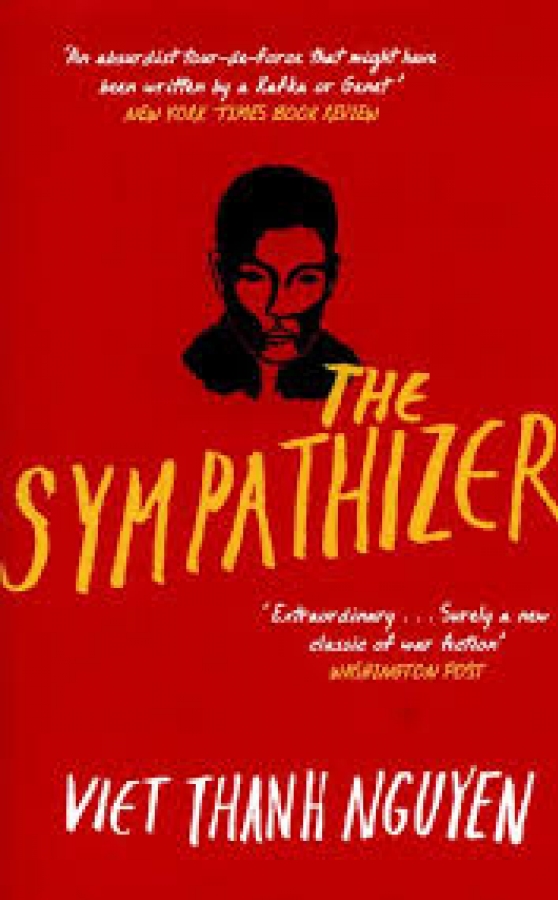
The Sympathizer
Reviewing this novel was no easy task: the narrative strands are numerous, rich in literary, political, and philosophical references, and what is more, they succeed and overlap one another so as to create an often indecipherable tangle to which it is demanding to give an overarching meaning. It is easier to say what the book is not: its subject is not the Vietnam War, as numerous critics have superficially claimed (for that, one must read Karl Marlantes's *Matterhorn*, reviewed on this site); the author does not speak—or at least not predominantly—of the condition of those straddling different histories and cultures, in this case American and Vietnamese (see Jhumpa Lahiri's *The Namesake*, also on rikipedia); nor, finally, is the narrative a political critique of the three nations involved: the United States (the defeated turned media victor), South Vietnam (the victim), and North Vietnam, the victor steeped in a cruel totalitarian ideology. In order to construct a unified picture, let us begin with the plot. The protagonist, and narrator, was born of a liaison between a French priest and a Vietnamese woman, > and strangers and acquaintances enjoyed reminding me of it since childhood, spitting on me and calling me bastard, although sometimes, for a change, they called me bastard first and then spat on me.(...) Perhaps not surprisingly, I am a man of two minds. I am not some misunderstood mutant from a comic book or a horror movie, although some treated me like one. I am simply able to see any issue from both points of view . We might call this quality sympathy, and it translates into an inconsistent disposition of mind: a melancholy nostalgia for French Saigon, destined to disappear, with its corruption, street beggars, nightclubs, gorgeous and available girls, so much so that the author writes that > we were not a people at war electrified by martial marches. No, we fought to the rhythm of love songs, as if we were the Italians of Asia ; a restive yet yielding allegiance to a country that > insisted for the first time in history on a mysterious acronym, USA, (...) that had drawn so many prefixes with super > from the federal bank of its narcissism, (...) that it would not be satisfied until it had locked every nation in the world in a wrestling hold and forced it to shout Uncle Sam ; an ideological bond with the dream of a socialist revolution that will finally liberate Vietnam from the colonizing powers: being a > vanguard that quickens the pace toward revolt, sets the clock of history, and rings the alarm of revolution . Why choose between these different souls? And indeed the protagonist spies for the Vietcong, belonging to a mysterious cell that answers to an equally obscure committee, while at the same time serving as an aide, and friend, to a South Vietnamese general—nationalist, racist, and classist—and is, finally, steeped in American culture, from alcohol abuse to a flawless diction in the language. To be a man of dual personality, he must fashion a mask for himself, > but most actors spent more time without the mask, whereas in my case it was the opposite. No surprise, then, that I sometimes dreamed of trying to remove the mask from my face, only to realize that the mask was my face. Being both spy and confidant is a trap, forcing the protagonist to perform deeds, and even think, against his own values: he must please the General and his friends ( > nothing could make me happier, I said, even if I was, for reasons I could not tell these people, utterly miserable ), he must help them flee to America, he must take part in a sickening propaganda film about good Americans and evil Vietcong, he must execute suspected traitors on the General's orders, he must collaborate on the conspiratorial schemes of the American right and Vietnamese refugees. How to shatter the mask? > What would happen if one took off the mask and the other saw him not with love, but with horror, disgust, and rage? Our protagonist would likely persist in ambiguity for his entire life were it not for a traumatic turning point. Sent on the General's orders to Laos to fight the Vietcong, he is captured by those who ought to be his comrades, left to rot in a re-education camp for a year writing his confession, and finally subjected to an interrogation that is outright torture: bound, gagged, deprived of sleep, blinded by light all day long. His interrogator is none other than the friend who introduced him in his youth to revolutionary doctrine and later became his cell leader. He is faceless, his visage destroyed by a napalm bombing, and so a man with two faces is tortured by a “face of hideous asymmetry.” The protagonist must reveal what he refused to admit in his confession: there is Nothing, we are trapped in the present and the past, here and there, exiled and alone in a fragmented and indifferent world, > where nothing was something now existed, specifically us, (...) we confess to being certain of one and only one thing, we swear to keep, on pain of death, this single promise: we want to live . Much like the protagonist of Ralph Ellison's novel (*Invisible Man*, reviewed on this site), our protagonist too recognizes that he had been “simply a material, a natural resource to be used,” and therefore > I no longer assign a role to myself, (...) the world has become one of infinite possibilities . A complex novel, as noted. It is sustained by refined writing, worthy of a great writer: articulate syntactic structures, with frequent subject shifts and numerous parentheticals, and yet the prose flows effortlessly, airy and engaging; the use of words and idioms belonging to a classic American register, which manages to stay true to the spoken language without lapsing into banality; shifts in narrative register, some typical of the espionage novel (one thinks of the escape from Saigon), others characteristic of fiction hinged on social relationships, in the vein of Andre Dubus (see *Separate Flights and Other Stories*, reviewed on this site), and still others bearing an intense lyrical stamp. I warmly recommend reading Chapter 14, and in particular the description of Lana's singing, a great stylistic masterstroke. To escape the pervasive intellectualism and move toward heartfelt sentiment, one should read the passages concerning his childhood and his bond with his mother (Chapters 9 and 11, though the theme resurfaces constantly). Why read it? A profound and refined novel.