Viet Thanh Nguyen
Books by this author (1)
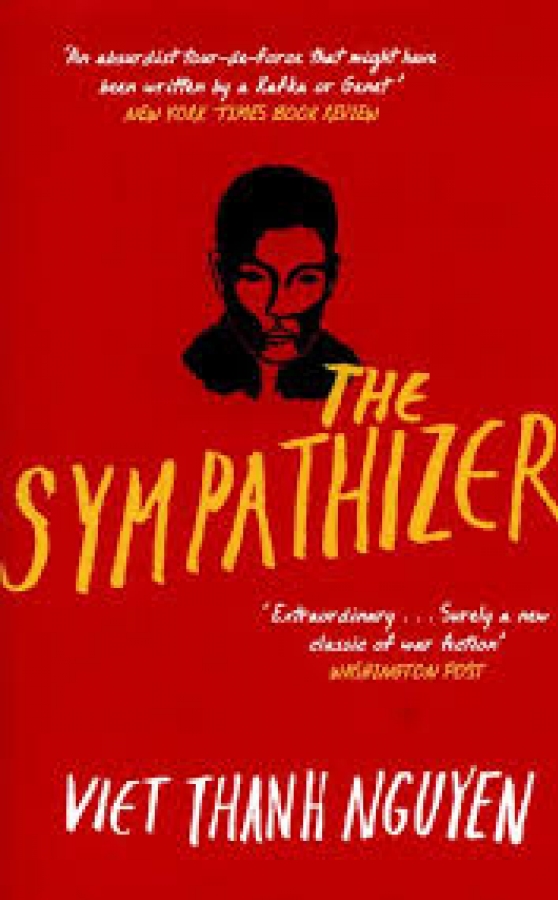
The Sympathizer
Reviewing this novel was no easy task: the narrative strands are numerous, rich in literary, political, and philosophical references, and what is more, they succeed and overlap one another so as to create an often indecipherable tangle to which it is demanding to give an overarching meaning. It is easier to say what the book is not: its subject is not the Vietnam War, as numerous critics have superficially claimed (for that, one must read Karl Marlantes's *Matterhorn*, reviewed on this site); the author does not speak—or at least not predominantly—of the condition of those straddling different histories and cultures, in this case American and Vietnamese (see Jhumpa Lahiri's *The Namesake*, also on rikipedia); nor, finally, is the narrative a political critique of the three nations involved: the United States (the defeated turned media victor), South Vietnam (the victim), and North Vietnam, the victor steeped in a cruel totalitarian ideology. In order to construct a unified picture, let us begin with the plot. The protagonist, and narrator, was born of a liaison between a French priest and a Vietnamese woman, > and strangers and acquaintances enjoyed reminding me of it since childhood, spitting on me and calling me bastard, although sometimes, for a change, they called me bastard first and then spat on me.(...) Perhaps not surprisingly, I am a man of two minds. I am not some misunderstood mutant from a comic book or a horror movie, although some treated me like one. I am simply able to see any issue from both points of view . We might call this quality sympathy, and it translates into an inconsistent disposition of mind: a melancholy nostalgia for French Saigon, destined to disappear, with its corruption, street beggars, nightclubs, gorgeous and available girls, so much so that the author writes that > we were not a people at war electrified by martial marches. No, we fought to the rhythm of love songs, as if we were the Italians of Asia ; a restive yet yielding allegiance to a country that > insisted for the first time in history on a mysterious acronym, USA, (...) that had drawn so many prefixes with super > from the federal bank of its narcissism, (...) that it would not be satisfied until it had locked every nation in the world in a wrestling hold and forced it to shout Uncle Sam ; an ideological bond with the dream of a socialist revolution that will finally liberate Vietnam from the colonizing powers: being a > vanguard that quickens the pace toward revolt, sets the clock of history, and rings the alarm of revolution . Why choose between these different souls? And indeed the protagonist spies for the Vietcong, belonging to a mysterious cell that answers to an equally obscure committee, while at the same time serving as an aide, and friend, to a South Vietnamese general—nationalist, racist, and classist—and is, finally, steeped in American culture, from alcohol abuse to a flawless diction in the language. To be a man of dual personality, he must fashion a mask for himself, > but most actors spent more time without the mask, whereas in my case it was the opposite. No surprise, then, that I sometimes dreamed of trying to remove the mask from my face, only to realize that the mask was my face. Being both spy and confidant is a trap, forcing the protagonist to perform deeds, and even think, against his own values: he must please the General and his friends ( > nothing could make me happier, I said, even if I was, for reasons I could not tell these people, utterly miserable ), he must help them flee to America, he must take part in a sickening propaganda film about good Americans and evil Vietcong, he must execute suspected traitors on the General's orders, he must collaborate on the conspiratorial schemes of the American right and Vietnamese refugees. How to shatter the mask? > What would happen if one took off the mask and the other saw him not with love, but with horror, disgust, and rage? Our protagonist would likely persist in ambiguity for his entire life were it not for a traumatic turning point. Sent on the General's orders to Laos to fight the Vietcong, he is captured by those who ought to be his comrades, left to rot in a re-education camp for a year writing his confession, and finally subjected to an interrogation that is outright torture: bound, gagged, deprived of sleep, blinded by light all day long. His interrogator is none other than the friend who introduced him in his youth to revolutionary doctrine and later became his cell leader. He is faceless, his visage destroyed by a napalm bombing, and so a man with two faces is tortured by a “face of hideous asymmetry.” The protagonist must reveal what he refused to admit in his confession: there is Nothing, we are trapped in the present and the past, here and there, exiled and alone in a fragmented and indifferent world, > where nothing was something now existed, specifically us, (...) we confess to being certain of one and only one thing, we swear to keep, on pain of death, this single promise: we want to live . Much like the protagonist of Ralph Ellison's novel (*Invisible Man*, reviewed on this site), our protagonist too recognizes that he had been “simply a material, a natural resource to be used,” and therefore > I no longer assign a role to myself, (...) the world has become one of infinite possibilities . A complex novel, as noted. It is sustained by refined writing, worthy of a great writer: articulate syntactic structures, with frequent subject shifts and numerous parentheticals, and yet the prose flows effortlessly, airy and engaging; the use of words and idioms belonging to a classic American register, which manages to stay true to the spoken language without lapsing into banality; shifts in narrative register, some typical of the espionage novel (one thinks of the escape from Saigon), others characteristic of fiction hinged on social relationships, in the vein of Andre Dubus (see *Separate Flights and Other Stories*, reviewed on this site), and still others bearing an intense lyrical stamp. I warmly recommend reading Chapter 14, and in particular the description of Lana's singing, a great stylistic masterstroke. To escape the pervasive intellectualism and move toward heartfelt sentiment, one should read the passages concerning his childhood and his bond with his mother (Chapters 9 and 11, though the theme resurfaces constantly). Why read it? A profound and refined novel.