Finished reading on: December 30, 2023
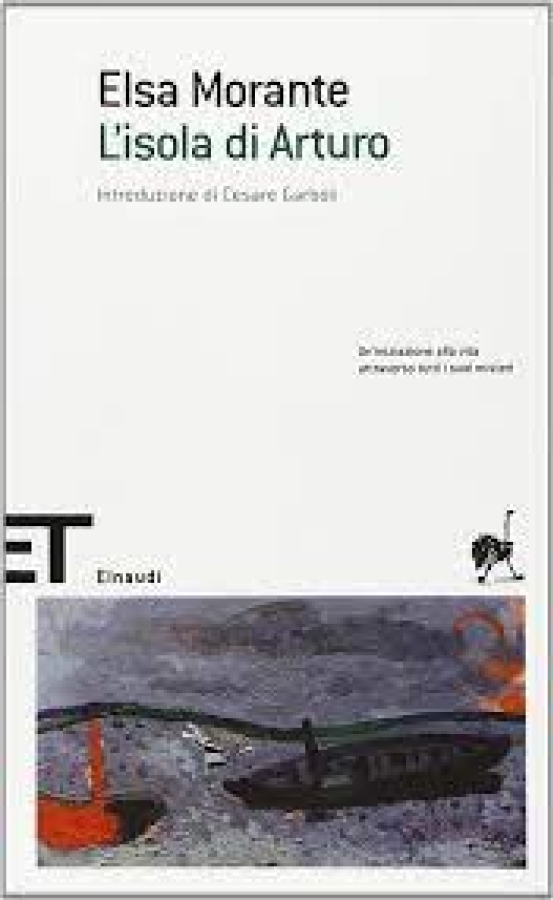
Arturo's Island
Title of the original version reviewed: «L'sola di Arturo»
AI Translation Notice: This review was translated from the original Italian using artificial intelligence. Book quotes and excerpts are translated interpretations and will not match the author's original English phrasing or official published translations.
One of my earliest boasts had been my name. I had soon learned (it was he, I think, who first informed me of it) that Arturo is a star: the swiftest and most radiant in the figure of Boötes, in the northern sky!. Thus begins Arturo Gerace’s long quest for Love:
an indecipherable dilemma, without the solace of hope, or of revenge
; a quest that, to unfold, required an enchanted place like Procida:
a land of adventure, a blessed garden!
, but also
a bewitched and voluptuous mansion. The novel encompasses three distinct natures, profoundly intertwined: the narrative, the fantastic, and the oneiric. Orphaned at birth, Arturo was nursed on goat’s milk by the foster-nurse Silvestro. He grows up alone in a ruined Castle. His father is perpetually traveling, and the boy roams across the island and along the shores. Arturo lives freely yet melancholically, fulfilled only when his father is at home.
My childhood is like a happy land, of which he is the absolute ruler! (...He who strode resolutely forward, like a sail in the wind, with his blond, foreign head, swollen lips, and hard eyes, looking no one in the face. And I followed behind him, proudly casting my dark eyes to the right and to the left, as if to say: “Men of Procida, my father is passing!”. This adoration is unmarred by the brusque and severe manner the father displays toward Arturo, nor is it broken by the arrival of the stepmother, a girl barely older than Arturo (who was then fourteen), perhaps married on a whim. The boy’s relationship with his stepmother wavers between jealousy and attraction, typical of an adolescent undergoing his first stirrings of love and perpetually searching for a maternal figure. One day, the father returns to Procida accompanied by a convict, who is locked up in the island's penitentiary. The man grows taciturn, no longer wanting to walk or sail with his son; instead, he frequently vanishes to sing a love serenade beneath the convict's cell. Arturo's infatuation with his father dissolves painfully, especially when he overhears him being dubbed a “Parody” by the malicious convict: a pitiful imitation of a man of the world, of a great traveler, when
it will be a stretch if he even made it as far as Benevento, or Rome-Viterbo!. Arturo enters adulthood because he sees his father in his true nature, selfish and petty: he must also leave the marvelous island, overly steeped in joyful roaming and anxious anticipation. Adolescence has ended; Arturo sets out to discover the world and resolves to go to war. Thus far, we are faced with a coming-of-age novel, at times verbose and banal. What renders it original and compelling are the narrative’s fantastic and oneiric dimensions. Consider the ascent toward the Penitentiary, trailing behind the father: the alleyways of the ancient village, the narrow, climbing streets, the walls plunging sheer over the island's high cliffs made the Penal Colony look like the
Castle of the Knights of Syria; fairy-tale adventurers (...) crowded that walled palace
, and Arturo became
a funereal Knight Errant, (...) and the voices of the village not far off (...) seemed to me the voices of a childish race. A central episode of the novel takes on fairy-tale suggestions, evocative of distant, fabulous worlds and spoken tales. Consider, on the other hand, the image of the seashell, a dreamy naturalism applied to a celestial phenomenon.
Outside the midnight window, (...) a tiny cloud could be seen which, drifting across the turquoise of the sky, within moments took first the shape of a seashell, then of a small hot-air balloon, then of an ice cream cone, then of an old man's beard, then of a ballerina. Reality, fantasy, and dream hybridize, and the narrative tones blur; the novel bears less and less resemblance to a coming-of-age tale (a sort of Neapolitan Treasure Island, see the review of Treasure Island on this site) and increasingly assumes the imagery and cadence of The Thousand and One Nights (see the review on this site).
Morante makes no attempt to impart a traditional stamp to the novel, as she had attempted in Menzogna e Sortilegio in 1948 (see review on this site); imagination soars from the opening pages, from that singularly starlit incipit. Even within a meticulous and ostensibly naturalistic style, the narration is so oneiric and fairy-tale-like that it suggests a journey deep into consciousness. An early clue lies in the choice of Arturo as narrator, and hence the first-person perspective; then, the disordered, invasive succession of images, bordering on dreams and visions; finally, the characters, who resemble archetypes of different facets of the psyche: the stepmother, an animalistic figure obstinately faithful; the father, stubbornly selfish and hostile; the foster-nurse Silvestro, embodying the Mother figure and returning to rescue him; the wicked malice of the convict, destroyer of Absolute Love. It is as though the protagonist (Morante herself?) hung in the balance, poised before divergent paths, ultimately choosing detachment: a separation also from the yearned-for place where one was born and raised.
The narrative proceeds at a leisurely pace, intent as it is on plumbing the depths of the narrator-protagonist’s soul when faced with the diverse situations that unfold before him. It is a continual excavation, marked by detailed descriptions that would border on tedious were they not sustained by grammatically exquisite prose, an airy and elegant lexicon, and a pervading atmosphere of pleasure.
Why read it? Fascinating, even if at times verbose.