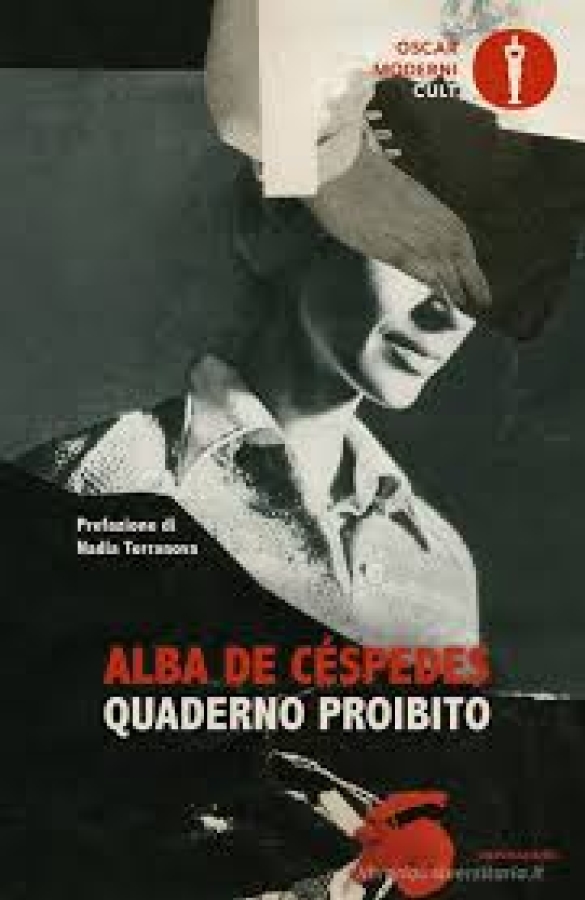
Forbidden Notebook
If in Dan Sijie's *Balzac and the Little Chinese Seamstress* (see the review on this site) a country girl > learned from Balzac that a woman's beauty is a treasure beyond any price , for Valeria it is the purchase of a notebook through which a mother and homemaker, by now known to everyone simply as “mammà,” can guiltlessly live out > her secret of still being Valeria. It is not merely a diary, but a “forbidden” hiding place; on the other hand, > all women conceal a black notebook, a forbidden diary. And they must all destroy it. It is from the vantage point of a notebook—a singular and magical perspective—that a story unfolds set in the 1950s, in an impoverished and traditional Italy, yet already transforming through nascent economic development. The first-person narrator is Valeria herself, of course; an efficient and busy mother, she discovers that > learning to understand the smallest things that happen every day is perhaps learning to truly understand the most hidden meaning of life. But I do not know if it is a good thing; I fear not. (...) This notebook, with its blank pages, attracts me and at the same time dismays me. Through the forbidden diary, Valeria realizes that her husband, on the surface so attentive, has encased her in the stereotype of the good wife and mother, while concealing from her, he too, that he has written a novel and hopes to publish it. Her two children as well, the rebellious Mirella and the fragile Riccardo, see her in that same role, never imagining that another life could be possible for “mammà.” She realizes how within the family, > despite loving each other so much, we defend ourselves from one another like enemies. To her daughter, who sees she is tired and would like to help her, Valeria says: > do not trouble yourself with these things, Mirella. (...) Then more softly, I added: “Leave,” (...) I fear there are many ugly things here, many lies. Perhaps I will never tell you again, but remember that I told you tonight: save yourself, you who can do so. Leave, hurry. (...) No, I am petty-bourgeois, and I am more familiar with sin than with courage and freedom. As Maria Luisa Spaziani says in the poem *The Present*, > now I know what living is: a cruel game that nails every fiber deep to the wheel of time. In *There's No Turning Back*, upon leaving the boarding school and taking different paths, all the friends will in some way betray the fullness and multiplicity of female nature, resigning themselves to the role—traditional or transgressive—that we assign to women. In *Her Side of the Story*, only an extreme act, the murder of her husband, saves Alessandra from a life that fails to satisfy the depth of the female soul (see the reviews of these two novels on this site). In *Forbidden Notebook*, there is no way out: the family is a cage too powerful and cruel to allow a woman to fulfill herself as an individual, outside the role of wife and mother. As Nadia Terranova says, > writing is always a subversive act, the reappearance of conflicts even when one seeks to erase them. Beyond the plot and characters, which are fundamentally ordinary, this is the truest meaning of the novel; > writing is never innocent, it refuses to stay in its place, and it is anything but abstract: it overflows onto bodies, it reverberates across faces. Only by throwing “the book” into the fire is it possible to prevent women and men from winning their freedom. De Céspedes' writing is elegant and airy. The plot frequently turns back on itself, waiting for a resolution that arrives, perhaps, too late; a love of detail often drives the author to repeat herself, in elaborations and episodes that are redundant and unnecessary to the narrative. It is the point of view, “the forbidden notebook,” that prevents the novel from being a typical family story, giving it a cohesion and originality that it would otherwise lack. Why read it? It is the desire of us all to keep a diary, but we are afraid to. , Mire

When you recognize me
Castenate is an imaginary small town in Northern Italy, a > prim and proper little village, where to your face everyone (...) is polite: good morning, good evening, how are things? how is Camilla doing? which school is she attending next year? Yet everyone knows, everyone talks. In this "prim and proper little village", the author sets two storylines that run distinct and parallel for much of the book. One is set in the 1990s and chronicles the relationship between two teenagers: Camilla, > beautiful, with her red hair and green eyes. All teenage girls resemble one another, but she is special. She knows it, and she takes pride in it; Enea, a shy, bookish boy who always raises his hand in class because he—unlike the others—has studied. Camilla delights in bullying poor Enea, humiliating him in front of their peers, as when she pulled down his shorts, shaming him before the female classmate he fancied. Above all, Camilla's insult weighs heavily on Enea: your grandmother > is a whore, the whole town knows it. While this story is steeped in adolescence, tracing a relationship that evolves from friction to friendship and ultimately to love, the other is set during the years of the Second World War and is pervaded by the violence of that era. Rodolfo is handsome, daring, poor, and anti-fascist—viscerally so, belonging to a family of farmhands exploited by agricultural landowners. It is to this very landowning class that Viola belongs; indeed, her father is one of Castenate’s fascist hierarchs, respected and feared throughout the town. So too is her intended husband (they were seen kissing in a reed bed!): a violent young man, always eager to beat up suspected anti-fascists like Rodolfo. Despite being worlds apart socially and politically, a passion flares between Rodolfo and Viola—initially resisted by the young woman, only to erupt into a loving bond when Rodolfo must leave Castenate, ultimately to die in the Russian campaign. From this passion a child is born, who will be raised by Viola in the bigoted climate of post-war Italy. These are two vastly different stories in terms of historical context and emotional stakes; while in the former, set in the 1990s, it is possible to grant love time to unfold, in the other, during those harrowing 1940s, there can be no waiting—everything must hasten forward. For many pages, the reader looks for some clue as to how the two narratives intertwine. Then, much like in Majgull Axelsson's splendid *Io non mi chiamo Miriam* (see the review on this site), the grandmother reveals to Enea that she is not Rita, but Viola, and that he is the grandson of Rodolfo, the twin brother of the man who killed his maternal grandfather. > Rotten blood, all rotten blood, those filthy partisans. The worst part is that that rotten blood contaminated my son as well. In his veins runs Rodolfo's blood, partisan blood. But he will never return. And yet I wait for him, and it destroys me to think I can never have him for myself again, and I despise myself for this weakness. (...) I have no peace, Enea. I have spent my life lying. The novel should have evolved around this dramatic revelation—around that confession, so steeped in both hatred and love, which the grandmother makes to her grandson. Instead, the author crowds the narrative with too many themes, ranging from adolescent issues to the partisan struggle. What emerges is a muddled plot, compromised by a narrative imbalance between the two storylines that comes at the expense of pacing and renders the account redundant. The ending, which perhaps aspires to be a surprise, is instead mundane and tedious. Its fundamental merit lies in making us realize just how distant today's Italy is from the dramatic events our country endured during the war. The prose is simple, effective, and elegant all at once. The brief sentences and tight dialogue suggest that the author intended to appeal to a teenage readership, who might perhaps better appreciate Camilla and Enea's love affair than an adult reader, who is left more struck by Viola's tragic omertà. It is a pity that the author did not devote more effort to capturing the provincial atmosphere, the "prim and proper little village"; had he done so, he would have lent depth to the entire narrative, framing it far more effectively within its social and cultural context. Why read it? It reads well, but it is dull.
When Teresa grew angry with God
It is the story of Alejandro’s ancestors, from their European-Jewish origins to their South American tribulations. They are all incredible characters with equally implausible life stories. The novel unfolds from the stories of the great-grandparents to the meeting of the parents, tracing a trajectory that moves from a delirious irrealism to an increasing verisimilitude of events and protagonists. It is impossible to summarize the contents of the novel in a few words: its fundamental themes can be clarified through the author's own words: > we are not the anarchists who rebel against God, Science, and the state. Nothing of the sort. Nothing can change the course of the Industrial Era... the important thing is to survive, and to do this we need no raw material other than the imagination . History, current reality, humanity, the entire world (present, past, and future) must be seen through imagination and myth, which exalts the traits of individuals, making possible situations and events that, if reduced to a concrete realism, would make living an extremely heavy burden; > do not ask yourself who you are, because you are no one. You have never existed. Like me... We are impostors in this world that is inauthentic, where there is nothing true and reality is a mirage. Uniforms everywhere, copies of copies of copies, every garment, every body, every soul is a disguise... we have been dead since the beginning of time. No one was ever born... Strangle me, deliver me from this lie ; > I do not know whether the memories prior to my birth correspond to the truth or are merely dreams. It does not matter. In any case, reality is the progressive transformation of dreams, there is no other world than the oneiric . The style and narrative rhythm correspond to the expressed content: it unfolds rapidly and convulsively, undoubtedly engaging, yet ultimately so delirious as to become, in certain stretches, tedious and superficial.
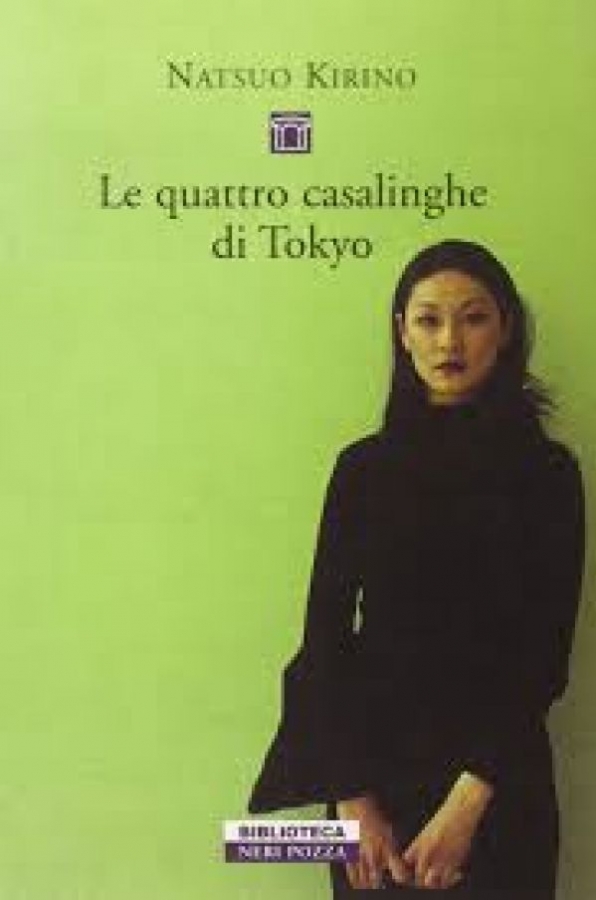
The Four Housewives of Tokyo
Masako, Kuniko, Yoshie, and Yayoi are four housewives; they work the night shift in a food-packaging plant. It is precisely there that they are introduced to us, across the various stages of production, from their arrival at the factory—always in the dark, gripped by the fear of being assaulted—to the assembly line, attentive to the rhythm of the packaging and the reprimands of the overseer. A shared habit develops, one that also breeds solidarity, if not friendship. The four women are markedly different: Masako, hardened and aloof, is a former bank clerk dismissed for her professional ambitions, suffering from a profound loneliness after having been cast aside by her husband and son; Kuniko is mired in debt due to her compulsive spending; Yoshie is a widow, forced to tend to her aged mother-in-law, who loathes her; Yayoi, delicate and gentle, is devastated by her husband’s confession that he has squandered their modest savings on gambling and prostitutes. One evening, thrown out by the owner of the club he frequented, the husband beats his wife. Yayoi unexpectedly retaliates by strangling him. > When she thought back to her husband’s face, the belt tight around his neck, right there in the entryway, she felt fabulously, utterly diabolical once more. Gotcha, serves you right! she thought . At a loss for what to do, Yayoi turns to Masako, who lucidly decides to dismember the man’s corpse in order to dispose of it more easily in dumpster bins. Taking part in the butchery, which unfolds in Masako’s bathroom, are Kuniko and Yoshie as well—partly out of solidarity, and largely for the money. Quite a way to make violent men pay! But why does Masako help Yayoi? Certainly not for the money. Out of friendship? Or because she feels > an almost savage desire to make a clean sweep of her relationships with others ? Is there a dark side to her personality that she herself does not know? It seems like the perfect crime, were it not for a petty loan shark who uncovers what happened; Kuniko confessed it to him to clear her debts. Instead of turning the four women in, the man proposes going into business with Masako: namely, making the dismembered corpses of victims of the yakuza, the powerful Japanese syndicate, vanish without a trace. Masako agrees. Had the novel pursued this narrative thread, we would have found ourselves before an original and entertaining tale: ordinary housewives turning a profit from corpses, mostly male; in short, a reversal of roles, a gender vengeance, however macabre. Instead, the author retreats into a conventional plot. In their investigation, the police had focused on the man who had thrown Yayoi's husband out: Satake, a psychopath who had served a long prison sentence for stabbing a woman to death while raping her. Satake had rebuilt his life, but the police inquiry ruins him, not least by unearthing the old, bloody crime. The man resolves to take revenge. He easily discovers what the four housewives have done and begins to stalk them. He is particularly intrigued by Masako’s personality, by her cold detachment and resourcefulness, but also because he realizes they are kindred spirits. He longs to re-enact that horrific congress with her. A duel begins between Satake and Masako, in which she maneuvers with consummate skill, even managing to turn the yakuza against him. Yet one night, she is ambushed and dragged by Satake into an abandoned warehouse. Is this the end for Masako? We will not reveal how the tale concludes so as not to spoil the surprise; suffice it to say that Masako finally comes to know herself. > Just as she was willing to let herself be killed by him, he wanted to be destroyed by her. Suddenly Masako understood Satake.... and loved him. (...) Their eyes met, their bodies became one. Now in Satake’s eyes she could see only the reflection of herself. A wave of incredible ecstasy was about to engulf her . The opening is promising; the first three hundred pages maintain a relentless pace, with episodes and characters that unfailingly surprise the reader. A subtle irony snakes through the narrative; the four women are examined in all their ambiguity: fundamentally decent women, criminals out of necessity. Masako’s personality is commanding—the unyielding, authoritative leader of a pack of terrified women who draw courage from her resolve. Rivalry, deference, envy, and fear churn among the friends, unsettled by Masako’s utter lack of empathy. Then the novel lapses into a conventional narrative: it loses its bite, turning sluggish, oppressive, predictable. One reaches the conclusion exhausted. Why read it? It is intriguing, yet one can abandon it without finishing.
Four Investigations in Màkari
Saverio Lamanna was the spokesperson for a prominent politician and was brutally dismissed after drafting a press release stating that his boss supported the liberalization of cannabis. Was it an error, or did Saverio simply wish to walk away from a job he no longer enjoyed? We do not know; at any rate, he was forced to leave Rome and return to Sicily, moving into his parents' house in the small, quiet village of Màkari, near the more renowned resort of San Vito Lo Capo. It is the house where he spent his childhood, deeply cherished by his mother, who had passed away some years prior. The book consists of four short stories, previously published by Sellerio in earlier collections; brief tales bound by the same common thread: «we often look for the big game, but sometimes the game is small». When set against our conventional view of Sicily, where everything is traced back to the Mafia, Saverio introduces us to an island far closer to home than we might suppose. It is the same approach adopted by other Sicilian authors, such as Andrea Camilleri and Cristina Cassar Scalia (see the review of *Sabbia nera* on this site). One might wonder whether this pursuit of ordinary crimes does not end up diverting attention from the fight against the Mafia, understandable though the weariness with stereotypes and crude readings of Sicily may be. In the first story, *Il lato fragile*, a prominent figure in the war against the Mafia is killed by a boy, a fragile youth under the care of a priest who is likewise an adversary of Mafia society. It might appear to be a Mafia-related hit or a sexually motivated crime. Could that be true? In *Il fatto viene dopo*, a friend of Saverio's has been fired from the firm where he had worked for many years; he asks Saverio, who has in the meantime become a celebrated author, if he would tell his sad tale: > there is still someone who believes in books, right now when they are of virtually no use anymore . But crafting literature is one thing, and real life—where events can take a turn for the worse—is quite another. In the third story (*La regola dello svantaggio*), Saverio's house has been leased for the summer without his knowledge: he intends to file a police report, but the shrewd real estate agent reminds him that it is better not to play the disadvantage rule, just as in football when play is waved on after a foul. Saverio would have to explain why he accepted under-the-table cash, the French tourists would have to testify and be left with a sour memory of their Sicilian holiday, and the island's tourism would suffer were the fraud to come to light: far better to do nothing, «so that everyone is happy». Alongside this quintessentially Italian affair, Saverio discovers that an elderly, wealthy gentleman did not die of natural causes, but was murdered with an overdose of insulin: was it the son, or the attractive young wife? The title of the final novella (*È solo un gioco*) could easily be turned into a question, for behind an innocuous football team lurks a murky secret that may well lead to murder. Savatteri is an incisive and ironic writer. Crime serves merely as an occasion to discourse lightly on Italy, without taking oneself too seriously and without any illusion of changing anything. The characters are very well drawn, and the Sicilian setting (Palermo, Màkari and its beach, the island's mythical cuisine) is depicted with charm; yet there is perhaps too much dialogue, often repetitive and tedious. The fundamental flaw is the total absence of suspense and mystery—the core ingredients of any compelling noir. Why not read these stories? Tedious, overlong, and devoid of suspense, albeit amusing at times.
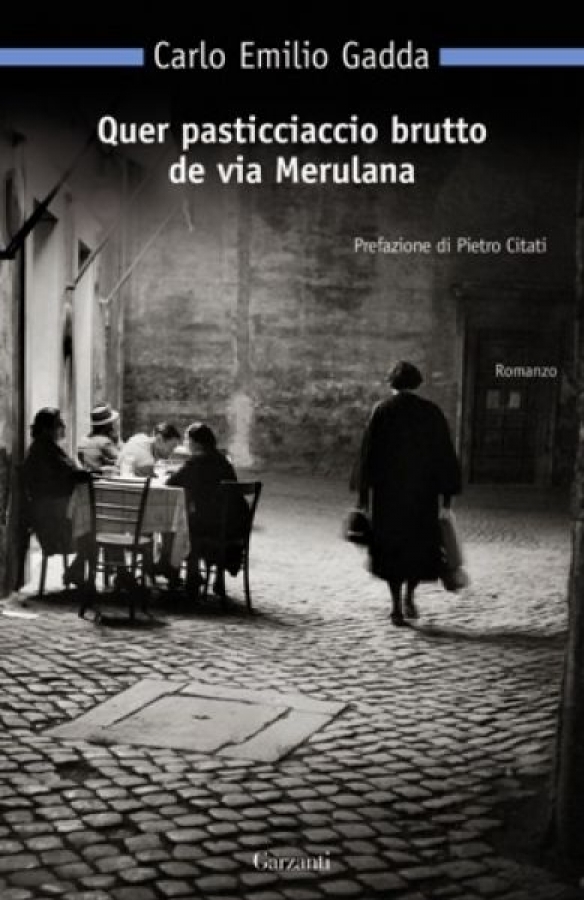
That Awful Mess on Via Merulana
This is a highly singular book, not only for the language employed (a blend of Romanesco and Italian) and its style, but also for its narrative, which, while framed within a typical detective plot, seems to serve as an occasion to reconstruct the social milieus of 1920s Rome. Two crimes occur on Via Merulana in Rome, in an apartment building of the Roman upper-middle class: several pieces of jewelry are stolen and, the following day, a woman is murdered. Thus unfolds the judicial inquiry, conducted partly by the police and partly by the Carabinieri. This investigation serves as the framework within which a series of social and individual portraits are developed. The settings consist of the Roman bourgeoisie and apartment-building life, the world of the police with its bureaucratic mechanisms and petty rivalries, and the Roman periphery with its poverty and desolation. The characters are embodied by Inspector Don Ciccio, the married couple—one of whom is the murder victim—the women of the Roman outskirts, as well as numerous minor figures. Beyond their differences, the author brings to the fore the weary resignation of life, devoid of novelty or change, the paltriness of human feeling (the primacy of money and petty jealousies), and a pervasive mediocrity: all tempered by a gentle irony and an overt understanding of life's tribulations. The language represents one of the novel’s most significant features: it is characterized above all by the use of Romanesco and, consequently, by an attempt to transcend the artificiality of literary prose, which renders the dialogues and conversations remarkably vivid. From this perspective, the lengthy police interrogation of a woman (Ines) is magnificent. Outside the dialogues, the author employs an invented language, rich in Romanesco terms, standard (even classical) Italian, and, in my view, neologisms as well. A D'Annunzian pursuit of sonority and effect emerges, which at times weighs the prose down and contributes to a sense of artificiality and formalism. As written in the *Enciclopedia della Repubblica*, > Gadda's work stems from an extremely fraught and violent relationship with reality, conceived as intimately convulsed, deeply and irremediably misshapen, disordered, upheaved, so much so that to it one can apply only a word that rivals its deformity, urging it to reveal itself fully.... the blending of dialects... as a divergence from the more orderly and mystified forms of language; then the metaphorical strainings, pushed to extreme tensions, of technical jargons; the intricately branched and labyrinthine syntax, through which the intention to thoroughly corrode the customary organization of things is manifested .
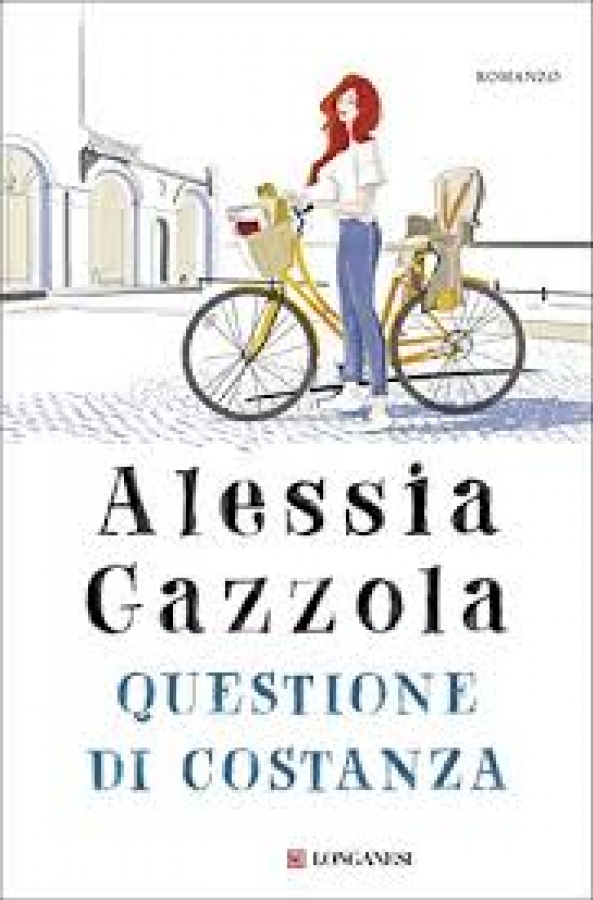
A Matter of Constancy
Costanza is a single mother from Messina with a degree in medicine and a specialization in anatomical pathology. Unemployed, she wins a competition for a one-year research fellowship at the University of Verona in paleopathology. > Utterly ignorant of everything concerning the Holy Roman Empire, the *Signorie*, and pre-Columbian mummies, (...) the truth is that I am interested in this grant neither more nor less than as an ATM . The novel presents itself as a historical mystery, very much in vogue today: archival and laboratory research carried out on human remains from the 1200s belonging to a high-ranking knight. In reality, there are three narrative strands that coexist uneasily. The dominant plotline concerns the experiences of a young mother: settling her daughter into a nursery school in Verona, her guilt toward the child—born of a casual encounter and forced to grow up without a father figure—and the search for the father (a wealthy Milanese architect) who, once tracked down, rekindles Costanza’s desires. It is a banal tale sustained by juvenile writing: it escapes monotonous ordinariness only when Costanza speaks of her erotic dreams, > which cannot be told to anyone, not even to one of those psychotherapists obsessed with the unconscious mind’s subliminal messages . A little courage, please! Dear Costanza, do not merely tell us that upon waking you are confused and bewildered; in any case, we shall turn to Patrizia Valduga: > in this cursed dark night/I was assailed by a temptation/whose shame still lingers in my heart./I, so modest, so proper,/saw a man come softly toward me/and embrace my waist almost greedily;/another came, and with his hand/oh delicately he opened me;... (From *La Tentazione*, 1985). The second narrative strand is more strictly a detective story. Starting from locks of red hair, Costanza and her colleagues trace their way back to Biancofiore, daughter of Frederick II, who lived in a French monastery where she purportedly extracted a perfume from roses, traces of which were identified in the human remains found in Verona. How did a princess of imperial rank—normally destined to be wed into houses advantageous for alliances—end up in a convent? The author imagines that Biancofiore was lame, and therefore useless for matrimonial purposes, and that she had furthermore fallen in love with a Guelph knight who betrayed Frederick II and was subsequently murdered. With the third narrative strand, we move to the 1200s, to the court of the Emperor and then to that of the Lord of Verona: the cruel Ezzelino. First, there is Selvaggia, a natural daughter of Frederick II, given in marriage to Ezzelino, who supposedly murdered her according to legend—though in reality, she died in childbirth. Then unfolds the sorrowful tale of Biancofiore, ultimately the protagonist of the detective plot. How do these three narrative strands come together? It is difficult to say. Straining one’s imagination, one might say that Selvaggia and Biancofiore bear a slight resemblance to Costanza; still in love with her daughter’s rediscovered father, she too must accept that he is marrying another woman. Together, the three young women can do nothing but resign themselves to fate, accepting it: > I will show no disappointment, I will show no disappointment. I will show no disappointment. (...) But inside I feel liquefied. My hidden hopes, liquefied. The small, great, draining infatuation, liquefied . The writing is far too puerile to support a plotless story, which would require an articulated style capable of lending depth to the characters and context. Why not read it? It is simply too banal.
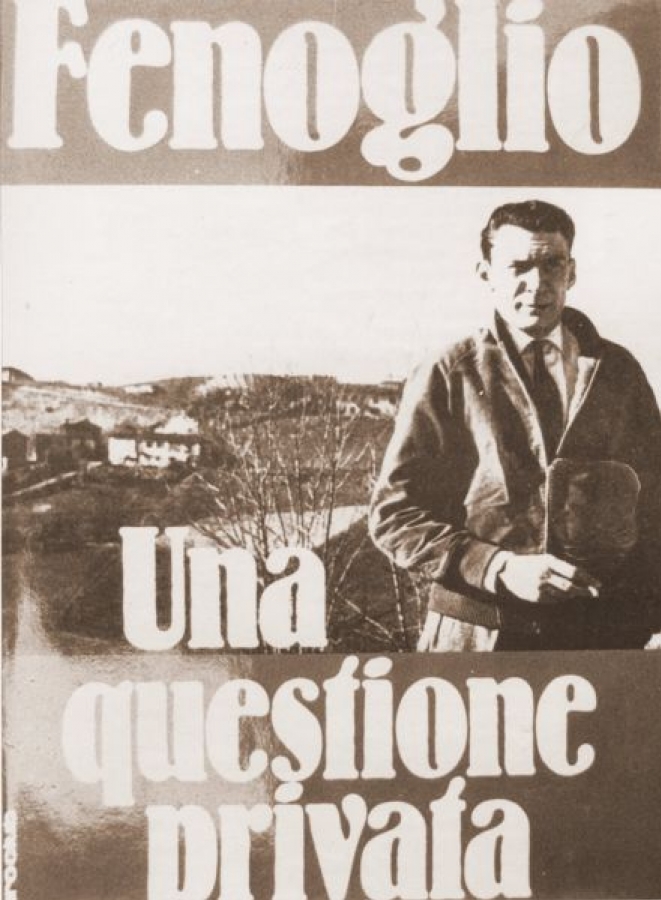
A Private Affair
The book is set in the hills of Alba during the Resistance. Milton is a partisan who returns to the house where he used to visit, and secretly love, Fulvia, and learns that she allegedly had a relationship with Giorgio, who has also become a partisan. To uncover the truth, he sets out in search of Giorgio, who has meanwhile been captured by the Fascists and faces execution by firing squad. Milton attempts to capture a prisoner to have a hostage to trade with the Fascists; failing in this endeavor, he returns to the villa, only to be pursued by the Fascists, who had set an ambush in the house. The narrative can be interpreted from multiple perspectives: Milton’s love story for Fulvia, which transcends political passion, a > novel of amorous madness and chivalric pursuits like *Orlando Furioso*, and at the same time there is the Resistance just as it was, inside and out (Italo Calvino, preface to *Il sentiero dei nidi di ragno*, 1964); the partisan war as an existential tragedy that "is born in the woods, along the rivers, on the hills, among the ravines, the rivulets, the paths of his Piedmont" (Geno Pampaloni); the raw and objective depiction of violence as the sole meaning of human relations, a theme already present in the short story collection *I ventitré giorni della città di Alba*. All of these interpretations are plausible, because, as Italo Calvino further wrote: > it is an absurd, mysterious book, in which what is pursued is pursued to pursue something else, and this other thing to pursue yet another, and one never arrives at the true why . I, however, like to think that one of the book’s central themes is the coexistence of the life typical of peacetime with a climate of war, manifesting both in the survival of the emotional realm (jealousy, friendship, practical jokes, grudges between neighbors) and in the acclimation to the conditions imposed by violence and precariousness. From this perspective, one need only think of the episode in the stable, where a group of partisans rests while an old woman knits and a young boy does his homework. > By the kitchen doorway an old woman sat on a child's low chair, spinning from a distaff. Her hair seemed made of the very same material as the yarn. "Good evening, ma'am," Milton said to her. Beside the old woman, a boy kneeling on a layer of sacks was writing his homework on an overturned tub . War is violence and cruelty, yet human beings must continue to survive; they must strive to live with it. This is the deepest violence of war. The novel is magnificent: the style is spare yet at the same time evocative and suggestive, above all in its rendering of the landscape and atmosphere.
The Quiet Game
Penn Cage, a former prosecutor and now a successful author, has recently lost his wife. To find himself again, he decides to spend some time with his parents in his hometown, a small town in Mississippi. It is like finding oneself > on the thin boundary of a universe of vibrant life and mysterious death, of hidden secrets and glittering facades, and of races inextricably bound by blood and tears, geography and religion, and above all time . In the town, long gripped by severe economic decline, silence and complicity prevail, for both Black and white residents wish to be left in peace, to “keep things quiet, lovely, and easy” so as to attract new investments to the area. By chance, Penn finds himself entangled in a crime that occurred twenty years earlier (a Black man was mysteriously murdered), at the very moment a powerful local figure, Judge Marston, accused his father—a respected family doctor—of having committed grave malpractice in the exercise of his profession. Sensing a link between Marston and the murder, Penn resolves to investigate the bloodshed out of a desire for vengeance against Marston’s accusations—false, as it turns out—against his father. In reality, he still feels guilty about what transpired all those years ago: he had had an affair with Marston’s daughter, the alluring Livy, and remains convinced that the judge sought to punish his father because of their relationship. Can the past be undone? > Who among us, if offered the opportunity, would not want to relive the day or the hour when we first tasted love, or made a choice that forever altered our future, denying a life we might have had? But this sentiment is a trap, because Penn > realizes with muffled surprise (that) intimacy with Livy is not a new experience. It is like walking through a checkpoint into a country I visited long ago and to which I return, older and, I hope, wiser . Indeed, as he presses forward with an investigation rife with plot twists and bloodshed, Penn uncovers that the murder of a poor Black man was entangled in national conspiracies (the machinations of the FBI's then-powerful director and the assassinations of Robert Kennedy and Martin Luther King Jr.), and that Marston’s motives were far more prosaic than he had imagined: the eternal lust for money. Above all, he must face the reality that Livy is a hollow, selfish figure, irrevocably trapped in her squalid past. Shattering the quiet of his childhood town allows Penn to unburden himself of the weight and suffering of memory, reclaiming life not by retreating into the past, but by looking toward the future. The novel’s greatest strengths lie in its setting and its style, polished and meticulous in its prose. As an illustration of this writing, one need only note the sweetness, distinctly Southern and rural, of the townscape described by the author: > the tree-lined road is dotted with trailers and small houses, but as I approach the two-hundred-year-old Episcopal church that defines the settlement, the trees recede, and the grounds flanked by splendid plantations stretch out on either side of the road. Beyond the moss-draped cedars and white fences, swans drift majestically across the ponds, so much so that it feels like being in England . The trouble is that this literary refinement comes at the expense of narrative architecture, which is frequently sluggish and weighed down by episodes tangential to the central plot. The progression toward the denouement is so drawn out that it borders on tedium. Why read it? It is engaging, elegant, and compelling in its evocation of place.
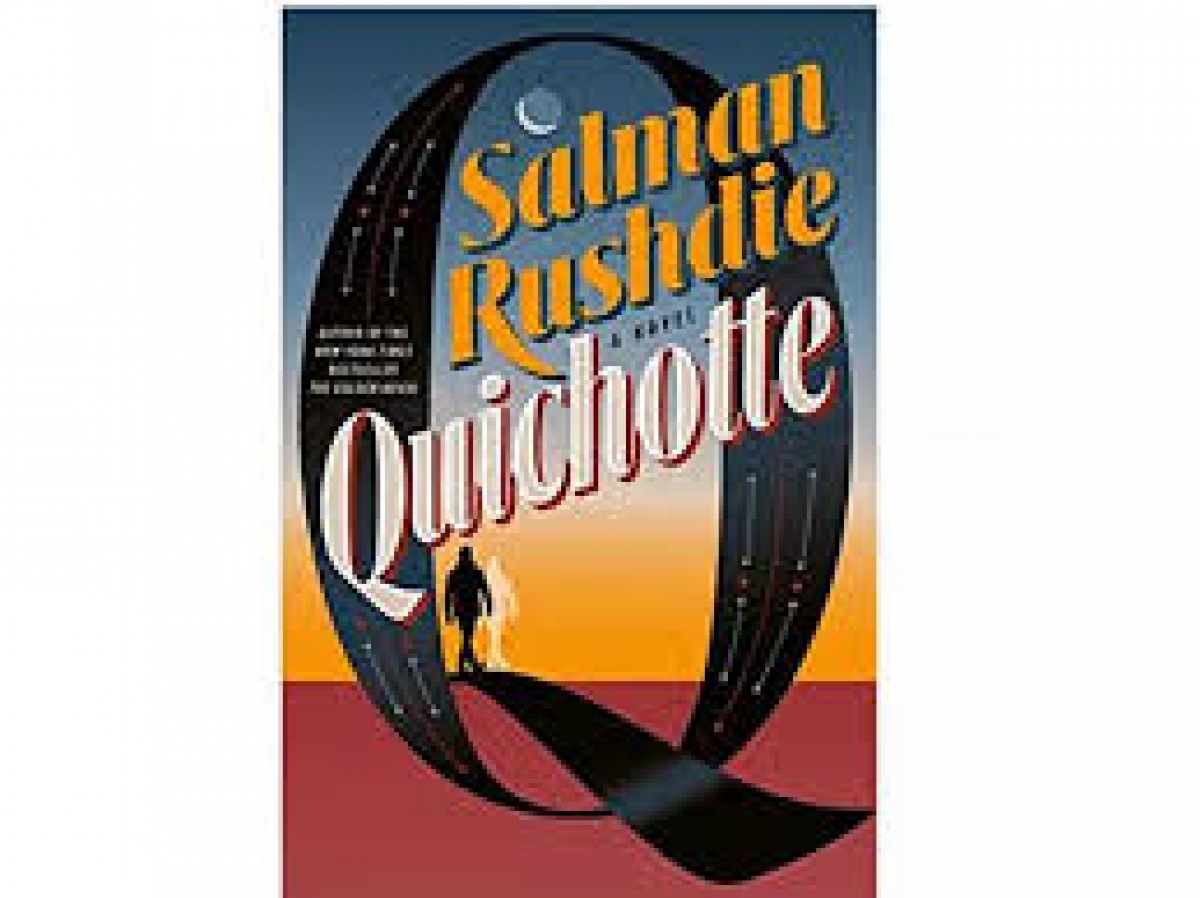
Quichotte
> For as I live this poor life of mine, I seem to brush past another as in sleep; and that that sleep is my present life (Camillo Sbarbaro). In a shattering world, is it possible to save oneself through fantasy, by conjuring up another reality? And in so doing, to elude death? Rushdie attempts to answer this question with a grand fresco: at its center lie the sources of our era's illusions, those that lead us to believe that "anything can happen"—television, cinema, new media, and so forth; then there is the tale of a modest thriller writer: an elderly pharmaceutical salesman peddling opioids is a modern Don Quixote, bearing the evocative name Quichotte, who sets off across the highways of America to win the heart of a television star; next comes the Author, an Anglo-Indian writer as chance would have it, who, as he constructs the story, realizes that Quichotte, > the lonely seeker of love, the loser nobody who believed himself capable, unaided, of winning the heart of a queen, had been with him all his life, a shadow of himself, glimpsed sometimes out of the corner of his eye, whom he had lacked the courage to confront ; and finally Rushdie himself, who seeks to detach himself from the present, so unsettling and ambiguous, in order to bind past and future and thereby conquer death. In the outer frame of this fresco of concentric circles, the "Great Partition"—a dominant theme of the Indian author—is renewed: climate change ravages the earth and imperils survival, populism advances triumphant with its easy panaceas, racism and violence spread, Great Britain is fracturing, cities once open and tolerant like London turn inward with rancor and mistrust, the anchors of an exile like Rushdie dissolve: > the world no longer has an end except that you must finish your book. When you have done so, the stars will begin to fade . This vast fresco, a sort of testament, could not but come at the expense of the narrative: it splinters into a thousand tributaries, loses itself in parenthetical—even philosophical—asides, weighed down by a verbosity typical of Rushdie, yet here unsupported by dazzling prose. The most intriguing narrative thread is the one centered on Quichotte. As he journeys along the roads of America, he is joined by the son he always wished for, Sancho—at first incorporeal, then acquiring flesh and blood through the intervention of the Blue Fairy and the Talking Cricket. A modern Pinocchio, Sancho possesses an individuality of his own but must forge a conscience; unwilling to do so, he will vanish into nothingness: that is, only ethics confers true life. Meanwhile, an eccentric billionaire pitches on television a "door" to another dimension to escape climate catastrophe. Quichotte thus has a purpose: to lead his beloved into another world, to save her. But is any of this real, even within fiction, or merely the byproduct of the opioids that now pervade our society? Most likely they are hallucinations through which one believes survival is possible, that one can do nothing while hurtling toward catastrophe. Together with his beloved, Quichotte bravely throws himself through the door, only to find himself in the Author's reality-unreality—a reality destined to disappear with the end of the book, as happens with all tales of fantasy. > The microscopic man, the creature of the Author's imagination, had brilliantly done the impossible and had joined the two worlds, had crossed from the fantasy world into the Author's real world (...) Stop, cried the Author, knowing what would happen next, the thing he could not stop, because he had already written it; it had already happened, so he could not prevent it from happening. His heart pounded, as if it might tear away from his chest. Everything was coming to an end. Rushdie > could not prevent the end of the world, nor the death of the Author, nor the end of two precious, if small, human lives . How many subjects the great Indian writer seeks to tackle! It is as though his entire life were before him and he wished to retrace it through a staggering tale: the great literature that inspired him, the vicissitudes of his family and homeland, the anguish of existence, the pleasure of fiction—even television fiction. It is as if he wanted to tear away a veil and, through the real-unreal, confront us with our destiny: the extinction of the human species, individual death. To be sure, we are gripped by nostalgia for what the narrative failed to deliver, the incredible story of the modern Don Quixote: how many of us would wish to possess the courage of this eccentric old man, television-addicted and yet wise, to plunge headlong into an improbable romance with a star! If anything can happen.... We have grown accustomed to a baroque, D'Annunzian, sweeping prose; instead, we are confronted with a flat style, easily readable but prosaic and banal, like that of ordinary writers. At times, the great Rushdie resurfaces. Faced with the prospect raised by Sancho that his beloved might not want an elderly bachelor, Quichotte indignantly cries out: > What kind of question is that? (...) It is the question of an ignoramus. It is the inquiry of a baboon trying to speak English. It is the spitting of a fish out of water. It is the dance of an amoeba that thinks it is a human being. It is an insult to the greatness of my quest...