Finished reading on: March 19, 2005
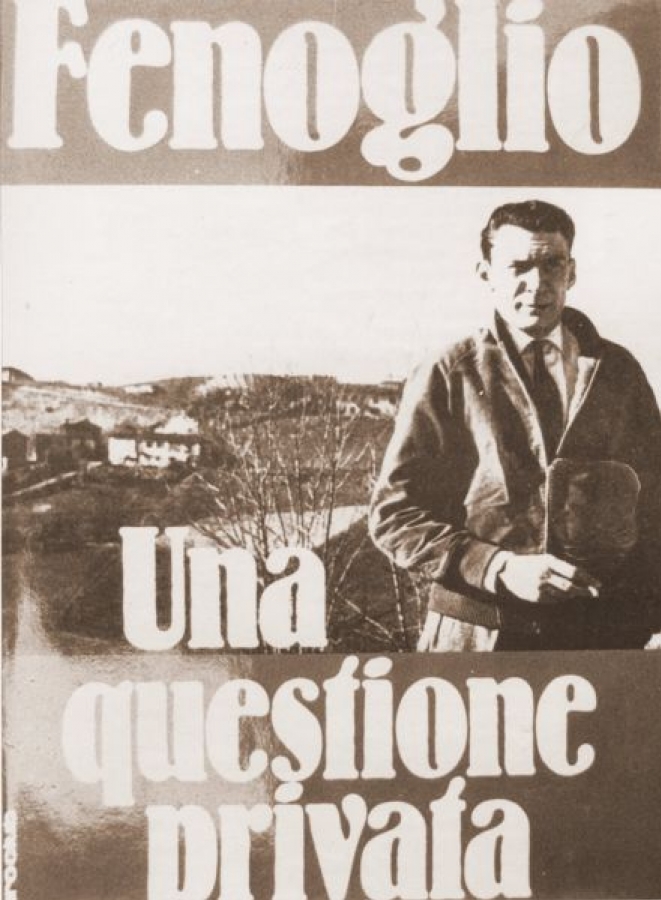
A Private Affair
Title of the original version reviewed: «Una questione privata»
AI Translation Notice: This review was translated from the original Italian using artificial intelligence. Book quotes and excerpts are translated interpretations and will not match the author's original English phrasing or official published translations.
The book is set in the hills of Alba during the Resistance.
Milton is a partisan who returns to the house where he used to visit, and secretly love, Fulvia, and learns that she allegedly had a relationship with Giorgio, who has also become a partisan.
To uncover the truth, he sets out in search of Giorgio, who has meanwhile been captured by the Fascists and faces execution by firing squad.
Milton attempts to capture a prisoner to have a hostage to trade with the Fascists; failing in this endeavor, he returns to the villa, only to be pursued by the Fascists, who had set an ambush in the house.
The narrative can be interpreted from multiple perspectives: Milton’s love story for Fulvia, which transcends political passion, a
novel of amorous madness and chivalric pursuits like Orlando Furioso, and at the same time there is the Resistance just as it was, inside and out (Italo Calvino, preface to
Il sentiero dei nidi di ragno, 1964); the partisan war as an existential tragedy that "is born in the woods, along the rivers, on the hills, among the ravines, the rivulets, the paths of his Piedmont" (Geno Pampaloni); the raw and objective depiction of violence as the sole meaning of human relations, a theme already present in the short story collection I ventitré giorni della città di Alba.
All of these interpretations are plausible, because, as Italo Calvino further wrote:
it is an absurd, mysterious book, in which what is pursued is pursued to pursue something else, and this other thing to pursue yet another, and one never arrives at the true why
.
I, however, like to think that one of the book’s central themes is the coexistence of the life typical of peacetime with a climate of war, manifesting both in the survival of the emotional realm (jealousy, friendship, practical jokes, grudges between neighbors) and in the acclimation to the conditions imposed by violence and precariousness.
From this perspective, one need only think of the episode in the stable, where a group of partisans rests while an old woman knits and a young boy does his homework.
By the kitchen doorway an old woman sat on a child's low chair, spinning from a distaff.
Her hair seemed made of the very same material as the yarn.
"Good evening, ma'am," Milton said to her.
Beside the old woman, a boy kneeling on a layer of sacks was writing his homework on an overturned tub
.
War is violence and cruelty, yet human beings must continue to survive; they must strive to live with it.
This is the deepest violence of war.
The novel is magnificent: the style is spare yet at the same time evocative and suggestive, above all in its rendering of the landscape and atmosphere.