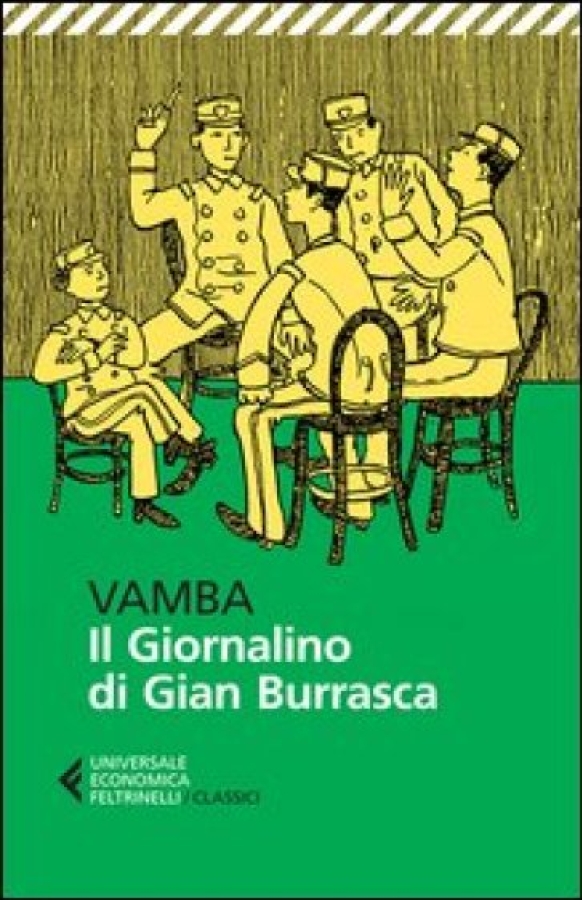
The Diary of Gian Burrasca
Vamba, the pseudonym of Luigi Bertelli, imagines having discovered *Il giornalino di Gian Burrasca* “from a portress, wife of a court usher, while she was reading it to her children”; indeed, Giannino Stoppani’s diary had long remained “forgotten among the files of the Judicial Chancellery, which will certainly come as no surprise to anyone who knows how everything concerning Italian Justice is protracted and oblivious, (...) wearisome and costly... > *Il giornalino di Gian Burrasca* begins on September 20 (the day of the capture of Porta Pia) and concludes on March 2 of the following year; the years are not specified, but they are likely 1907 and 1908, when the story was published in installments in *Il Giornalino della Domenica*. The setting is the typical bourgeois family of the early twentieth century, of modest means, constantly awaiting an inheritance and anxious to find a good husband for their three grown daughters. Giannino is the youngest, and we may assume he is around ten years old: mischievous, rebellious, always ready for new pranks, the consequences of which he fails to grasp, whether out of naivety or excessive shrewdness. After the lawyer Maralli, future husband of his sister Ada, nearly loses an eye due to Gian Burrasca’s latest stunt, to his mother who tearfully tells him: “do you see, my Giannino, how much sorrow, how many misfortunes because of you!...” Giannino replies “to comfort her, (...) but if they are misfortunes, excuse me, how is it my fault?” > The diary is divided into two parts. In the first, roughly 200 pages long, Giannino's antics unfold in succession—some hilarious, others frankly exaggerated, often repetitive in their narrative structure. Vamba harbors no pedagogical intent, as is the case with De Amicis’s *Cuore* and Collodi’s *Pinocchio* (for the latter, see the review on this site). A penchant for pranks prevails over everything. In the second part, Giannino is sent to a boarding school, where the boy discovers solidarity among peers and the meaning of revolt as a challenge to authority. Highly effective are the figures of the Headmaster and the Headmistress: he “so very thin and so very tall”, she “so very short and so very fat” and who calls her husband “idiot” > . She, after all, is the owner of the boarding school, founded by her uncle. And here unfolds one of the funniest episodes of the entire story. The boys realize that the pair are fond of séances in which they summon the spirit of the founder; by means of a ruse, Giannino and his friends fake responses from beyond the grave, but they cannot contain their laughter and end up being discovered. The diary ends on a bitter note. Humiliated by the Headmaster and the Headmistress because he is a poor boarder unable to pay his tuition, feeling unworthy in front of his peers, his friend Barozzo flees the boarding school: “he turned to me and threw his arms around me, holding me tight, so very tight; he kissed me and our tears mingled upon our faces, (...) and when I came to my senses I was alone, leaning against the main gate of the institute, which was shut.” The diary could have ended with this feeling of grief and shock over a friendship lost to wounded pride; yet instead, stubbornly, Vamba chooses to add yet another of Giannino’s stunts, thereby pinning the entire diary to its caricatured aspects. Through modern eyes, the atmosphere and episodes of *Il giornalino di Gian Burrasca* seem to belong to another society, distant from our own. For us adults, the diary can serve as an intriguing portrayal of the early-twentieth-century bourgeoisie, that which Guido Gozzano depicted with irony; a social structure that endured throughout Fascism and into the early postwar decades, until it was swept away by consumerism and the sexual revolution. To teenagers, I suspect Giannino may seem an incomprehensible boy, though they might appreciate his spirit of revolt against adults, who are perceived as a hostile, rigid, and downright hypocritical counterpart. Unintentionally, Vamba chronicled the generational conflict, albeit in a paradoxical and therefore implausible manner. The Tuscan cadence of the language makes Giannino’s diary a testament to a living, popular, and authentic Italian. And this is precisely why *Il giornalino di Gian Burrasca* remains an enjoyable read. Why read it? It offers a cross-section of an Italy that is no more.

The given day
We are in Boston in 1919, at the close of the First World War. The novel's protagonists are Danny, a police officer from a traditional white family whose patriarch is a high-ranking official in the police department, and Luther, a Black man who could have been a formidable baseball player, but, because he is Black, must resign himself to menial jobs. This is, therefore, a deeply stratified American society, one in which the relations between social classes and different ethnic groups are clearly demarcated. Both protagonists feel ill at ease within this rigid social framework. Danny lives in the Italian neighborhood and is drawn to the social and ideological upheavals that characterize the years immediately following the end of the Second World War. At first, it is mere curiosity, but he soon finds himself increasingly involved. He is sent to infiltrate anarchist and Bolshevik groups as an informant, only to discover that they are simply demanding a more just society.. Meanwhile, he attends meetings of police officers demanding fairer wages and less grueling working conditions. He soon becomes their leader. Luther, in turn, is forced to flee his hometown—leaving behind a wife and child—after killing some criminals. He arrives in Boston and finds work with Danny’s father’s family: he is blackmailed by a corrupt cop who attempts to implicate him in fabricating evidence to frame the Black community for subversive activities. As this brief synopsis shows, the plot is remarkably intricate and packed with twists and turns, in the vein of the best American thrillers. It culminates dramatically with the Boston Police Strike of 1919, which leaves the city at the mercy of criminals, petty thugs, and subversives for two days. Danny emerges defeated: as the leader of the striking officers, he is accused of inciting his colleagues to abandon their posts (in reality, it was political machinations that left the city abandoned). At the beginning of the novel, Danny believes that this world belongs to men like his father (hierarchical, authoritarian, convinced that everyone must know their place), but he comes to realize that this is neither a genuine nor a just world. > - I'll tell you, Luther, it’s been a terrible year-. Luther thought back on his own year and it made him laugh, really laugh.- What-, Danny said, Luther gave him his hand:- you and me together- What do you think you do, Danny replied, when everything you have done in your life turns out to be a damn lie? Build a new life. I guess Luther replied. The most compelling aspect of the book is that a social issue—such as the great Boston Police Strike of 1919 and the birth of the American labor movement—is framed within the conventions of a thriller, making the narrative gripping and fast-paced. Like all American thrillers, it ultimately proves verbose, redundant, and even muddled. Many of its narrative threads get lost in the sheer mountain of pages, and the colloquial, distinctly American style fails to sustain the momentum, being far better suited to delivering plot twists than to exploring character and circumstance in depth. Everything is left far too unresolved. Why read it? The historical context is intriguing for us Europeans, who are unfamiliar with American history.
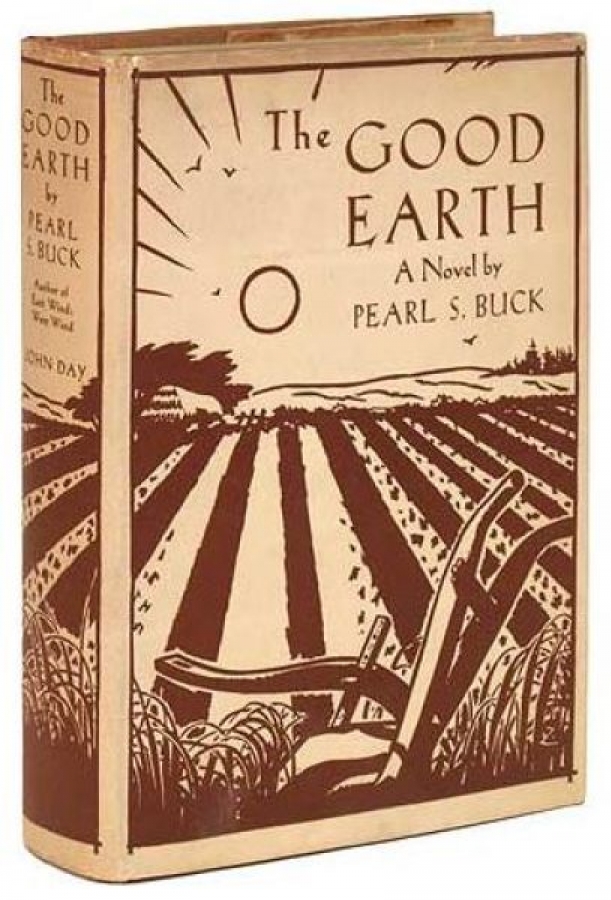
The Good Earth
The book is the saga of a Chinese peasant family who, from a state of abject poverty, becomes exceedingly wealthy following the discovery of a hoard of jewels, all of which are invested in the purchase of land. The protagonist is Wang Lung, an impoverished peasant who marries the maidservant of a great and powerful family. The bride, O-lan, is a plain, taciturn woman, yet tenacious and a tireless worker. She proves to be the peasant's true fortune, as much for her capacity for labor as for her wisdom and common sense. Forced to abandon their land following a severe famine, the couple moves to the city, where they lead a life of bitter hardship. During an uprising, O-lan, drawing on her experience as a servant, uncovers a hidden cache of jewels and gives them to her husband, keeping only two pearls for herself. Thus begins the fortune of Wang Lung, who betrays his wife by taking a new bride and relegating the woman to a subordinate status. O-lan’s illness and subsequent death bring home to her husband her profound importance, leaving him to feel her absence deeply. The book closes somberly with the sons’ decision to sell the land, bringing to an end a family cycle that had made the earth its steadfast anchor. The true subject of the book is the land, and consequently the quintessential peasant yearning to possess as much of it as possible. Another central figure is O-lan, who embodies the traditional role of women, along with their familial and social function. And it is precisely the examination of this character—who never mounts any genuine rebellion against her husband—that exposes the author’s conservative outlook, revealing her inability to offer a realistic, unvarnished reading of the female condition in Chinese society, or to chart a path toward emancipation that could nonetheless have been identified, even if at the cost of some strain on historical reality. Likewise, the other characters, both male and female, operate entirely within established social conventions, with the sole exception of one son who chooses the path of revolution over the quiet life of a landowner. There is no aspiration toward change, and everything is reduced to a complacently sentimental fatalism. The most compelling pages of the book are the opening ones (Wang Lung going to claim his bride-to-be from the powerful household) and the depiction of urban life, with the contrast between city and countryside, the impact of early social revolutions, and the presence of foreigners. Thereafter, the narrative turns maudlin, submerged in an often cloying pietism. While the opening seems driven by an ambition to provide a portrait—however raw and realistic—of rural Chinese life (with faint echoes of Zola’s *Earth*), this subsequently dissolves into an apologetic approach that relegates the Chinese setting to mere backdrop. The pacing of the book remains consistently effective, making for a swift and effortless read; the language is rich at the outset, drawing on the lexicon proper to peasant existence, only to thin out into an increasingly impersonal and detached English. The prose thus accentuates the drift toward a narrative that grows steadily less incisive and alive.
The Grass Harp
*The Grass Harp* is a coming-of-age novel, but it must be read as an assonance of wondrous images and extraordinary sounds, “a harp of voices telling a story.” And all that is left for us is to listen. As was already seen in Salvatore Satta's *The Day of Judgment*, remembrance is not a succession of events, a sequence of situations and characters; it is instead like closing one's eyes > to fix their image, (...) a series of ripples, rings that do not evolve with the freedom of a spiral: for me, passing from one to the next was a leap, not a gradual change . In this case, the one remembering is an adolescent: Collin. Orphaned of both parents, he is taken in at his aunts' house in a small country town. Verena, the younger of the two sisters, is an authoritarian woman, shrewd in business, always ready to impose rules and restrictions. Dolly, the other sister, is eccentric, with the eyes of > a person endowed with a natural talent, gentle, transparent eyes, of a luminous green color, like crème de menthe . And then there is Dolly's only friend, Catherine. > They were always together, and everything they had to say they said to each other: resting my ear against a beam, I could listen to the fascinating tremor of their voices flowing like a hum between the old wooden partitions. (...) I know: Dolly, they said, was Verena's cross. (...) Perhaps it was so. But those were happy years. (...) If some sprite wanted to give me a gift, he would have to give me a bottle filled with the voices of that kitchen, the ha-ha-has and the whispers of the stove, a bottle brimming with the smells of baking, of butter and sweets, even if Catherine smelled like a sow in heat . Verena, ever greedy for profit, wants her sister to agree to commercialize her natural herbal recipes, for which Dolly is famous, but also justifiably protective. For the first time, the two sisters clash, and Dolly, so fragile and docile, reveals all her stubbornness: she decides to leave, taking Collin and Catherine with her, and chooses a tree as their dwelling: > spacious, sturdy, (...) it was like a raft floating on a sea of branches, (...) Dolly knew, and made sure I knew, that it was a ship, that being in it was sailing along the cloudy shores of every dream, (...) we belonged to it, just as the sunlit branches belonged to it, a nest for night birds. It is a scandal, clearly a revolt—against Verena and against the whole town. And indeed, several times the sheriff, the reverend, and the townsfolk gather beneath the tree to convince Dolly to come down. The situation becomes even more awkward when an old retired judge joins the “revolutionaries,” who in turn allow a strange and large family of wanderers to camp near the tree. The orderly life of the town is disrupted. Things escalate to physical confrontation, to forceful action; Catherine is arrested. In the end, Dolly will be the one to decide: her wisdom, and her affection for her sister, for Collin, and for Catherine, convince her to come down, not least because Verena has realized she was in the wrong. The story concludes with Dolly’s prolonged illness and her death. It is time for Collin to leave. What does the tree symbolize? Many things: freedom, dreams, nature, and especially a bond so powerful as to outlast death: that between Collin and Dolly. > I would have invented someone, a story to find her again, because she seemed to be moving forward into the future, while I was unable to follow her in my monotonous stillness . Yet as I went on writing > we flowed together again like a stream of water that an island had divided for an instant . As had already been seen in *The Great Gatsby*, the eye of the young narrator—an adolescent—illuminates through imagination the figure of a modest provincial woman and an ordinary treehouse built by other boys at play. Imagination is the most powerful means (the only one?) to transfigure reality and make us happy. The first chapter is splendid; after that, the narrative proceeds slowly, devoid of rhythm, bogged down by too many digressions and the entrance of an excessive, redundant cast of characters. In short, the writer drags things out, failing to develop the ingenious premise of the treehouse as a refuge and a realm of dreams and freedom. Perhaps it was detrimental to insist on constructing a plot rather than surrendering to the mysterious atmosphere of the woods: too much prose, too little poetry! Why read it? It is worth reading for the first chapter alone.
The Silent Cry
> I wake in the darkness before dawn, flailing among the agonized shreds of dreams that still linger in my consciousness, searching for a burning sense of anticipation. (...) In every part of my body, I perceive separately the distinct weights of flesh and bone, sensations that coalesce into a dull ache within my consciousness, reluctant to resurface into the light. (...) I have slept with my arms and legs curled to the side, in the posture of one unwilling to recall his own nature or the circumstances in which he finds himself. This is the novel’s opening; it encapsulates the essential traits of a narrative that is oneiric yet deeply rooted in reality: the refuge of dreams to flee suffering—the latter manifested through bodies often described in grotesque terms; memory as a prison enclosing a human destiny already doomed; the ambiguity of familial and social ties, thickened by resigned silences and unspeakable memories. We find ourselves before a stream of consciousness set against a backdrop portrayed both naturalistically and like a dark fable. Mitsui, the first-person narrator, is shattered by the tragicomic suicide of a friend. His life is already scarred by his son’s monstrous disability and his wife’s alcoholism; furthermore, tragic family events weigh upon him, their recollection repressed yet ever-present in his consciousness. Perhaps to effect a turning point in his life, he accepts the invitation of his brother Taka to return to the village at the edge of the “mighty” forest, where the family home stood and where they grew up as children. It is a return to the past: for Mitsui, a desperate hope for change that translates into the definitive awareness of his estrangement from the world; for Taka, a desire for self-punishment enacted by retracing dramatic events that engulfed their family. In 1860, upon the fall of the Shogunate, their great-grandfather’s brother led a peasant uprising, later bloodily suppressed; at the end of the Second World War, in the very same village, a brother died in a clash between Japanese and Koreans, the latter prisoners of war. Seeking to retrace the deeds of his uncle and brother, Taka decides to lead the villagers in pillaging the local supermarket, owned by a Korean known as “The Emperor” (perhaps to confer upon him a sacred aura, Korean as he is!). Mitsui remains aloof from the events, curling further into his stupor, while Taka emerges as a vigorous and cunning leader; yet it is all a charade through which Taka seeks to punish himself for a grave sin: as a youth, he raped his disabled sister, driving her to suicide. Taka confesses to a murder he did not commit and then, disbelieved by Mitsui, kills himself. > He looked like a life-size plaster dummy, entirely red and dressed only in trousers. shouts the wife to Mitsui, who tries to justify himself. > You reject people and let them die, and the only thing you can do to make amends is cry out in your sleep: “I have abandoned you!” (...) In the deep gloom of the cellar, stirred by swirling eddies of wind, I saw the eyes of a dying cat. (...) As I contemplated them in the darkness, the eyes of my cat, a companion of many years, became the eyes of Taka, the eyes of the great-grandfather’s brother I had never known, and the eyes of my wife, red as plums; and they all merged into a luminous circle that was rapidly asserting itself as an undeniable part of my being. (...) And I would survive in an agony of shame, beneath the light of those stars, peering with my single eye and the timidity of a mouse into a vague, dark outside world... The setting is similar to that of *The Water Forest* (see the review on this site), and certain historical references are analogous, such as the peasant uprisings of 1860, but the narrative structure is profoundly different. Unlike in *The Water Forest*, here the first-person narrator is redundant, just as the familial relationships are intricate, unfolding along two axes: the bond between Mitsui and Taka, a mixture of affection and revulsion, and the former's relationship with his wife, which seemingly remains in the background. > Remaining silent for a moment and then staring at me with eyes full of desperate hostility, this time red from tears rather than whisky, my wife said to me: > When the time comes when, as you say, we must acknowledge that there is no turning back, perhaps then we will be a little kinder to each other! . Despite the complex interplay of themes and narrative layers, perhaps the unifying meaning of the novel lies in the acceptance of the disabled child—the sole possibility for rebuilding a relationship torn apart by merciless fate. The narrative unfolds slowly, with numerous references and digressions, as if the author were wary of uncovering the depths of consciousness too quickly. One is captivated by the spell of the words, rich in psychological and social resonance; yet an oppressive sense of claustrophobia looms over everything, offering no glimpse of development or resolution, so that reading becomes burdensome and one reaches the novel's end with difficulty. Why read it? Splendid prose, and the haunting allure of pain and death.

War and Peace
The book deals with the Napoleonic Wars, and in particular the French invasion of Russia, the sacking of Moscow, and the defeat of Napoleon. In the early parts of the novel, war is something distant, a matter for the powerful and their diplomatic games, whereas > life, the real life of men, with its fundamental necessities concerning health, illness, work, rest... , proceeded, as always, independently and outside political friendship and hostility toward Napoleon Bonaparte, and beyond all possible reforms . There exist, therefore, several narrative planes: the great political and military events, the battles and political rivalries, through the narration of which Tolstoy articulates from the outset one of the book’s fundamental themes. His philosophy of history is that everything is accomplished in accordance with an end that man is not granted to understand, being the work of Divine Providence. This philosophical conception contrasts, then, with the stark depiction of war as destruction, suffering, and death—a catastrophe that spares neither the vanquished nor the victors; the vacuous life of the court and the aristocrats, enclosed in their web of relations, their petty worldly pleasures, and their intrigues: behaviors that persist even during the sacking of Moscow itself, heedless of the danger looming over the country; the search for a meaning to existence, embodied by Pierre (Freemasonry and the ideals of French democracy), by the inner torments of Prince Andrei (who perceives the absurdity of war from the start and recoils in horror), and by Princess Marya’s steadfast religious faith; the domestic life of the Rostovs, woven of small, genuine occurrences, Natasha’s awakening to love, Sonya’s unrequited devotion to Nikolai, first infatuations, balls, and receptions. This structure of the novel shatters with the French invasion, when war intrudes into civil life. As Prince Andrei observes, > my father, too, was building at Lysye Gory and thought that was his place, his land, his air, his peasants; but Napoleon came and, without even knowing of his existence, struck him aside, casting him like a splinter out of the road, and Lysye Gory and his entire life collapsed . War reshuffles the novel’s distinct narrative planes and upends the lives of the protagonists, opening paths that once seemed impossible, yet are made viable by suffering, necessity, and the authenticity demanded by extraordinary events. Marya is rescued by Nikolai and falls in love with him; Pierre, in captivity, through close contact with privation, death, and simple souls, comes to understand the true roots of serenity and happiness; Natasha discovers love while nursing Andrei, grasping the genuine, deeper dimensions of romantic devotion, thereby preparing herself to embrace Pierre’s affection. Everything culminates in the discovery of fundamental values (family, marriage, the pleasures of country life and good stewardship, religion) in a “hosanna” to tradition and the good. The heavy religious and philosophical imprint comes at the expense of the depth and complexity of the characters and the events narrated. The protagonists are stereotypes of social and familial roles, devoid of genuine torment, substantive evolution, or change. The pace of the narrative is brisk, if one sets aside the philosophical digressions, but this is due to a sequence of episodes that, in certain instances, degenerate into impromptu snapshots, paradoxically mirroring the structure of a modern television drama. A few pages are redeemed: Nikolai’s visit to the military hospital with the vision of the sick in appalling hygienic conditions, the Battle of Borodino, the mingling of Russian soldiers and French prisoners reduced to a single shared destiny, Andrei’s death, and the grief of Marya and Natasha. From this standpoint, one cannot share the opinion expressed in the *Enciclopedia Treccani*, which casts in a positive light what is, in truth, the work’s most profound limitation. > What struck and continues to strike the reader most in this epic of recurring yet ever-new motifs is the total absence of any artistic arbitrariness, the seamless fusion of art with life. Sustained by a prose of pure substance, without a shadow of embellishment, the diverse threads of the narrative knot and unravel with absolute spontaneity. Life and death are celebrated within it with the same devotion, both humble and solemn. From the protagonists to the minor extras, all possess an unmistakable individuality, and all, in turn, are as if absorbed by a humanity that resides within them and above them. Only toward the end of the novel does one sense the presence of an author who has a thesis to defend and to preach. And this presence would indeed be grating, were it not to bring us back to the very essence of the work: man creates nothing, commands nothing; he merely follows the inevitable march of events unfolding before his eyes . The contemporary relevance of the novel lies in its agonizing portrayal of war, in its devastating repercussions on soldiers and civil society alike. In this sense, the dichotomous theme of war as a cluster of remote occurrences that do not touch individual conscience, versus war as a violent intrusion into daily existence, offers a line of reflection equally valid for today’s political landscape. Tolstoy does not condemn war in itself (his appreciation of partisan warfare and his romantic conception of war as an emancipator of authentic values are readily apparent); rather, he seems above all to condemn war as a diplomatic and political “game” that disregards the toll of suffering and grief inflicted upon the people.