Finished reading on: February 04, 2007
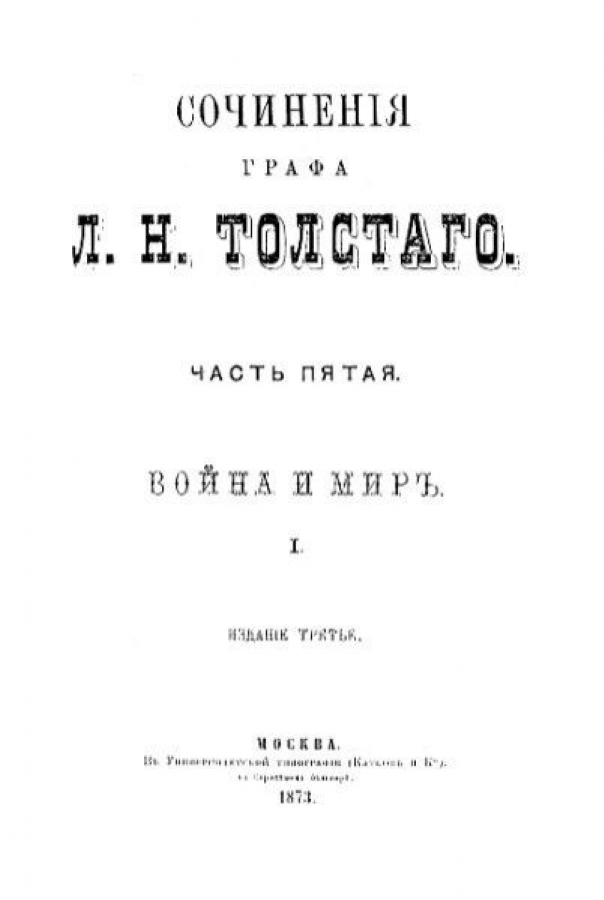
War and Peace
Title of the original version reviewed: «Guerra e pace»
AI Translation Notice: This review was translated from the original Italian using artificial intelligence. Book quotes and excerpts are translated interpretations and will not match the author's original English phrasing or official published translations.
The book deals with the Napoleonic Wars, and in particular the French invasion of Russia, the sacking of Moscow, and the defeat of Napoleon.
In the early parts of the novel, war is something distant, a matter for the powerful and their diplomatic games, whereas
life, the real life of men, with its fundamental necessities concerning health, illness, work, rest...
, proceeded, as always, independently and outside political friendship and hostility toward Napoleon Bonaparte, and beyond all possible reforms
.
There exist, therefore, several narrative planes: the great political and military events, the battles and political rivalries, through the narration of which Tolstoy articulates from the outset one of the book’s fundamental themes.
His philosophy of history is that everything is accomplished in accordance with an end that man is not granted to understand, being the work of Divine Providence.
This philosophical conception contrasts, then, with the stark depiction of war as destruction, suffering, and death—a catastrophe that spares neither the vanquished nor the victors; the vacuous life of the court and the aristocrats, enclosed in their web of relations, their petty worldly pleasures, and their intrigues: behaviors that persist even during the sacking of Moscow itself, heedless of the danger looming over the country; the search for a meaning to existence, embodied by Pierre (Freemasonry and the ideals of French democracy), by the inner torments of Prince Andrei (who perceives the absurdity of war from the start and recoils in horror), and by Princess Marya’s steadfast religious faith; the domestic life of the Rostovs, woven of small, genuine occurrences, Natasha’s awakening to love, Sonya’s unrequited devotion to Nikolai, first infatuations, balls, and receptions.
This structure of the novel shatters with the French invasion, when war intrudes into civil life.
As Prince Andrei observes,
my father, too, was building at Lysye Gory and thought that was his place, his land, his air, his peasants; but Napoleon came and, without even knowing of his existence, struck him aside, casting him like a splinter out of the road, and Lysye Gory and his entire life collapsed
.
War reshuffles the novel’s distinct narrative planes and upends the lives of the protagonists, opening paths that once seemed impossible, yet are made viable by suffering, necessity, and the authenticity demanded by extraordinary events.
Marya is rescued by Nikolai and falls in love with him; Pierre, in captivity, through close contact with privation, death, and simple souls, comes to understand the true roots of serenity and happiness; Natasha discovers love while nursing Andrei, grasping the genuine, deeper dimensions of romantic devotion, thereby preparing herself to embrace Pierre’s affection.
Everything culminates in the discovery of fundamental values (family, marriage, the pleasures of country life and good stewardship, religion) in a “hosanna” to tradition and the good.
The heavy religious and philosophical imprint comes at the expense of the depth and complexity of the characters and the events narrated.
The protagonists are stereotypes of social and familial roles, devoid of genuine torment, substantive evolution, or change.
The pace of the narrative is brisk, if one sets aside the philosophical digressions, but this is due to a sequence of episodes that, in certain instances, degenerate into impromptu snapshots, paradoxically mirroring the structure of a modern television drama.
A few pages are redeemed: Nikolai’s visit to the military hospital with the vision of the sick in appalling hygienic conditions, the Battle of Borodino, the mingling of Russian soldiers and French prisoners reduced to a single shared destiny, Andrei’s death, and the grief of Marya and Natasha.
From this standpoint, one cannot share the opinion expressed in the Enciclopedia Treccani, which casts in a positive light what is, in truth, the work’s most profound limitation.
What struck and continues to strike the reader most in this epic of recurring yet ever-new motifs is the total absence of any artistic arbitrariness, the seamless fusion of art with life.
Sustained by a prose of pure substance, without a shadow of embellishment, the diverse threads of the narrative knot and unravel with absolute spontaneity.
Life and death are celebrated within it with the same devotion, both humble and solemn.
From the protagonists to the minor extras, all possess an unmistakable individuality, and all, in turn, are as if absorbed by a humanity that resides within them and above them.
Only toward the end of the novel does one sense the presence of an author who has a thesis to defend and to preach.
And this presence would indeed be grating, were it not to bring us back to the very essence of the work: man creates nothing, commands nothing; he merely follows the inevitable march of events unfolding before his eyes
.
The contemporary relevance of the novel lies in its agonizing portrayal of war, in its devastating repercussions on soldiers and civil society alike.
In this sense, the dichotomous theme of war as a cluster of remote occurrences that do not touch individual conscience, versus war as a violent intrusion into daily existence, offers a line of reflection equally valid for today’s political landscape.
Tolstoy does not condemn war in itself (his appreciation of partisan warfare and his romantic conception of war as an emancipator of authentic values are readily apparent); rather, he seems above all to condemn war as a diplomatic and political “game” that disregards the toll of suffering and grief inflicted upon the people.