
The House by the Medlar Tree
The setting is a fishing village in late nineteenth-century Sicily. The Malavoglia are a family of fishermen, owners of a boat (the *Provvidenza*) and a home with a small plot of land (the house by the medlar tree). Life unfolds serenely and with dignity within a community that respects the Malavoglia because they are economically self-sufficient. In short order, a succession of misfortunes plunges the family into poverty and grief: the *Provvidenza* is shipwrecked, claiming the life of Bastianazzo, the son of Padron ’Ntoni, and a cargo of lupins is lost. The family is forced into debt to repair the boat and repay the loan contracted to purchase the lupins. Then one of the sons, Luca, dies as a soldier, and a second shipwreck forces the sale of the house by the medlar tree as well. ’Ntoni, Padron ’Ntoni’s other grandson, turns to smuggling; surprised by the police, he severely wounds an officer in the ensuing scuffle. To spare him a life sentence, the defense lawyer invokes the officer’s pursuit of one of the Malavoglia daughters, who, consumed by disgrace, flees the village. Following this series of catastrophes, the novel appears to conclude on a positive note: Alessi, Padron ’Ntoni’s other grandson, manages to repurchase the house by the medlar tree. In reality, this positive note bears witness to the cyclical nature of history, the perpetual struggle for survival composed of positive moments and negative ones—the latter far more frequent. Alongside the Malavoglia family, the book’s other primary subject is the community itself, embodied by a gallery of characters, their mutual entanglements, and their utilitarian logic, but also by a continuous intertwining of economic concerns with gossip, the hunt for husbands, moral hypocrisy, and, ultimately, indifference toward misfortune. No one aids the Malavoglia, save for fellow unfortunates, while the propertied families—or those who perceive themselves as such—abandon them, as misfortune is, at bottom, regarded as evidence of guilt. It is a complex work, layered with manifold themes. In the background lies an absolute fatalism, reflecting a destiny already sealed by social hierarchy and economic utilitarianism: > What ails you? he would ask him. Nothing ails me, only that I am a poor devil. And what can you do if you are a poor devil? We have to live as we were born . "When a man cannot catch good fortune, he is a fool, as everyone knows." It would be reductive, however, to limit the novel to a mere mirror held up to society, or to subsume it under a kind of philosophy of history. In truth, the vitality of the various characters, the narrative tempo, and above all the language—highly idiosyncratic in that it is non-dialectal yet profoundly representative of its milieu—are all elements that elevate the narrative into a realm that is non-realistic, imaginative, and expressive of universal sentiments. If one compares Verga’s work with those of Émile Zola, particularly *La Terre*, a profound difference clearly emerges. Verga’s novel seeks neither to sensationalize nor to incite revolt or desolation; instead, it operates on the terrain of "lightness," steeped in irony toward a society locked within its own rigid codes and incapable of comprehending the heroic spirit that animates the Malavoglia. The clash between individual (and familial) heroism and the narrow-minded conservatism of society constitutes an inherently Italian theme, and is thus emblematic of a culture and a country.
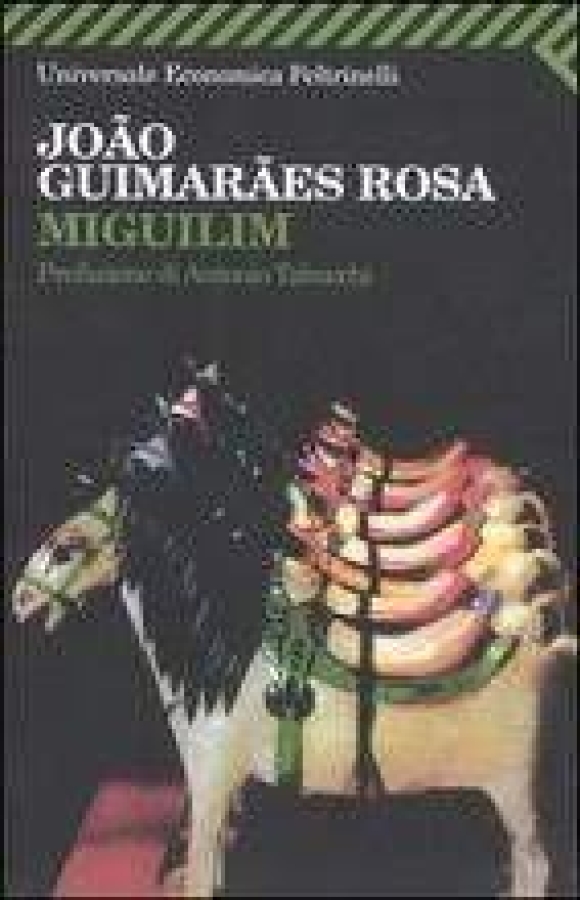
Miguilim
> A certain Miguilim lived with his mother, his father, and his siblings, very far from here, (...) in the Mutùm. In the middle of the Campo Gerais, but in a hollow within forest country, black earth, at the foot of the mountains. Miguilim was eight years old . With this fairy-tale incipit, Guimarães Rosa narrates an extended peasant family through the eyes of a child. > Miguilim had no desire to grow up, to become a grown-up; grown-ups' talk was always the same dry things, with that need to be violent, frightened things . In a family plunged into poverty (the father > shouted that he was poor, on the verge of becoming destitute, of having to beg for alms ), Miguilim lives at the heart of a complex social nucleus made of people and animals: the violent father, the uncle carrying on an affair with the mother, the eccentric grandmother possessing a severe and atavistic wisdom, the witch-servant, "so pitch-black, as Death must be," the cowherds and the village folk, the farmyard animals, and so much more; yet none is like his brother Dito—self-assured, protective, capable of standing up to their father. > All at once, it burst. (...) And then came the thunder! It thundered tremendously, again and again; everyone covered their ears, closed their eyes. Then Dito held Miguilim close. Dito wasn't trembling, only he was more serious. (...) Dito was clever and peaceful. (...) Dito never truly quarreled with anyone, (...) Miguilim always wanted not to quarrel, yet ended up quarreling with everyone. How wonderful to be like Dito: suited to all people's hours... . Miguilim is fragile, unsuited to peasant labor, afraid to venture alone into the forest to bring lunch to his father working in the fields; nothing comes of the cowherd's reassuring words when Miguilim asks if he is deformed, nor of the hugs and kisses of the witch-servant, nor even of the purring rubs of the cat Sossoe, > eyes of a green so much less empty --- it was a light inside another inside another, inside another, without end . It is as though Miguilim lived in a world of his own: magical, incomprehensible, wondrous, and terrifying. It is no wonder that Dito's death shatters the boy; he nearly loses his mind, can no longer hide behind his brother's reassuring certainty, and must himself go to work in the fields, grueling hoeing beneath the sun. As in an exquisite fairy tale, a knight on horseback arrives to save him; he addresses little Miguilim directly and hands him a pair of spectacles. > And Miguilim looked at everyone, with such intensity. (...) He looked at the dark forests on the mountain crest, here the house, the hedge of wild beans and sao-caetano; the sky, the cattle pen, the yard, the round eyes and the high windowpanes of the morning. (...) The Mutùm was beautiful. Now he knew it. If in Anna Maria Ortese's *Il mare non bagna Napoli* (see the review on this site), eyeglasses unleash an unbearable reality upon an impoverished girl from the slums, here, instead, the lenses possess a salvific power, as though only the true knowledge of reality could make it bearable. A fairy-tale ending brings little Miguilim's childhood to a splendid close, foreshadowing the great social narrative of João Guimarães Rosa's masterpiece (see the review of *Grande Sertao* on this site). The extended peasant family characterized the social fabric of our country until the 1950s. And yet there are no great novels chronicling the sharecropping and tenant-farming world. *Pinocchio* is the son of an artisan, the Malavoglias in *I Malavoglia* are fishermen, Giannino in *Il giornalino di Gian Burrasca* is the quintessential bourgeois lad, the stories in *Cuore* are too edifying to mirror a social reality; perhaps only the splendid chapter "The Four Seasons" in *Il mulino del Po* investigates the dynamics typical of the peasant world (for *Pinocchio*, *I Malavoglia*, *Il mulino del Po*, and *Il giornalino*, see the reviews on this site). Here, however, Guimarães Rosa retraces a child's early years within the intricate web of relationships of an impoverished reality, entirely geared toward survival, yet one in which emotions churn and dreams remain possible. The relationship between Miguilim and Dito denotes an informal hierarchy in which the more fragile child seeks the support of the stronger personality, forging a privileged and steadfast bond that offers security—one that only the fairy-tale conclusion can replace. In his intense preface, Antonio Tabucchi defines the novella > an operetta with a Mozartian timbre, performed on the magic flute of an uncommon narrator . It is a particularly apt definition: it is the fluctuating cadence between hyperrealistic moments and fantastic ones, of "non-story," that imparts the sense of ambiguous allure that characterizes the narrative. Behind the easy screen of the fairy tale (but is it truly one?), the story > stirs unease and always retains an unattributable valence, on the margins of (or beyond) speculative formulation. Something reminiscent of the savage mind, bound to the mystery of Being . (Tabucchi's Preface). Why read it? Magnificent!
The Thousand and One Nights, Volume I
*The Thousand and One Nights* is an Arabic manuscript likely dating back to the Abbasid Caliphate, between 750 and 900 AD: the setting is the fabulous empire of Baghdad, stretching from North Africa across the Arabian Peninsula to Central Asia and India. Its discovery is credited to Antoine Galland in the early eighteenth century, and from that moment the text spread throughout the West, sparking wonder and scandal: Orientalism was born. Owing to the many versions of the work, it should be clarified that this review refers to the text established from the original manuscripts by René R. Khawan. Let us begin with *The Weaver of Nights*. The king has been betrayed by his wife: a Moor “lifted her legs in the air, slipped between her thighs, and penetrated her.” From that moment on, the sovereign resolves to take a maiden as his bride each night and execute her at dawn. The vizier's daughter, Shahrazad, who “had read books and writings of every kind,” asks her father to arrange her marriage to the king, saying: > either I shall rise in the esteem of my fellows by freeing them from the peril that threatens them, or I shall die or perish with no hope of deliverance, sharing the fate of those who have died and perished before me . Her father attempts to dissuade her with tales urging a prudent, unassuming life, but the daughter, obstinate and self-assured, replies that she could offer him other stories leading to entirely different conclusions. And herein lies the crux of *The Thousand and One Nights*: the word. Through literary invention, fabulation, and poetry, one can confront the direst straits, vanquish evil spirits, and even bend the will of God to one’s favor. According to the widely accepted interpretation—though not strictly corroborated by the work’s architecture—each night Shahrazad tells a story to the king: enthralled, the sovereign spares the maiden's life out of the desire to hear another tale, ultimately making her his lifelong bride. A miracle of the word! The work follows a recursive pattern: a frame narrative within which other stories unfold, all designed to persuade and astonish the listener. The prose narrative is interspersed with verses in a style characteristic of Abbasid civilization. One does well to surrender to its spell; nevertheless, certain common threads can be traced. In the celebrated *The Fisherman and the Jinni*, the central motif is cunning. A fisherman frees a demon imprisoned for centuries inside a jar at the bottom of the sea. Once liberated, the Jinni seeks to kill the poor man. The fisherman preys upon the demon's vanity, challenging him to demonstrate how he could possibly fit into such a small vessel; it is a ruse to seal the Jinni away once more. To the creature's pleas and promises, the fisherman replies with tales displaying the wisdom of poetry: > they might have remained just and pure,/but they abused their power/ and the world in turn oppressed them/(...) behold them restored to their squalor... One would gladly sink into the allure of the tales of the *Fisherman and the Jinni* (echoing the line “if you return, we shall return”), yet we must hasten to illuminate another magnificent tale: *The Porter and the Ladies*. Here the theme is clemency, itself the fruit of love. A porter finds himself in the house of three ladies of consummate beauty, which prompts the poet to say: > inviolate...when I beseech her to grant me/the embrace. Beauty advises her/to show herself generous,/ but Coquetry forbids her to yield . Three one-eyed mendicants arrive, and presently even the sultan and his vizier. A banquet ensues in which the guests are bound by an oath: > whatever you see us do, whatever you observe around us...do not seek to understand the reason . Yet the strangeness of what they witness is too great for the guests to refrain from questioning. Ten Moors appear, poised to behead the reckless intruders who failed to honor their pledge. To appease the wrath of the three ladies, the mendicants recount their life stories and plead for mercy: it will be granted to all the guests, so profound is the wonder inspired by the tales and the pleasure derived from them by the three magnificent maidens! How can one punish when love is being sung? > The woman took the weapon and advanced until she stood before me. (...) I looked at her for a long time. (...) Her cheeks then expressed the feelings that occupied her soul, and the verses of the poet came to my mind: if my mouth is silent, my glances speak/and they will tell you what I cannot say,/for love makes manifest/the feelings hidden within me.(...)/the one is a writer of genius, though his rhetoric is beholden only to the play of eyelids;/the other is no less fine a man of letters/though he expresses himself solely through the eye . We grasp from these lines how the bewitching word is also the fruit of oral and gestural performance, all within delightful company amidst pleasing music, sweet perfume, and the bliss of embrace, consummate > only if supplied with these four elements/youthful age, wine,/a beloved body, gold coins... One may investigate the myriad underlying themes of the work, from the philosophical to the depiction of a society centered on beauty, art, wealth, the supernatural, and magic, set against a prevailing backdrop of sovereign violence and tyranny. Let us not ask too many questions; let us lose ourselves in the tales, in their astonishing plots, in their incredible deeds and figures, the harvest of an exuberant and irrepressible imagination; let us indulge in the pleasure of the many verses, as seductive and mysterious as the following: > the oath that binds me, I have sworn/by the intoxication stirred within me by the flutter/of her eyelid, by the curve of her hips,/by the bewitched arrows she looses at me/(...) the sorrows have fled as at the radiant rising/of the sun, leaving the moon perplexed./Was the star of day ahead of time?/Did it perhaps already wish to put her to flight?... Why read it? Astonishing, magnificent, spellbinding, an explosion of the imagination.
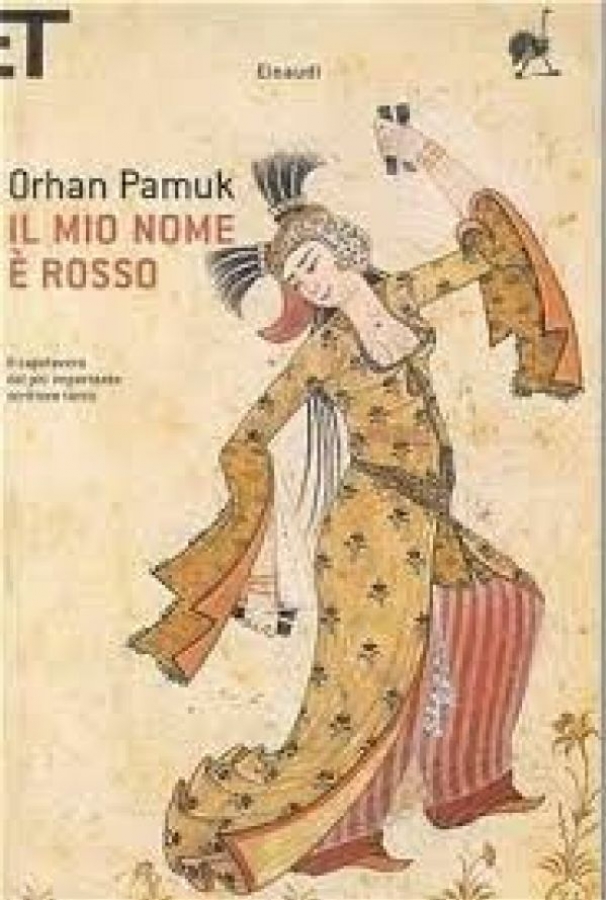
My Name Is Red
The book unfolds across multiple plotlines, difficult to trace back to a single narrative thread. A first path concerns the decline of the miniature painting technique, which had flourished in the sixteenth century under the influence of Persian and Chinese art. Ottoman miniature art justified the depiction of images to accompany books on the grounds that real individuals were never portrayed and no personal style existed; rather, figures and landscapes represented the world through the eye of God, constantly reiterating images and styles codified by the old masters and thus legitimized by the authority of the past. In truth, this approach served both as a justification and an ideal, since the miniaturist and the workshop to which he belonged would inevitably introduce subtle variations or innovatively assemble the iconography established by the great masters of the past. The Sultan decides to commission a book illustrated in the European style, introduced to the Ottomans via Venice. Given the sensitivity of the request—which risked provoking a fierce backlash from the orthodox—the execution of the book is not entrusted to the court workshop, but to an elderly artist, Uncle Effendi, who assigns individual illustrations to the workshop’s miniaturists themselves. The account of how the illustrations are executed is rendered by the author in a unique manner: from the perspectives of the various subjects depicted—the dog, the tree, the coin, the horse, Death, the color red. Through this narrative device, the author charts the history of miniature art, which has reached its twilight: following the Sultan’s death, it will be abandoned, deemed non-compliant with Islamic precepts. The history of this art form also opens up glimpses into the history of Islamic civilization (notably the Mongol invasions and the Ottoman-Persian wars) and into its predominant narrative themes, most notably the love story of *Khosrow and Shirin*. A second narrative arc takes the form of a murder mystery. One of the miniaturists murders a colleague and Uncle Effendi. Multiple motives intertwine: jealousy and envy, career ambition, and the conviction that a blasphemous book was being forged and had to be stopped. Here too, the author employs the device of narrating events from the viewpoints of different characters. The manner in which the investigation unfolds is striking: the Sultan entrusts the master of the miniature workshop with identifying the murderer among his own disciples, under penalty of torture and death for all of them. The master detects a peculiarity in the rendering of a horse—a distinctive trait that identifies the illustrator—and subsequently requests the Sultan’s permission to enter the treasury to study the antique manuscripts, thereby tracing the historical lineage of that stylistic mark and identifying the miniaturist through knowledge of his life and artistic development. In truth, the master has little concern for the investigation itself. Resolute in his desire to punish his disciples for betraying him by agreeing to collaborate on the book, his true interest lies in beholding the Sultan’s magnificent treasury one final time. An artistic heritage on the brink of vanishing, along with a history of struggles and creative breakthroughs, unfolds before the master, who resolves to blind himself in accordance with an ancient ritual of the great masters. A third narrative thread follows the romance between Black, returned to Istanbul after many years, and Shekure: a somber tale, for the woman does not truly love Black, consenting to marry him merely to secure her position and provide a father for her sons. These three narrative strands intertwine, drawn together into unity less by their plotlines than by a pervasive atmosphere of nostalgia and sorrow: a world is fading away. It is the great Ottoman Empire, and the confluence of civilizations and cultures rooted in the Islamic faith. Miniature painting cannot withstand the twofold assault of Western culture—which captures “the real” and asserts the artist's individuality—and religious orthodoxy. The master deliberately chooses to dismantle the workshop, realizing he can no longer rein in the aspirations of his disciples. The city’s streets and houses are desolate, love is reduced to mere expediency, and the children themselves appear as pale imitations of childhood. Black, who risked his life to unmask the killer out of love for Shekure, is destined to lead a somber, solitary existence beside a woman who does not love him. Why is it that we either do not change, or we change too fast, relinquishing what was handed down from the past? As the master says: > now I understand that thousands of miniaturists, drawing the very same designs in delicate secrecy for centuries, had drawn the secret and delicate transformation of the world into another world . It is not the plot events that engender this atmosphere of melancholy and decline, but the author’s style, which succeeds—through the juxtaposition of themes and the deliberate choice of adjectives—in creating a lingering sense of suspension and tender melancholy.
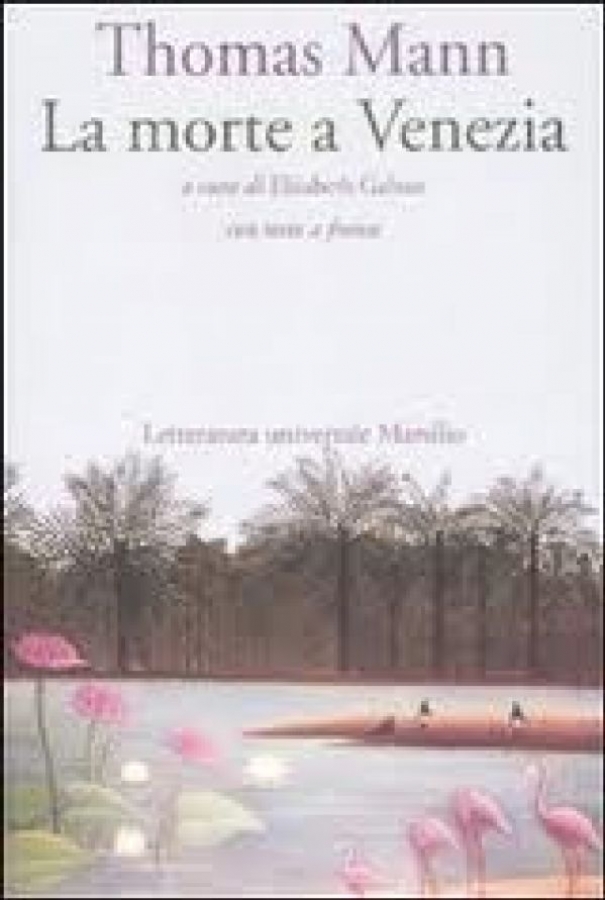
Death in Venice
The protagonist is a renowned man of letters. > He had never known idleness, never the carefree negligence of youth . He had led > a life of self-conquest and of "in spite of all," a harsh, tenacious, and temperate life, which he had shaped into a symbol of a delicate heroism commensurate with the times . Yet deep within him there had always been an inner restlessness, “a strange expansion of the soul,” channeled by an unyielding daily discipline toward ideal perfection in art and the representation of elevated moral values. Now in his sixties, at the pinnacle of his fame, during a walk through the city streets he happens upon a foreigner whose gypsy-like, exotic features leave a deep impression on him, stirring within him > a youthful thirst for distant lands, a longing so intense, so new, or at least so long set aside and unlearned... he questioned his heavy, weary heart to discover whether a new enthusiasm, a new perturbation, a belated adventure of the sensibilities might still be in store for the indolent traveler . It is therefore not merely a desire to travel, but a dream-like vision of > all the wonders and horrors of the multiform terrestrial globe . With this “enigmatic desire,” his destination could only be Venice, > the flattering beauty, the city, half fairy-tale, half foreigner’s trap, in whose miasmas art once bloomed in voluptuous profusion, and which inspired musicians with lulling, caressingly languorous notes . He takes up lodging in an elegant hotel, frequented by the wealthy and variegated bourgeoisie of early twentieth-century Europe. He spends his days contemplating the sea, visiting “on warm nights” St. Mark’s Square and the *calli* of that marvelous city. > The pleasantly constant rhythm of that existence had already held him in its thrall, the soft and luxurious sweetness of that way of life had swiftly seduced him . When, as he lost himself in the “vast expanses of the sea,” > the horizontal line that marked the boundary of the earth was suddenly intersected by a human figure... he saw the beautiful boy pass before him on the sand and from that moment > mind and heart were intoxicated; the demon that delights in trampling human reason and dignity guided his steps . He, an aging man, a man of letters acclaimed for his classicism and for the rigorous rules of his art, becomes infatuated with, and ultimately falls in love with, the splendid youth, and > his soul savored the lust and the frenzy of dissolution . After all, > what value could he still ascribe to art and virtue, faced with the advantages of chaos? Falling in love is accompanied by the draining of energy in an already frail body, by “an ever more violent anguish,” by a “sense of the absence of any way out and of all hope”: he moves toward a voluptuous death. Before the expanse of the sea and the beloved boy gazing at the horizon, “an absolutely isolated and unrelated figure,” the protagonist lets himself die, as if absorbed in a deep slumber, “hovering into an immensity full of promise.” The novella, clearly autobiographical, can be interpreted in three distinct ways. The first interpretive key is the simplest. An elderly gentleman discovers, at the end of his life, his own homosexual orientation, perpetually repressed to conform to narrow-minded bourgeois norms. The author seems intent on lending this revelation the sense of a moral dissolution, yet in truth the protagonist willingly lets himself be carried away by passion, seeing it even as a liberation. > Joy, surprise, admiration could openly depict themselves there when his gaze met... the beloved image . And he was overcome by the desire > to kiss the sweet lips of his shadow, coquettish, curious and faintly anguished, seduced and seducing . It is an explicitly erotic and sexual desire. The second interpretive key, conversely, regards the novella as a spiritual construct, a sort of meditation on the author’s artistic journey. We will never know whether Thomas Mann was homosexual, but it is clear that the dichotomy of “reflection and restlessness,” “order and eros,” constituted the undercurrent that gave life to a literary oeuvre outwardly nestled within the riverbed of the typical bourgeois novel. In this sense, the boy embodies this contradiction between classical beauty and decadent disorder: the failure of that civilizing mission (we are, after all, on the eve of the First World War) which the writer entrusted to Germany. Yet this was also a phase in which the bourgeois novel was opening itself to new ventures, searching for innovative forms capable of narrating the European conscience, now in crisis. > The face, pale and gracefully impenetrable, framed by ringlets of honey-colored hair, with its straight-descending nose, charming mouth, and expression of sweet and divine gravity, recalled Greek sculptures of the golden age , but > care had been taken never to touch with scissors his beautiful hair, which curled over his forehead, above his ears, and even more thickly at the nape of his neck . And finally, the last interpretive strand, undoubtedly the most complex, is the oneiric, composed of dreams and imagery. Here the author abandons himself to fantastical visions, which find their transposition into reality through the description of Venice. And what if Venice were the synthesis of these three interpretive strands? Voluptuous decay, forms both classical and unbound at once, dreamlike wonders—these are the traits that make the city the mirror of the poet’s disheveled soul. Venice is not merely a background context, but the dominant protagonist of the narrative. Why read it? It is magnificent, above all for its writing—alluring, baroque, multiform, yet wholly consistent with the novella’s aims and its overarching narrative design. A true masterpiece!
White Musk
To comprehend this literary "gem," one must return to an earlier novel by the author: *Aniko*, a review of which can be read on this site. Aniko has abandoned her people, the Nenets, to live far away, leaving behind Aleska, her childhood companion, and her father, Petko. The tale begins with the decision of Aleska’s mother to find a wife for her son. > Her husband had died, (...) yet the hearth had not gone out after the master's departure. There remained another task to accomplish (...): to engender a living current that would not scatter or dry up like a puddle in spring, but would continue to flow like a river within its banks. At twenty-six, her son was not yet a true man. (...) He had to be married at all costs. Aleska's heart, however, is weighed down by his love for Aniko. If as a child he felt > like a defenseless fledgling with wings not yet formed , now he is > a spiteful, wounded vulture. He felt like a bird of prey that, spreading the talons of self-regard, leans against the deaf wall of life without anyone being able to understand his sorrow. At night he dreams of Ilne (as Aniko is called in the book), of her seductive smile, and he possesses her. (...) When he realizes that it is merely a dream and not reality, he is consumed by longing. Longing is like a black, hairy spider. The touch of its legs poisons the soul. The novel recounts Aleska's liberation from awaiting Aniko's return, and it does so within a society—that of the Nenets—now in dissolution, yet still anchored to old values, to the stubborn determination to preserve its own culture. At the center of this world lies the hearth, the fire kept perpetually alight—the woman's duty and prestige; hers is the task of bearing and raising children, hers the burden of preserving and passing on Nenets culture. Hence arises the enormity, for the old mother and the entire community, of a man who refuses to marry, obstinately bound to a "distant" love. The two narrative planes, the individual and the collective, overlap, alternating oneiric moments with choral tales. In the dream, > Ilne stared at him and smiled. She was no longer the same Ilne who had invited him to follow her. A sly, knowing smile, which he had never seen on her face and which for some reason unsettled him, never left her lips. (...) He realized that he wanted to wipe that smile from her face; (...) hers was an invitation to a game of love that was nothing but an illusion. If Aniko turns into a painful remembrance before fading from Aleska's heart, with the surrender of her sledges old Petko declares before the community that Aniko will never return; there is no need to keep the dowry, > ten abandoned sledges (...), like orphans, guilty before men and life. (...) The chum was silent, as though immersed in sleep. Yet the young man knew that, motionless, the two women (the mother and the young bride) awaited him, kneeling before the fire. (...) Parting the tent behind his shoulders with a wide gesture, he entered. Thus enters a boy who has become a man. There is a hidden protagonist, and it is Aniko. She appears suddenly, unexpected, with a sort of declaration of love in which Nerkagi seems no longer able to restrain her own "I," in a novel where the narrator is "omniscient." > I love old trees, says Aniko, (...) I love them for all the summers gone by, for the mystery of life they conceal, for the murmur of the leaves that might be mistaken for a song or a lament, a confession or a tale. Ancient trees resemble the old. And it would be wonderful to be certain that they, indeed, are still the keepers of that Golden word of truth, forgotten by mankind heaven knows when. Moreover, in this deceptively simple narrative—much as Dante stands behind the figures of the *Commedia*—there are certain characters behind whom Nerkagi conceals herself. To be sure, one of these is Aleska's mother, the emblem of a stubborn attachment to tradition; yet there is another figure, so delicate as to seem superfluous to the plot. It is the young bride rejected by Aleska, reverent toward the mystery of her husband's soul. Through a splendid simile, Nerkagi thus sings the sorrowful and resigned plight of an unreceived bride: > the girl's world was like that of a tiny flower blossomed by the will of fate at the bottom of a ravine, where the rays of the sun penetrate only in the early morning and the hostile stones exude cold. Covered in a slimy moss, they emit a foul stench and envy the beauty and sweetness of the flower's petals, blind to the light that its corolla radiates into the darkness. I have remained silent for too many years, the author confesses, and now it is time for the moss to turn white. The style is a gentle flow of words, at times elegiac, at others lyrical, rich in similes drawn from the natural world, from trees and animals; a seemingly motionless nature that contrasts with the shifts in the Nenets world and the enigmas of the human soul. Such is the sweetness of the prose that a kind of metamorphosis takes place within the reader, allowing one to measure oneself against the mystery without deciphering it. Why read it? Outside of time and space, it is a hymn to our human condition.