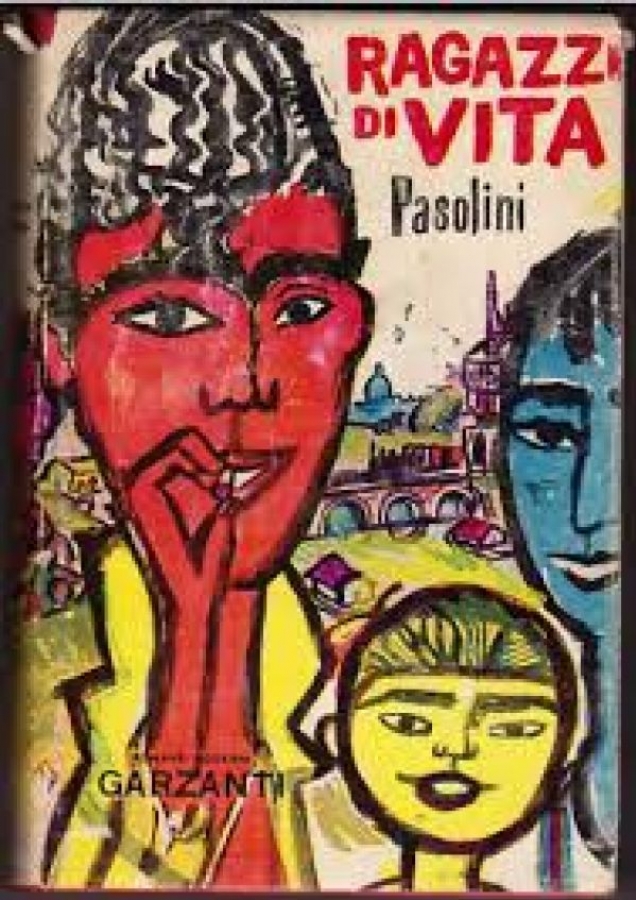
The Ragazzi
> It was hot, not with the heat of the scirocco or a scorching drought, but just hot. It was like a coat of paint brushed over the light breeze, over the yellowish walls of the *borgata*, over the fields, the carts, the buses with clusters of passengers hanging from the doors. A coat of paint that held all the joy and squalor of summer nights past and present. (...) And in the centers of the *borgate*, at the crossroads, like there in Tiburtino, people swarmed, ran, shouted, (...) even in the loneliest spots there was turmoil, with lines of youths out looking for some cheap whore, (...) one great siege encircling Rome, between the city and the surrounding countryside, with hundreds of human lives teeming among the vacant lots, their shacks of evicted paupers, or their tower blocks. And all that life was not just in the suburban *borgate*, but inside Rome as well, in the heart of the city, right beneath the Great Dome . Set in a Rome of the early 1950s—yet in truth timeless—Pasolini chronicles the daily existence of poor, ragged slum youths who, > disordered like a little swarm of flies on a dirty table (...) wanted (...) to take on the world at large, just like that, along with the whole race of men who did not know how to enjoy themselves as they did . It is a “crafty gang” of young males, narrated in their coarse Roman dialect, so far removed from the contrived Italian of the bourgeoisie. > “So what do we do here now?” Alduccio said. “Let’s take a walk, come on!” said the Begalone. (...) They kept on guffawing for a while even when the whores could no longer hear them, doubling over at the knees, leaning against the low wall or cuffing each other: more than laughing, they were making coarse faces with their mouths and spitting. (...) They were both so horny they would have done it even with a seventy-year-old crone. (...) “Man, they’re gorgeous!” yelled the Bègalo. Gorgeous were two girls sitting on the steps of the little temple: two bold, dazzling blondes firing on all cylinders, in husband-hunting skirts that were absolute knockouts, and necklines revealing half their tits. (...) “Which one would you ravish down to the bone,” Begalone asked, “the blonde or the redhead?” “Both of 'em,” said the other. (...) “Either both or neither, 'cause otherwise the other gets sour” . Naturally, they both strike out, as the two girls pay them no mind. The book is a collection of short stories centered on the same group of youths; there is no overarching plot, merely slices of human lives. The finest is “Il bagno sullʼAniene,” linked to the final tale: *La commare secca*. On a putrid river, choked with trash and industrial runoff from a nearby factory, a swarm of youths and young boys strip naked, shedding their filthy and wretched clothes to bask in the sun, play, prank and bully one another, and plunge into the water—to find relief, to wash themselves, and to prove their manhood by swimming through the river’s hazardous currents. They have fled cramped and squalid dwellings to escape violent, drunken fathers, to distance themselves from their mothers' screams and from teenage sisters already pregnant: they seek freedom. Like a pack of stray cats, they turn on the weakest among them, who is set on fire while “the boys kept on kicking and shouting.” Cocky and reckless, they drown while trying to swim across the river; in the face of death, the reaction is sheer indifference. > From below, Borgo Antico and Mariuccio could be heard shouting and crying, Mariuccio still clutching Genesio’s undershirt and shorts to his chest; and already they were starting to scramble up the embankment using their hands. \- Let’s beat it, it’s better - Riccetto said to himself . The stories remain perpetually suspended, devoid of development because there is no future for the urban lumpenproletariat; and perhaps it is better that way, for were they to rise above their wretched condition, these boys would lose their fascination, their raw authenticity, thereby precluding > that immediate, human, so-called vital experience, (...) (wherein) ideological bombardment has not yet touched, except generically, the problems of sex. (...) Therefore, the sociological necessity having subsided, I nonetheless continue to live necessarily in the periphery . So wrote Pasolini in 1958 in an article for the journal *Città Aperta*. In this aestheticizing depiction of the subproletariat, is there not the intellectual relish of “a momentary regression” from high culture to subculture? Furthermore, did not the freedom sought by these “boys of life” along the banks of the Aniene and through Roman nights in Villa Borghese inevitably evolve into the gratuitous, criminal violence of the 1980s? Are these not the forebears of the Banda della Magliana? Behind biographical and sociological justifications, Pasolini conceals a deep-seated pessimism regarding Italy, a conservative vision, and a total incomprehension of modern society. The defining peculiarity of Pasolini’s novel resides in his use of the language spoken by the inhabitants of the Roman periphery. Pasolini follows in the footsteps of Fogazzaro, Verga, and Gadda, attempting to narrate through actual spoken idiom. Yet while this constitutes the work's primary virtue—lending tangible depth to characters and situations alike—the book's limitation lies in its static nature: lacking a narrative arc, it ultimately becomes tedious. Why read it? It remains an original novel from a stylistic standpoint.
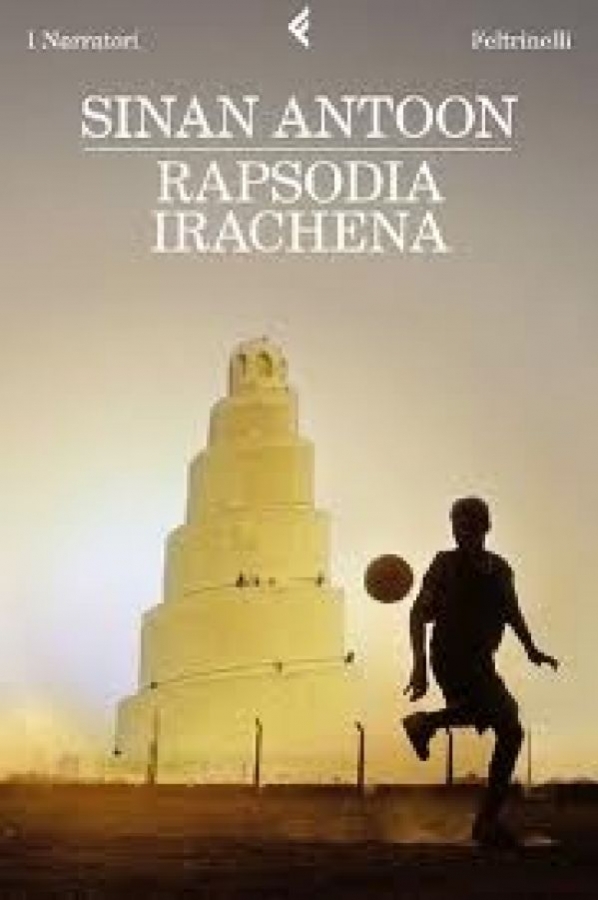
Iraqi Rhapsody
> Words that outlive their author take on a life of their own. They shift, assume new forms, generate new meanings. And they always retain their intrinsic ambiguity . This reflection by Ibn Khaldun, who lived in the fourteenth century and is regarded as one of the greatest Arab philosophers, introduces the essence of this short tale. We are in 1980s Iraq, during the bloody war between Saddam Hussein’s country and Iran. The dictatorship’s repression is particularly harsh, pervading every aspect of society, even the most intimate sphere. The author imagines the discovery of a manuscript belonging to a young inmate named Farat, who has been imprisoned and tortured for no real reason other than failing to conform to the regime’s ideas and rules, believing that “imagination fights reality.” In prison, he is given blank sheets of paper and a pencil. > The whiteness of the paper seduces me, offering me the freedom to wander within my solitude. I will tear through the silence with my ravings. Words will transform into mythological beings that will dig a tunnel and carry me outside. Or they will be prisms that I will hang all around me to look through . The blank page is a gift that seems to say: “take me and do with me what you will!” And the young man begins to recount episodes from his life, finding himself “down (t)here,” both inside and outside prison at the same time. And the reader, too, like the young narrator, is swept into the delicate freshness of everyday life: Farat’s affectionate bond with his grandmother, his only surviving relative; the clever stratagems to evade the regime’s agonizing and ridiculous rituals; the pervasive sarcasm through which anger at a power indifferent to its people’s needs is vented; the search for authentic reading; the yearning for poetry and truth; and, finally, the discovery of love and the female body. In this wandering between memories and words, it matters little if one forgets to add diacritical marks, leaving room for the ambiguity inherent in a language like Arabic, rich in semantic roots and potential variations and combinations of the alphabet’s letters. What matters to Farat are the naive sweetness and gentle irony that characterized his brief life before prison. The “over there” makes the “down here” bearable, yet it is like crouching “before the wall of this vast nightmare.” > Born of the whiteness of the pages, suns pierce the gloom of this night and summon another galaxy. Yet they are captive suns, themselves trapped behind rows of bars . When, in full delirium, the young narrator speaks of his release, we readers believe it too—only to remember that we are in 1989. “This is my last sheet... Yes, I want to keep writing.” To fully appreciate the story, one must detach oneself from the Iraqi reality and Farat’s cruel fate. One must surrender to the scattered, varied episodes of his life, to the novel’s many delightful fragments. Farat falls in love: > that day you were leafing through a magazine. You were alone, motionless as an island of silence amidst the roar of applause and slogans, indifferent to the abject circus surrounding you. In class I always tried to sit next to you, and while the students attempted to conjugate French verbs in various tenses, I tried to conjugate the details of your body in the present. I read them with the voracity of a child learning a new language . Far from the philosophy of language, fleeing bloody and obtuse dictatorships, what endures is the timeless story of youth: open to the world, irreverent, restless, and naive. Why read it? A delightful tale, if one forgets the context.
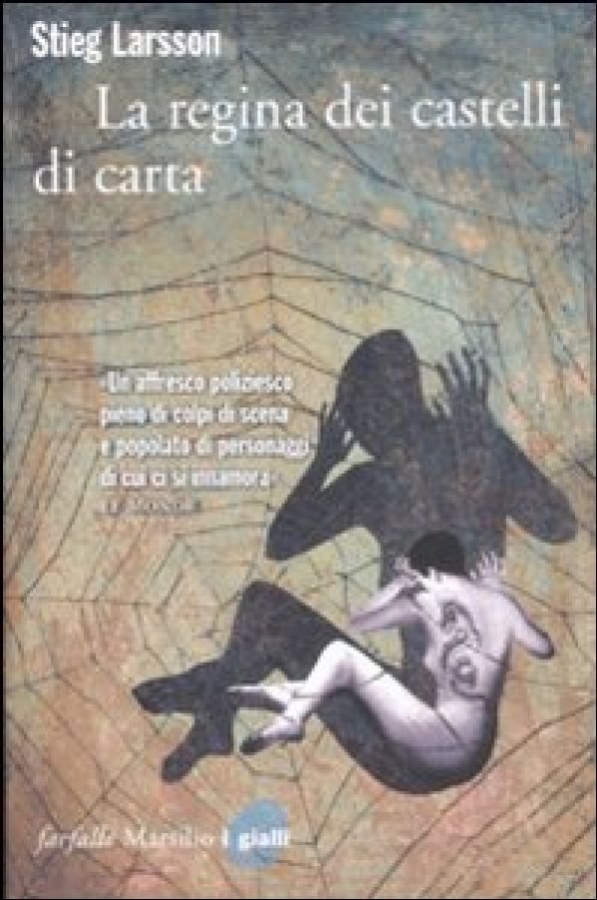
The Queen of Paper Castles
The book picks up from the closing scene of Larsson’s previous volume: *The Girl Who Played with Fire*. Lisbeth Salander, after gravely wounding her father, has been rescued by her friend Mikael Blomkvist. She is, however, in critical condition, undergoing surgery and hospital confinement. Meanwhile, a special unit within the secret service attempts to have Lisbeth recommitted to a psychiatric institution to prevent the exposure of plots orchestrated over many years—targeting prominent politicians as well—which hinged upon the figure of Lisbeth’s father. The latter is murdered by a secret service operative, further killings are carried out, and, above all, evidence is fabricated to frame the young woman once again. Complementing the main narrative is the work of Mikael, a true journalist, who gathers information and corroborating evidence to save the girl and unmask the "rogue" secret services. Action is subsequently set in motion by the "good" secret services, who collaborate with Mikael to expose the rogue unit and excise the "cancer" threatening to destroy Swedish democracy. As is typical of the author, other subplots unfold, one of which centers on Mikael’s business partner—and lover—who takes charge of a major newspaper, endures sexually charged smear campaigns, and is ultimately forced to resign after discovering that the paper’s owner exploits child labor in an East Asian country: this does not, however, prevent her from publishing the investigation—as true journalism demands—and ruining the avaricious chairman. Ultimately, everything concludes happily with Lisbeth’s exoneration and the triumph of hard-hitting journalism and of a country that—unlike others—possesses robust institutional antibodies. The book’s underlying theme appears to be the stark confrontation between good and evil: the villainous doctor is contrasted with the benevolent, competent one; the superficial, easily manipulated prosecutor is counterbalanced by honest police officers and judges; and so forth. The conflict is far too overt and so entirely devoid of ambiguity as to become utterly predictable. It is a thriller, yet even more so than the author’s first two novels, the plot unfolds slowly and at times tediously, weighed down by an overabundance of characters and a redundancy of dialogue at the expense of actual action. Furthermore, the formidable operational prowess attributed to a task force made up of secret service retirees strains credulity, making it glaringly obvious from the outset that the threat will be thwarted with ease. Moreover, the sheer multiplicity of themes addressed (rogue intelligence services, the resilience of democratic institutions, the duties of real journalism—which must investigate and speak the truth—sexual intimidation, and women’s uphill battle to assert themselves) produces a sense of fragmentation that undermines the narrative’s cohesion. One gets lost in the digressions, blunting the overall effectiveness of the storytelling. What remains is envy for an honest, investigative journalism so far removed from the Italian variety: if only our own country had a magazine like *Millennium*!!

Romanzo Criminale
We are in the Rome of the 1970s and '80s, in an Italy stepping into the consumer society and traversed by terrorism and subversive plots. A few youths from the Roman outskirts decide to > assert undeniably a dominion destined to last forever over the Old Whore . From drifters, they become a gang and turn into the masters of Rome: they are the famous Banda della Magliana. What gives the group strength is friendship, a leader (the Lebanese), and > the dream of finally counting for something, all of them intolerant of the old bosses and the foreigners coming to lord it over our home turf. All fired up by the fantasy of taking, once and for all, the eternal old whore, complete with she-wolf and twins. (...) But even that wasn't entirely true. Beyond all agendas, well beyond reason, the cement of it all was action . It is hardly surprising, then, that their political ideology is fascist, that the group gravitates toward black squadrismo. In their race toward criminal dominion over the city, the gang contends and, in spite of itself, allies with a series of surrounding organizations and figures: the Mafia and the Camorra, who concede control of Rome to the gang, but dictate its boundaries and use it for their own criminal ends; the fixers, who allow dirty money to be laundered into clean—or near-clean—enterprises; the institutions (the police, the judiciary, the lawyers, the prison system), which in one way or another abet the gang's criminal operations, sometimes unwittingly out of a legalistic conception of justice, and far more often because they are collusive, corrupt, and acquiescent. Yet presiding over it all is the Old Man, who > commanded an intelligence unit (of the Secret Services) with a neutral name (and played) at throwing the world into disarray . He is the master puppeteer and the gang one of the puppets: > you take a deviant or presumed deviant, you make him deviate, you grab him while he’s deviating. (...) And now he had the Lebanese and his boys. To do what with them? To play with them, of course . The only one to realize the trap is Freddo, the gang's "pure" soul, who yells at the Lebanese: "So now we work under a boss! And what a boss! The State! The filthy State! > Amid the general apathy and cowardice, the only one standing up to the gang is a police commissioner: Nicola Scialoja. To him it is clear, right from the start, that this is a criminal organization, and not merely a gang of petty hoodlums, that drugs were the key to everything. (...) Whoever controls the drug market controls the city. The Lebanese's boys controlled the city > ; and slowly he realizes that behind the gang there is a puppet master, pulling the strings from an obscure office of the Secret Services. Scialoja is the positive hero: he stubbornly fights the gang; he is defeated, betrayed, vilified, yet he never lets go. He witnesses the unraveling of the Banda della Magliana. The Lebanese is killed, and from that moment the ties holding the group together snap: the boys went their separate ways. (...) The loyalty to the group was becoming loyalty to the groups > . Scialoja knows the gang is becoming more vulnerable; he attempts to strike at it by every means, but as long as the Old Man shields it, all his efforts shatter against the wall of omertà, corruption, and collusion. Scialoja defeats the Banda della Magliana only after the Old Man, by now dying, designates him as his heir, co-opting him as head of his obscure yet all-powerful office. He had the Old Man's diary! He was the custodian of the Republic's secret history. (...) He could do virtually anything. He had power. (...) But as he slipped into the elevator, (...) he felt a sharp, painful pang deep in his heart. At the moment of triumph, from what obscure recesses of the past could this incomparable sense of defeat possibly be welling up? > The story can be read from different angles: a fictionalized chronicle of real events, a desolate fresco of Italian society and of Rome in particular, a painful, resigned indictment of Italy's dark malady: the perverse connection between politics, the underworld, rotten businessmen, rogue Secret Services.... when this cancer is rooted out... if it ever is rooted out... > . There is a simpler reading: the story of a group of boys, of their desire for rebellion and freedom, and of how their dreams, and their friendship, founder in the Roman quagmire of money, drugs, and compromises. When Roberta, after making love, asked him for the umpteenth time why he did all this, (Freddo) managed to find the honest answer: 'cause this way I feel free > . In the prologue, a survivor of the gang, after gunning down a petty criminal in cold blood, indifferent to the weeping, the sound of footsteps, the approaching sirens, turned his back on him, and aiming his weapon at the bastard moon screamed with all the breath in his lungs: I was with the Lebanese!" The setting is the book’s fundamental asset. Its flaws lie in the characters and the plot. The former are stereotypes, treated superficially—perhaps because the author does not favor the trajectory of certain figures over others: they all crowd onto the very same plane, appearing and disappearing in ways that cause the reader to lose track of their trials and sentiments. The plot unfolds slowly, devoid of surprises, in repetitive fashion: years go by, the gang evolves, yet the events feel perpetually identical, as though criminal deeds were inherently monotonous, forever repeating themselves; without a great writer to grant them depth and rhythm, boredom inexorably sets in. Why read it? It represents a chapter of our history, but in the end, the novel is prolix and tedious.

Vermilion Red
> I feel as though I have lost myself in an underground cave full of perilous crevices and labyrinthine hollows unknown to me, so many chasms into which I might slip. Questo mi succede adesso, quando guardo avanti e mi accorgo che non cʼè più strada, e allora mi volto indietro e vedo che di strada non ce nʼè neanche lì . The protagonist, the first-person narrator, is now an elderly woman living on an estate in Tuscany where she has succeeded in producing a wine of great quality, *Rossovermiglio*. Her mind now frequently wanders back to distant times, and the novel unfolds, indeed, through a continuous alternation between present and past. Born into an aristocratic Turinese family, she marries very young to a man of her own social station. It is an arranged marriage that will bring the young woman nothing but misery. Betrayed, wounded in her deepest sensibilities, repulsed by the coldness of her husband and of a formal, vacuous social class, the protagonist decides to take refuge in Tuscany on an estate inherited from her brother. And here she leads an isolated life, with her beloved horses and a growing passion for the land. When a man with whom she had once been infatuated reappears. An affair begins, and the young woman finds herself pregnant. Yet the man disappears, and the woman, to preserve propriety, decides to pass off her own child as that of the estate bailiffs. Why did the man disappear? Up to this point, the protagonist appears as a “sleeping beauty”: young, wealthy, restless, slightly eccentric, over whom the great shifts of history—such as fascism, the world war, the partisan struggle, the dawn of the republic—merely glide. Yet at the very end of her life, the protagonist discovers that the man she loved disappeared because he received a handsome sum from her husband, who, even from afar, meddled once more in her life. She was condemned to live as others dictated. From her social class she received nothing but sorrow and deceit, while she is surrounded by the affection and loyalty of the local people. Only the land (the vines, the olive trees, the woods) is something steadfast and true. > At times I dismount from my horse and sit on a stone, and I remain there looking at this land, unchanged through time, with these colors and these scents, slow and silent as I have known it . Yet on the other hand, “we do not live tragedies, we only have sorrows.” At the beginning of the novel, the reader is left somewhat disconcerted by the vacuity of the events, settings, and characters. Why should we care about nobles who squander their fortunes on elegant, refined receptions? First comes the prose, exquisitely refined and meticulous, and then the growing discovery that the superficiality and detachment from the present of aristocratic life are the interpretive key to the novel. We often live a life “made of nothing,” and thus find ourselves swept along by chance and by others. Why read it? It is written in beautiful Italian.