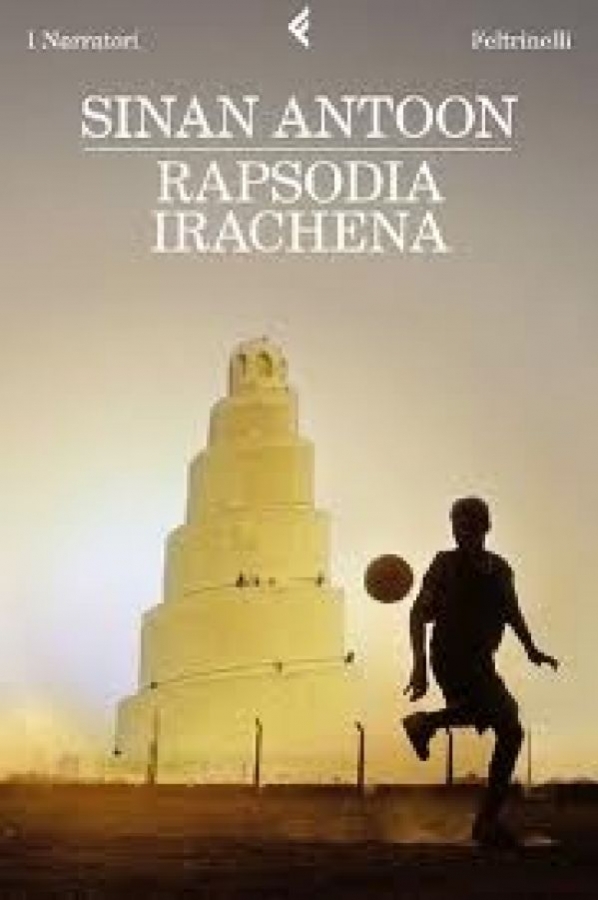
Finished reading on: November 21, 2013
Iraqi Rhapsody
Title of the original version reviewed: «Rapsodia irachena»
AI Translation Notice: This review was translated from the original Italian using artificial intelligence. Book quotes and excerpts are translated interpretations and will not match the author's original English phrasing or official published translations.
Words that outlive their author take on a life of their own.
They shift, assume new forms, generate new meanings.
And they always retain their intrinsic ambiguity
.
This reflection by Ibn Khaldun, who lived in the fourteenth century and is regarded as one of the greatest Arab philosophers, introduces the essence of this short tale.
We are in 1980s Iraq, during the bloody war between Saddam Hussein’s country and Iran.
The dictatorship’s repression is particularly harsh, pervading every aspect of society, even the most intimate sphere.
The author imagines the discovery of a manuscript belonging to a young inmate named Farat, who has been imprisoned and tortured for no real reason other than failing to conform to the regime’s ideas and rules, believing that “imagination fights reality.”
In prison, he is given blank sheets of paper and a pencil.
The whiteness of the paper seduces me, offering me the freedom to wander within my solitude.
I will tear through the silence with my ravings.
Words will transform into mythological beings that will dig a tunnel and carry me outside.
Or they will be prisms that I will hang all around me to look through
.
The blank page is a gift that seems to say: “take me and do with me what you will!” And the young man begins to recount episodes from his life, finding himself “down (t)here,” both inside and outside prison at the same time.
And the reader, too, like the young narrator, is swept into the delicate freshness of everyday life: Farat’s affectionate bond with his grandmother, his only surviving relative; the clever stratagems to evade the regime’s agonizing and ridiculous rituals; the pervasive sarcasm through which anger at a power indifferent to its people’s needs is vented; the search for authentic reading; the yearning for poetry and truth; and, finally, the discovery of love and the female body.
In this wandering between memories and words, it matters little if one forgets to add diacritical marks, leaving room for the ambiguity inherent in a language like Arabic, rich in semantic roots and potential variations and combinations of the alphabet’s letters.
What matters to Farat are the naive sweetness and gentle irony that characterized his brief life before prison.
The “over there” makes the “down here” bearable, yet it is like crouching “before the wall of this vast nightmare.”
Born of the whiteness of the pages, suns pierce the gloom of this night and summon another galaxy.
Yet they are captive suns, themselves trapped behind rows of bars
.
When, in full delirium, the young narrator speaks of his release, we readers believe it too—only to remember that we are in 1989.
“This is my last sheet...
Yes, I want to keep writing.”
To fully appreciate the story, one must detach oneself from the Iraqi reality and Farat’s cruel fate.
One must surrender to the scattered, varied episodes of his life, to the novel’s many delightful fragments.
Farat falls in love:
that day you were leafing through a magazine.
You were alone, motionless as an island of silence amidst the roar of applause and slogans, indifferent to the abject circus surrounding you.
In class I always tried to sit next to you, and while the students attempted to conjugate French verbs in various tenses, I tried to conjugate the details of your body in the present.
I read them with the voracity of a child learning a new language
.
Far from the philosophy of language, fleeing bloody and obtuse dictatorships, what endures is the timeless story of youth: open to the world, irreverent, restless, and naive.
Why read it? A delightful tale, if one forgets the context.