Finished reading on: January 10, 2015
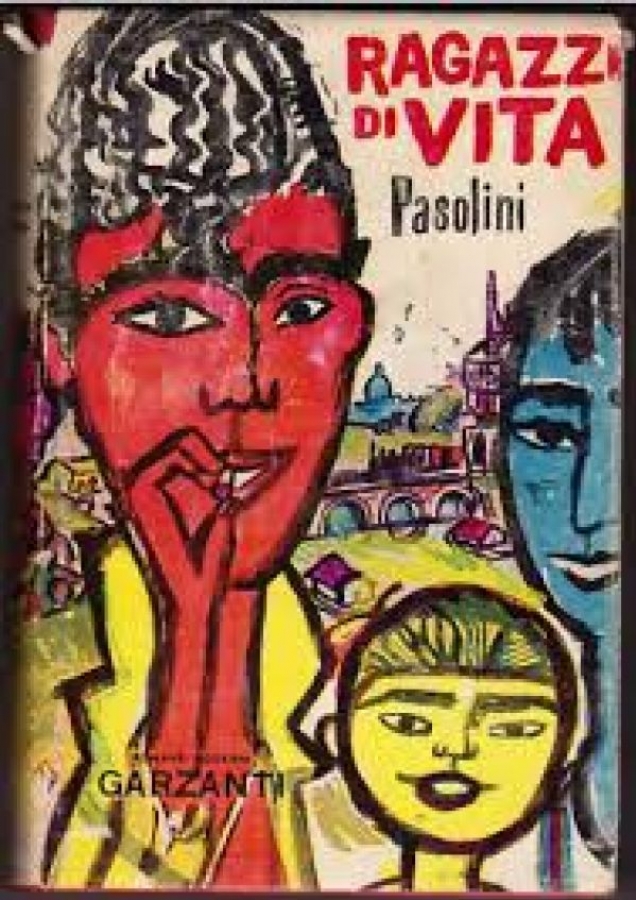
The Ragazzi
Title of the original version reviewed: «Ragazzi di vita»
AI Translation Notice: This review was translated from the original Italian using artificial intelligence. Book quotes and excerpts are translated interpretations and will not match the author's original English phrasing or official published translations.
It was hot, not with the heat of the scirocco or a scorching drought, but just hot.
It was like a coat of paint brushed over the light breeze, over the yellowish walls of the borgata, over the fields, the carts, the buses with clusters of passengers hanging from the doors.
A coat of paint that held all the joy and squalor of summer nights past and present.
(...) And in the centers of the borgate, at the crossroads, like there in Tiburtino, people swarmed, ran, shouted, (...) even in the loneliest spots there was turmoil, with lines of youths out looking for some cheap whore, (...) one great siege encircling Rome, between the city and the surrounding countryside, with hundreds of human lives teeming among the vacant lots, their shacks of evicted paupers, or their tower blocks.
And all that life was not just in the suburban borgate, but inside Rome as well, in the heart of the city, right beneath the Great Dome
.
Set in a Rome of the early 1950s—yet in truth timeless—Pasolini chronicles the daily existence of poor, ragged slum youths who,
disordered like a little swarm of flies on a dirty table (...) wanted (...) to take on the world at large, just like that, along with the whole race of men who did not know how to enjoy themselves as they did
.
It is a “crafty gang” of young males, narrated in their coarse Roman dialect, so far removed from the contrived Italian of the bourgeoisie.
“So what do we do here now?” Alduccio said.
“Let’s take a walk, come on!” said the Begalone.
(...) They kept on guffawing for a while even when the whores could no longer hear them, doubling over at the knees, leaning against the low wall or cuffing each other: more than laughing, they were making coarse faces with their mouths and spitting.
(...) They were both so horny they would have done it even with a seventy-year-old crone.
(...) “Man, they’re gorgeous!” yelled the Bègalo.
Gorgeous were two girls sitting on the steps of the little temple: two bold, dazzling blondes firing on all cylinders, in husband-hunting skirts that were absolute knockouts, and necklines revealing half their tits.
(...) “Which one would you ravish down to the bone,” Begalone asked, “the blonde or the redhead?” “Both of 'em,” said the other.
(...) “Either both or neither, 'cause otherwise the other gets sour”
.
Naturally, they both strike out, as the two girls pay them no mind.
The book is a collection of short stories centered on the same group of youths; there is no overarching plot, merely slices of human lives.
The finest is “Il bagno sullʼAniene,” linked to the final tale: La commare secca.
On a putrid river, choked with trash and industrial runoff from a nearby factory, a swarm of youths and young boys strip naked, shedding their filthy and wretched clothes to bask in the sun, play, prank and bully one another, and plunge into the water—to find relief, to wash themselves, and to prove their manhood by swimming through the river’s hazardous currents.
They have fled cramped and squalid dwellings to escape violent, drunken fathers, to distance themselves from their mothers' screams and from teenage sisters already pregnant: they seek freedom.
Like a pack of stray cats, they turn on the weakest among them, who is set on fire while “the boys kept on kicking and shouting.”
Cocky and reckless, they drown while trying to swim across the river; in the face of death, the reaction is sheer indifference.
From below, Borgo Antico and Mariuccio could be heard shouting and crying, Mariuccio still clutching Genesio’s undershirt and shorts to his chest; and already they were starting to scramble up the embankment using their hands.
- Let’s beat it, it’s better - Riccetto said to himself
.
The stories remain perpetually suspended, devoid of development because there is no future for the urban lumpenproletariat; and perhaps it is better that way, for were they to rise above their wretched condition, these boys would lose their fascination, their raw authenticity, thereby precluding
that immediate, human, so-called vital experience, (...) (wherein) ideological bombardment has not yet touched, except generically, the problems of sex.
(...) Therefore, the sociological necessity having subsided, I nonetheless continue to live necessarily in the periphery
.
So wrote Pasolini in 1958 in an article for the journal Città Aperta.
In this aestheticizing depiction of the subproletariat, is there not the intellectual relish of “a momentary regression” from high culture to subculture? Furthermore, did not the freedom sought by these “boys of life” along the banks of the Aniene and through Roman nights in Villa Borghese inevitably evolve into the gratuitous, criminal violence of the 1980s? Are these not the forebears of the Banda della Magliana? Behind biographical and sociological justifications, Pasolini conceals a deep-seated pessimism regarding Italy, a conservative vision, and a total incomprehension of modern society.
The defining peculiarity of Pasolini’s novel resides in his use of the language spoken by the inhabitants of the Roman periphery.
Pasolini follows in the footsteps of Fogazzaro, Verga, and Gadda, attempting to narrate through actual spoken idiom.
Yet while this constitutes the work's primary virtue—lending tangible depth to characters and situations alike—the book's limitation lies in its static nature: lacking a narrative arc, it ultimately becomes tedious.
Why read it? It remains an original novel from a stylistic standpoint.