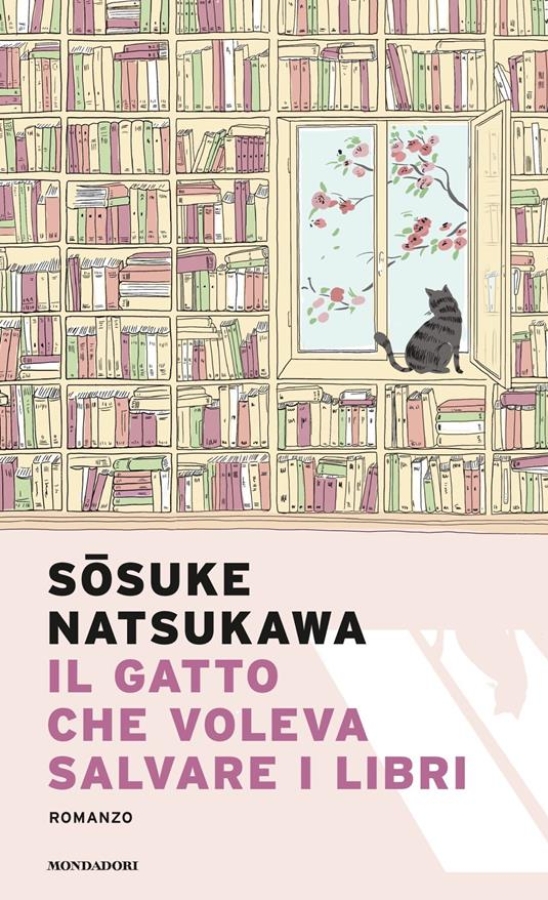
The Cat Who Saved Books
What is the fascination of books? Why do so many of us spend so much time reading novels and poetry? The author attempts to answer these questions through a coming-of-age story, a cross between *Harry Potter* and *Treasure Island* (see the reviews on this site). Natsuki Rintaro is the typical *hikikomori*, a term synonymous with an antisocial, apathetic, and misanthropic adolescent. To be sure, he possesses a passion for reading, born of living in his grandfather’s crowded, dusty bookshop. It is a small secondhand bookshop with a peculiar layout. > When entering the bookshop through the brightly lit front door, the room seemed in perspective far deeper than it actually was, and for a moment it felt as though that book-lined corridor stretched out endlessly into the darkness . There is a power in books, the grandfather used to tell his grandson as he quietly opened a volume. Upon his grandfather’s death, the boy is supposed to go live with an aunt—a fate he accepts passively, almost indifferently. Suddenly, out of nowhere, a cat appears; with gentle yet firm manners, it invites him on a quest: to save books. Together with the cat, the boy ventures down the corridor beyond the back wall of the bookshop; the two find themselves in palaces, veritable labyrinths, from which the boy will only be able to escape if he frees the books. Each labyrinth corresponds to a specific way of understanding our relationship with this “collection of sheets of paper covered in printed characters”: the obsessive urge to hoard, the pursuit of digests that allow one to consume the greatest number of writings in the shortest possible time, and the conception of the book as a consumer good—a business in which everything that does not sell must be destroyed. It is a taxonomy all too familiar to us book lovers, yet one forgets that > reading a book is rather like climbing a mountain. (...) Every now and then you have to examine line by line, re-read the same sentence backwards several times, and proceed slowly, striving to understand. As a result of such arduous effort, suddenly your mind opens up . These are the grandfather’s words resurfacing in the boy’s mind, dense and vigorous words. Through the climbing metaphor, the grandfather means that one can only endure the grueling ascent if one loves the mountain. And it is this very argument that disarms his interlocutors and saves the books: how can one hold them prisoner, chop them up, and treat them as mere commodities, if one truly loves them? The journey of personal growth is not yet complete. To paraphrase Karl Marx in *The Poverty of Philosophy*, we are still in the realm of ideas, bound in an erudite and narcissistic attachment to reading. Only the final trial will bring the adolescent’s maturation to fruition: as Confucius held, the humanities, literature, and poetry allow us to understand “the sense of reciprocal humanity”—that is, the empathy that binds all human beings together. The author attempts to give narrative momentum to the story while simultaneously conjuring a magical atmosphere. To this end, he resorts to the literary device of the cat, a frequent trope in Japanese literature—one need only think of Natsume Soseki’s *I Am a Cat* (see the review on this site). Yet while in Soseki’s work the cat is an ironic, wise figure, an alter ego to the dull and narrow-minded schoolmaster, here the small feline is a plodding censor of the protagonist, akin to the Owl in *Pinocchio*. The long corridor that opens mysteriously into the labyrinths calls to mind the far more original railway platform from which the magical adventure of *Harry Potter* begins; moreover, the description of the palaces is so meticulous as to become predictable and verbose. Having started off well, the novel lapses into a pedantic meditation on the book, containing reflections that would be agreeable and worthwhile were this a work of non-fiction. What elevates the novel’s quality is the prose: plain, pleasant, and fluid, even if occasionally repetitive; the brushstrokes portraying the bookshop and sketching the boy and his friends are spot-on. What a pity the author did not develop the characters more thoroughly! Why read it? It speaks of our love for books.

God help the child (Children first)
For many of us, childhood was a source of suffering. > And each will rewrite this story forever, knowing the sorrow, imagining the plot, inventing its meaning, and forgetting its origin . Then one day we discover that > you accepted like a beast of burden the weight of an incomprehensible curse and the unjustified threat that binds you to wounds and leaves you with a fate; and you spend your life denying, even though that hateful word is only a fragile line drawn on a rock, quickly dissolved at any moment by the force of the sea . But what is this force? The author seems to suggest it may be love, attested by the birth of a child. Two young people meet by chance, each bearing a secret. Bride was born with skin of a “terrible color”: black. She repulsed her mother to such an extent that she never touched her, even though it was hardly the child’s fault, but rather the twenty percent Negro blood in her family. Still a young girl, in an effort to gain acceptance Bride commits a terrible act: through her testimony, she sends a woman to prison by accusing her of sexual molestation, knowing full well she is innocent. Booker is a brilliant young man and a talented musician; his life was shattered by the death of his brother, raped and tortured by a sexual predator. He wishes to live in memory and has run away from home, confronted by his family’s refusal to persist in perpetual commiseration. They spend six intense months together, marked by overwhelming passion and a profound communion of purpose and feelings; yet both keep their painful secrets hidden from one another. And then, one day, Booker walks out, simply saying: “you’re not the woman.” Did he do it, perhaps, because she is Black, despite being glamorous and wealthy? Can neither beauty nor success overcome racism? Is it still the ancient sin of being born with that skin color? Bride wants to know; she sets out in search of Booker, eventually finding him at an elderly aunt’s home. While searching for him, a strange phenomenon befalls her: she reverts to being a child, as though life were starting over from the beginning: > a child. New life, immune to evil or disease, protected from kidnapping, violence, rape, racism, insult, hurt, self-loathing, abandonment, Error-free, All goodness. Angerless. Or so they believe . Through this inexplicable transformation, Bride frees herself from guilt and is ready to confess the terrible truth, as well as to embrace Booker’s suffering: she realizes he left her because he loves her, > so as not to overwhelm her with a grief so deep it would have broken her heart : > Now she is pregnant. Good luck. (...) Listen to me, You are about to find out what it takes, what the world is like, how it works and how it shifts when you are a parent. Good luck and God help the child . It is difficult to grasp the narrative line of this novel; too many themes overlap: violence against children, racism, liberation from suffering, and perhaps others besides. The plot is muddled, and the constant shifting of narrator (the mother, Bride, the friend, the third-person narrative) certainly does not help; on the contrary, it disorients the reader by forcing them to piece the overarching thread back together, without adding anything to the understanding of the story or the characters. What redeems the novel is the prose: even if weary when compared to the author’s other works, it still manages to enthrall with its elegant, muted syntactic construction, with words so evocative as to create expectations of meaning that nevertheless slip away and remain suspended. In short, one is left somewhat disappointed. Why read it? It is intense.

The Golden Notebook
It is the mid-1950s in England. Anna is a writer living off the royalties of her successful novel, set in Africa during the Second World War. Divorced after a brief, loveless marriage, she is the mother of a young daughter and a friend to Molly, who is likewise divorced from an immensely wealthy man and the mother of a twenty-year-old son. "Free women," independent, shouldering the burden of raising their children, yet destined for loneliness and relationships with men incapable of meeting women's needs: > women's emotions are still geared to a kind of society that no longer exists. My deep emotions, the truest ones, are about my relationships with men. One man. But I don't live that kind of life, and I know few women who do. I ought to be like a man, care more for work than for people; I ought to put my work before everything, and take men as they come, or find an ordinary but well-off man for financial support, but I won't do it, I can't be like that . Anna can no longer write and turns to a psychoanalyst, who advises her to keep a diary. *The Golden Notebook* consists of four notebooks: the black one, concerning Anna the writer; the red, for politics (Anna is a member of the British Communist Party); the yellow, for stories outside of real experience; and the blue, which attempts to be a genuine diary. A spiral unfolds in which reality blurs with imagination, a sort of descent into the depths of consciousness. It all unfolds unexpectedly, because > the things that are important in life advance furtively, by surprise; one doesn't expect them, they take no shape in the mind. They are recognized when they appear, that is how it is . The book becomes a sort of box which, when opened, > instead of beautiful things, there is a mass of fragments and pieces. Not a whole thing, broken into fragments, but little pieces from everywhere, from all over the world.... seeing the mass of horrible fragments was so painful that I could not look, and I closed the box . But what is so terrible within consciousness? The dissolution of human bonds, the pain that inexorably marks relationships between individuals, the chaos of a world hurtling toward destruction, and hence loneliness within chaos, from which the only possible remedy seems to be the aridification of emotion—erecting a defense against the destruction of human relationships, against their reduction purely to the forces "of property, money, and power." Anna’s is an existential and cosmic suffering that cannot but lead to madness. Yet at the end of the journey, Anna realizes that salvation is anchored in the deepest bonds: those of affection and care. At the climax of a deeply fraught passage, a simple sentence offers the alternative to death: "I can hear Janet (Anna’s daughter) coming up the stairs." It is a highly complex novel, philosophically as well, open to many readings: the exhaustion of hope for the future, of the grand ideologies; the culmination of a political and literary trajectory asserting female independence—one that began with Jane Austen's heroines and ends in Anna's profound solitude, where, in a passage unquestionably shocking for the era in which the book was written, she declares that she prefers masturbation to sex with men incapable of love; the theme of psychoanalysis and thus the discovery of one's unconscious; literature as imagination, but also as a search for self, as memory and nostalgia. What makes the book timely is its reflection on the repercussions of a world in destruction upon individual consciousness, the author’s ability to grasp how the absence of a broader hope has a devastating impact on human relationships themselves: one cannot be saved by retreating into the domestic sphere, nor, however, can one rely on outworn ideologies. The narrative is sustained by an elegant prose style, pleasurable to read. The multi-layered structure of the tale would have required a tremendous ability to maintain a compact narrative architecture, which instead fragmented and dissolved. That very intellectual richness, while often offering compelling food for thought, does not favor the frugality and concision of the narrative. Why not read it? A few pages hold up well, but the overall reading proves ponderous and prolix.
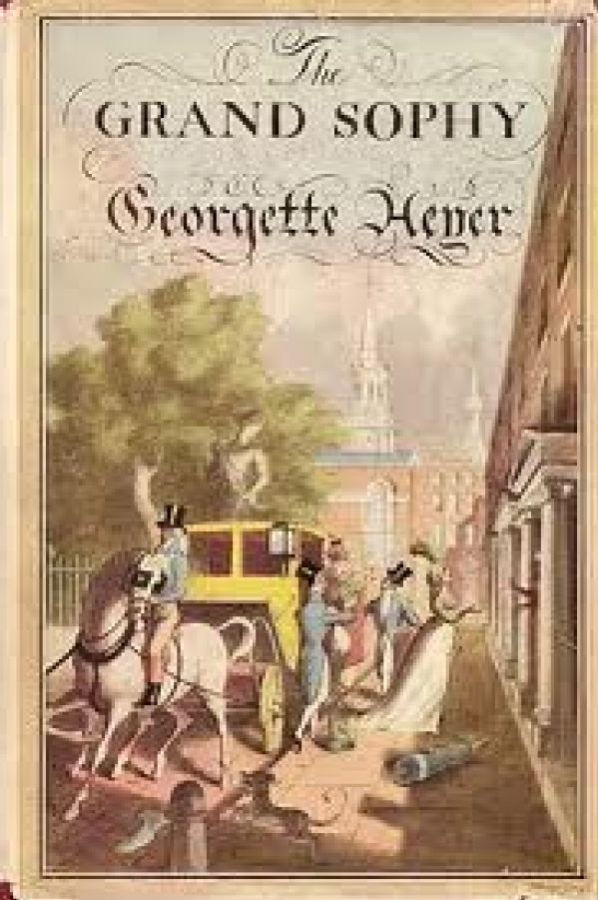
The Grand Sophy
Georgette Heyer was one of the most popular twentieth-century English writers. *The Grand Sophy*, recently translated into Italian, chronicles the intrusion of an independent, daring, and willful young woman into a traditional family of the English upper nobility at the beginning of the nineteenth century. The novel opens with Sir Horace’s unexpected request to his sister, the mild-mannered Lady Ombersley, to host his seventeen-year-old daughter, Sophy, for several months. The reader is immediately introduced to the cast of characters and to the circumstances from which the narrative unfolds: the two eldest children, the authoritarian and short-tempered Charles and the “so typically English” Cecilia, a female figure straight out of Jane Austen; the family’s financial ruin following Lord Ombersley’s gambling debts; and the providential inheritance bequeathed to Charles, which has cast him in the role of head of the family, fostering an atmosphere of subservience and reverent dread among his brothers and numerous sisters. Then there are the impending marriages. Charles has engaged himself to Miss Wraxton, unquestionably of high breeding and moral standing, yet detested by the Ombersleys for her patent intention to impose order on a household management she considers far too lax and permissive. Cecilia has accepted Lord Charlbury’s suit, yet has become infatuated with a handsome, penniless young poet. Lady Ombersley’s anxieties are thus manifold; she initially attempts to resist her brother’s insistent pleas, but ultimately agrees to take Sophy in, expecting a timid adolescent eager to be welcomed into the warmth of a home, having been orphaned of her mother as a young child and raised by a father, Sir Horace, who was perpetually on the road. She is consequently left stunned and somewhat alarmed when, accompanied by a mountain of luggage, a greyhound, a small monkey, and a splendid black horse, there appears an imposing girl—not pretty, but > built on generous lines, tall, with a fine bosom, an intensely lively countenance, and a wealth of rich brown hair under one of the most dashing hats her cousins (the numerous young Ombersleys) had ever seen . Her appearance reveals the girl’s character: impatient of rules, stubborn, capricious, and generous all at once, but above all > Sophy could not see anyone in trouble without instantly wishing to discover the cause, and, if possible, to set it right . This attitude cannot fail to bring her into conflict with Charles, by now accustomed to commanding. The girl causes a scandal (driving unchaperoned through London in a racing carriage!), flouts his directives, and openly challenges his betrothed, a sanctimonious busybody. Above all, however, Sophy schemes to make people happy, brushing aside the dictates and conventions of polite society. Yet, as so often happens, strong personalities relish encountering minds capable of defying them, and gradually Charles falls in love with Sophy. Could it be that the girl had been maneuvering from the very outset to conquer her sullen and difficult cousin? The plot is the novel’s greatest strength: unexpected twists, brisk dialogue, and Sophy’s subtle machinations coming to fruition in the teeth of adversity, malicious gossip, and the opposition of Miss Wraxton—virtually the only character who makes a pitiful attempt to thwart her. One senses that quintessential self-critical complacency of English culture, which views itself as rigid and conventional in contrast to Continental culture, imagined conversely as nonconformist and free. It is a trope reflected in the overly schematic portrait of Sophy—monotonously self-consistent, far too assured and mature for her years—and in the profiling of the other characters, so formal and predictable. Cecilia and Charles are the exceptions. The former asserts her complete independence—unprompted, in this instance, by her exuberant cousin—the moment she declares that she does not love Charlbury, but intends to marry the dreamy, handsome poet. Yet it will ultimately be Sophy who plays precisely upon the girl’s ingrained English values—her regard for propriety and respectability—to lead her back to desiring her original betrothed. Charles, on the other hand, represents the synthesis. While it is true that he is mindful of society’s rules and conventions, there resides within him that Elizabethan vigor that underpinned the British Empire. He is, after all, the hero, and one is left to wonder whether it will be he who changes Sophy, molding her into the noblewoman her rank naturally calls her to be. The scene in which Charles and Sophy declare their love is so thoroughly dominated by him that it raises the apprehension that Sophy’s future may simply be to yield to the conformism that surrounds her. Why read it? The plot is full of twists—somewhat predictable, perhaps, but thoroughly entertaining.
The Great Crossing
We find ourselves inside a major publishing house, in the department tasked with compiling dictionaries. Despite being a profitable business, the staff is remarkably small, not least because preparing a new dictionary is an exceptional endeavor—a difficult, complex undertaking that does not happen every year; between an old dictionary and a new one lies a process of continuous revision, which nevertheless does not overhaul the entire structure of the work. We learn how a dictionary must be exhaustive, up-to-date yet concise, especially since it is compressed into pages where each headword (as the individual entries are called) must occupy a space calibrated so as not to disrupt the balance with the other entries. For example, how does one describe a great poet from around the year 1000 (samurai, monk, and poet), whom tradition named Saigyō—a term laden with meanings, from “immortal” to “wandering pilgrim,” and even “freshwater snail”? Should some of the poet's verses be quoted? Is it right to state that every Japanese person “cannot help but be moved” by Saigyō's poetry? A dictionary ought to be precise and objective, eschewing value judgments. Another challenge is the paper: it must be extraordinarily thin, yet prevent ink from bleeding through to the reverse side. It is hardly surprising that such peculiar work requires individuals so engrossed in the secrets of words as to think of nothing else. Compulsively, > they studied and analyzed them with extreme detachment, almost as if vivisecting them. There was something vindictive about their obsession, as though they were hunting down a hated enemy, gathering information to catch it red-handed and make it pay . Our story begins when the department head retires and seeks someone to replace him. In the office, there is a seasoned colleague, but he suffers from a fatal flaw: he lacks the meticulous obsession required for lexicographical work. Over in sales works a young man, a fellow with “madman's hair who never sheds those hideous black sleeve protectors.” His very name intrigues the department head: Majime is an unusual word, apparently meaning “horse supplier.” When, over lunch, the young man describes his favorite pastime (watching people ride the escalator), the department head knows he has found his man. Just as people queue two by two in a harmony that is “fabulous, elusive,” an enthusiastic Majime exclaims, so too an astonishing tide of words arriving from all quarters can be classified, arranged into columns, and set in immaculate order across the pages of a dictionary: it is within this order that the lexicographer's pleasure resides. Majime gradually settles into his new responsibilities, falls in love, and marries a brilliant young chef. They seem an improbable match, yet they are bound by the same meticulousness and quest for order: Majime in his obsessive exploration of words, and she in the impeccable preparation of traditional Japanese dishes. The publisher decides to embark on a major new dictionary, titled *The Great Passage*. Time is of the essence; they must outpace the competition, which is also working on a new lexicon. The staff needs reinforcing, and an employee from the Marketing Department arrives. Incredulous and intimidated by Majime's “ardent, almost devilish expression,” Kishibe feels she lacks both the competence and the passion; she stands before “a steep, jagged wall impossible to scale.” Yet she gradually comes to realize that this new dictionary—to be published as quickly as possible, concise and precise as any good lexicon must be—is for her a true passage. > She had carried on with her life and career without ever pausing to reflect. (...) Becoming aware of the power of words—the power not to harm others, but to respect them, to communicate, and to forge healthy interpersonal relationships—had taught her to know herself better and to understand the thoughts and feelings of others . All of us, avid readers that we are, believe that words have the power to change people, or at least to offer a deeper understanding of oneself and others. To develop such a compelling and poignant thesis, however, the characters needed greater psychological depth. Instead, Majime is a monolith, fated from the outset to harbor a morbid obsession with minutiae; Kishibe is more complex as a personality, yet she attains self-knowledge through sheer grit and determined labor, without our ever understanding where she comes from or where she truly wishes to go. At times, the author seems eager to inject a suspenseful, quasi-thriller tone into the narrative: will our heroes manage to complete the dictionary against a thousand obstacles and setbacks, despite the skepticism of corporate executives? Yet the plot is sluggish and devoid of surprises, lapsing at times into melodrama and superfluous detail. Why read it? It is pleasantly written and opens a window onto the world of dictionaries.
William and the Gold Coin
It is a book for children aged 9–10. Guglielmo is a young boy who finds a gold coin and discovers that people, even good ones, turn false and wicked out of greed. The only bonds left to him are those with his dog and a vagrant, a former soldier. In the end, Guglielmo realizes that, if > a man is free, has friends, has honest work, cares for people, well, perhaps he has something more than one gold coin, or a hundred. Therefore he is rich . The book is pleasant, but it strikes me as somewhat dated, overly simple, and lacking that touch of suspense needed to keep the reading from being entirely predictable.