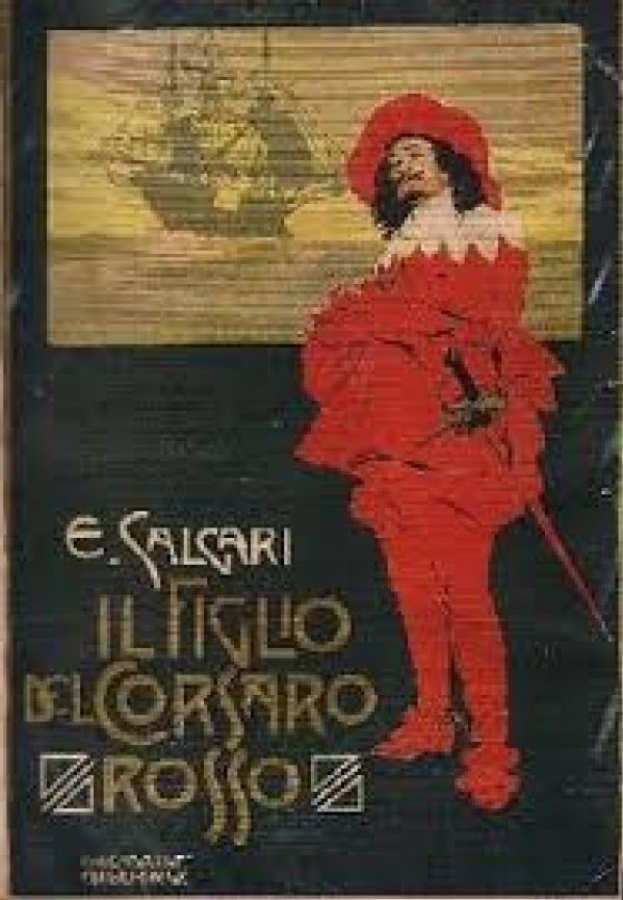
The Son of the Red Corsair
The Son of the Red Corsair > was a handsome young man, (...) of exceedingly elegant form that bespoke the great lord, with jet-black, fiery eyes, a black moustache, and very pale skin . One would expect a new Black Corsair. Yet such is not the case: first, because the son of the Red Corsair frequently distances himself from the pirates, even paying them out of his own pocket to prevent them from sacking conquered cities—confirming a notion widespread among the buccaneers, namely that the counts of Ventimiglia (the Black, Red, and Green Corsairs) were always “amateur corsairs”; second, because the son of the Red Corsair does not seek revenge, but merely wishes to find his sister, even though she is held by the Marquis of Montelimar, the very man who killed the Red Corsair and now keeps his daughter captive. The relentless hatred of the Black Corsair is missing. And this is why the exploits of the son of the Red Corsair lack the tension of the great novels of the Caribbean cycle: *The Black Corsair*, *The Queen of the Caribbean*, *Jolanda, the Daughter of the Black Corsair*. The classic ingredients of Salgari’s narrative structure are all present: the duels, the equatorial rainforest, the naval battles, the sieges of Spanish fortresses. What is missing is the sense of these adventures, the anticipation of something dark and brooding—the true source of the author’s astonishing narrative rhythm. The book’s peculiarity lies elsewhere. In Salgari, we invariably find sidekicks flanking the protagonist, often helping to humanize him and introduce elements of levity. Here, the system is inverted: the son of the Red Corsair remains in the background, while ostensibly supporting figures take center stage. The first part of the novel takes place on the island of Santo Domingo. Our heroes are pursued by the Spanish and by “exceedingly ferocious” hounds. The setting is at once terrifying and wondrous: thickets of vegetation, marshes, and deadly quicksands alternate with islets, boasting > splendid clumps of rhododendrons, over ten meters high, (...) clusters of purple flowers, (...) magnificent palms crowned by parasols of immensely long palmate leaves, cascading elegantly with spathes of an iridescent violet edged in purple, and clusters of fruit that resembled green apples . In this unreal nature, described with a few grammatical lapses (*parasole* being an invariable noun), the son of the Red Corsair comes across a buccaneer who appears quite savage. He lives by hunting and inhabits a > wretched dwelling made of crudely woven branches and a few poles . Aided by wine and conversation with a European gentleman, the buccaneer reveals, “with dilated eyes, his face bathed in sweat,” his terrible secret: > I must drown distant memories! Ah, the sad fate that has struck me down! (...) Well, such is this terrible life, if one falls prey to an evil genius . Thus we learn that the buccaneer was a nobleman of France, who dishonored his ancestors’ coat of arms and fled to America. Can the Count of Ventimiglia restore him to his former rank? It is no longer possible, > everything is past, everything has been forgotten. I killed two wild pigs, down there on the edge of the marshes... that is my trade. The buccaneer leads the son of the Red Corsair to safety, who then discovers that his sister has been taken to Panama. We move on to the wealthy Spanish cities of Central America’s western coast. The chases, clashes, and sieges are repetitive, almost formulaic. An exception is the duel between the son of the Red Corsair and a hitman, a skilled swordsman hired to kill the Count of Ventimiglia. Deluded fool! The bandit “crouched down completely, almost curling into a ball.” It was his secret move: the hundred-pistole strike. The count’s sword caught him in the throat, sinking in several centimeters. > He stood almost upright for a moment, arms outstretched, then tumbled heavily into the sands, murmuring: I am finished . In this section of the novel as well, the real protagonist is a supporting character: a Gascon—a drunkard, a chatterbox, always ready to throw punches, yet capable of resolving the direst predicaments through his cunning and brazen audacity. The band of buccaneers is on the verge of being captured by the Spanish in the city of Panama. Whereupon the Gascon, instead of fleeing, steps forward and tells the guards he was there to serenade his > splendid Catalan girl, you know, with two eyes that sparkle like stars and... a sweet little mouth, my dear sirs, enough to turn the head even of the Lord President of the Royal Audiencia . On another occasion, he poses as a Castilian nobleman, the Count of Alcalá, laden with titles and names, and even manages to obtain horses, provisions, and muskets—naturally, to make his escape. It is one of the rare instances where Salgari departs from adventurous, imaginative, or shadowy storytelling to invent an amusing, witty character, a sort of Harlequin. The story naturally has a happy ending, yet a feeble and hurried one. Despite not knowing him, the sister, still a young girl, embraces her brother and flees with him. Yet she had never seen him before! She feels the pull of the blood tie: a somewhat shallow explanation. Even more so is another fact: once the son of the Red Corsair is captured, it is the Marquis of Montelimar himself who leads him to his sister. A true gentleman! What remains of the gloomy saga of *The Black Corsair*? Very little, merely the trappings! By the end of this lengthy novel, Salgari seems more preoccupied with convincing the reader that what he recounts is true, not invented, than with lending rhythm to the tale. The entire narrative frays; the author himself realizes he has dragged it out too far and for too long. Why skip it? It is dull, and that is surprising for Salgari.
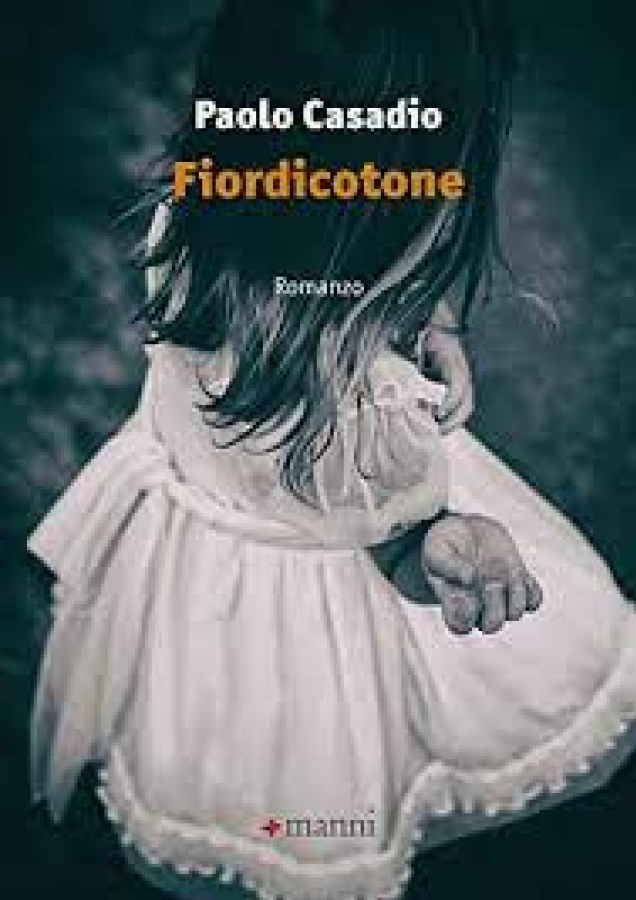
Cotton Flower
On December 15, 1943, the Jewish De Fano family was arrested and sent into internment: Omero, «the gentle bookbinder», the elementary school teacher Alma, her mother, and little Velia, the couple's daughter, an albino child nicknamed Fiordicotone. In the chaos of the roundup, the girl was hidden beneath a man's black cape, thereby surviving. Omero and the elderly mother were immediately put to death, while Alma was set aside for the SS officers for their sexual diversion. «Do whatever they ask of you, if only to save your life», her mother had told her, «naked among other stripped women». Yet if placing her body at the service of her tormentors had preserved her life, the experience had profoundly wounded her spirit. Looking into the mirror after the liberation, Alma > could not recognize herself. She had unbuttoned tunic and shirt and looked at herself. A perfect, desirable body. She saw herself colorless, her eyes worn out, her face faded and lifeless. In that body she once loved so much, she caught the sadness, the anguish of a solitude continuously abused . It was from this dual suffering, as an internee and as a prostitute, from the heaps of the dead and the humiliation endured ( > the sour taste in her mouth, on her skin the wretched, lingering scent of violence ) that there grew in Alma the perception that no afterwards existed, > for that hell was so bottomless and devoid of dignity as to leave no room for hope. Nothing was left. Only Fiordicotone. As is to be expected, the book recounts the search for the daughter: the initial shelter in Switzerland, the journey through a ruined Italy as far as Lugo, the discovery that the girl was no longer in the town, the struggles to learn where she was, and finally the encounter with Velia. An old blind woman's omen hung constantly over Alma: «You will find her, and when you have found her, you will return to the shadows». Like Alma, the reader too fails to understand the words, obscure as the oracles of the Sibyl. What does it mean to return to the shadows? We discover throughout the narrative that Alma cast no shadow; she was like a ghost, corporeal yet insubstantial, soulless. Alma «was the prisoner of a tattooed number», had no hope, and did not believe there was a future for her daughter. In tones perhaps overly melodramatic, yet keeping us suspended in anxious anticipation, the author carries us through to the conclusion. In an earlier novel (*Il bambino del treno*, reviewed on this site), Paolo Casadio took as his starting point a true event, set in a precise location: a small, now-abandoned station on the Faenza–Florence railway line. Both the setting and the historical episode provided a concrete anchor for the narrative; along with the elegant style, they contributed to the novel's success. In *Fiordicotone*, Casadio disperses his focus across too many themes, from the existential drama of the internees to the search for the daughter. The unifying thread is not so much the story or the protagonist, but an aura of death, of ghosts hovering from the past, running the risk of slipping into «fantasy» (one need only consider the image of the shadow, frankly overstated) or, more nobly, into the evanescent, abstract register of much of Mario Luzi's poetry. In attempting to say too much, the author neglects the setting of Lugo di Romagna, the characters, and in particular the reconstruction of the ambiguities, the craven compromises, and the petty, well-intentioned subterfuges of so many people who nevertheless acquiesced to the horrific aims of the Nazi regime: consider, for instance, the figure of the *maresciallo*. The frequent resort to full stops, with the resulting verbless sentences, fragments the narrative and undermines the elegance of the prose: a detrimental legacy of the prevailing journalistic style. Why read it? It reads very well and is interesting from a historical perspective.

Maybe Esther
The narrator-protagonist sets off from Berlin on a long journey through the countries to the east of Germany, across that vast geopolitical space where everything seems to have taken place unbeknownst to us Western Europeans. First, she visits the grand German Historical Museum in Berlin with her daughter (a visit I recommend to everyone), and in the area dedicated to the Shoah, her daughter asks her: > where are we here on this panel, Mama? (...) I would have liked to add that we did not appear in that image at all . Yet that is not true, and it is perhaps for this reason that she seeks to trace back her family tree: Jewish, partly Polish and partly Russian, victim of dramatic upheavals: the collapse of great empires, the Russian Civil War, the rebirth and partition of Poland, Nazism and Stalinism with their massacres, slaughters, ghettos, concentration camps, millions of dead; and worse still, the loss of one's own language and one's own history. And indeed the author skips, “in an odd and clumsy way, like the needle on a record that has reached its end.” Names and pet names follow one another along the family tree, and it is futile to identify and remember them; the confusion is perhaps intentional. Certain passages of the narrative leave a lasting impression, such as the genocide at Babi Yar, not least through the words of the great poet Yevgeny Yevtushenko (“Every old man shot here/me. Every child shot here/me”). In general, people, events, places, and words are like “lost scripts,” inscriptions found by chance that one tries to decipher, without even understanding which alphabet they belong to. > I realized that I had arrived too late, that knowledge had been lost, and I lacked the strength to recover it; I had lingered, with my birth and in general; it was not a fault, it was just too late . But does it make sense, then, to search for one's roots? Or does that “naturally” used by the author at the opening of the story serve to > underline the senselessness of her journey, (...) as if that disappearance and that nothingness were natural or even obvious phenomena . In Warsaw, the author believed she had found the house where her family had lived, only to discover it was another one, now destroyed. > During the night I couldn't sleep, I dreamed of the sauna, the ghetto, naked bodies twisted in death or pleasure, I dreamed of difference, men and women, (...) I don't know whether I was ever among my own people and who my people are, these ruins around us and inside us, and the transition from one language to another that I undertake in order to be on both sides, to be at once me or not-me, (...) in German language is feminine, in Russian it is masculine, what have I done with this exchange? It is a difficult book due to its disorderly plot, as if it were an assemblage of anecdotes, places, and characters crowding the mind without finding an order, a rational arrangement. It is as if memory loomed over and overwhelmed the protagonist; the images are too powerful, the pain too intense. > Knife blades emerge from the wall and move a short distance from the body. They hang somewhere, (...) and you describe them from a theoretical perspective, (...) but you cannot convey that terror, nor the horror of their presence, because to convey it means acknowledging it and granting it access. So terrible are these things. Granted, the family history is exceptional, but one wonders whether it truly makes sense to lift the lid on the past—what does it lead to, if not tears and delirium? The novel closes with an emblematic episode. > When I found myself in front of the house that was supposed to be mine, (...) an elderly lady (...) said to me—or was it perhaps a reprimand?—I've run into you a bit too often around here lately! And in astonishment I replied that I hadn't been there in years. That doesn't count for anything, she said . It is a splendid metaphor for the dark fascination of remembrance. Why read it? It is difficult, yet elegant and refined. It offers a narrative reflection of a history and culture unknown to us

Freedom
Among the possible meanings of the word *Freedom*, one defines it as > being able or having the opportunity to do what one wants without being restricted by something or someone (Collins Dictionary). The characters in this novel have always lived poised between the “set of possibilities” and events (what used to be called destiny), which push inexorably toward a specific direction in life. There are no externally imposed constraints; rather, it is the very nature of things that leads down one path rather than another. And life is made up of the complexity of interpersonal structures, of conformism, and of the pursuit of realizing ideas that are often theoretical and generic. The story unfolds between the Reagan and Obama presidencies, set within an increasingly frightened American middle class, riddled with divisions, moral and political dilemmas, and a burgeoning awareness of the nation’s decline. As in all good bourgeois stories, it begins with a triangle: Walter, an earnest young man brimming with environmentalist ideals, loves Patty, a star basketball player who feels rejected, on account of this passion, by her politically prominent, establishment family. Patty, in turn, is drawn to Richard, a musician and Walter’s close friend. Patty and Richard take a car trip together to join Walter, and for Patty it becomes a missed opportunity: Richard, a consummate womanizer, refuses to sleep with his best friend’s fiancée. The bond between Patty and Richard feeds on regret. > in all these years, (Patty) had treasured the memory of their little trip, had kept it locked in a deep interior space, letting it age like wine, so that, symbolically, what might have happened between them remained alive and grew older with the two of them . Within Richard there grew “envy of his friend for his unwitting possession of his wife.” Walter and Patty’s marriage drags on wearily (“they could not live together, but could not imagine living apart”), until a vacation by Patty and Richard in Walter’s beloved old lake house, set in a stunning natural landscape, precipitates events: the two sleep together. Walter cannot accept being betrayed by his best friend: the couple separates, doing so just as Walter finally realizes he cannot pursue abstract environmental ideals with the money of American capitalism. And it is precisely from the breakdown of false interpersonal relationships and the undoing of vague ideals that Patty and Richard find each other again and can rebuild the family. In truth, the book is not confined to these three characters; it also involves the younger (Walter and Patty’s children) and older generations, chronicling the histories of their families of origin. There are also numerous forays into the political and social issues that have characterized America in recent decades; the author is particularly invested in environmental themes, which are also framed as an emblem of the hypocrisy and vacuity of much of the bourgeoisie. The message seems invariably the same: it is impossible to change the world; we must learn to live with ourselves and our problems. Emblematic in this regard is the final chapter. Walter has retreated into nature, finding his life’s mission in the defense of migratory birds, particularly against a domestic cat prone to murderous rampages. This stance puts him in conflict with the small middle-class community bordering the nature reserve. The tensions are resolved when Patty returns; she nurtures social ties with the neighbors (the conformism of the American bourgeoisie) and eventually brings Walter back to New York, back to the family. At that point, the organization managing the reserve erects a dividing wall between the natural habitat where the migratory birds nest and the small community. Is the world, then, composed of countless walls, within which each person seeks their own freedom? And does true freedom perhaps lie in that other possible meaning of the word *Freedom*: “the condition of being able to move around,” even within separate worlds? The book’s greatest strength undoubtedly lies in its style—marked by tight, highly effective dialogue—and in the depth of its psychological and existential exploration of the characters and their mutual relationships. The narrative pacing is slow, and the story unfolds sluggishly. Overall, it is dominated by that intellectualized, erudite, yet often evanescent approach typical of many contemporary American writers. Why read it? It is interesting, but recommended only to a very patient reader.

Friendly fire
Eyal, Yirmy’s son, was killed during his military service by his own comrades, who mistook him for a wanted Palestinian. Amotz, Yirmy’s brother-in-law, in breaking the news of his son’s death, inadvertently uses a cruel term: Eyal was killed by friendly fire. This is the premise of the narrative, which gets underway from the moment Daniela, Yirmy’s sister-in-law, departs for Africa, where her brother-in-law has sought refuge and where her sister died. From this point onward, the novel unfolds along two parallel trajectories: Daniela’s journey to Africa and the life of Amotz, alone, in Israel. Daniela wants to know where her sister died, and in some way she is undertaking a journey of liberation from grief and death. Yet she also wants to understand why her brother-in-law, now in his seventies, chooses to live in Africa. The landscape, the animals, and the people form the backdrop of an ongoing dialogue between Daniela and Yirmy, in which familial themes (the sister, Yirmy’s quest to uncover the true circumstances of his son’s death) overlap with broader issues linked to the condition of Israel and the peculiarities of a religion—Judaism—so unyielding and severe. If it is possible to come to terms with the death of one’s loved ones, it is far more difficult to serenely overcome the existential anguish of an entire people. And so, the only recourse is flight to a distant continent: I came, Yirmy says, > to take a break from my people, from Jews in general and from Israelis in particular “everything that oppresses me slips away without philosophies and arguments.” Meanwhile Amotz, head of an engineering design firm, must find a solution to strange noises emanating from the elevator shaft of an apartment building: is it a technical issue, or is there something mysterious, unfathomable, arising from a country blithely living on the edge of a precipice? *Friendly Fire* addresses many themes, perhaps too many: death, family, religion, the destiny of a people, flight from it all. The underlying thread is the notion that the true threat comes not from without (for instance, from the Palestinians), but from within—from a people, the Jews, who have always wandered without ever wishing to integrate with others. The book does not intend to be an indictment of Israel, even if the passages concerning the Bible are undeniably critical; rather, it constitutes an expression of profound existential suffering. The Israeli people today are like that elephant paraded around as an attraction because of its gigantic eye. > Daniela feels her heart ache at the sight of its suffering, as though it were a relative. And in that iris flecked with blue, yellow, and green looking at her with sadness, a drop gathers that gradually turns into a tear, followed by another, and the weeping of that mute, and perhaps even grateful, animal shakes Daniela to the core, as if in that moment the desire that brought her to Africa during the festival of Hanukkah were finally fulfilled . *Friendly Fire* expresses the suffering of a people and its inability to break free from its condition. The flaw of the book, however, is that the theme unfolds sluggishly, almost smothered by words that seem to serve only to conceal and dissipate it. The phrasing is pleasant, but the sluggishness, the lack of narrative drive, and the monotonous reliance on the device of parallel plots are all factors that render the book verbose and tedious. Why not read it? It is a rambling, ponderous tale despite the author’s seasoned skill. The reader gets lost in an infinity of words.