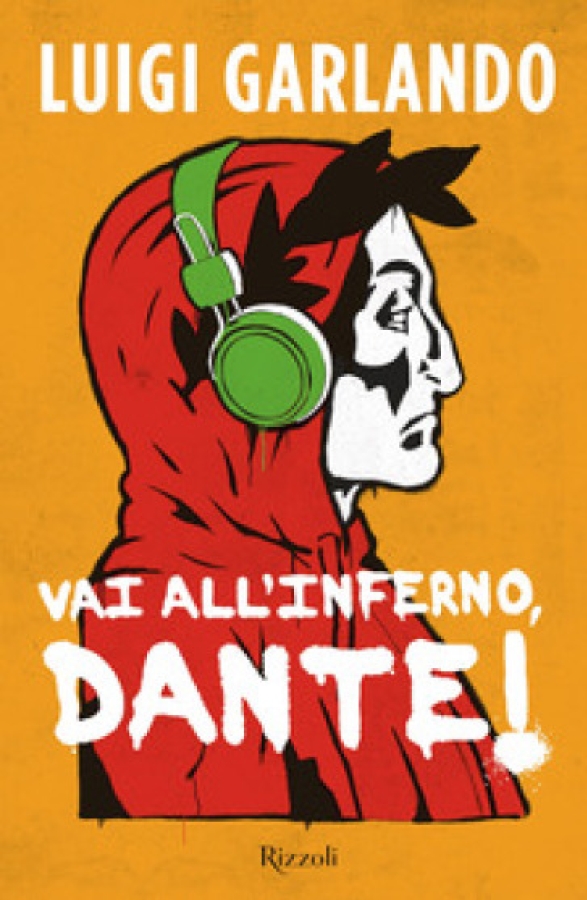
Go to hell, Dante!
Vasco Guidobaldi, scion of an ancient and wealthy Florentine family, is a spoiled, arrogant, and selfish adolescent, accustomed to always having his way—at home, at school, and with his friends. Having recently lost his mother, his father has retreated into deep isolation; beneath the veneer of a carefree boy lies acute suffering, a blend of remorse and resignation. He vents his rage through Fortnite, a video game, a virtual battlefield where he often emerges victorious. > To clearly separate my real life from Fortnite there is no river, there is no mountain, but only an imaginary frontier that I often cross without realizing it....) I like the game, because the adrenaline rushing into my gut drives away the lion gnawing at my heart, just as hatred does when I play Fortnite. At least for that hour. When, out of nowhere, a new player bursts into Fortnite and wipes the floor with Vasco; calling himself Dante, he issues a warning: > you were not made to kill the B.R.U.T.E./but ever to succumb to Dante's might./Soon you shall know why I have come . Perhaps too early for the narrative's suspense, we discover that this new competitor is none other than Dante Alighieri himself, descended to Earth at the behest of Vasco's mother, who worries for her son. > In that fair heaven of blessed souls/a gentle shade approached me/with the elegance of fairies./(...) be his guide as Virgil was to me, /teach him love and wisdom,/as though he were your son and not mine. (...) This thing drives me wild with joy, but also just drives me mad. It’s as if I saw her through unbreakable glass; our hands can draw close, but never truly touch . And while it is predictable that maternal love works the miracle of redemption, there is genuine interest in the inversion of Dante’s character: from an unwitting traveler journeying toward beatitude through the grace of Virgil and Beatrice, he here becomes the Guide himself along an adolescent's path. His relationship with Vasco, to whom he is both mentor and friend, humanizes the great poet, so often depicted as haughty, aloof, and prematurely aged. It would have been a fine lesson for so many tedious Dantists and pedantic schoolmasters, yet this brilliant intuition is left undeveloped by the author: much like Manzoni’s Unnamed (see the review of *I Promessi Sposi* on this site), Vasco undergoes an effortless conversion, turning into a well-behaved boy—studious, gentle, ready to offer solidarity and love. Three hundred useless pages follow. We are presented with a coming-of-age novel in which quintessentially youth settings—video games, soccer, and rap music—are effectively blended with the *Divine Comedy*, retold in this manner for a teenage audience. The author is clearly an attentive reader of Dante Alighieri, perceptive of the profoundly contemporary resonances of his poem, as when he puts these words into the poet's mouth: > Learn that love is not coin. /A thousand kisses will not make you rich/if with your feelings you remain a miser.(...) I, instead, loved as the sun teaches/who never laid a hand upon the moon/(...) At every dusk, he yields the sky to her . One feels the full presence of *Paradiso*, where love for Beatrice, and for the supreme Good, allows Dante to «trasumanar» [transhumanize] and renders him «one who sees in dreaming» (Canto I, line 70 and Canto XXXIII, line 58 of *Paradiso*). Once again, as in *Harry Potter* (see the review of *Harry Potter and the Philosopher's Stone* on this site), the transition from adolescence to adulthood requires the intervention of an external force endowed with magical powers, precluding any autonomous development of consciousness—unlike what occurs in *Treasure Island* (see the review of *Treasure Island* on this site). Considering that this book is addressed to young readers, one must regretfully note how, once more, the message remains paternalistic and overprotective, ultimately failing to foster any genuine individual growth. Why not read it? It is boring.
Truth and Lie
Questo libro uscì postumo, ad un anno dalla morte dell'autore. Nel sito sono presenti le recensioni di *Lettere di una novizia* del 1941 (senza dubbio il migliore dei romanzi di Piovene) e di *Le stelle fredde* del 1971. Se in quest'ultimo racconto il confine tra la vita e la morte è dato da un vecchio ciliegio, la natura (il Carso, i colori, le antiche case) nella loro infinitezza e immobilità non offrono alcuna barriera. Come scrive Mario Luzi in *Diana, risveglio*, > nascono lieti immagini,/ filtra nel sangue, cieco nel ritorno, /lo spirito del sole, aure ci traggono/con sé: a esistere, a estinguerci in un giorno . Sergio lavora alla soprintendenza di Milano e scrive di politica, anche se ormai da tempo non ci crede più. Una telefonata del padre da Gorizia lo invita con urgenza ad una riunione familiare per decidere della sorte di Nico, un fratello con gravi problemi psichici. In realtà l'obiettivo è un altro: comunicare al figlio che intende suicidarsi. Tanti sono stati i presagi di questa cupa e drammatica decisione. Quando rivede il padre dopo molti anni Sergio si trova dinanzi ad una faccia, nella quale > c'era qualcosa di spaurito, la recessione verso il bambino magro che riappare per mescolarsi con il vecchio pesante, senile, uno sconcerto di crisalide in attesa di metamorfosi che non possono più avvenire . Così il padre ha cambiato casa, è andato a vivere in una grande dimora in campagna, con un salotto ammobiliato da un arredatore, una biblioteca dove i libri sono predisposti a caso (lui vecchio professore universitario), stanze disabitate, un ampio giardino trascurato, un automobile di lusso (lui così frugale). > Ecco quello che capita ai vecchi quando vogliono cambiar vita anziché sbrigarsi a lasciarla. (...) Non possediamo nulla fuorché il nostro passato. Cosa siamo, se non c'è più, o si rivolta contro rendendosi repellente, orribile? A questo punto il suicidio è avvenuto . Solo con la morte > il passato non fa più male. Non c'è più. Non esiste più niente di passato alle nostre spalle, nulla ci manda nulla, siamo appesi in un vuoto . Se il ragionamento del padre è razionale, il ritorno alla città della sua infanzia, ad un genitore distante ma ammirato, ad una natura, quella del Carso, ricca di «esistenze innumerevoli» (luce, colori, alberi protesi verso il cielo con le loro sagome contorte, voci diverse «non ancora confuse, d'amore, invocazione, lamento, sfida, desiderio di fuga», tutte queste immagini spingono Sergio al delirio. E' come «una di quelle zattere della memoria che affondano in un eccesso d'anima»; o come dice Luzi in *Anno* > tempo passato e prossimo si libra.../ Io, come sia, son qui venuto, avanzo/da tempi inconoscibili, ardo, attendo;/ senza fine divengo quel che sono,/trovo riposo in questa luce vuota . Sergio non ha la determinazione e la forza intellettuale del padre, si lascia trascinare nella depressione, con allucinazioni, deliranti affollamenti di incubi, che lo sovrastano e lo conducono, sempre e inesorabilmente, al cane della moglie, amico-nemico, vivo-morto micidiale, apparentemente senza un corpo: come un fantasma, > tornava, solo dal fondo buio, grande come una tigre, col pelo molto lungo agitato da un vento, gli occhi più strabici che mai e la corona d'oro in testa. Vicino alla morte, estenuato dalla «delusione, rinuncia, tristezza della verità, gusto di vivere esaurito»,Piovene cerca di imbastire una storia, qualcosa che, forse, avrebbe voluto essere un ritorno ai luoghi dell'infanzia e un tentativo di recuperare il rapporto con il padre e con la famiglia d'origine; decisamente non ci riesce perché i sogni, le divagazioni, i vaneggiamenti hanno la meglio sulla narrazione. Non c'è né una verità né una menzogna: la vita non brancola tra questi due capisaldi alternativi, si scivola invece nel vuoto verso la morte. Resta la scrittura a sorreggere il racconto, ma non è sufficiente. Perché non leggerlo? E' un delirio.
The Truth About the Harry Quebert Affair
Marcus is a successful young writer, but he has lost his inspiration. In a state of panic, he decides to turn to his mentor: Harry Quebert, a renowned author who, in the 1970s, sold over fifteen million copies of his second book, *The Origin of Evil*. Harry’s advice is reassuring, albeit unsettling in light of the novel’s conclusion: > blank pages are nonsense, exactly like sexual debacles caused by performance anxiety and he advises Marcus to come stay with him, in the quiet town of Aurora. The young man accepts, only to find himself at the center of a police investigation that directly implicates Harry. The remains of a fifteen-year-old girl, who vanished in 1975, are unearthed, and numerous clues point to Harry as the killer: the body was found buried in the garden of his home alongside the manuscript of the famous novel; Harry had carried on a love affair with the girl and likely murdered her to prevent a scandal from erupting. Marcus refuses to accept the police’s conclusions and sets to work to refute the accusations and unmask the real killer. Slowly—far too slowly—the events that led to the teenager’s tragic end unravel. The reconstruction of the truth unfolds across two narrative tiers, nested within one another. The first tier chronicles Marcus’s investigation and thus the gradual discovery of what actually transpired all those years ago. The accounts of Harry and the other characters also allow for the development of the second tier: the present-tense narration of the events back then. While the first tier exhibits more of the hallmarks of a classic small-town “noir”, the flashbacks seem aimed above all at probing the individual backstories of the characters, particularly Harry and the girl. Why did his friend choose to become embroiled in a romance with a fifteen-year-old: out of superficiality, genuine love, or because he was hunting for material for a novel? Just as Marcus exploits his friend’s and the other characters’ long-guarded secrets, so Harry had “stolen” another man’s book to achieve literary stardom. > I was terrified, Marcus! That summer, writing was an enormous struggle. I thought I would never make it... and in my hands I held the original manuscript of what I considered a masterpiece. So I decided to make it my own. There it is: that is how I built my career and my life on a lie . As the saying goes, “too much of a good thing spoils everything.” The author has weighed down the novel with an excessive number of ambitions: constructing a detective story; reconstructing, through an exasperating use of the “back-and-forth” technique, provincial life with its hidden mysteries beneath a bleak everyday serenity; addressing the unchecked ambitions of writers, willing to do anything to succeed in the greedy, ruthless world of publishing. The outcome is an overlong tale, devoid of suspense as well as the requisite psychological and atmospheric depth: in short, a noir too tedious to captivate, and an inward and social exploration far too superficial to sustain interest. The novel’s two-tiered, matryoshka-like structure is a sophisticated literary device; however, it renders the narrative repetitive and muddled when it fails to bring thematic and character-driven innovations to the story and lacks a recognizable formal cadence—two rules ignored in this book, often giving the reader the impression of pointlessly rereading the very same events. The overwhelming predominance of dialogue over exposition does nothing to foster moments of suspense, as the “noir” genre demands, nor to better define the situations and characters, as the novel’s non-detective ambitions require. Why not read it? It is dull, laborious, and inconclusive. One is left wondering why it ever enjoyed such immense success.
Camellia Street
Cecilia was abandoned as an infant on the doorstep of a couple, Señor Jaime and Señora Magdalena, who raised her as a daughter. Her appearance and her name, found on a note left inside the cradle, are a mystery: why Cecilia? Perhaps her father was a musician, or else «he must have been a very wicked man and that I had the ears of a criminal». Cecilia feels like an outsider, attuned to the world (flowers, the fragrance of gardens, stars, dresses, and sets of jewelry), but not to mankind. > Era come se la casa e i signori che mi avevano raccolto, con le tazze di tiglio e la torretta e la poltrona gialla e la storia della spilla da balia e del biglietto fossero una di quelle storie che si raccontano ai bambini per fargli paura nelle sere dʼinverno o per farli ridere, secondo come viene . An existential loneliness hangs over Cecilia, leading her to love only herself: observing her teenage reflection in a mirror, the girl realizes she is different from others, because «I was the one who made people fall in love, and inside the mirror I was the one in love». This emotional self-sufficiency leads Cecilia to drift, first accepting loveless romantic relationships, then turning to prostitution, and ultimately becoming the opportunistic mistress of wealthy, powerful men. Cecilia endures a joyless existence, a «living until death». And it is precisely the weary awareness of the futility of her existence that prompts the woman to retrace her steps in life to investigate how she had been abandoned, to unravel the mystery of her birth—the root of all her suffering. And she discovers that many loved her, that her adoptive parents were shattered by grief over losing her, and that her appearance and her name had a thoroughly mundane origin. A night watchman «had found a baby girl, like a kitten, who would be named Cecilia». In the novels of Mercè Rodoreda, there is always an initial, almost primordial wound that shapes the protagonist's entire life. In this case, the existential angst is the very meaning of birth: feeling that we do not know where we come from breeds a sense of estrangement toward humanity, an inability to forge authentic relationships—something Cecilia manages instead to achieve with objects and animals. Yet why not accept that we are all born like kittens, and that our true parents are those who took us in with affection? It is a demanding novel, with a slow narrative pace and rich in symbolism, rendering it frequently cryptic and elusive. There is never a shift in tone, never an acceleration, almost as if the plot simply rolls on like life itself, which, as the author puts it, consists of «many days». Why not read it? It is so surreal and cryptic as to be tedious.
The Road to Kabul
The year is 1939. Annemarie, having emerged from drug rehabilitation, undertakes a journey to Kabul with her friend Ella Maillart. The journey, which was meant to be an opportunity for rebirth for Annemarie and to strengthen the bond with her friend, fails in every respect. It would, however, be a mistake to expect references to drugs or to the romantic relationship between Annemarie and Ella (the latter’s name appears only a handful of times in the narrative), just as it would be illusory to seek an analysis of the places and diverse societies the two friends encounter. The real subjects of the book are the car, a Ford, and the journey as an escape. The various sketches that make up the narrative describe a social environment and a natural world—ever harsh and at times captivating—that nevertheless remain in the background, often proving repetitive and characterized by a dominant aestheticism. > I am amazed by the notes taken during the journey. I have forgotten most of the names. I do not even want to recount the legends I collected . The only real anchor is the car, struggling up impossible ascents, swallowed by sand, its engine boiling in the extreme heat and failing to start in the cold, constantly having to be repaired by local mechanics, who are always kind and accommodating. Everything else is illusion! Yet even the journey as an escape is an illusion. In a beautiful passage, Annemarie thus sums up her journey toward Kabul: > to tell the truth, I was simply tired of traveling and wanted to go home. I feared I had pushed myself too far and had unwittingly crossed the boundary of the space allotted to human beings... That is why one day I wanted to break free, from what fate I do not know exactly... Yet when once again the magic of twilight descends, when the shadowless day fades, and the roe deer stand on the grassy slope already shrouded in mist; when once again such an innocent hour is granted to me, I am ready to lower my eyes and repent and indulge temptation no longer, to admit that we are rooted in a narrow space and can traverse only a very short span, while beyond, in an incalculable distance, the ships were putting in at the shores of death . From a reading of this passage, the narrative’s limitations become evident: it is made of small elegies (almost prose poems) that have little to do with the events of the journey, with the setting and nature. The narrative is, in fact, introspective; yet, because the protagonist’s personal drama (drugs and despair) never emerges except between the lines, it ultimately proves too bloodless to make for an engaging read. Why not read it? It is repetitive, tedious, and insubstantial.
Traveling in Giallo
The publisher Sellerio has launched a series of crime anthologies centered on specific themes: it began with *Calcio in giallo* and now tackles the subject of travel. It is an excellent idea, but Gimenez-Bartlett, Malvaldi, Manzini, Recami, Rebecchi, and Savatteri ought to have applied themselves, rather than simply “dashing it off,” striving instead to cultivate the link between the assigned theme and the noir genre. This was not the case; the results are dull, banal, and pointless stories. Let us dwell on the only one worth discussing. In Gaetano Savatteri’s short story, *La segreta alchimia*, Saverio is an unemployed Sicilian; he has written a moderately successful novel and has a girlfriend who works in Milan. He finds himself in a supermarket with his friend Pippo, pretending to shop for a television just to pass the time. Unable to resist the temptation of a promotional deal, he buys some Duracell batteries, turns out to be the millionth customer, and wins a prize trip to Prague. Thus, entirely by accident, he finds himself on a flight to the “magic” city, accompanied by his friend Pippo and bound for his girlfriend, who awaits him in the Czech city. The algorithm that randomly assigns seats (an “electronic god,” a modern Jupiter) places a stunning girl next to Saverio; > as the engineer Gadda used to say, unexpected catastrophes are never the consequence or the effect, if you will, of a single cause, but are like a vortex , Larisa (“a high-class escort or one of Putin’s spies...?”) sweeps the young Sicilian off his feet; with > the movement of her red-painted lips, (...) the pressure of her arm, (...) her crossed legs , she leads him to reflect > on the destiny of peoples, the dictatorship of the proletariat, the gulags, Stalin... , which is to say, on all those historical events that made it possible to > sit serenely beside the splendid Bolshevik comrade Larisa . Yet the “god of low-cost travel” can be exceedingly spiteful: Larisa is an international spy carrying a flash drive loaded with crucial industrial secrets—a drive she slips into Saverio’s jacket to keep it from falling into the hands of other shady traffickers. The vacation turns into a thriller, complete with all its typical ingredients: stakeouts, trashed hotel rooms, nocturnal escapades that are risky but not excessively so, the indifference of the Czech police, and the investigations of the Italian authorities, culminating in a denouement surprising in its sheer prosaicness. There is little real suspense—Savatteri is no le Carré—but above all, the plot is not what interests him: he wants to recount how a young Italian, who fancies himself quite the hotshot, can be duped by the first female fellow traveler who comes along, provided she is slender, blonde, and buxom. Why write crime stories about travel if one has nothing to say? The rules of engagement were clear and simple: situate a noir story within the context of a journey, whether for business or leisure, in a neighboring or distant country, in a great metropolis or an exotic setting—in short, wherever the author pleased. Well, the authors produced an utter fiasco: perhaps they have never traveled, or perhaps, more simply, they just couldn’t be bothered. I suspect it was an act of rebellion: one cannot assign a schoolmasterly task to a writer, penning them within predefined boundaries; the “prompt,” evoking memories of the classroom, withers the imagination and creativity. Why not read it? It is dull and banal: the worst possible failing for a mystery and a travel story alike.
Life is not in alphabetical order
> On the first day of school, the teacher placed a wooden box on his desk. Then he lifted the lid, peered inside, and one after the other began to pull out the letters of the alphabet... with twenty-one letters... you can build and destroy the world . Letters can be arranged according to the alphabet. To each letter corresponds a word capable of describing and qualifying, yet, unlike the alphabet, there is no logical or causal sequence among words. For example, Bandiera and Buio are words that both begin with the letter b, but what connection is there between them? And such is life: episodes, emotions, relationships crowd in and follow one another without reason, without rule. The book is a collection of very short stories, just a few lines long, which, taking their cue from a single word, capture the essence of a state of mind, of a social and familial context, of an existential condition. Entrata is a mundane word. Proceeding from it, from its very self-evidence, the author describes the profound bond between mother and son: > she hears you, inside your trousers, and laughs, and in the room where every evening you return to the world, together with her you smile . How many times has one gone to a pastry shop, to sip a coffee with a fine pastry? And yet, the word Pasticceria holds the sense of a forbidden indulgence, yet tasted ever anew: > so you drink a coffee at the counter, never taking your eyes off the chosen pastry, held captive with downcast eyes behind the glass. And you think....when you will be able to enter the pastry shop, part the crowd, set it free. And then offer it in sacrifice to your desires . What links the adverb Senza to nostalgia? When the child leaves school and > finds not only his mother but also fathers waiting for his classmates.... the child understands that inside his box there was one piece less, even though his mother was remarkable at keeping the world standing all the same. It is thus that, all at once, the child comes to know nostalgia for things that never were... above all he feels the melancholy of when one realizes they have stopped looking for something, of when one notices that among the many things learned, one has learned to live without . If one reads the novel a second time, with greater detachment than the first—when one had let oneself be enchanted by the delicate, muted imagery of the short stories—one perceives how the juxtaposition between life's disorder and the alphabet's order, the latter emblematic of the rules that loom over us, is merely a literary device. The short stories, which compose the book without any apparent logic, are traversed by a single underlying vision: sadness. There may be profound affection, such as a mother's, just as families may dissolve after quarrels and silences, but melancholy, a sweet ache of living, the sense of ineluctable and unhappy destinies always prevail. Yet then life does answer to a rule of its own; it simply has an order different from that of the alphabet. It is difficult to encapsulate states of mind and life situations in just a few lines. One runs the risk of lapsing into evocative yet fleeting imagery, necessarily superficial. The narrative remains suspended. The reader always expects something more at the conclusion of each very short story. It is a literary exercise that flatters the author, and fellow writers, more than it does the readers. The latter would expect a thorough, articulated development, worthy of the complexity of the existential condition. Why not read it? It is superficial.