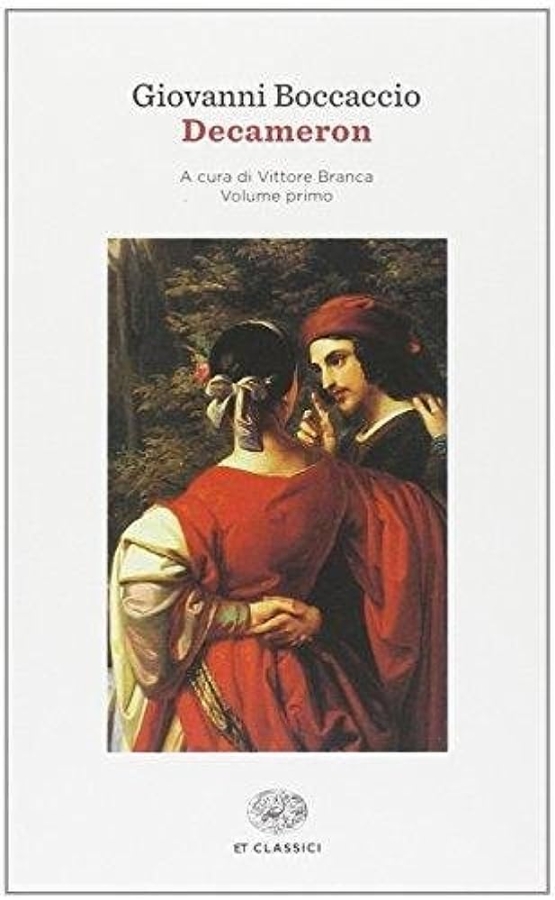
The Decameron
If we consult the Zingarelli dictionary, we find the following definition of the adjective "boccaccesco": "affected, salacious as in certain tales of Boccaccio." And the dictionary adds: "identifies situations, descriptions, writings of a sexual nature, to which a vein of lightness, amusement, and even mordancy is nonetheless not foreign > . This definition reflects common perception, which stems from many novellas of the *Decameron* (one need only think of the fourth novella of the first day, where a monk and his abbot take a young peasant girl to bed), and resonates with its language: vernacular, rich in double entendres, and often coarse. On the other hand, for Giosuè Carducci the *Decameron* is the reverse of Dante's divine comedy," and Boccaccio a "cynic, (...) in whom there is naught but paganism and decrepit corruption" (quotations from "Life and Works of Giovanni Boccaccio" > in Vittore Branca's introduction to the *Decameron*). Poor Boccaccio, who loved Dante so dearly! The critical debate is vast and complex; as a mere reader, I shall outline a few general traits before proposing possible groupings for the hundred novellas. In the proem, the author writes that women are restricted by the wills, the pleasures, the commands of fathers, mothers, brothers, and husbands, spending most of their time enclosed within the narrow circuit of their bedchambers... (...) Wherefore, so that through me fortune's fault may be in part amended > . Woman stands at the center of the novellas; she is neither Dante's Beatrice (the personification of Love for the Good) nor Petrarch's Laura, simultaneously object of desire and mother figure; we are speaking of real woman, made of flesh, (...) "full of concupiscible desire," who proudly considers herself equal to men, as Ghismunda says to her father Tancredi (Novella I of the Fourth Day): > look somewhat to the beginnings of things, and thou shalt see that we all have our flesh from one same mass of flesh, and that all souls were created by one same Creator with equal forces, with equal powers, with equal virtues . The writing of the novellas takes its cue from an extraordinary and tragic event: the plague of 1348. And it is precisely from the description of this terrible epidemic that we can glean two other essential traits of the work. With the brushstrokes of a great sociologist, Boccaccio analyzes the social mechanisms triggered by the pestilence, lucidly capturing how it devastated above all the most destitute classes of society, who were unable to protect themselves from contagion by fleeing the city. It is an acute, cold analysis, free of that compassionate and tiresome moralism found in Manzoni's description of the plague. The poor folk wished to bury their dead with dignity; and so > countless times it happened that, as two priests were walking with a cross for someone, three or four biers, borne by bearers, fell in behind it: and where the priests believed they had one dead body to bury, they had six or eight and sometimes more . Certainly, to an obtusely conventional mindset, such as that of Carducci and indeed Benedetto Croce, this hilarious scene might seem a biting act of cynicism by an urchin laughing at the world. And yet it reveals the empathetic and pessimistic attitude that pervades Boccaccio's entire work: a realism that shares in the suffering of the human being. A living woman, the portrayal of society as it is, sympathy toward the destiny of humanity—these are the hallmarks of the hundred novellas. It is precisely in light of these interpretive keys that they can be grouped into four fundamental strands, for each of which I indicate the most representative novella. The first strand is the fairy-tale one, for which Boccaccio draws upon Arab-Muslim and chivalric literature: I single out Novella VII of the Second Day. The second group of tales is the picturesque, and here one cannot fail to cite a masterpiece: the celebrated Novella V of the Second Day. Then there are the masks of the *Commedia dell'Arte*, drawn from popular, urban, and rustic culture: to laugh bitterly at our own gullibility, I recommend Novella X of the Sixth Day. Finally, for the moralizing strand—Boccaccio's weary and pessimistic reflection on life and its misfortunes—I invite you to read the final novella of the *Canzoniere*, which so pleased Petrarch and his contemporaries (Novella X of the Tenth Day). The *Decameron* is a magnificent masterpiece of prose-poetry, a masterly synthesis of the Dantean hendecasyllable and Padan and Mediterranean narrative. Critics have spoken of plurilingualism to denote Boccaccio's lexical richness, which draws upon so many tongues of our country to reflect the social and cultural differentiation of our land. As has been written (see Vittore Branca, "A Key to Reading the *Decameron*," in the introduction to the Einaudi edition), this linguistic expressionism is programmatic because > it aims to create, at the phonetic, lexical, and grammatical level, an ambient atmosphere of spirits rather than things, even through phonic, not to say musical, suggestions . In short, the *Decameron* is a testament to what the Italian language could have been and was not: the rejection of homogenization by a ruling class that was distant and frightened of the people. We had to wait until the second half of the twentieth century! Why read it? Entertaining, fascinating, splendid.
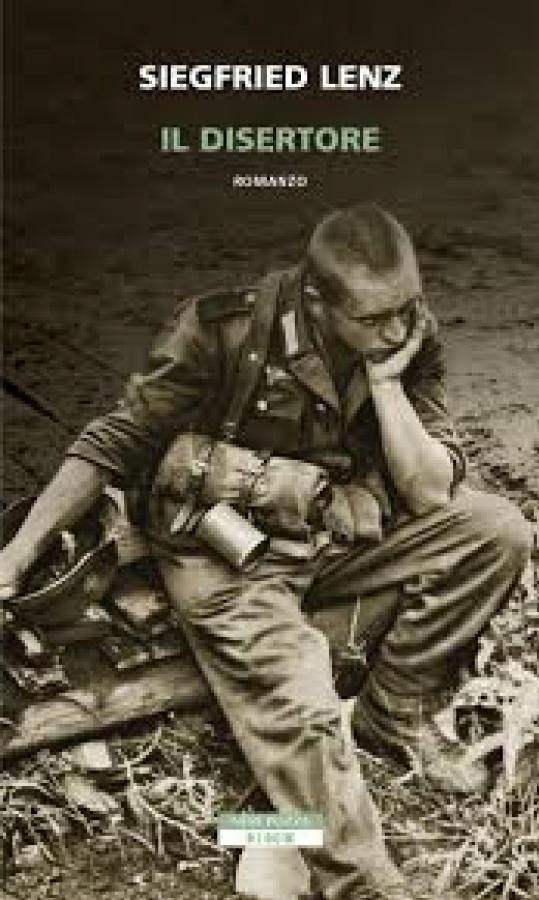
The Deserter
It is a great anti-war novel; it recalls two other books on the subject, both reviewed on this site: Karl Marlantes's *Matterhorn*, set in the Vietnam War, and Erich Remarque's *All Quiet on the Western Front*. While the former is an epic tale, a sort of modern *Iliad* demonstrating the futility of war as an occasion for social change (dispelling a great myth!), and the latter is a descent into the underworld where "living dead" survive in the trenches, *The Turncoat* tells the story of a German soldier who becomes conscious of the absurdity of nationalism, of the tragedy engulfing him, and believes he can find a solution by crossing over to the other side to fight among the partisans. The setting is World War II in Poland; a small German outpost must guard a railway line in territory now held by the enemy. Isolated, abandoned, and demoralized, > the wilderness gazed with innocent voluptuousness upon those soldiers who, viewed from a fair distance, hardly seemed seized by gasping, moaning, or nearing despair; from afar, they appeared more like figures one sometimes finds depicted at the market of old engravings, moving merrily, aimlessly, free from all gravity . Proska finds himself in this detachment by chance; he was traveling on a train toward the Eastern Front when a bomb wrecked the convoy; having miraculously survived, he falls into rank, naturally like a good soldier, in a small squad under the orders of a clumsy, authoritarian, and violent non-commissioned officer; the military command is far away. It is a motley assortment of humanity, ranging from a somewhat dim-witted beanpole to a former fire-eater whose companion is a hen, through to a young student, the butt of the commander's sadistic jokes. As in *Matterhorn* and *All Quiet on the Western Front*, it is brotherhood that cements the group, while patriotism is by now seen as a swindle. > They call it a sense of duty, Milkbun said contemptuously (a nickname for Wolfgang, the young student), they injected it into our blood. And with that, they unhinged us, stripped away our independence. (...) Nationalist resentment is contagious. A resentment that is the root of presumed German superiority and the wellspring of this goddamned sense of predestination . A few words, and above all the deadly consequences of a delusion of omnipotence, dismantle that universal mission of which Thomas Mann spoke, and which infected German society. It is for this reason, and because of the story it tells, that the novel had to wait a long time before being published. In war, a soldier's primary task is to save himself, and that cannot be done without dealing death. > Quick, the trigger is impatient; it has a great thirst for death. (...) Another burst. All twenty-eight. What else are you waiting for? And the rounds left the muzzle and shaved the reeds. (...) The river, brazen-faced, silently pushed its waters to the sea, sweeping past meadows and soaring woods, sweeping past the granite vaults of the bridges, past towns great and small, sweeping, sweeping past. A man dreamed of his wife. Water under the bridge. He dreamed of a son. (...) All water under the bridge: the fire leaping from lips, the longings welling in eyes; the tenderness, the steadfast loyalty, and the anguish in the chest. Only the conscience does not run dry, this proud, harsh landscape of justice, this fortress against remorse . Proska watches a young partisan walking as though taking "a sentimental stroll." He does not want to shoot him, yet "we are forced to obey war even if we hate it like the plague." There is no alternative to war, and it is this feeling, together with disillusionment and the opportunistic instinct for survival, that drives Proska to defect and fight with the partisans. On the other side of the barricade, life is "just as gray, not a bit better." Proska does his duty nonetheless, just as he had as a German soldier. And he shoots, dealing death without even knowing who faces him. With the great westward advance of the Red Army, Proska reaches his sister's house and, unintentionally, on instinct, kills his brother-in-law, who—failing to recognize him, and likewise driven by instinct—was leveling the barrel of a rifle at him. When Proska realizes what he has done, he hides the corpse: for years, his sister believes her husband to be missing in action. > Maria wants certainty. Only you can give it to her, Proska. You must give it to her. (...) Once you know where to sleep, once you have found where you can be alone with yourself and your long days, once you know that all roads wish to be traveled to the very end: then, Proska, you must write to her. You will do so. You must . A wretched man, a decent man yet too small to make the right choice, finds himself caught up in the war against his will. He reacts as best he can and becomes a deserter not out of choice, but out of necessity, because in war one must deal death regardless. This is the book's profound message: violence can only be answered with nonviolence if one wishes to save one's conscience. It is an illusion, a poignant yearning, to hope that one might sink "into the remote swamps of oblivion," or that evil can be remedied with more evil. Only a choice for peace can truly bring serenity. It is a virtually flawless novel: masterfully constructed with an exact balance of plot, characters, and landscape; traversed by an intense pacifist spirit, never declamatory, but voiced through the lives of ordinary people, soldiers despite themselves: > the clock that every war/clasps within its bloody claws/drips down along its hands/the minutes of its soldiers/and the pride of life/falls silent, without an echo,/and the wind sweeps away names/upon the swing of oblivion . Why read it? A masterpiece.
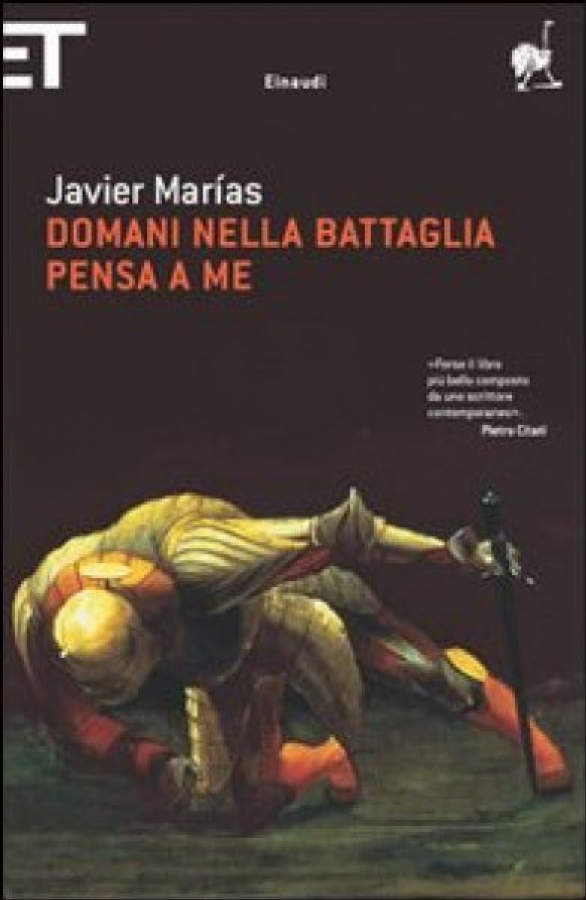
Tomorrow in the battle think on me
The novel recounts the peculiar story of Victor, a ghostwriter who is invited over one evening by a married woman, Marta; however, on the verge of making love, Marta dies, and Victor, frightened and uncertain, leaves the house without alerting anyone. Seized by remorse and curiosity, he manages to make contact with Marta’s family: her father, a Madrilenian gentleman; her sister, with whom he hopes to begin an affair; and her husband, a businessman who was in London at the time Victor was invited by Marta. In the end, Victor confesses that he was the man in Marta’s house, and the husband, in turn, confesses that he was in London with his mistress, who had told him she was expecting a child and wished to have an abortion in the English city. In reality, this was untrue, and the man, in a moment of madness, attempted to kill her; the woman fled and was fatally struck by a taxi. Alongside this main storyline, two parallel plots unfold. Someone has told Victor that Celia, his ex-wife, works as a prostitute. One evening, Victor believes he recognizes his wife in a prostitute named Victoria, whom he picks up in his car in order to determine whether she is indeed his wife or simply another person who resembles her. The difficulty of distinguishing between truth and falsehood, between fiction and reality, recurs in his encounter with a powerful man, the Only One, who has summoned him to ghostwrite a speech. In fact, Victor introduces himself under a friend’s name (another fiction that turns into reality); furthermore, during their conversation, the Only One reveals his despair at being unable to voice the doubts and uncertainties that lie at the foundation of his actions. In his commentary on the book, the author identifies its fundamental theme as deception—not deliberate deception (the outcome of a rational plot or societal hypocrisy), but that which arises from time and memory. > The most complete of biographies is made of nothing but irregular fragments and faded scraps, even one’s own biography. We believe we can recount our lives in a more or less reasoned and precise manner, and when we begin, we realize that they are crowded with shadowy zones, with unexplained and perhaps inexplicable episodes... Deception and its discovery show us that the past, too, is unstable and precarious, that not even what seems fixed and established within it is so once and for all... . Is deception truly the book's leitmotif? I do not believe it exhausts the substance of this novel, in which the characters move through a kind of enchantment, an unreal dimension born of two fundamental forces: time and memory. > What weighs on us, says Marta’s husband, the terrible thing is that the time during which we believe what was not becomes something strange, fluctuating and fictitious, a kind of enchantment or dream that must be suppressed by our memory; suddenly, it is as if we had not lived through that period at all . And again > the dead woman who haunts and spies on and visits him is another, his own dead woman who dwells in his thoughts as mine resides in mine, like an incessant throb in waking or in sleep, his wretched wife and his wretched mistress mingled and lodged together in our heads for lack of more comfortable lodgings, struggling against dissolution and seeking to become incarnate in the only thing left to them to retain their vigor and presence, the infinite repetition and reverberation of what they once did or what took place one day: infinite, yet each time more tired and faint . The protagonists of this novel are swept away by events that appear paradoxical and unpredictable, governed by a rhythm that dissolves the distinction between past, present, and future. Yet an event, the moment it has passed, in turn disperses, and one desperately longs to turn back, wishing that things had never happened or had taken another course. Yet do we truly live, are we truly ourselves, or do we inhabit a continuous fiction, since reality cannot encompass our imagination? In this context, only death seems to be a real fact, yet death is the beginning of a gradual loss of memory. It is an important book, propelled by an irresistible narrative pace, "a literary rap," which demands that one immerse oneself fully in the reading to keep up with its stride.
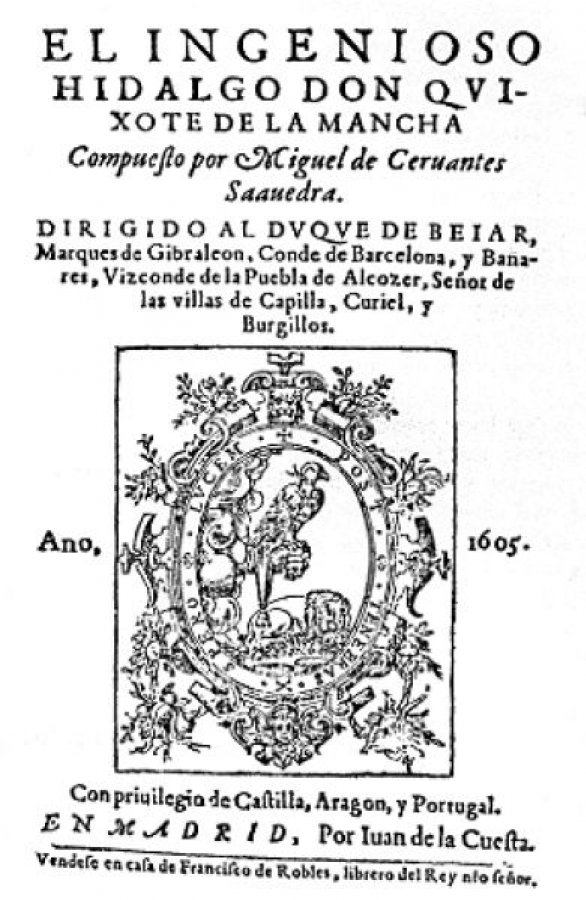
Don Quixote
The novel is set in the early seventeenth century and narrates the exploits of a country gentleman who, inflamed by chivalric tales, imagines himself to be a knight-errant. He thus embarks on a journey through La Mancha with his squire, Sancho Panza, and two faithful beasts: the horse Rocinante and the donkey. The novel is structured in two parts. In the first part, the most incredible episodes unfold, born of Don Quixote’s imagination: an inn becomes a castle to be stormed, a party of wayfarers enemy knights to be engaged in battle, a gang of convicts unfortunate souls to be freed—who will in turn rob Don Quixote. All these episodes generally come to an unhappy end: Don Quixote and Sancho emerge beaten, mocked, and with their bones half-broken; yet Don Quixote remains forever convinced that he was defeated by an “enchantment,” an artifice concocted by some malevolent sorcerer. The first part closes with Don Quixote’s return home, carted away inside a cage. The tale of the knight-errant is interspersed with a series of episodes—genuine autonomous stories—whose sole unifying thread appears to be the depiction of a hypocritical reality where brute force and overbearing arrogance hold sway. This first part pivots on the contrast between the heroic dream, that of Don Quixote, and the plebeian dream, that of Sancho. Don Quixote dwells in a perfect world and collides with history and reality; Sancho lives within history and accepts it as it is: a human realm of petty miseries and mediocre joys, devoid of disillusionment because it harbors no grand illusions. In the second part, the author imagines that Don Quixote’s exploits have already been narrated; consequently, the people the knight-errant encounters on his new adventure take pleasure in playing along with him, contriving paradoxical and often cruel situations. The novel concludes with Don Quixote’s return and his deathbed acknowledgment that knight-errantry is a falsehood and that the only true faith is that of the Catholic religion. This part of the book was written many years later, and one can certainly assert that Don Quixote “dies while living,” in that > the story now precedes him and makes him the ridiculous laughingstock of peasants and servants, of dukes and bandits . The novel is an exaltation of the imagination. In a dull, hypocritical, and unjust world, Don Quixote devises his own rules—those of chivalry errant—and even when these rules clash with reality, the phenomenon of enchantment allows Don Quixote to go on living according to his worldview. Yet is he mad, or does he act deliberately so as to survive and find amusement nonetheless? To Sancho’s admonition that he should not have set the prisoners free, Don Quixote retorts that > knights-errant must aid the oppressed as people in need, looking to their distress and not to their crimes. I came upon a troop of miserable and unfortunate souls, and I did for them what my rule commands, and for the rest, come what may . Yet what is this rule? > The ultimate aim is to administer distributive justice upon earth, rendering to each his own, interpreting and upholding good laws... (arms) have for their object peace, which is the greatest good that men can desire in this life . Don Quixote is thus mad, yet at the same time wise; his figure, still central in the first part of the book, increasingly takes on the role of a counterpart to the other great protagonist: Sancho Panza. A witty yet credulous peasant, he embodies peasant wisdom, resolving problems with common sense. The bond between Don Quixote and Sancho is one of profound affection and deep esteem: the squire is the only one who believes in the knight, and he does so even while recognizing that he is mad, because he loves him. When it is pointed out to Sancho Panza that he too must be mad if he believes in a madman, the squire replies that loyalty to Don Quixote prevails in him, and with it the desire to stand by him and aid him. Moreover, conversation with Don Quixote has been for Sancho Panza > the manure fallen upon the barren soil of my dry wit, and the time spent serving and frequenting your worship has been its cultivation... Don Quixote laughed at Sancho’s speeches, so full of affectation . Along with Don Quixote and Sancho, the other two protagonists are Rocinante and the donkey: > the friendship between the two beasts was so close, so unique of its kind... that whenever the two beasts could come together, they took care to scratch each other... and Rocinante would rest his long neck across that of the donkey . Freedom of the imagination and friendship are thus the two fundamental themes of the book, to which must be added the taste for adventure—expressed not in distant realms, but in La Mancha itself, just a few kilometers from home. The book’s modernity lies precisely in these themes and in the hall of mirrors (fiction within fiction) that unfolds in the second part—which is, however, the less accomplished, and in many passages verbose and redundant.
The Gifts of Life
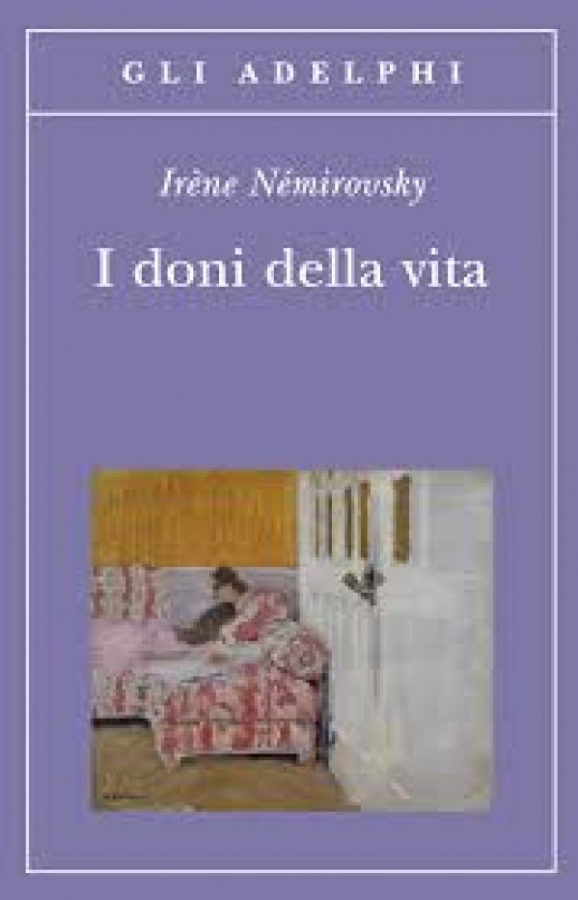
The delicate elegance of the writing welcomes the reader from the novel’s very first pages: the prosaic, tranquil life of a provincial town, daily routines, rigid social roles, thwarted romances, predictable and mundane existence are described with such affectionate and ironic detail that one wishes the story would continue along this path, as if it were a modern, condensed edition of Marcel Proust’s masterpiece (*In Search of Lost Time*), where truly nothing happens. Non è così, because war bursts in! The story begins with a scandal: against the will of his grandfather, a powerful and wealthy industrialist, Pierre marries Agnes, a girl without a dowry or useful social connections, with whom he is nonetheless deeply in love. Pierre’s mother > thought confusedly: to have loved him so much, protected him, shielded him from every evil, only for him to be snatched away from me in an instant! He will not be able to stay in Saint-Elme. His grandfather will not allow it. I have lost him . The First World War breaks out, and Pierre is called up to arms. There is far more to worry about. People cling to the illusion that > a world war must unfold almost without bloodshed. (...) no State will want to answer before posterity for such a crime! (...) It is impossible for such a thing to happen, she told herself, and millions of people that evening repeated the very same words. (...) But out there, my God, there is Pierre; come now, there is Pierre, my baby boy! It is not possible. It is a nightmare . (...) And yet, not a single tear escaped her. Her grief was too strange and too intense to allow her to weep > . If these were the mother’s conflicting feelings, the newlyweds had bid each other farewell with calm resignation. Alone, in the silence of their room, in the warmth of their bed, the night before they had exchanged their parting kiss, a mute and deep kiss, without lamentations, without futile recriminations. Now their lips were weary and lifeless > . When returning home on leave, the soldiers do not recount what truly happens at the front; they want to keep the war separate from the lives of their loved ones. It is enough that we suffer > , they think. Yet that is impossible. Saint-Elme, too, is overwhelmed by bombings, by columns of refugees and fleeing soldiers, by the German occupation. The population stubbornly resists. On the other hand, the war will pass, we will pass, but there will always be these simple, innocent pleasures: the coolness of the air, the sun, a red apple, a fire burning in winter, a woman, children, everyday life... the roar, the din of wars will eventually fade away > . It is a vain hope: once the first great slaughter is over, another follows, even more terrible. War was awaited as a man awaits death. He knows he cannot escape it; he merely pleads for a reprieve > . It is the Second World War. This time it is Guy, the son of Pierre and Agnes, who is called up to the front. During a leave, Rose, Guy's wife, announces to him that she is expecting a child: this war is horrible... No, don’t laugh. I’m a woman, I’m childish. But what do you expect? I see things as a woman. (...) Do you remember the book you had me read, (...) a military commander is ironic because the man he sent to his death has a wife waiting for him at home, with the lamp lit on the table and flowers on the tablecloth, and clean sheets on the bed? But she is the one who is right, and I, I....(...) I am very happy, he repeated without looking at her, with a strange shyness, very, very happy. (...) It was a feeling of triumph. Ah, you mock me, but I mock you too. (...) You want to destroy me, and I live! You want to rob me of all hope? Look, I marry, I love, I rejoice, I have a child! And the more you vent your fury upon me, the more stubborn I will be on my part! > By many, the novel is viewed as the story of a provincial bourgeois family during the two world wars. It is a reductive approach to a book that speaks of how feelings—real ones—withstand every tempest and allow human beings to overcome any disaster. Pierre and Agnes continually seek each other out, drift apart, and reunite; there is perhaps not the passion one might expect, but rather a profound tenderness. In the novel’s conclusion, Agnes finds her husband again after a long and arduous journey through the war. He is alive; he is safe. She stopped at the doorway, seized by such a trembling that she could go no further. He seemed to sense her presence. He walked toward her: Is it you? My God, at last it's you!, he said. Everyone was watching them. They kissed fleetingly, awkwardly. No kiss, no embrace could express the joy of their hearts". Is it a bourgeois story? Perhaps, but it expresses the strength that enables survival and rebuilding after the most appalling disasters. It shows how a woman, with her sensitivity and gentleness, views one of man’s most absurd follies: war. One can speak of death without being captivated by it: a lesson for our own time, traversed by so much violence, both real and narrated. Why read it? It is a masterpiece, for its splendid writing.
A Woman
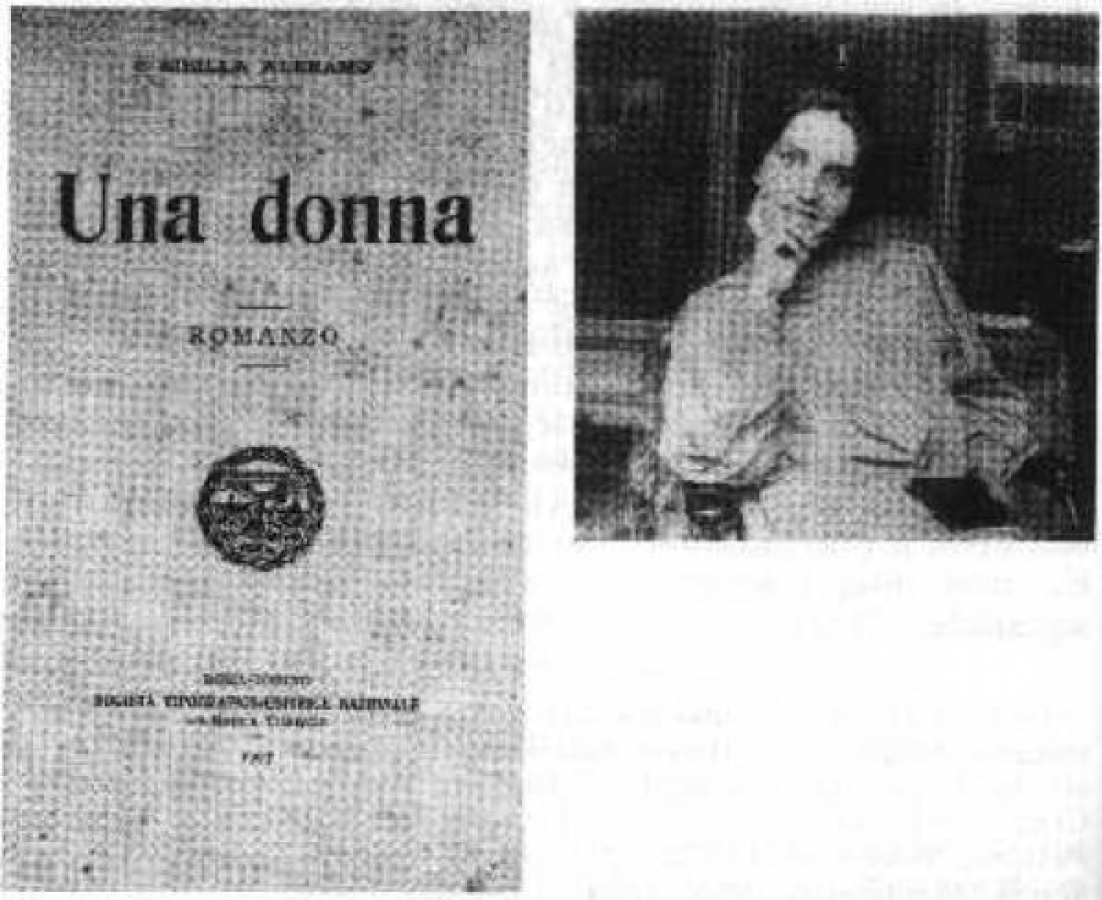
The book is autobiographical in nature and historically set in the early twentieth century. The protagonist, still a girl, is raped by a young man whom she later marries and with whom she has a child. She lives with her husband in a small provincial town, where she strives to abide by social conventions that dictate a woman be confined to the home, in total dependence on man. When her husband loses his job, the couple relocates to Rome, where the protagonist begins writing for a literary journal, makes herself known in cultural circles and within the feminist movement, and cultivates a broad network of friendships—among them a singular intellectual with whom she becomes fascinated. The husband himself is attracted to one of his wife's colleagues, and thus traditional social values begin, in a sense, to shatter. The husband, however, finds the opportunity to return to work in the small provincial town, and the protagonist once again finds herself locked within domestic walls, despite having awakened to the ideals of the feminist movement, to her own literary abilities, and, above all, to the fact that she no longer loves—and can no longer endure—her husband. The crisis erupts, turning into a tragedy for the woman, as she knows that should she decide to leave her husband, she will lose her son. Yet she resolves to move to Milan, enduring an agonizing separation from her child. With great discernment, the author titled the book *Una donna*, because, beyond its autobiographical dimensions, it chronicles woman's emancipation and, above all, the spiritual conflicts that engulf her on a path that runs counter to the maternal role. "It struck me as strange," writes the author, recounting a parliamentary debate, > inconceivable that educated people attached so little importance to the social problem of love. Not that men were unconcerned with woman; on the contrary, this seemed to be their principal concern, or nearly so. Poets and novelists continued to rehearse the eternal duet and trio, with sentimental complications and sensual perversions. No one had been able to create a great figure of a woman . And this is the premise of the book: to narrate the realm of male-female relations as seen by woman. In this sense, the novel deals not so much with the social emancipation of woman as with her role within the couple's relationship. Its contemporary relevance lies precisely here: the great social revolution that shattered the nineteenth-century social fabric is woman's autonomy from husband and children, even if this autonomy is subsequently circumscribed by woman's acceptance of male benchmarks in the workplace and, more broadly, in politics. There are four fundamental themes in the novel: the rupture of the dependent relationship with man in order to construct a different relationship with the other. > How can she become a woman, if her relatives surrender her—unaware, weak, incomplete—to a man who does not receive her as his equal; who uses her as a piece of property; who gives her children with whom he leaves her alone, while he fulfills his social duties, so that she may continue to play with trifles as in childhood? and further > between the two phases of female life, between the virgin and the mother, stands a monstrous, unnatural being, created by a bestial male egoism: and she avenges herself, unwittingly. Here is the crisis of the struggle of the sexes. The naive, dreaming virgin finds in her bridegroom a sorrowful heart and withered senses: made a woman and experienced, she understands how her love was forestalled by a brutal initiation. Between the two, the intruder often returns, and the mere memory degrades their kiss ;eroticism, namely the pursuit of pleasure, including physical pleasure, in the relationship with man. > He would enter the dark room, tired or irritated, light the lamp, move about without looking to see if I was asleep. Then, my eyes were shut, and I would feel a heavy mass stretch out beside me; in the silence a few words, meant to express passion, ecstasy; and I was in his power.... This is my life. To be used as a thing of pleasure, to feel my innermost substance bound. And to see days follow nights, one after the other, without end ;the crisis of motherhood as both a bond and a prison for woman’s autonomy, but above all the depiction of the harrowing conflict ignited by two opposing imperatives: love for one’s children and the pursuit of a full and complete life. > Why in motherhood do we worship sacrifice? Whence has this inhuman idea of maternal immolation descended upon us?... It is a monstrous chain... What if, once and for all, the fatal chain were broken, and a mother did not suppress the woman within herself, and a child learned from her life an example of dignity? . the pursuit of truth, which transcends the hypocrisy, ambiguity, and deceit of a society capable of accepting anything so long as it is not spoken or done openly, in the light of day; and all this even at the expense of the relationship with her son, opening a lacerating conflict. > To leave, to leave forever. Never again to relapse into lies. For my son even more than for myself! To suffer everything—his absence, his oblivion—to die, but never to feel disgust at myself, never to lie to the child... This was the dreadful dilemma. If I left, he would be an orphan. If I stayed? A debasing example; he, too, would grow up between crime and madness . I do not know for what reason, after an initial great success, this book was cast aside in Italian literature, accused of aestheticism and sentimentality. Criticisms were even leveled against its excessive fidelity to reality, to the author's actual lived experiences. Pirandello himself believed that the novel should have concluded with the protagonist departing with her son: talk about a happy ending! The novel exhibits lapses in style, at times overly lyrical and emphatic, and in narrative pacing, especially in the section dealing with life in Rome. It is nevertheless a profoundly relevant book, precisely because it brings to light the figure of woman as an individual, in her expectations and her contradictions, demonstrating how the quest for an autonomous female role generates harrowing conflicts of great depth and complexity: in particular, the relationship with motherhood and children. It would do well for this book to be read—indeed, learned by heart—by people like Buttiglione, who presume to accuse women of superficiality and hedonism merely because they seek to claim a fully realized role as individuals.