Finished reading on: April 09, 2006
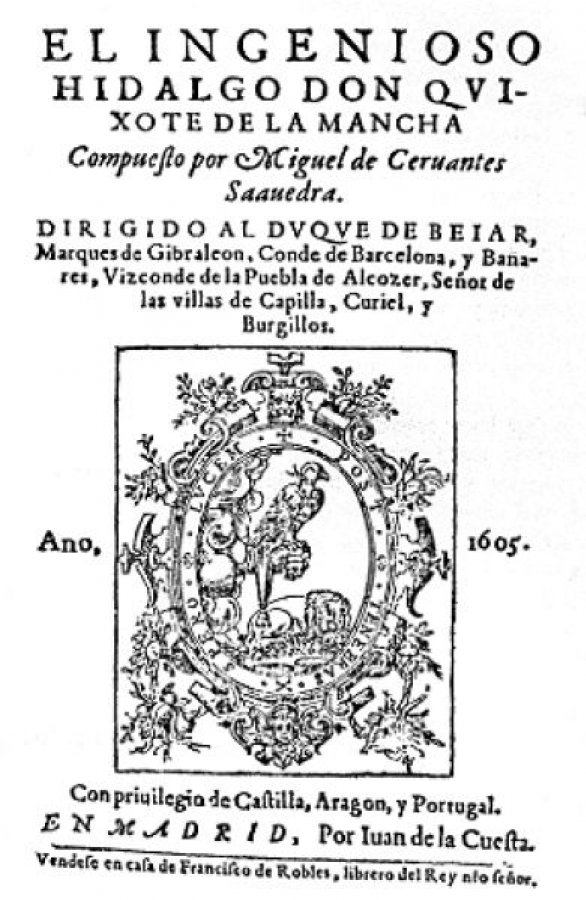
Don Quixote
Title of the original version reviewed: «Don Chisciotte»
AI Translation Notice: This review was translated from the original Italian using artificial intelligence. Book quotes and excerpts are translated interpretations and will not match the author's original English phrasing or official published translations.
The novel is set in the early seventeenth century and narrates the exploits of a country gentleman who, inflamed by chivalric tales, imagines himself to be a knight-errant.
He thus embarks on a journey through La Mancha with his squire, Sancho Panza, and two faithful beasts: the horse Rocinante and the donkey.
The novel is structured in two parts.
In the first part, the most incredible episodes unfold, born of Don Quixote’s imagination: an inn becomes a castle to be stormed, a party of wayfarers enemy knights to be engaged in battle, a gang of convicts unfortunate souls to be freed—who will in turn rob Don Quixote.
All these episodes generally come to an unhappy end: Don Quixote and Sancho emerge beaten, mocked, and with their bones half-broken; yet Don Quixote remains forever convinced that he was defeated by an “enchantment,” an artifice concocted by some malevolent sorcerer.
The first part closes with Don Quixote’s return home, carted away inside a cage.
The tale of the knight-errant is interspersed with a series of episodes—genuine autonomous stories—whose sole unifying thread appears to be the depiction of a hypocritical reality where brute force and overbearing arrogance hold sway.
This first part pivots on the contrast between the heroic dream, that of Don Quixote, and the plebeian dream, that of Sancho.
Don Quixote dwells in a perfect world and collides with history and reality; Sancho lives within history and accepts it as it is: a human realm of petty miseries and mediocre joys, devoid of disillusionment because it harbors no grand illusions.
In the second part, the author imagines that Don Quixote’s exploits have already been narrated; consequently, the people the knight-errant encounters on his new adventure take pleasure in playing along with him, contriving paradoxical and often cruel situations.
The novel concludes with Don Quixote’s return and his deathbed acknowledgment that knight-errantry is a falsehood and that the only true faith is that of the Catholic religion.
This part of the book was written many years later, and one can certainly assert that Don Quixote “dies while living,” in that
the story now precedes him and makes him the ridiculous laughingstock of peasants and servants, of dukes and bandits
.
The novel is an exaltation of the imagination.
In a dull, hypocritical, and unjust world, Don Quixote devises his own rules—those of chivalry errant—and even when these rules clash with reality, the phenomenon of enchantment allows Don Quixote to go on living according to his worldview.
Yet is he mad, or does he act deliberately so as to survive and find amusement nonetheless? To Sancho’s admonition that he should not have set the prisoners free, Don Quixote retorts that
knights-errant must aid the oppressed as people in need, looking to their distress and not to their crimes.
I came upon a troop of miserable and unfortunate souls, and I did for them what my rule commands, and for the rest, come what may
.
Yet what is this rule?
The ultimate aim is to administer distributive justice upon earth, rendering to each his own, interpreting and upholding good laws...
(arms) have for their object peace, which is the greatest good that men can desire in this life
.
Don Quixote is thus mad, yet at the same time wise; his figure, still central in the first part of the book, increasingly takes on the role of a counterpart to the other great protagonist: Sancho Panza.
A witty yet credulous peasant, he embodies peasant wisdom, resolving problems with common sense.
The bond between Don Quixote and Sancho is one of profound affection and deep esteem: the squire is the only one who believes in the knight, and he does so even while recognizing that he is mad, because he loves him.
When it is pointed out to Sancho Panza that he too must be mad if he believes in a madman, the squire replies that loyalty to Don Quixote prevails in him, and with it the desire to stand by him and aid him.
Moreover, conversation with Don Quixote has been for Sancho Panza
the manure fallen upon the barren soil of my dry wit, and the time spent serving and frequenting your worship has been its cultivation...
Don Quixote laughed at Sancho’s speeches, so full of affectation
.
Along with Don Quixote and Sancho, the other two protagonists are Rocinante and the donkey:
the friendship between the two beasts was so close, so unique of its kind...
that whenever the two beasts could come together, they took care to scratch each other...
and Rocinante would rest his long neck across that of the donkey
.
Freedom of the imagination and friendship are thus the two fundamental themes of the book, to which must be added the taste for adventure—expressed not in distant realms, but in La Mancha itself, just a few kilometers from home.
The book’s modernity lies precisely in these themes and in the hall of mirrors (fiction within fiction) that unfolds in the second part—which is, however, the less accomplished, and in many passages verbose and redundant.