Giovanni Boccaccio
Books by this author (1)
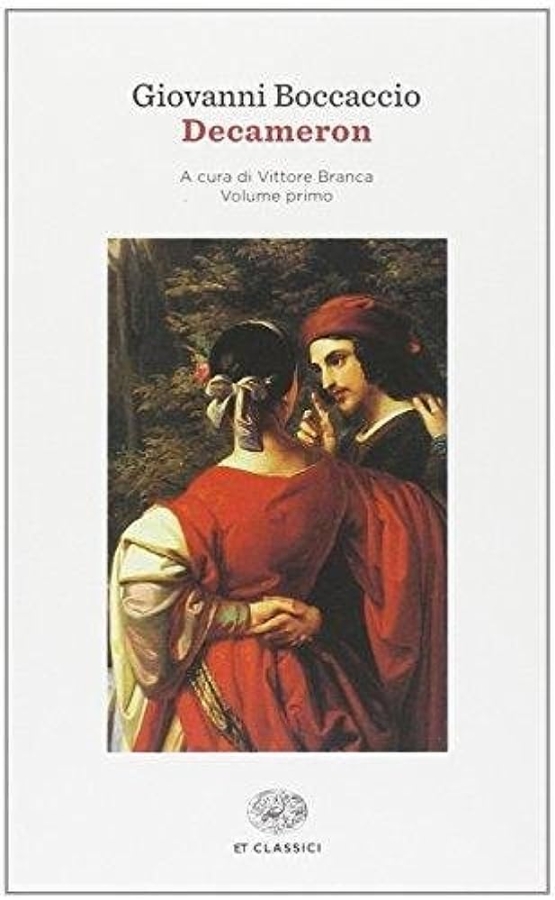
The Decameron
If we consult the Zingarelli dictionary, we find the following definition of the adjective "boccaccesco": "affected, salacious as in certain tales of Boccaccio." And the dictionary adds: "identifies situations, descriptions, writings of a sexual nature, to which a vein of lightness, amusement, and even mordancy is nonetheless not foreign > . This definition reflects common perception, which stems from many novellas of the *Decameron* (one need only think of the fourth novella of the first day, where a monk and his abbot take a young peasant girl to bed), and resonates with its language: vernacular, rich in double entendres, and often coarse. On the other hand, for Giosuè Carducci the *Decameron* is the reverse of Dante's divine comedy," and Boccaccio a "cynic, (...) in whom there is naught but paganism and decrepit corruption" (quotations from "Life and Works of Giovanni Boccaccio" > in Vittore Branca's introduction to the *Decameron*). Poor Boccaccio, who loved Dante so dearly! The critical debate is vast and complex; as a mere reader, I shall outline a few general traits before proposing possible groupings for the hundred novellas. In the proem, the author writes that women are restricted by the wills, the pleasures, the commands of fathers, mothers, brothers, and husbands, spending most of their time enclosed within the narrow circuit of their bedchambers... (...) Wherefore, so that through me fortune's fault may be in part amended > . Woman stands at the center of the novellas; she is neither Dante's Beatrice (the personification of Love for the Good) nor Petrarch's Laura, simultaneously object of desire and mother figure; we are speaking of real woman, made of flesh, (...) "full of concupiscible desire," who proudly considers herself equal to men, as Ghismunda says to her father Tancredi (Novella I of the Fourth Day): > look somewhat to the beginnings of things, and thou shalt see that we all have our flesh from one same mass of flesh, and that all souls were created by one same Creator with equal forces, with equal powers, with equal virtues . The writing of the novellas takes its cue from an extraordinary and tragic event: the plague of 1348. And it is precisely from the description of this terrible epidemic that we can glean two other essential traits of the work. With the brushstrokes of a great sociologist, Boccaccio analyzes the social mechanisms triggered by the pestilence, lucidly capturing how it devastated above all the most destitute classes of society, who were unable to protect themselves from contagion by fleeing the city. It is an acute, cold analysis, free of that compassionate and tiresome moralism found in Manzoni's description of the plague. The poor folk wished to bury their dead with dignity; and so > countless times it happened that, as two priests were walking with a cross for someone, three or four biers, borne by bearers, fell in behind it: and where the priests believed they had one dead body to bury, they had six or eight and sometimes more . Certainly, to an obtusely conventional mindset, such as that of Carducci and indeed Benedetto Croce, this hilarious scene might seem a biting act of cynicism by an urchin laughing at the world. And yet it reveals the empathetic and pessimistic attitude that pervades Boccaccio's entire work: a realism that shares in the suffering of the human being. A living woman, the portrayal of society as it is, sympathy toward the destiny of humanity—these are the hallmarks of the hundred novellas. It is precisely in light of these interpretive keys that they can be grouped into four fundamental strands, for each of which I indicate the most representative novella. The first strand is the fairy-tale one, for which Boccaccio draws upon Arab-Muslim and chivalric literature: I single out Novella VII of the Second Day. The second group of tales is the picturesque, and here one cannot fail to cite a masterpiece: the celebrated Novella V of the Second Day. Then there are the masks of the *Commedia dell'Arte*, drawn from popular, urban, and rustic culture: to laugh bitterly at our own gullibility, I recommend Novella X of the Sixth Day. Finally, for the moralizing strand—Boccaccio's weary and pessimistic reflection on life and its misfortunes—I invite you to read the final novella of the *Canzoniere*, which so pleased Petrarch and his contemporaries (Novella X of the Tenth Day). The *Decameron* is a magnificent masterpiece of prose-poetry, a masterly synthesis of the Dantean hendecasyllable and Padan and Mediterranean narrative. Critics have spoken of plurilingualism to denote Boccaccio's lexical richness, which draws upon so many tongues of our country to reflect the social and cultural differentiation of our land. As has been written (see Vittore Branca, "A Key to Reading the *Decameron*," in the introduction to the Einaudi edition), this linguistic expressionism is programmatic because > it aims to create, at the phonetic, lexical, and grammatical level, an ambient atmosphere of spirits rather than things, even through phonic, not to say musical, suggestions . In short, the *Decameron* is a testament to what the Italian language could have been and was not: the rejection of homogenization by a ruling class that was distant and frightened of the people. We had to wait until the second half of the twentieth century! Why read it? Entertaining, fascinating, splendid.