Irène
Books by this author (2)

The Gifts of Life
The delicate elegance of the writing welcomes the reader from the novel’s very first pages: the prosaic, tranquil life of a provincial town, daily routines, rigid social roles, thwarted romances, predictable and mundane existence are described with such affectionate and ironic detail that one wishes the story would continue along this path, as if it were a modern, condensed edition of Marcel Proust’s masterpiece (*In Search of Lost Time*), where truly nothing happens. Non è così, because war bursts in! The story begins with a scandal: against the will of his grandfather, a powerful and wealthy industrialist, Pierre marries Agnes, a girl without a dowry or useful social connections, with whom he is nonetheless deeply in love. Pierre’s mother > thought confusedly: to have loved him so much, protected him, shielded him from every evil, only for him to be snatched away from me in an instant! He will not be able to stay in Saint-Elme. His grandfather will not allow it. I have lost him . The First World War breaks out, and Pierre is called up to arms. There is far more to worry about. People cling to the illusion that > a world war must unfold almost without bloodshed. (...) no State will want to answer before posterity for such a crime! (...) It is impossible for such a thing to happen, she told herself, and millions of people that evening repeated the very same words. (...) But out there, my God, there is Pierre; come now, there is Pierre, my baby boy! It is not possible. It is a nightmare . (...) And yet, not a single tear escaped her. Her grief was too strange and too intense to allow her to weep > . If these were the mother’s conflicting feelings, the newlyweds had bid each other farewell with calm resignation. Alone, in the silence of their room, in the warmth of their bed, the night before they had exchanged their parting kiss, a mute and deep kiss, without lamentations, without futile recriminations. Now their lips were weary and lifeless > . When returning home on leave, the soldiers do not recount what truly happens at the front; they want to keep the war separate from the lives of their loved ones. It is enough that we suffer > , they think. Yet that is impossible. Saint-Elme, too, is overwhelmed by bombings, by columns of refugees and fleeing soldiers, by the German occupation. The population stubbornly resists. On the other hand, the war will pass, we will pass, but there will always be these simple, innocent pleasures: the coolness of the air, the sun, a red apple, a fire burning in winter, a woman, children, everyday life... the roar, the din of wars will eventually fade away > . It is a vain hope: once the first great slaughter is over, another follows, even more terrible. War was awaited as a man awaits death. He knows he cannot escape it; he merely pleads for a reprieve > . It is the Second World War. This time it is Guy, the son of Pierre and Agnes, who is called up to the front. During a leave, Rose, Guy's wife, announces to him that she is expecting a child: this war is horrible... No, don’t laugh. I’m a woman, I’m childish. But what do you expect? I see things as a woman. (...) Do you remember the book you had me read, (...) a military commander is ironic because the man he sent to his death has a wife waiting for him at home, with the lamp lit on the table and flowers on the tablecloth, and clean sheets on the bed? But she is the one who is right, and I, I....(...) I am very happy, he repeated without looking at her, with a strange shyness, very, very happy. (...) It was a feeling of triumph. Ah, you mock me, but I mock you too. (...) You want to destroy me, and I live! You want to rob me of all hope? Look, I marry, I love, I rejoice, I have a child! And the more you vent your fury upon me, the more stubborn I will be on my part! > By many, the novel is viewed as the story of a provincial bourgeois family during the two world wars. It is a reductive approach to a book that speaks of how feelings—real ones—withstand every tempest and allow human beings to overcome any disaster. Pierre and Agnes continually seek each other out, drift apart, and reunite; there is perhaps not the passion one might expect, but rather a profound tenderness. In the novel’s conclusion, Agnes finds her husband again after a long and arduous journey through the war. He is alive; he is safe. She stopped at the doorway, seized by such a trembling that she could go no further. He seemed to sense her presence. He walked toward her: Is it you? My God, at last it's you!, he said. Everyone was watching them. They kissed fleetingly, awkwardly. No kiss, no embrace could express the joy of their hearts". Is it a bourgeois story? Perhaps, but it expresses the strength that enables survival and rebuilding after the most appalling disasters. It shows how a woman, with her sensitivity and gentleness, views one of man’s most absurd follies: war. One can speak of death without being captivated by it: a lesson for our own time, traversed by so much violence, both real and narrated. Why read it? It is a masterpiece, for its splendid writing.
Suite Française
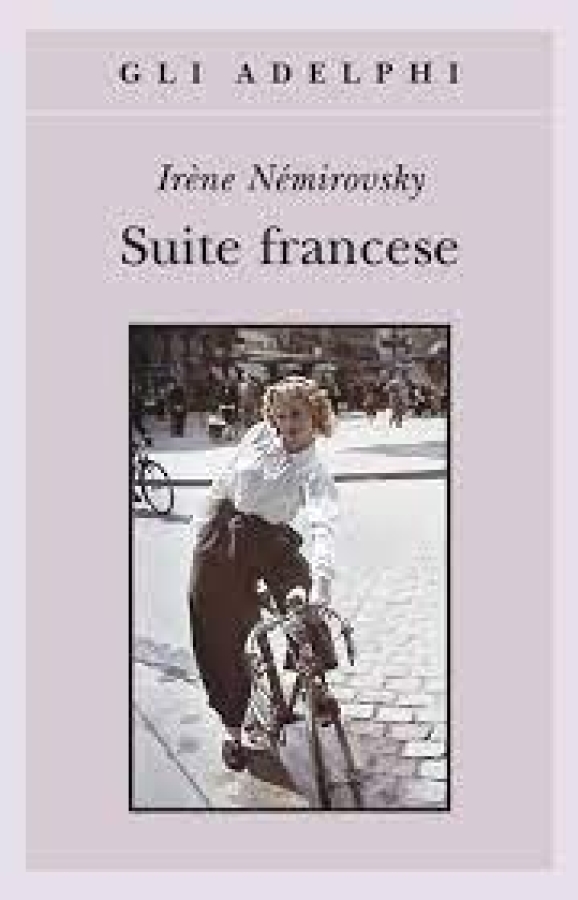
Following the defeat of the French army in 1940, the Germans occupied France until 1944—directly in the North and via the collaborationist Vichy regime in the South. Despite dire circumstances (Némirovsky and her husband being Jewish), the author embarked upon a grand fresco of a defeated France, not so much to discern its causes or analyze its events, but to address a single question: did the war, the defeat, the flight, and the coexistence with the invader change the French people? The answer is that > nothing was changing, everything remained the same, that they were not witnessing an extraordinary cataclysm, the end of the world as they had believed, but rather a series of human relationships, bounded in time and space. The author was only able to complete the first two parts of *Suite Française* before being deported to an extermination camp. The first part, "Storm in June," recounts the frantic and terrified exodus of Parisians in June 1940, doing so through microcosms that mirror the social structure of the French bourgeoisie: the wealthy Péricand family, steadfast in their wealth and adherence to authority; Gabriel Corte, a renowned man of letters, self-assured yet disgusted by such fleeing rabble; the Michaud couple, loyal bank clerks betrayed by the cynical banker Corbin; and finally Charlie Langelet, a vain and miserly collector, willing to do anything to save his porcelain. They are clearly archetypes, treated with affectionate irony in their struggle for survival, to save themselves, their family, and their worldly goods. They are patriots, but sensible ones; charitable within reason; pragmatic in their moral principles, always ready to adapt them to circumstances. Whoever naively believes that war is an opportunity for redemption will meet the fate of Philippe Péricand, brutally murdered by the young orphans entrusted to his care. It is better not to lift the lid on the human soul, lest we discover that we are "between Satan and God, plunged in deep darkness." The second part of *Suite Française*, "Dolce," is set in a village in central France, a small town occupied by the Germans. The author recounts the relationships between the locals and the invader by taking small-scale incidents as her starting point. Shades of gray prevail over black and white. The troops are composed of young soldiers, disoriented and eager for acceptance; the population professes hostility yet seeks coexistence, at times pursuing personal gain, if not actively collaborating. Némirovsky abandons irony and sweeping strokes, immersing herself instead in detailed descriptions of the settings, in a realistic yet severe portrayal of an obtuse rural bourgeoisie. There is a faint undercurrent of disdain, softened only in the figure of Lucile. Married to a narrow-minded and unfaithful man, currently a prisoner of war, the young woman lives a bleak existence with her grim mother-in-law. She falls in love with a young German officer; in him, Lucile sees not merely a gentle, cultured, and refined man, so unlike her husband, but glimpses the possibility of change: > to be free, inwardly, to choose my own path, to follow it, not to follow the swarm. (...) I am a poor, useless woman, I know nothing, but I want to be free! . And romantically, the young officer, himself a prisoner of conventions, of Ideas, and of the State, dreamed for Lucile of a > white dress with wide muslin flounces, flared like a corolla, so that dancing with her (...) every now and then he would feel around his legs the frothing rustle of her lace . These are dreams, futile hopes. The killing of a German by a partisan, who is then hidden by Lucile herself, brings both back to harsh reality: > those quiet peasants with impenetrable faces, those women who only yesterday were smiling, (...) were nothing more than a mass of enemies! Lucile cries: > Never, no! No! Never! Never would she be his. (...) What made them enemies was neither reason nor the heart, but those dark impulses of the blood on which they had relied to unite them, and over which they had no power whatsoever . The novel was published posthumously in 2004 to great critical and commercial acclaim. The tragic human ordeal of the author perhaps fostered an overly flattering critical reception. The first part has a lively and engaging pace, but the narrative leads nowhere; it remains as if suspended, with even grotesque conclusions that recall the paradoxical, unsettling stories of Dino Buzzati (think of "Fear at the Scala" in Dino Buzzati's *The Sixty Stories*, reviewed on this site). The second part, undoubtedly more robust from a psychological standpoint, is reminiscent of Émile Zola's *The Earth* (*La Terre*), offering an all-too-predictable depiction of the narrow-mindedness and cowardice of the rural bourgeoisie. The figures of Lucile and the handsome officer are too steeped in romanticism—at times cloying—to be truly compelling. Why read it? Enjoyable: the prose is elegant and fluid.