Oliver Twist
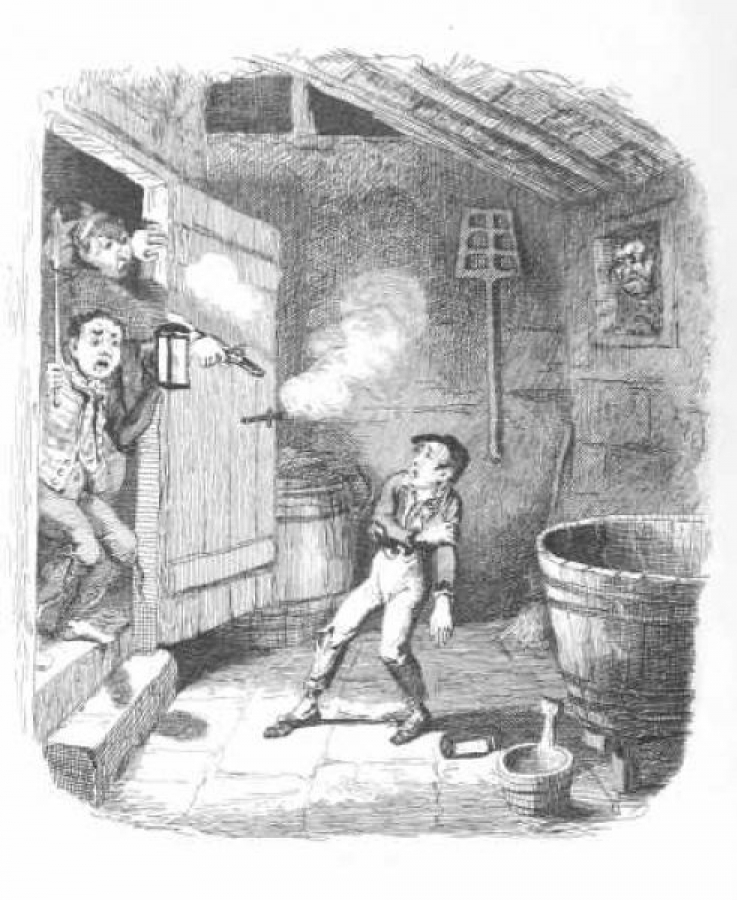
The setting is the England of the second half of the nineteenth century, marked by widespread poverty, rising criminality, and a bigoted bourgeoisie that was often hostile toward the poor. Oliver is a foundling who is first raised in a workhouse, only to be apprenticed (or handed over) to a family to learn a trade. There he suffers relentless abuse and consequently decides to flee, only to fall into the hands of a gang of criminals led by an avaricious and cruel Jew (Fagin), and by another character who is violent and paranoid. Oliver is forced to learn how to steal; during a burglary, however, he is wounded and taken in by a family who nurses him back to health, thereby introducing him to the kindness and generosity of the respectable middle class. There follows a series of adventures and an entanglement of characters, through which it is ultimately revealed that Oliver is the heir to a vast fortune and had been abducted by the Jew on behalf of his half-brother, who sought to prevent Oliver from claiming his lawful birthright. All ends well: the villains are punished, and Oliver can live happily with his new family. At a certain point in the novel, Dickens recalls how > it is the custom on the stage in all murderous melodramas to present comic scenes and dramatic scenes in regular alternation. Such changes appear absurd: but they are not so unusual as they seem at first sight. The transition in real life from a well-spread board to the deathbed, and from mourning weeds to holiday garments is no less incredible: only, there, we are actors rather than passive spectators, and that makes a vast difference . Life is thus an endless surprise, and the story of *Oliver Twist* seeks to portray the nineteenth-century journey of a hero in the era of massive urbanization. Yet there is nothing fantastical or truly adventurous in Dickens’s tale, save for a sequence of frequently maudlin episodes steeped in a facile moralism that sharply demarcates good from evil. In the first part of the novel, recounting the trials of young Oliver, the author still displays a subtle irony toward the English society of his day and a critique of the hypocritical approach to poverty that conceals contempt and cruelty beneath a veneer of charity and benevolence. Particularly effective in this regard is the scene where young Oliver, timid and awkward, appears before the workhouse board to be evaluated regarding his future placement. Dickens describes the various board members masterfully, revealing a lucid portrait of a bourgeoisie that views poverty as an innate predisposition toward wickedness and misfortune. Similarly, the author advances a social critique against the exploitation of child labor and the utter disregard for children's physical and intellectual needs. In the novel’s second half, the narrative lapses into melodrama, drawing a stark divide between the “world of good” (the middle-class gentry fueled by wholesome sentiments) and the “world of evil,” embodied by society’s underworld: the grasping Jew, the young prostitute who ultimately redeems herself, the brute, and the wicked half-brother. Oliver himself fades from view, while Fagin emerges as the pivotal figure, incessantly scheming in his pursuit of wealth and possession. The finest scenes are precisely those depicting the gang of criminals and their movements through the streets of London: a dark, filthy, decaying city where people dwell in windowless, dilapidated, foul-smelling tenements. In its richness and expressive power, the depiction of London recalls D’Annunzio’s poetry on the monstrous cities. Urbanization is viewed by Dickens as the community’s descent into an inhuman world, in contrast to the countryside, where one can live happily and serenely. It is hardly coincidental that Oliver and his companions ultimately abandon London to return to the small villages of rural England. The plot is predictable, an overbearing moralistic approach predominates, and the style is not always fluid—the sentence structure being frequently convoluted and redundant: all elements that render the novel scarcely enjoyable.
One of us and Home, sweet home
These are two short stories which, as is customary for Fante, are set within the milieu of the typical Italian family. In the first story, a telegram arrives announcing the death of a cousin, a boy who had been a childhood playmate of Mike, one of the family’s many brothers. A deeply humorous scene unfolds: while the mother weeps for the grief of her sister, who has lost a son, the boys fight over the telegram to the point of tearing it to pieces, thereby opening a dispute over how the cousin died and when the funeral will be held. The scene shifts to the funeral, attended by the mother, Mike, and his younger brother, the narrator. What strikes the boys is that the uncle does not weep for the death of his son, whereas all the relatives, particularly the women, unleash a flurry of wailing and shrieks. Mike, in particular, is afraid to approach his uncle, fearing that his resemblance to the dead cousin might make him the target of resentment. Yet it is precisely the sight of Mike—of what his own son might have been—that breaches the solitude of grief and moves the uncle to tears: > they sat there. Mike greedily sipped a milkshake, and Uncle Frank sat opposite him, his face in his hands, large tears sliding down his cheeks and dropping onto the table as he watched Mike and his milkshake . In the second story, Jimmy returns to his parents' home, which he had left after a stormy quarrel with his father. Once again, the portrait of a classic Italian family emerges: the mother has prepared a fine dinner with the sweets Jimmy loves, hoping that all will go well, without fights or arguments; the father pretends to have forgotten, unemployed, heading off to the tavern after dinner as he does every evening; the siblings greet their older brother enthusiastically, yet inevitably settle back into the everyday routine from which Jimmy now feels alienated. The conclusion cannot be otherwise: > I’ll get up and throw away the cigarette, and I’ll want to be with her (his girlfriend), not here, in this goddamned insignificant town forgotten by God . The stories, particularly the first, are very fine. The style is quintessentially Fante’s: elegant, tender, and effortlessly fluid.
Open City
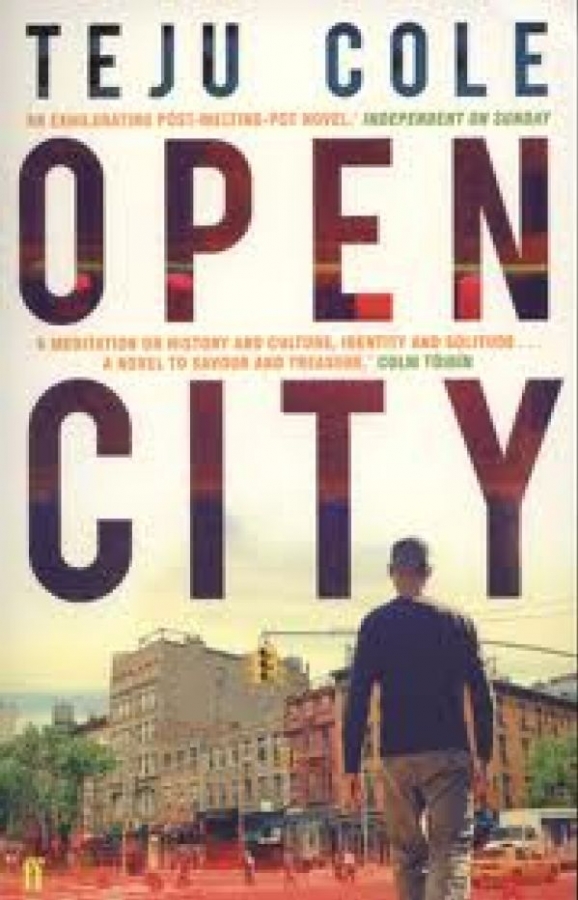
When walking the streets of a city > every decision, where to turn, how long to linger lost in thought before an abandoned building, was of no consequence, and for this reason was a sign of freedom. I traversed the city’s neighborhoods as though I had to measure them with my stride, and the subway stations served as recurring motifs of my unending wandering . The protagonist and narrator of this novel is a young psychiatrist of Nigerian descent, the child of a mixed couple: an African father and a European mother. He spends much of his free time wandering the streets of New York. > The walks fulfilled a need: they were an escape from the strictly regimented mental environment of work, and once I discovered them as therapy, they became normal, and I forgot what life had been like before I began walking . Wandering the city on foot is a grand metaphor. It is a toponymic itinerary, a geographical discovery, and as such “a regime of competence and perfection.” At the same time, it is a journey into the labyrinth of the mind. Like the urban plan of a city, the human mind is a network of logical intersections, a rational model within which, however, we move in leaps. An image, a snatch of conversation, a chance encounter is enough to carry us “far away,” to other images, to memories, to the depths of the unconscious toward an "I" > never fully explored and unlocked. The novel can be read on three levels. First and foremost, it is an account of the protagonist’s urban wanderings. Moving aimlessly, he encounters places meticulously described in their history and urban function; they are also, and above all, watersheds between neighborhoods and unpredictable turning points in his journey on foot. Walking allows one to upend the rational model, since one is not constrained to follow traffic arteries, inadvertently leading to unexpected quarters of the city—historically significant, yet long forgotten in the consciousness of its inhabitants. The improvisation and slowness of walking also allow for encounters with others. Many are casual encounters, while others involve habitual acquaintances, yet always met by chance. In any case, they offer the opportunity to hear others’ lives narrated: their memories, their aspirations, and the ideas that animate their existence. Our protagonist does not like to speak; he prefers to listen, yet he does so without curiosity, almost as if fulfilling his psychiatric vocation even outside of work. The city then yields unexpected discoveries that bring us to the novel’s second level of interpretation: the genocides perpetrated by Western man. It is incredible, but in Manhattan itself, at the very center of global capitalism, there are sites that recall the slaughter of indigenous peoples, just as entire neighborhoods of skyscrapers and apartment buildings were erected over a burial ground where slaves were interred—those who died during the crossings from Africa or perished just after arriving in America. For all its pomposity, the West does not even respect the veneration of the dead! The city thus expresses a cosmic wound, a universal sorrow, latent and concealed within the consciousness of contemporary man. Aimless roaming also stirs remembrances, ushering us to the narrative’s third level: childhood, with the brief and intense bond with his maternal grandmother, his father’s funeral, the military academy where the young protagonist completed his education before moving to the United States. It is Nigeria resurfacing, with its spiritualism so distant from Western culture. Yet above all, it is the unresolved relationship with his mother, who carries a deep wound: she is the product of a rape, for which she blames her own mother, the maternal grandmother, and her native land, Belgium. Pursuing the labyrinth of the mind, the protagonist has thus arrived at a dark juncture: his mother’s existential grief, which prevented her from truly loving her son. Have we reached the conclusion of this journey into the unconscious? Is there something else the protagonist refuses to acknowledge and accept? In his peregrinations along the city streets, the protagonist happens to meet the sister of a childhood friend. It is she who recognizes him and speaks to him. They exchange the customary pleasantries of people who have not seen each other in a long time, between individuals whose relationship was superficial and slight. The friend invites the protagonist to a party at her boyfriend’s home. While looking out from the terrace at the countless lights of Manhattan, the friend pulls the protagonist aside and reminds him that, when she was fifteen years old and I was a year younger..... I had forced myself into her... afterward, she said, in the weeks that followed, in the months and years that followed, I had acted as if I knew nothing, I had even forgotten her to the point of not recognizing her when we met again, and never tried to acknowledge what I had done... but it was not so for her, she said, the pleasure of denial had not been possible for her". > Each of us must, at some level, take oneself as the yardstick of normality, must assume that the mansion of one's own mind is not, cannot be, entirely opaque to him To myself, I am always the hero > and so, what does it mean when, in someone else's version, I am the villain? The novel concludes with a highly evocative metaphor. The Statue of Liberty is what all immigrants see upon arriving in New York. Yet against this great statue hundreds of birds crash, driven by the currents and the wind. A precise system of statistics records each death: species, number, date, and weather conditions. With scientific precision, an attempt is made to bring rationality to a cosmic and existential phenomenon that encapsulates the destiny of each of us: as an emigrant people and as an individual in search of himself. We are faced with a complex book, difficult in its content, intellectually rich yet lacking in vigor, in some ways cryptic and prolix. What sustains a nonexistent narrative plot and an equally fragile system of characters is the prose: an English that is elegant, delicate, sophisticated, and simple all at once. It is read with pleasure, yet one gets lost in the narrative dispersion and in the obsessive effort to give voice to too many topics and reflections. Why not read it? Too long and verbose. One loses oneself.
Oracle Night
The protagonist is a writer slowly emerging from a serious illness. On his daily walks, he enters a stationery shop, run by a Chinese man, and buys a notebook. He begins writing once more, but above all, a sequence of events is set in motion—some actually lived, others imagined and the product of illusions. Is the notebook magical? Does it possess the power to reveal what the writer had not previously realized? For example, the protagonist's wife is expecting a child, yet she does not seem happy: but is the child truly his own, or the result of an affair between his wife and an old family friend? The conclusion is not unequivocal, because reality is entirely an illusion, and it is always difficult, if not impossible, to know the truth. Like other novels by this author, the reading moves swiftly, aided on the one hand by a linear, elegant style, and on the other by a spare language that leaves no room for the use of difficult words. Yet a certain intellectualism always prevails, which in the long run makes the book heavy going.
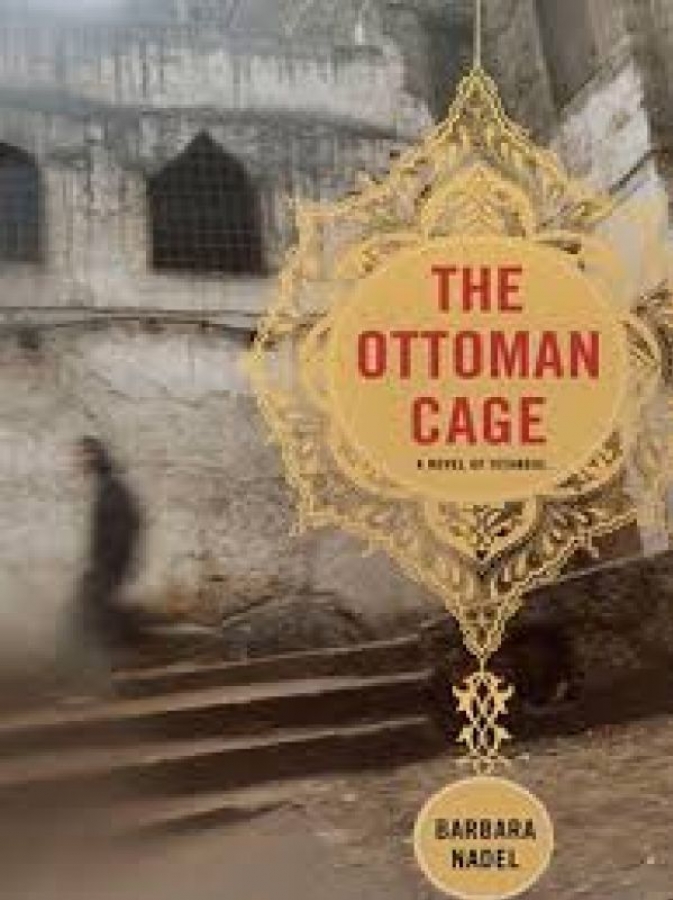
The Ottoman Cage: a novel of Istanbul
A body is found in an old, typically wooden building adjacent to the Topkapi Museum, in Istanbul. It is a young man, kept locked away for years, sedated by the constant use of drugs. He is uncircumcised, and the apartment’s tenant is described by the neighbors as a reserved Armenian gentleman. Everything points to a crime within the Armenian community, but > the inhabitants of Istanbul are not known for their predilection for simple things . A difficult investigation begins. Leading it is Inspector Ikmen: a typical modern Turk, secular, seemingly broad-minded, but in fact deeply attached to tradition. Devoted to his work and to frequenting bars at night, he neglects his large family and his sick wife. Despite her serious condition, he has left his father in her care, now ravaged by senile dementia. The coroner, and Ikmen’s best friend, is a well-to-do Armenian physician, while his primary colleague on the police force is Jewish. It is a mixture of communities that reflects the history of Istanbul, with the distinction that Armenians, owing to the 1915 genocide, are > somehow a special case, even compared to the other non-Turkish communities . This distinction is called distrust. Can an Armenian be trusted, even if he has been a friend and colleague for years? Or is it true, instead, that the bond among Armenians is stronger than friendship and the institutional role one holds? Alongside the investigation, which progresses through unexpected revelations, the novel deals with cooperation among people belonging to different cultures, histories, and religions. Only if institutional loyalty takes precedence over clan solidarity is there any guarantee that freedom can exist. As Ikmen says > we who have chosen to serve the law must put it first, ahead of our personal feelings , because as long as “there are men like us, the ‘others’ cannot really take control.” It is a well-crafted noir. The author unravels the clues with skill, albeit with a narrative pace devoid of suspense, at times tedious. Alongside the main plot, the personal affairs of the various protagonists unfold. In particular, the narrative lingers on the figure of Ikmen. His indifference toward his wife makes him genuinely unsympathetic, beyond the emblematic function the author seems to assign him: that of modern Turkey’s contradiction between East and West. The inclination to dwell on sexual perversions and the trite, predictable ending compromise the quality of a novel that is, in other respects, well written. Why read it? It is a good noir.
Our Man in Havana
The novel is set in Cuba in the period immediately preceding the revolution. The protagonist, a vacuum cleaner salesman (business is bad) and a widower with a fourteen-year-old daughter, is recruited by British intelligence as an agent in Havana. Enticed by the money, the protagonist fabricates a fictitious network of spies and invents a stream of reports, which are, of course, utterly false. Given the importance his operation assumes, London dispatches two agents to support him, among whom is Beatrice, with whom the protagonist falls in love. The narrative unfolds around this paradoxical premise, satirizing the machinery of espionage. Even when unmasked, the protagonist will be offered a position within the organization, as admitting a mistake is out of the question and, in any case, some grain of truth might still reside in the intelligence provided, blatantly fabricated though it is. Graham Greene himself placed this novel in the category of "entertainments," and this classification has undoubtedly influenced critics and readers in their interpretation of the book: a mockery of the world of espionage and an indictment, albeit framed as satire, of its tendency to distort reality (a remarkably timely subject). In truth, if one reads the novel outside this interpretive framework, other thematic layers emerge: the imaginary world forged by the protagonist (a web of spies and false reports) sets in motion a sequence of events, some of them tragic, that destroys the peace and the bonds of friendship that had defined his life. Furthermore, the latter acts by prioritizing familial devotion (providing his daughter with a prosperous future) over the demands of politics and the values of allegiance to one's country. What emerges is the contradiction between "genuine" values, formed by friendship and family ties, as opposed to "false" ones > , represented by a sense of belonging to abstract entities, such as the nation and ideologies. In the epilogue Beatrice, in truth the only genuinely positive character in the novel, explains to her superiors that even had she known, she would not have stopped the protagonist, because he was working for something important, not for someone's conviction about a global war that might never happen... and what does one's country mean anyway: a flag that someone invented two hundred years ago." The most significant limitation, which renders the label of "entertainment" appropriate, lies precisely in the figure of the protagonist, who seems not to realize what he has created, passively enduring events and leaving it to others to create and resolve problems. This is a passive attitude, which at times renders the novel monotonous and predictable. The style is highly effective, closely tied to dialogue, with a sentence structure displaying clear cinematic hallmarks: the English is classic.