Finished reading on: March 15, 2008
Oliver Twist
AI Translation Notice: This review was translated from the original Italian using artificial intelligence. Book quotes and excerpts are translated interpretations and will not match the author's original English phrasing or official published translations.
The setting is the England of the second half of the nineteenth century, marked by widespread poverty, rising criminality, and a bigoted bourgeoisie that was often hostile toward the poor.
Oliver is a foundling who is first raised in a workhouse, only to be apprenticed (or handed over) to a family to learn a trade.
There he suffers relentless abuse and consequently decides to flee, only to fall into the hands of a gang of criminals led by an avaricious and cruel Jew (Fagin), and by another character who is violent and paranoid.
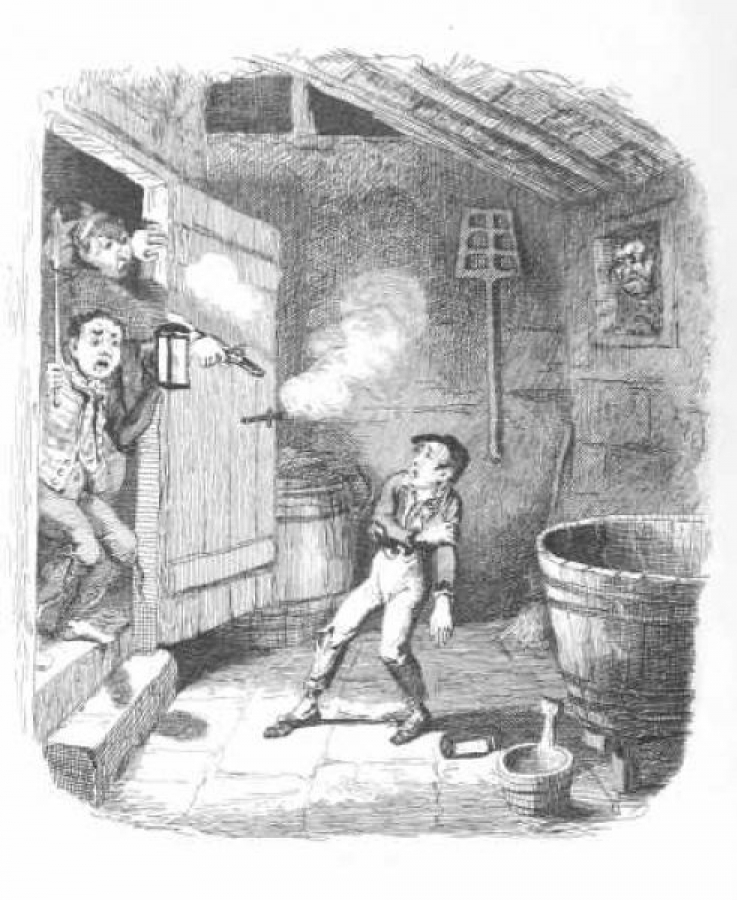
Oliver is forced to learn how to steal; during a burglary, however, he is wounded and taken in by a family who nurses him back to health, thereby introducing him to the kindness and generosity of the respectable middle class.
There follows a series of adventures and an entanglement of characters, through which it is ultimately revealed that Oliver is the heir to a vast fortune and had been abducted by the Jew on behalf of his half-brother, who sought to prevent Oliver from claiming his lawful birthright.
All ends well: the villains are punished, and Oliver can live happily with his new family.
At a certain point in the novel, Dickens recalls how
it is the custom on the stage in all murderous melodramas to present comic scenes and dramatic scenes in regular alternation.
Such changes appear absurd: but they are not so unusual as they seem at first sight.
The transition in real life from a well-spread board to the deathbed, and from mourning weeds to holiday garments is no less incredible: only, there, we are actors rather than passive spectators, and that makes a vast difference
.
Life is thus an endless surprise, and the story of Oliver Twist seeks to portray the nineteenth-century journey of a hero in the era of massive urbanization.
Yet there is nothing fantastical or truly adventurous in Dickens’s tale, save for a sequence of frequently maudlin episodes steeped in a facile moralism that sharply demarcates good from evil.
In the first part of the novel, recounting the trials of young Oliver, the author still displays a subtle irony toward the English society of his day and a critique of the hypocritical approach to poverty that conceals contempt and cruelty beneath a veneer of charity and benevolence.
Particularly effective in this regard is the scene where young Oliver, timid and awkward, appears before the workhouse board to be evaluated regarding his future placement.
Dickens describes the various board members masterfully, revealing a lucid portrait of a bourgeoisie that views poverty as an innate predisposition toward wickedness and misfortune.
Similarly, the author advances a social critique against the exploitation of child labor and the utter disregard for children's physical and intellectual needs.
In the novel’s second half, the narrative lapses into melodrama, drawing a stark divide between the “world of good” (the middle-class gentry fueled by wholesome sentiments) and the “world of evil,” embodied by society’s underworld: the grasping Jew, the young prostitute who ultimately redeems herself, the brute, and the wicked half-brother.
Oliver himself fades from view, while Fagin emerges as the pivotal figure, incessantly scheming in his pursuit of wealth and possession.
The finest scenes are precisely those depicting the gang of criminals and their movements through the streets of London: a dark, filthy, decaying city where people dwell in windowless, dilapidated, foul-smelling tenements.
In its richness and expressive power, the depiction of London recalls D’Annunzio’s poetry on the monstrous cities.
Urbanization is viewed by Dickens as the community’s descent into an inhuman world, in contrast to the countryside, where one can live happily and serenely.
It is hardly coincidental that Oliver and his companions ultimately abandon London to return to the small villages of rural England.
The plot is predictable, an overbearing moralistic approach predominates, and the style is not always fluid—the sentence structure being frequently convoluted and redundant: all elements that render the novel scarcely enjoyable.