Graham Greene
Books by this author (5)
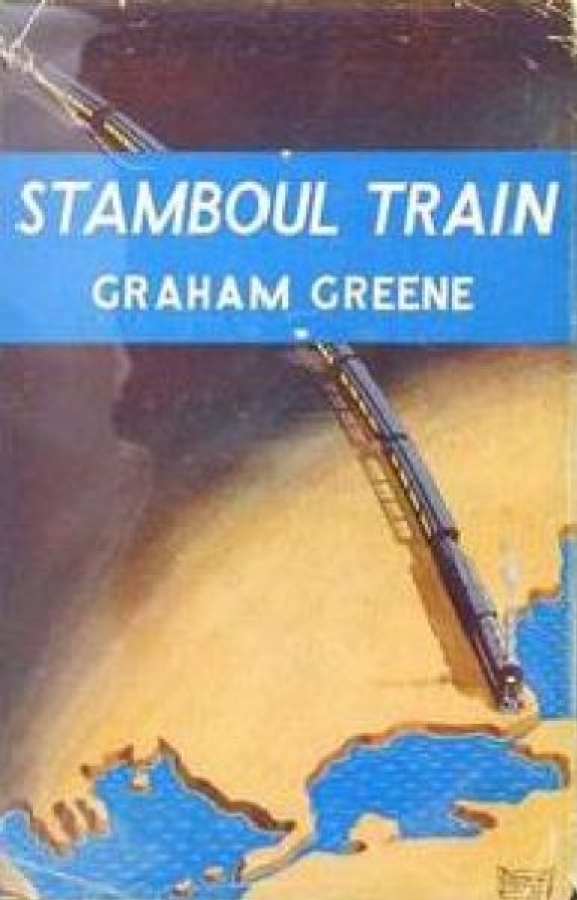
Stamboul Train
The novel recounts the journey from Ostend to Istanbul of a group of travellers: a female journalist with her lover, a young Jewish merchant on a business trip, a thief turned murderer despite himself (on the run), a famous political fugitive, and a young woman named Coral. During the journey, adventures and love stories intertwine, in particular the romance between the young merchant and Coral, between whom a genuine and lasting relationship seems to blossom. At the Hungarian border, the police arrest the political fugitive (tipped off by the journalist), along with the thief and Coral. The three manage to escape, but during the flight the political fugitive is mortally wounded and Coral stops to tend to him. The young merchant, who was waiting with a car, leaves nonetheless for Constantinople, where he enters into a marriage of convenience. All the characters are driven by selfish interests (money, fame, business, etc. ) with the exception of Coral, who gives up the young merchant in order to care for the political fugitive. The girl is thus the only figure who reflects genuine feelings, unmediated by economic and ideological superstructures, but oriented toward the deeper dimensions of human life, such as solidarity toward a person in distress. This novel, too, belongs to Greene’s “entertainment” vein, yet frankly from this perspective it is undoubtedly disappointing: the pacing is slow by the standards of modern detective fiction to which we are accustomed, and in any case insufficient to generate suspense and drive interest in the plot. The most compelling section is the detention at the Hungarian border, as the contradictions of the various characters finally emerge and Coral’s figure comes to the fore. Unlike *Our Man in Havana*, the novel is marked by a pervasive, profound bitterness: selfishness and vacuity invariably prevail over altruism and sincerity. Interpersonal relationships are dominated by false feelings and by the pursuit of self-interest and narcissistic gratification.
Murder for the wrong reason
This is a short story, divided into three chapters. In the first, the corpse is discovered and, as in classic detective fiction, the inspector arrives with his assistant. The author seems to take pleasure in reconstructing the dynamics, well-tested by crime literature, between the seasoned superior and the young officer. From the outset, however, certain peculiarities emerge. The inspector claims to have arrived too late to save the victim (did he know then that he was about to be killed?), who deserved, according to the inspector, to be murdered, being a blackmailer who had numerous affairs with women. Solving the case is difficult, he then adds, “as there are five hundred men, and other women, with a motive.” It must be said that the reader is left disoriented by the first chapter, sensing something unusual yet not quite able to grasp the direction of the story. The second chapter opens receptive to any development. The inspector visits the alleged killer’s house (and, tellingly, goes alone, without his assistant), and here the narrative turns into a continuous oscillation between past and present. The inspector addresses the suspect, who does not reply, reminding him of bygone events: the man had once been in love with a woman who ultimately chose the victim over him because he was wealthy and powerful. The story now abandons the order and rationality of a detective tale, increasingly becoming a sequence of images from the inspector’s mind. The memory of his life resurfaces: > a succession of images drifted through his mind, of days and nights of great passion, tenderness, and continuous peace. He forgot the days during which he had watched the slow disintegration of his own personality and corruption; he even forgot that he was Detective Inspector Mason of Scotland Yard . Yet the bond between past and present is like a mirror in which one is reflected, and through which one can view the present from the past and vice versa. At this point, the mystery grips the reader, and, as in all detective novels, the solution is simple: the inspector is the murderer. One realizes that the second chapter has conveyed the inspector’s thoughts, and that the entire sequence lasted only a few minutes. The third chapter details the mechanics of the crime as well as the evidence that pins down the murderer. A brief yet fascinating story, albeit a challenging read. First of all, the theme of reality’s ambiguity emerges, which only in death finds a consistency beyond imagination: “after all, everything was reduced to a biological fact.” Secondly, the story is a display of virtuosity, both in terms of narrative structure—capable of generating disorientation and suspense in the reader—and in its writing technique. The author readily resorts to idioms and vocabulary belonging to colloquial speech, which does not always make the text immediately accessible: this contributes to the mysterious allure of the story. Why read it? To appreciate the author’s narrative technique.
The power and the glory
The novel is set in Mexico during the period of civil wars between 1911 and 1924, when various revolutionary governments pursued a vigorous anti-Catholic policy in open opposition to the Church of Rome. The protagonist is a priest, a «whisky priest», an alcoholic, father to a daughter he abandoned, a coward to the point of letting hostages who refused to betray him be condemned to death; in short, a «bad priest». Hunted for years by the police, he manages to cross the border, and once he is finally safe, he decides to return to Mexico to hear the confession of a dying murderer. He is subsequently captured and executed by firing squad: he dies like a saint, and the Church ultimately triumphs. Generally interpreted through a religious lens as a celebration of the superiority of faith and the Church’s capacity to continually rise again from persecution, the most compelling part of the novel lies in its depiction of the profound material and human squalor of a poor, wretched society in which—and to whose detriment—the protagonist’s ordeal unfolds. It is peasant, mestizo Mexico, composed of uneducated people endowed with great dignity and a religiosity so naive and deeply felt that they are willing to risk their lives to preserve it. The pages describing the priest’s arrival in the village where he was once parish priest and where he had a lover (if only for a single night) who bore him a daughter are deeply evocative. The villagers are afraid and urge him to leave, yet they shelter him, asking to confess and to attend Mass, even though the soldiers are only a few miles away. When the troops arrive, take a hostage, and interrogate the villagers, the priest hides and remains unbetrayed. In this circumstance, as in others, there emerges the stark contrast between the strength of the peasants’ feelings and the vacuity of the protagonist, who, the moment he resumes his sacerdotal role, instantly recovers the arrogance, smugness, and self-assurance of a man who knows he holds the conscience of the people in his hands. Far from being a novel celebrating the Church of Rome! Perhaps in spite of the author’s own intentions, what emerges with dramatic force is the desolation of a religion founded on hypocrisy and the manipulation of consciences. The novel seems almost a companion piece to Dostoevsky’s splendid dialogue between Christ and the Grand Inquisitor. The novel ought to have concluded at the end of the second part, when the priest finally finds a church and > si sedette improvvisamente sul prato intriso di pioggia e appoggiando la testa contro la parete bianca cadde addormentato, con la casa dietro le spalle. Il suo sogno fu pieno di suoni gioiosi . Instead, the author chose to provide a conclusion that exalted sacrifice, burdened with a long, tedious description of the capture, implausible conversations between the priest and a police officer, and a final celebration featuring the reappearance of another priest: utterly gratuitous chapters that severely compromise the quality of the book in terms of both content and narrative pacing. The style is characteristically Greene’s, structured across different episodes and undeniably evocative in its portrayal of atmosphere; as usual, however, the dialogue and the psychological introspection of the characters fall short of the vivid illustration of the setting.

Our Man in Havana
The novel is set in Cuba in the period immediately preceding the revolution. The protagonist, a vacuum cleaner salesman (business is bad) and a widower with a fourteen-year-old daughter, is recruited by British intelligence as an agent in Havana. Enticed by the money, the protagonist fabricates a fictitious network of spies and invents a stream of reports, which are, of course, utterly false. Given the importance his operation assumes, London dispatches two agents to support him, among whom is Beatrice, with whom the protagonist falls in love. The narrative unfolds around this paradoxical premise, satirizing the machinery of espionage. Even when unmasked, the protagonist will be offered a position within the organization, as admitting a mistake is out of the question and, in any case, some grain of truth might still reside in the intelligence provided, blatantly fabricated though it is. Graham Greene himself placed this novel in the category of "entertainments," and this classification has undoubtedly influenced critics and readers in their interpretation of the book: a mockery of the world of espionage and an indictment, albeit framed as satire, of its tendency to distort reality (a remarkably timely subject). In truth, if one reads the novel outside this interpretive framework, other thematic layers emerge: the imaginary world forged by the protagonist (a web of spies and false reports) sets in motion a sequence of events, some of them tragic, that destroys the peace and the bonds of friendship that had defined his life. Furthermore, the latter acts by prioritizing familial devotion (providing his daughter with a prosperous future) over the demands of politics and the values of allegiance to one's country. What emerges is the contradiction between "genuine" values, formed by friendship and family ties, as opposed to "false" ones > , represented by a sense of belonging to abstract entities, such as the nation and ideologies. In the epilogue Beatrice, in truth the only genuinely positive character in the novel, explains to her superiors that even had she known, she would not have stopped the protagonist, because he was working for something important, not for someone's conviction about a global war that might never happen... and what does one's country mean anyway: a flag that someone invented two hundred years ago." The most significant limitation, which renders the label of "entertainment" appropriate, lies precisely in the figure of the protagonist, who seems not to realize what he has created, passively enduring events and leaving it to others to create and resolve problems. This is a passive attitude, which at times renders the novel monotonous and predictable. The style is highly effective, closely tied to dialogue, with a sentence structure displaying clear cinematic hallmarks: the English is classic.
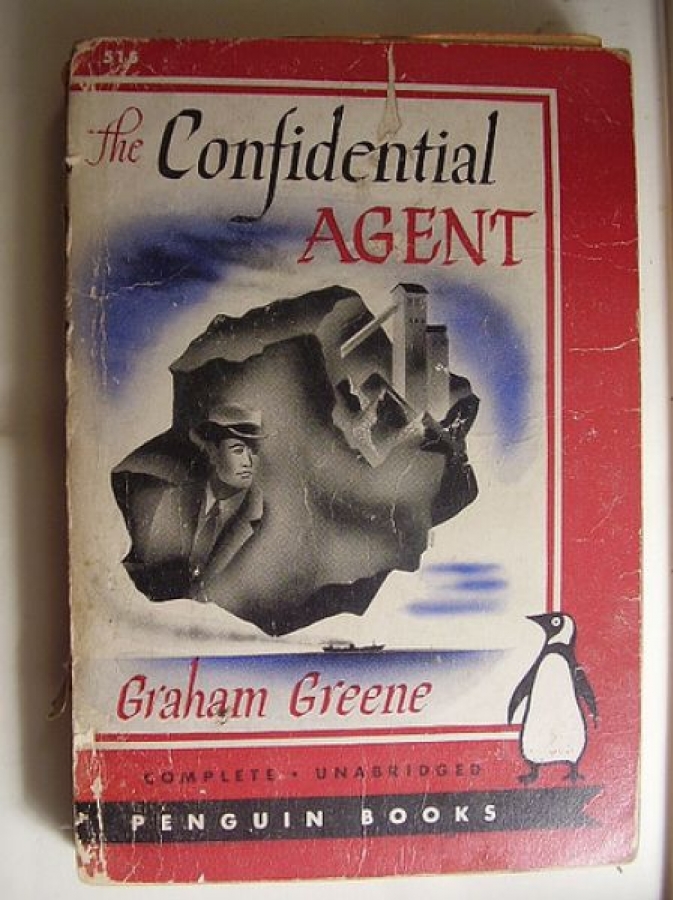
The Confidential Agent
The novel is set in England, where a secret agent must negotiate the purchase of coal for his country at war. The book is dull, perhaps because it is not so different from Greene’s other adventure novels, and in any case it lacks the irony and narrative pace of *Our Man in Havana*.