Finished reading on: April 08, 2009
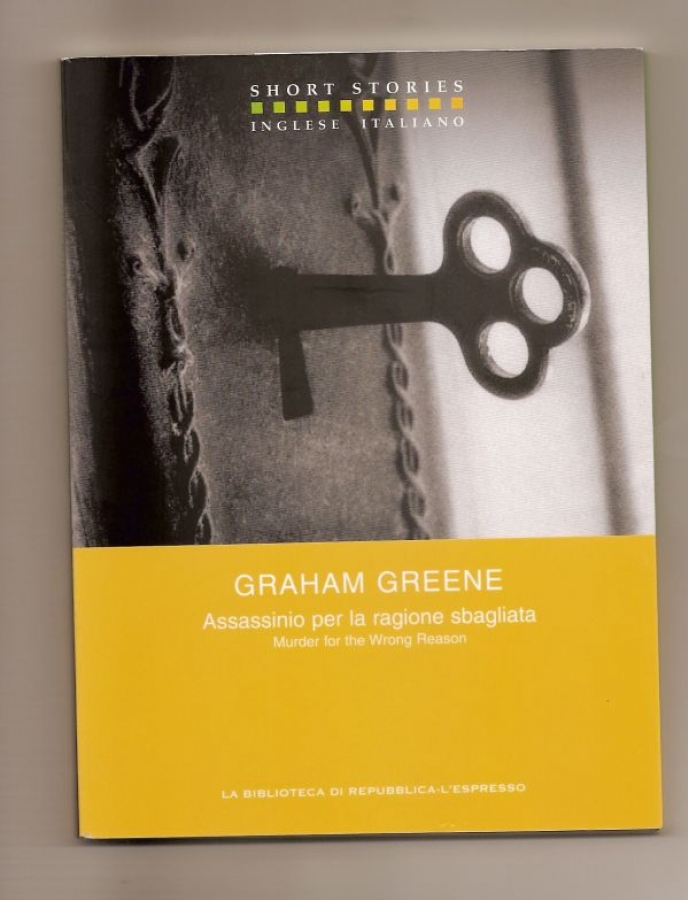
Murder for the wrong reason
AI Translation Notice: This review was translated from the original Italian using artificial intelligence. Book quotes and excerpts are translated interpretations and will not match the author's original English phrasing or official published translations.
This is a short story, divided into three chapters.
In the first, the corpse is discovered and, as in classic detective fiction, the inspector arrives with his assistant.
The author seems to take pleasure in reconstructing the dynamics, well-tested by crime literature, between the seasoned superior and the young officer.
From the outset, however, certain peculiarities emerge.
The inspector claims to have arrived too late to save the victim (did he know then that he was about to be killed?), who deserved, according to the inspector, to be murdered, being a blackmailer who had numerous affairs with women.
Solving the case is difficult, he then adds, “as there are five hundred men, and other women, with a motive.”
It must be said that the reader is left disoriented by the first chapter, sensing something unusual yet not quite able to grasp the direction of the story.
The second chapter opens receptive to any development.
The inspector visits the alleged killer’s house (and, tellingly, goes alone, without his assistant), and here the narrative turns into a continuous oscillation between past and present.
The inspector addresses the suspect, who does not reply, reminding him of bygone events: the man had once been in love with a woman who ultimately chose the victim over him because he was wealthy and powerful.
The story now abandons the order and rationality of a detective tale, increasingly becoming a sequence of images from the inspector’s mind.
The memory of his life resurfaces:
a succession of images drifted through his mind, of days and nights of great passion, tenderness, and continuous peace.
He forgot the days during which he had watched the slow disintegration of his own personality and corruption; he even forgot that he was Detective Inspector Mason of Scotland Yard
.
Yet the bond between past and present is like a mirror in which one is reflected, and through which one can view the present from the past and vice versa.
At this point, the mystery grips the reader, and, as in all detective novels, the solution is simple: the inspector is the murderer.
One realizes that the second chapter has conveyed the inspector’s thoughts, and that the entire sequence lasted only a few minutes.
The third chapter details the mechanics of the crime as well as the evidence that pins down the murderer.
A brief yet fascinating story, albeit a challenging read.
First of all, the theme of reality’s ambiguity emerges, which only in death finds a consistency beyond imagination: “after all, everything was reduced to a biological fact.”
Secondly, the story is a display of virtuosity, both in terms of narrative structure—capable of generating disorientation and suspense in the reader—and in its writing technique.
The author readily resorts to idioms and vocabulary belonging to colloquial speech, which does not always make the text immediately accessible: this contributes to the mysterious allure of the story.
Why read it? To appreciate the author’s narrative technique.