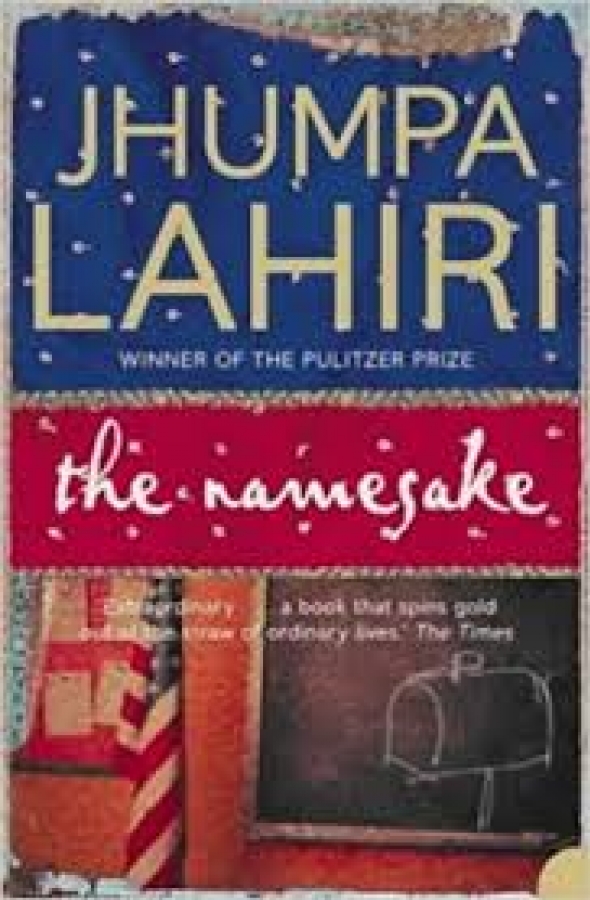
The namesake (the nickname)
> Transform yourself into words: (...) if running around a single name it is always you and me at stake and always the same the potent weapons of mourning and affliction that even in dreams chase my smoothness to ruin (Cosimo Ortesta, from *Il progetto di un freddo perenne*, 1988). Reading this novel brought this line of Ortesta’s to mind: names follow us throughout our existence, speaking of ourselves, of the bond we share with others, and of all the feelings, even painful ones, we carry with us; as Lahiri writes, “names die over time, they perish with people.” Gogol is the son of a Bengali couple who moved to the United States; the name was bestowed upon him at birth while awaiting the “true > name that was supposed to arrive from India, but never did: a pet name, then, chosen by his father out of his passion for Russian writers. Gogol hates even signing his name at the bottom of his drawings in art class. He hates that it is at once absurd and obscure, that it has nothing to do with who he is—that is, neither Indian nor American, but above all not Russian > . Being named Gogol is the mark of his ambiguity, of an identity suspended between two worlds, two different cultures, histories, and traditions. And Gogol attempts to break free from this indeterminacy, to escape the name, stubbornly pursuing separation from his parents and from the large, noisy, crowded Bengali community, with its clothing, cuisine, customs, and language—strenuously defended precisely because they live far from their homeland. He is weary of returning to Calcutta to visit relatives, a journey so eagerly anticipated by his parents. And above all, he no longer wants to be called Gogol. He goes to study far from home, earns a degree in architecture, finds work in another city, changes his name to Nikhil. The protagonist's attitude does not shift even when he learns the true reasons that led his father to give him that pet name. One evening, the train bringing Nikhil home is severely delayed. His father waits for him at the station in a state of great anxiety: he reveals to him that he named him Gogol because, as a young man, he was one of the few survivors of a catastrophic train accident; the book by the great Russian writer had saved him. Is this what you think of when you think of me, Gogol asks him, Do I remind you of that night? Not at all, his father says at last, with a hand on the boy’s hip, an accustomed gesture that had embarrassed Gogol up until that moment. You remind me of everything that followed > , that is, of family, work, and hard-won prosperity; and the name bestowed upon his son holds many meanings, not least what Dostoevsky said: we all came out of Gogol’s Overcoat > . The enigmatic phrase cannot yet be understood by young Nikhil, who resumes his flight from his roots. He meets Maxine, a classic daughter of the upper-middle-class liberal > , with beautiful homes, beautiful objects, solid points of reference. A guest at the house where Maxine’s parents—so cultivated and accommodating—spend their holidays, by the shores of a splendid lake amid woods and green meadows, Gogol understands that this is a place that will always be here for her. It makes it easy to imagine Maxine's past, her future, to picture in his mind her growing old. (...) Through the windows, he sees that dawn is slowly emerging in the sky, only a few stars are still visible, the silhouettes of the surrounding trees and buildings gradually become distinguishable. A bird begins to sing. And then he remembers that his parents cannot reach him: he hasn't given them the phone number. (...) And here beside Maxine, in this welcoming wilderness, he feels free. > The flight is cut short when his father suddenly dies. The rush to the morgue, the identification, gathering the few possessions his father had with him, the return home to his now-solitary mother, the Indian funeral rites surrounded by the entire Bengali community, brutally pull Gogol back to his condition of being neither Indian nor American, nor even Russian. Maxine invites him on a vacation together (because it might do you good (...) to get away from all this”); Nikhil replies to her: “I don’t want to get away > . And just like that, he is Gogol once more; he lets his mother guide him into a marriage with a Bengali girl, in a lavish and crowded ceremony he would have scornfully refused only a short time before. Reclaiming one's identity is not so simple. We cannot delve deeply into the story of the girl Gogol marries—a tale within the tale. We can only outline a few fundamental traits: she has a name unpronounceable in American and is therefore called by a pet name; she too fled her family, went to Paris where she acquired a third language (neither American nor Bengali), returned to the United States to teach French literature at university, surrounds herself with refined intellectuals (so removed from Gogol’s straightforward technical background), has had many men, betrays Nikhil, returns to Paris. Gogol is a romantic, and as such engages in a love affair—intense at least for him—genuinely believing he has found solid roots in a modern Anglo-Bengali family. The betrayal and separation abruptly throw him back into a state of limbo. He wonders how his parents managed, leaving behind their respective families, seeing them so rarely, without a place to reunite, in a perennial state of waiting, of nostalgia. (...) Gogol knows that his parents lived their lives in America despite what they lacked, with a strength he fears he does not possess.” What's in a name? Shakespeare wonders in *Romeo and Juliet*: “that which we call a rose by any other name would smell as sweet > . The novel does not tell us whether Juliet is right. In the old house his mother is vacating to move to Calcutta, Gogol finds the stories of the great Russian writer once again: a book his father had given him as a teenager, which he had abandoned on the shelf with a mixture of indifference and annoyance. And he finds a dedication: the man who gave you his name, from the man who gave you your name.” Here is Dostoevsky’s enigma: “the name he had so detested was hidden and preserved here. (...) Those who had given and preserved the name of Gogol were far from him now. One dead, the other, a widow, on the verge of a different kind of departure, to live filled with nostalgia, like his father, in a world apart. (...) Once or twice a week he will hear the name Gogol over the telephone wires, or written on a screen. (...) Without people in the world to call him Gogol, no matter how long he lives, Gogol Ganguli, once and for all, will vanish from the lips of those who love him, and so, cease to exist. It is an intense and complex novel: fluid, elegant prose, a spasmodic attention to detail. Places, objects, food, clothing are meticulously described, unlike the characters, who are not treated superficially, but rather deliberately kept always waiting” for something else, or yearning with nostalgia for something else. The author seems to be saying: everything is vacuous except places, naturalistically rendered yet rich in myth, suggestion, transmitters of values and worlds. At times one loses the thread of the plot, but what does it matter? The allure resides in the writing, and it is up to the reader to reassemble and interpret the whole. Why read it? A masterpiece, fascinating and dense with meaning and resonance.

The Birth of Rome
The book chronicles the events surrounding the birth of Rome through the story of two brothers, Servio and Plistino. Enslaved, they flee to find freedom in Rome, which was then coalescing around the figure of Romulus. The two brothers make their fortune, but Servio is unable to have children, and Plistino’s descendants perish in a plague. Servio and his wife resolve to adopt one of the brothers of Plistino’s wife so as to perpetuate the family name. The novel features all the most celebrated episodes of the founding of Rome, yet the style and storytelling elevate when dealing with domestic themes: the love between spouses and the bond with children, death and grief, a religion centered on the veneration of ancestors, adoption as the expression of a love that transcends ties of blood, and the values of justice and freedom. The pedagogical intent is less pronounced here than in *Storia delle Storie del mondo*, yet the prose retains that affectionate, gentle, and at times lyrical tone distinctive of the author. The narrative structure is often fragmented, lacking the momentum required to keep the reading from growing tedious at times (particularly in the middle section).

No one turns back
We find ourselves shortly before the Spanish Civil War (1936–1939); a group of young women comes together in a nunsʼ boarding house in Rome. An intimate and intense friendship develops among these young women, despite their different social classes and diverse personal experiences. It is as if the external social structure were momentarily suspended, allowing them all to live with a freedom and sincerity unthinkable out in society. > They went on confiding in one another: at first they seemed to feel a certain shyness about their aspirations, then, little by little, they laid themselves bare, even moving closer, touching each other to communicate better, until Silvia observed: ---still, it is wonderful to talk like this among ourselves, all women: if a man were here, we would never have dared speak (...). We women are sincere only among women. There is a singular solidarity among us. It is a feminine world, conscious of its exceptional condition and nonetheless waiting for what comes next, when they leave the boarding house. > Here we chose one another from among so many, one might say, out of genuine affinity. Yet it is only the continuous, daily familiarity that binds us; as soon as that falls away, an unbridgeable distance opens between us . And yet something will remain. > Who can forget having been mistress of herself? (...) Those who stayed behind, who passed from their motherʼs hands into their husbandʼs hands, do not forgive us for having seen new things, new faces, for having had the key to our room, coming and going at whatever hour we pleased. And men do not forgive us for knowing as much as they do . Disrupting a state so rich in reciprocal humanity (as Confucius would say) is the arrival of Emanuela. > I donʼt understand what she is doing here--Silvia remarked from the bed--she doesnʼt study, did you notice? and one comes here to study . Emanuela is at the boarding house in Rome to be close to her daughter, born of an extramarital affair. The young woman does not intend to reveal her peculiar situation to her friends; she pretends to be like them because she wishes she were—unencumbered, still with all of lifeʼs possibilities before her. > I belong to your group. An oath sworn upon the common table, like the musketeers. Eight for one, one for eight. And now I know everything about them, who with others are so secretive and elusive. And what do they know about me? All lies. The flawless harmony among the young women falters, as if an alien presence, that of Emanuela, were setting fire to the dormant embers of individual destiny. The first to leave is Xenia: she flees the boarding house after failing her degree examination, disappears without a trace, and goes to live in Milan, becoming a cynical woman who uses men for her own gain. > To her, of all pleasures this alone seemed an ineffable delight: to enjoy herself, her own company, her own image . Then Milly dies, gravely ill: «Her companions were right to wonder whether she had ever truly existed». Next comes Anna, the daughter of wealthy landowners, who, as soon as she graduates, marries a peer from her own social class, shelving her studies, friendships, and freedom simply to live on her family estates. > I think, she continued earnestly, that it is a mistake to wish to leave oneʼs own social class and force oneʼs way into another . Vinca also leaves the boarding house—a Spanish woman who fled home to avoid living with her stepmother; she stays with compatriots awaiting news of her fiancé, who went off to fight for Franco in the civil war; her beloved, however, has married another woman there in Córdoba, and Vinca has no choice but to remain in Rome, living modestly by giving Spanish lessons. Then there is Silvia, plain but intelligent, who graduates with honors. > And now, Silvia? Now? Nothing had changed except that 'Dr.' she could place before her name. She would have to do everything on her own . Augusta and Valentina remain, destined for spinsterhood and for this reason bound by a peculiar friendship, shielded by the walls of the boarding house. And it is they, custodians of an utopia of female communion, who finally drive Emanuela out. > Her torso bent forward, her face next to hers, breathless, Augusta spoke to her in a muffled, murky voice: Thief! (...) Not even the other day, when you were in bed, did you speak. (...) Yourself, always before anything else. (...) You must leave now. (...) Tonight, before all of them, I wanted to tell you: Get out! But then I thought that it isnʼt your fault: there are beings who, like you, are born flawed, indifferent . We are in the presence of a great female novel, perhaps the first in Italian literature. The protagonists are women in all their complexity: their feelings, erotic reveries, and aspirations. Men are entirely absent, and when they do appear (one need only think of Xeniaʼs trajectory), they serve merely as instruments for achieving goals conceived by the protagonist in solitude, without the contribution of the opposite sex. The setting is the 1930s, and one can well imagine the revolutionary impact of such a narrative, even within an apparently traditional framework. The young womenʼs paths, once they leave the boarding house, diverge into different yet entirely plausible stories: in some way, they also reflect the diverse facets of the female psyche—a coexistence of ideas, emotions, and desires that the author likely felt within her own consciousness as a young woman with so many potential destinies still ahead of her. None of the protagonists will achieve complete fulfillment; all will, in one way or another, betray the fullness and multiplicity of female nature, resigning themselves to a single path—traditional, transgressive, or vacuous, yet always a single path, necessarily reductive of the complexity of the human soul. Yet how many of us, men or women, abandon the multifaceted richness of youth? Perhaps because, as Silvia remarks, «living events is much easier than imagining them». Regarding the narrative style, there is little to say: the writing is flawless, the diction elegant, the entire literary construction refined. It is a splendid contribution to the Italian language, a demonstration of how one can write in a manner both erudite and lucidly simple. Why read it? A great book of womenʼs literature.

All Quiet on the Western Front
The novel, made famous by a film, is a war diary. Set during the First World War, it recounts the story of a group of German twenty-year-olds: “the iron youth,” as their schoolmasters called them. Everything is confused; memories of their previous lives are > mute visions, (...) an immense, disconsolate melancholy. (..) As long as we were in the barracks they awakened in us a wild and rebellious longing. (...) But here in the trenches that world is lost. The memory rises no more; we are dead, and it appears far away on the horizon like a ghost, like an enigmatic reflection that torments us and that we fear and that we love without hope. (...) And even if it were restored to us, this landscape of our youth, we would no longer really know what to do with it . What Paul, the first-person narrator, recounts is a descent into hell; and he does so without rhetoric, victimhood, or self-indulgence. > Our thoughts are like soft clay molded by the shifting fortunes of the days; they are good when we are at peace, dead when we find ourselves under fire. Churned-up ground, within us and without us . The book retraces the various facets of military life amid the great slaughter that was the First World War: the agony of a comrade-in-arms ( > This is Franz Kemmerich, nineteen and a half years old; he does not want to die, Do not let him die! ), whose fine boots are appropriated while he is on his deathbed; the harsh and oppressive discipline of the barracks, the infantryman's petty revenges against the obtuse and malicious non-commissioned officer; the vital importance of rations, the scrounging and stealing to supplement meager food; visits to young prostitutes while dreaming that they are the girls from the propaganda posters; the atmosphere of the field hospital, where limbs are amputated amid the wretches' shrieks, and men can hardly wait for a dying comrade to vacate a bed; leave back home, made grating by having to endure the warmongering speeches of the “bourgeoisie”; friendship, a bond strong enough to make the harshness of a soldier’s life bearable, yet so fragile because companions die so easily; and, finally, the trenches. Anyone expecting an epic tone, a sort of *Iliad*, will be disappointed. The fighting is, in truth, pure butchery: bodies riddled with bullets and pulverized by shells, the death rattles of the wounded with disemboweled bellies, blood and corpses everywhere, even the screams of dying horses; all that matters to the infantryman is survival. > We have become dangerous beasts, we no longer fight, we defend ourselves against annihilation. (...) We rave with rage, we are no longer bound helplessly to the scaffold, we can destroy, kill in our turn, to save ourselves, to save ourselves and to avenge ourselves . The book is an indictment of war, not only because it is absurd and cruel, but because it transforms men, stripping them of their humanity: > this life has reduced us to barely thinking animals, (...) it has kneaded us with insensibility, to make us withstand the horror that would crush us; (...) it has given us the indifference of savages so that we may endure, despite everything, every moment of reality. (...) Thus we lead a closed, hard existence, entirely on the surface . There is no plot in the strict sense; the characters act like people living “empirically,” day by day, devoid of apparent feelings, which would in any case be useless to show. The narrative is sustained by an essential, stripped-down prose made of short, almost frantic sentences capable of driving the story forward at a relentless pace. At times, moments of calm supervene, such as life in the barracks or leave at home (and here the author's stylistic weakness emerges); yet this is momentary: the images of the great slaughter return, evocative of that cruel death which is war; despair overwhelms us, and we realize that life is a wretched semblance. There are only stumps of life: > red poppies on the meadows around our billets, glossy insects on blades of grass, warm evenings in the cool, half-dark rooms, black and mysterious trees in the twilight, stars and the flowing of waters, dreams and long sleep . Why read it? It reminds us of what war truly is.

Nothing is true except the eyes
With this novel as well, Faletti confirms his standing as a fine author of American-style thrillers. An excellent style and a brisk narrative pace that nonetheless leaves room for evocations of the mysteries surrounding life and human relationships. The only flaw lies in the fact that the protagonist sees the scenes through the eyes of one of the murder victims—eyes that were transplanted into her. It is an implausible conceit that introduces a jarring note, one that is, moreover, superfluous to the unfolding of the plot.

The New Life
The novel’s protagonist is the book: a book, but also all books. > The culprit is not only that book, the book that deceived my son, but all books pouring from the printing presses; they are all enemies of our time, of our lives . Thus spoke Mehmet’s father menacingly—Mehmet being one of the novel’s central figures, the first to read the book and flee. The other two protagonists are Osman, a young student who falls in love with Canan, Mehmet’s girlfriend. It is she who leads Osman to read the book, and the two youths embark on a dizzying journey across Turkey, ostensibly in search of Mehmet, though they are in fact driven by a restlessness, an existential malaise ignited by the reading of the book: > passengers of night buses, wretched brothers, I know that you too seek that weightless moment. You want to be neither there nor here, to become other and wander in the pleasant garden that lies between the two worlds . Yet what are these two worlds? Current life and the new life, or the quest for the angel: death. The novel unfolds as a succession of bus journeys, fatal crashes, blaring television sets, travelers, and surreal landscapes. The search for Mehmet ends with Osman killing him, hoping to rid himself of his romantic rival; yet at this juncture the quest remains unfinished, for Osman has failed to attain any inner equilibrium. He resumes his travels, fully aware that the true threshold into a new life is death. > The angel appears at that magical moment of departure, and only then do we perceive the true meaning of the confusion we call life. Only then can we return home . And Osman indeed dies in a traffic accident, just like those he had witnessed during his bus journeys. What is the true meaning of this novel? First and foremost, reading a book represents a rupture in human equilibrium: > a good book is a piece of writing in which things that do not exist are explained, a kind of absence, a kind of death. Yet it is futile to search outside the book for the country that lies beyond words . Thus the book constitutes an alternative reality to actual existence: other worlds nourished by text and imagination. Their impact, however, is disruptive to human existence, exposing and laying bare the one-dimensionality of life. Another central theme is travel, perpetual motion, which serves as the sole point of stability for both the novel and its protagonist. When Osman realizes that Mehmet, too, had set out from the book and > after searches, journeys, and adventures in which he had encountered death, love, and misfortune, had attained what I had failed to attain: inner peace , he decides to kill him, seized by envy and resentment. The third theme is undoubtedly death, the much-sought angel: the journey, like life itself, inevitably culminates in death, with > my eyes dazzled and filled with dread, just as I had once gazed upon the incredible light spurting from the book, I would pass immediately into a new life . The new life, so desperately sought, is death. It is a cryptic novel, whose true meaning remains elusive. Each reader can draw their own interpretation: one tied to the social context suspended between modernity and tradition, an unhappy love story, or the notion of conspiracy as the engine of history. I prefer to believe that the book speaks of life’s multiple dimensions, of that relentless quest for a new life that perpetually animates humanity. The author also evokes Dante’s *Vita Nuova*, rebirth, the revelation of a more authentic spirituality.