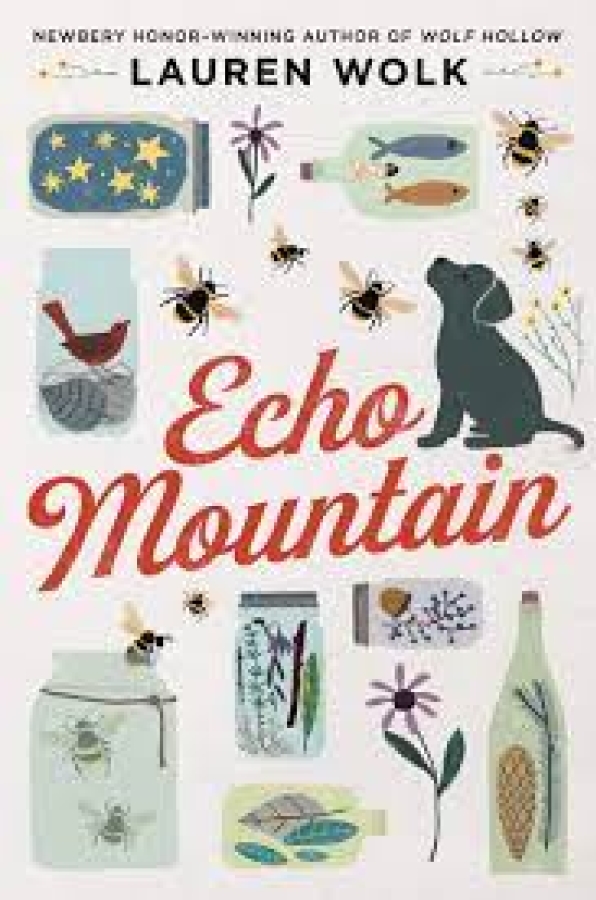
Echo Mountain (The Echo Girl)
We are in Maine in 1934: in the wake of the Great Depression, a family has had to leave the city and relocate to the foot of a mountain, on the edge of the forest, adapting to life in an environment entirely foreign to their urban past. The mother confesses to her daughter Ellie, still an adolescent: > she looked at her ruined hands. I feel like a stranger in this new skin. I left behind too much of who I had always been. Ellie, by contrast, is fascinated by this new life; she wants to understand and adapt. In this she has been helped by her father, a vital anchor for the young girl. > This bond with my father and the wilderness drove a wedge between me and my mother, and especially my sister, because both seemed to think that I had somehow betrayed them by feeling happy when they were not. To understand what the "mountain’s echo" represents for the girl, one can point to the episode of her encounter with the bear. > But then I made the mistake of reading, in his eyes, that primitive quality I so admired. Of sensing, in him, a love for things I loved: lying in a meadow with the grass growing tall all around, hiding from everything except the sky and swarms of bees, heavy with flower pollen, nodding toward me (a splendid turn of phrase!) bobbing the way bees fly. Or the pink of the sunset. Or the clear whisper of a wood thrush. We are in the throes of a full romantic idealization of nature! In Ellie, contradictory feelings coexist: an aching loneliness because she no longer feels part of the family, and a sense of freedom in an environment where she can roam, exploring the forest, learning to harvest honey, and doing practical chores under her father’s guidance. This precarious situation unravels when her father suffers a grave accident that leaves him in a coma. Ellie takes the blame upon herself, concealing the truth of what had happened: it was her little brother who, chasing a rabbit while the father was sawing a tree, caused the man to move, leading him to be struck by the falling trunk. > Part of me wanted to tell her that it was Samuel’s fault (the little brother), if the little boy could be blamed for anything. But when I thought of saying those words, I felt fragile and sad. (...) I decided that shifting the blame would be worse than shouldering it. If I had learned anything from the mountain, and from my father, it was that I would feel stronger and happier if I were able to face adversity and do it well. So I remained silent. And they took the silence for a confession. How will Ellie overcome the anguish that overwhelms her: the estrangement from her mother and sister, the sight of her paralyzed father, the strained relationship with her little brother, the arduous life in the wilderness, the material hardships of an impoverished and isolated family? She will do so by venturing into mysterious nature, uncovering its magical and salvific secrets. It is certainly a *bildungsroman*, though it must be said that Ellie appears to be a strong, resolute girl right from the outset. It is as if life’s hardships and the forces of nature merely brought out something Ellie already possessed. What weighs upon the entire narrative, rich in characters and adventures, is the banal depiction of a benign nature—the dream of an escape from urban and industrial life. It is too easy! The woods, the mountain, the wild animals are not friends, but primordial forces answering to the blind laws of the primitive world. Ellie ostensibly sets out to discover her new surroundings; in reality, the latter are merely a mirror of what we romantically daydream nature to be. To understand the novel’s limitations, one must turn to *Treasure Island* (see review on this site), where Jim faces dangers alone, evades the allure of evil—which exists regardless of what we might think—and in doing so truly comes of age. The writing is elegant, alternating tight dialogue with fine descriptions rich in musical and captivating phrasing. Across too protracted an expanse, the plot frays, grows prolix, and loses the sharpness of the opening chapters. Why not read it? It is banal.
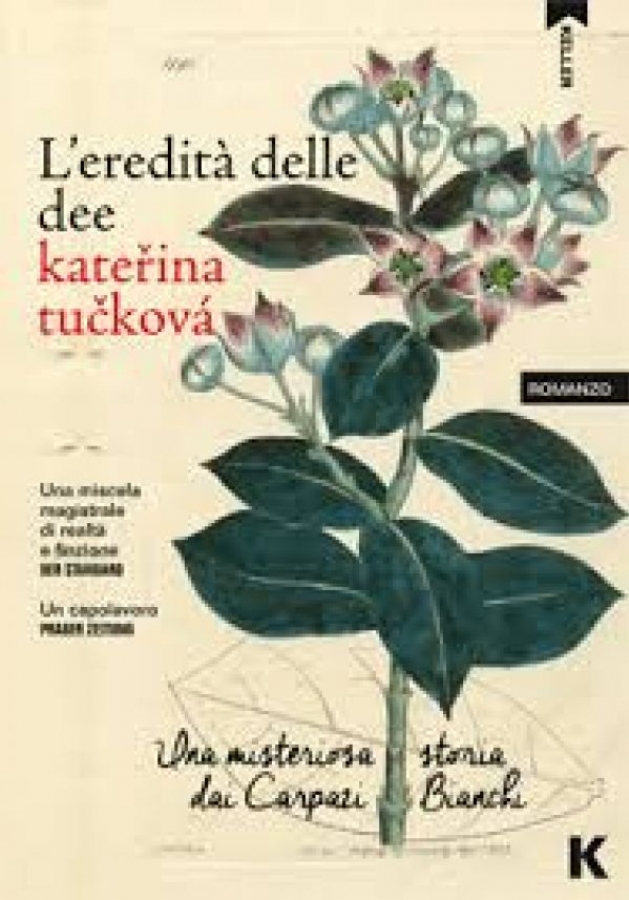
The Legacy of the Goddesses
> The Kopanice region lies on the border between Moravia (the south-eastern area of today’s Czech Republic) and Slovakia, comprising various villages scattered across the slopes of the White Carpathians. Si tratta di una regione che ha pienamente conservato le sue tradizioni folcloristiche, anche perpetuate in una forma arcaica, soprattutto perché è un luogo quasi isolato dal mondo circostante . The women called goddesses are > subjects who possess, according to widespread belief, specific abilities enabling them to heal illnesses, to see the past, to foretell the future, and to uncover information generally inaccessible to ordinary people . So read Gestapo documents, intent on confirming the theory that a remnant of Germanic population had survived in Moravia, thereby justifying the Third Reich’s claims over Central Europe. It is not political motives, however, that prompt Dora, a young ethnography researcher, to study the goddesses. She herself was raised by a goddess, her aunt Surmena, ever since discovering—still a child—the body of her mother, hacked to death with an axe by her father. > For a long time, she had thought that this was the origin of all her suffering. But that was not true. (...) Dora was not stupid, and the stricken faces of the villagers spoke clearly: her and her brother’s misfortune had begun much earlier, at a time that her short memory could not recall . With the resolve of a scientist and the tension of someone personally implicated, Dora retrieves and scrutinizes archival documents, tracing back the course of history: from the witch hunts to the meticulous Nazi investigations, right through to the socialist era, with its rationalistic and conspiratorial theories. She does not confine herself to analyzing and comparing police reports, research by anthropologists and ethnographers, letters and accounts; she frequently returns to the places of her childhood to gather the women’s testimonies and experience anew > the woods filled with beeches and oaks, (...) the meadows teeming in summer with rare orchids, marsh orchids, and anemones, interspersed with strips of cultivated fields, with low cottages clinging to the ground, (...) with those cold mornings of a sweltering summer, (...) and with those harsh winters. (...) With that round, gigantic moon rising over the dense mountain peaks. (...) And before the doorstep, on the ridge of the hill, one seems to be in heaven, with the entire world unfolding at our feet. Ma perché tornare al passato? Riportare alla luce i mostri? Sulla famiglia di Dora incombe la maledizione di una dea cattiva, contro la quale Surmena aveva combattuto tutta la vita. Se non si affida a «quelle occulte mani che mʼintridono» (come dice Ungaretti) come può spiegare Dora i tragici eventi: il truce omicidio della madre, il fratello minorato in coma per un attacco epilettico, la zia Surmena rinchiusa in manicomio a morire come una povera pazza, il suicidio del padre? > She rested her head against the tiled wall of the hospital and closed her eyes. (...) And what if it really was the fault of the curse that had dragged itself down to them? What would it have meant for her to grow up with that awareness? The novel can be read from many angles: as a historical thriller, a conflict between science and superstition, a romantic immersion into an ancestral world of women, a search for Central Europe’s common roots—Germanic and Slavic at once because steeped in the same Indo-European paganism; and above all the story of Dora, of her loneliness, of her desperate need for a family, of her resilience that refuses to surrender to mystery. Dora cannot accept the vilification of her beloved Aunt Surmena, accused of collaborating with the Nazis and for that reason unjustly persecuted by the socialist regime. The author wanted to tackle too many subjects: the result is an overabundance that wearies the reading, dissolves the plot, and fragments the narrative. And the reader is left with one question: who is Dora? The protagonist is submerged beneath too many facts and too many characters, and we still do not understand who she is, even after more than four hundred pages. Why not read it? It is intriguing at the beginning, but ultimately proves prolix and tedious.


The Examination
> I publish this old story today because I hopelessly love its free language, its fable without a moral, its *porteña* melancholy (typical of the inhabitants of Buenos Aires) and also because the nightmare in which it was born is still awake and roams the streets . With this note Cortázar introduces a story written in 1950, during the years of the first Peronism, between 1945 and 1955. It was a period of profound social change: emerging wealthy from the Second World War, under Perón's leadership Argentina seemed to face a future of development. And yet, unease and pessimism were growing among intellectuals and within the urban middle class; a moral and psychological malaise born of the muted, tacit awareness of the contradiction between a cosmopolitan city, as Buenos Aires was, and a regime obtusely hostile to culture and individual freedoms. The characters of the story—the young couple Juan and Clara, Andrés, Clara, and the chronicler—wander through the night in an unreal city, shrouded in fog. Theirs is a seemingly senseless banter, constantly revolving around the futility of the intellectual. > All this talk, passing papers to one another, these café tables with books and books and books and premieres and exhibitions.... Believe me, there is a swindle here, a betrayal. All that is left for you is to join betrayal to reality, to life, to action, and with this and an emblem on the jacket lapel you are ready to embark on any career . The group has no destination, nor do the events involving them lend a plot to the narrative; alternating between prose and poetry, Argentine, Latin American, and European literary quotations, the youths continue to dwell on the very same theme, in an obsessive and patently futile manner: > a good biologist would laugh his head off hearing our squeaking. Because we don't even scream; ours is the piping of mice . > So absurd to talk at random, thought Juan as they stepped out, to hear oneself talk and know that one is never sufficiently in the right. This is another, perhaps the worst, of our acts of cowardice . Juan, you are truly right! Unfortunately, we are weary of so much idle chatter; we would like a bit of reality, of sound pragmatism. It is for this reason, together with the lack of plot and the shallowness of the characters, that I painfully decided to abandon the book at the end of the first chapter. The story might well proceed to change its narrative pace radically; I shall never know, so be it! «Free language» is fine, provided it is taken in small doses. The question that naturally arises for us Italians of the second millennium is this: how much of this story do we find in our own country? > Creation is born of morality, not of ingenuity (says Juan). Ay, ay, went Clara, we are spineless. Right, spineless, without tension. (...) I mean that we lack a spirit of system (be it freedom or for freedom), and this is above all a moral defect . Why not read it? It is profoundly boring.