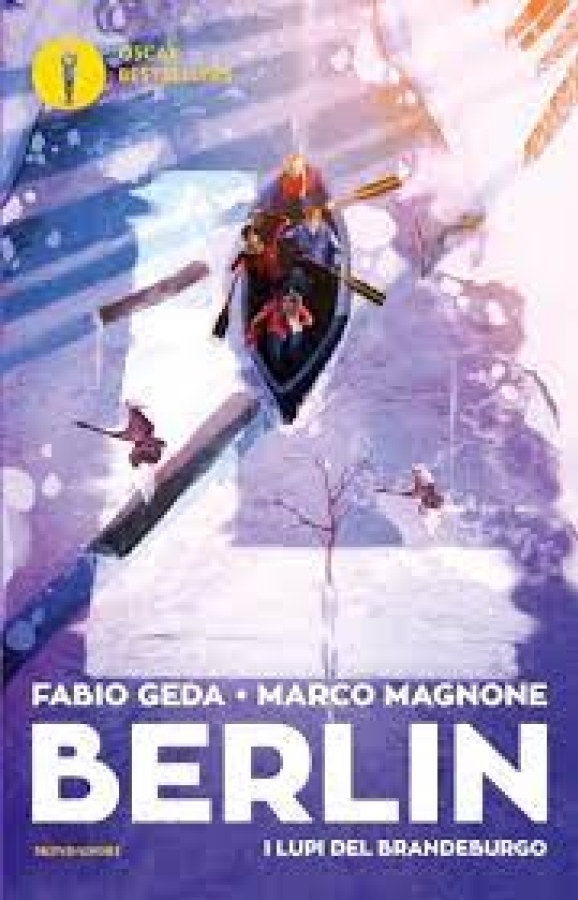
Berlin
On this site, we have already published a review of the first volume of the great Berlin saga, written between 2015 and 2018 by Fabio Geda and Marco Magnone (see *I fuochi di Tegel*). In a “worn and decaying Berlin,” an epidemic had wiped out all adults, leaving only those under the age of eighteen alive: they had plummeted into a > violent, primordial world beyond time, [that] was robbing them even of words . They must carry on living, even though > they were certain that something hideous would leap out at them from a balcony, or from inside a car, catching them unawares . They have banded together into factions with distinct values and dynamics, within a wall encircling the whole of Berlin—a kind of prison that protects them yet confines them to a claustrophobic fate, living with the knowledge that they will die at eighteen. While in *I fuochi di Tegel* the authors introduced the setting and characters, the subsequent volumes chronicle life in this feral world: in *L'alba di Alexanderplatz*, it is the fight against a panther, a ferocious beast lurking in abandoned subway tunnels; in *La battaglia di Gropius*, amidst a freezing winter, with the vast supplies of food and firewood from abandoned supermarkets and buildings exhausted, hunger and cold drive a major battle between the Tegel faction, led by the savage Wolfrun, and the Gropius faction, headed by the hesitant Jacob; in *I lupi di Brandeburgo*, our heroes must venture beyond the wall to rescue little Nina; and finally, in the last two books (*Il richiamo dell'Havel* and *L'isola degli Eroi*), the epic saga culminates in a clash between adults and youths, in a haunting finale albeit brightened by a Hollywood-style epilogue. The narrative is kaleidoscopic, multifaceted and rich in viewpoints, allowing each reader to pursue whichever dimension appeals most, should one wish to look beyond the adventure—which remains consistently surprising and compelling. Identifying a common thread might seem challenging, yet it becomes clear if one follows the trajectory of a single character. Sixteen-year-old Jacob has found himself reluctantly thrust into leadership of the Gropius group; Sven, the former leader, was a charismatic figure, confident in his choices because he was always guided by the values of solidarity and peace. Jacob, by contrast, longs to continue living his adolescence (first loves, friendships, nostalgia, melancholy), but cannot; he must shoulder his responsibilities. And he does so in his own way, not always conforming to conventional notions of leadership: he is hesitant, often ponders what Sven or his father would have done, and does not always make decisions that prove right. It is his conscience that drives the pivotal choice of the entire epic saga. In a frozen and hostile landscape, a brave few have ventured beyond the wall in search of Nina. They cross paths with Wolfrun, the ruthless leader of the Tegel faction, an unsparing enemy driven by hatred toward life. Stranded with her horse, Wolfrun has fallen into icy water and would surely perish were it not for Jacob’s decision to rescue her. > Jacob thought of that idea of the world they had tried to build day after day, a world where saving one's own life was not enough to feel safe, and without giving himself any more time to think, he turned back . And it will be Jacob and Wolfrun, so divergent yet now allied and perhaps already in love, who lead the youths to face their final, most daunting challenge. Deftly constructed in terms of style and narrative, it reads like an epic poem, a blend of the *Aeneid* and the *Iliad*. Alongside the grand battles shines a sense of mutual humanity, a Virgilian *pietas*, the bedrock of familial sentiments of care and friendship. To be sure, the narrative depicts mechanisms of power and domination, extending to the racist attitudes of adults toward the young, yet the numerous positive characters consistently make choices that defy the delusion of subjugation. It is regrettable that the authors eventually abandon the backbone of the narrative—namely, the rebuilding of a society liberated from the burden and errors of the “grown-ups”—only to become ensnared (who knows why) in a plotline recalling the horrors of Nazism, weighing down the narrative unnecessarily and redundantly. Why read it? It captivates through its setting and characters.

Borders no Borders
*Borders* (2022) and *No Borders* (2023) are two novels that develop the same story and must be read and reviewed together. The common thread can be identified in one of the many literary references found in both books: the short story *The Seven Messengers* by Dino Buzzati. The prince, having set out to explore his father’s kingdom, after years of travel recognizes that > there is no border, I suspect. (...) There are no separating walls, no dividing valleys, no mountains closing the pass. I will probably cross the boundary without even noticing, and I will keep going forward, unaware (see the review of Buzzati’s *Sessanta Racconti* on this site). Borders are those between peoples, just as they are the barriers we erect between one another. Following an epidemic triggered by the environment’s revolt against human exploitation, the survivors built themselves a technological city, enclosed within high walls and surrounded by a vast desert of concrete. In this metropolis, called Magnolia to evoke the cruelty of Nature, > the past has been erased, and with it the literature of the past. (...) In Magnolia there is only one version of our history! With food and attentive care, they have turned citizens into faithful servants incapable of thinking! (...) everything is eco-sustainable, recyclable, and interconnected, where civil society is satisfied and the youth is confident in its own beliefs, disdainful of the beliefs of old. In this world where Utopia is forbidden, an elderly poetess continues to live, having adopted the metaphorical name of Olmo. She has taken in four young people. They bear the names of forgotten writers: Lindgren is a Black girl with a mass of bushy hair, and like Pippi Longstocking she looks at the world from her own perspective, wilful and stubborn; Dickens, like the English writer, is a great storyteller > but he is so charming that you forget about it ; Alcott, like the author of *Little Women*, > is so serious, always thoughtful yet always willing to listen ; Verne > sees beyond , capable of envisioning the future in harmony with animals and plants. Between the four of them is a deep bond of brotherhood: they grew up together, feel different from their peers, and are guided by Olmo, the bard of a different world, of an Earth regenerated to new life, which she remains convinced still exists somewhere out there. And so, when Olmo urges them to leave Magnolia without her, the youths feel abandoned. > You want to make explorers out of us! Deep down, nobody cares about us. We are worth nothing. Then, they realize that they are > the children of Olmo, (...) Magnolia cannot tolerate the presence of four young people endowed with the strength and power of Olmo. (...) To be sure, they have absorbed all her knowledge, but would they know how to use it?. Like the protagonist of the film *Poor Things*, who must break away from her creator to claim the world for herself, Olmo's children feel they must leave. It is time to cross borders, to venture toward the unknown, retracing a journey once undertaken by the great explorers and, further back still, the Argonauts: the quest for a Promised Land, the pursuit of a Utopia. Lindgren, Dickens, Alcott, and Verne abandon the safety of Magnolia and take to the road, like the father and son in Cormac McCarthy's *The Road* (see review on this site); awaiting them is a desolate, deadly reality at first, followed by a lush, wild nature that has reclaimed the planet, and ultimately a community of men and women desperately striving to safeguard the past—books, for instance—despite living an existence regressed to primitive levels, devoid of technology and science. Which is better? The hyper-advanced city where everything is regulated and diseases no longer exist, or returning to the dawn of humanity, when one fought merely to survive and ensure the reproduction of the species? Here lies Utopia: fighting for a world where an equilibrium is struck between Technology and Nature, between Progress and Freedom, and where Poetry may once again become the driving force of Humanity. Alongside the “Grand History” in which fundamental material and ideological forces contend, there is also the story of the four young people. Leaving the protective wing of Olmo and Magnolia leads them to encounter other youths, thus fracturing their bonds of kinship. Lindgren slowly discovers she has fallen in love with the very nephew of Magnolia’s Dictator, yet unlike *The Black Corsair* (see review on this site), she overcomes these barriers through a gradual journey of growing trust; Alcott meets a young woman who > walks straight as a queen, (...) uses unusual words, (...) raised by the characters of her novels preserved in the great library of the Lighthouse where she lives in solitude; Dickens falls in love, without knowing why, with a girl who wishes to live in Magnolia, where women are not forced to bear children as in her primitive village; and finally Verne finds, within this society returned to a primitive state, that loving bond with animals he has always yearned for. At first, the intruders are received with mistrust and threaten to break the brotherhood; then, affection, the desire for mutual support, and understanding of the other lead them to evolve from a closed group into an open community, where borders are blurred and constantly shifting. As Dino Buzzati’s character puts it, > Tomorrow morning a new hope will draw me even further ahead.... One should not think that this is a novel dominated by philosophical digressions. The narrative is rich in adventure, even if a lyrical dimension prevails and consistently overshadows the plot. The narrative structure is akin to that of *The Road*: short, almost self-contained paragraphs, providing occasions for evocative descriptions of nature and psychological insights into the characters—analyses that remain, however, perpetually suspended; the dialogues, very well constructed, alternate with detailed yet fantastical representations of the setting: consider the allure of the Lighthouse on the coast of Brittany, one of the most intense moments of the entire novel. The author fails to create plot twists, dramatic turning points, or moments of genuine tension. Perhaps it is a book addressed more to adults than to young adults. Why read it? Enjoyable, interesting, with a beautifully drawn figure in Lindgren.
The Bottle Imp
*The Bottle Imp*, in Italian *Il diavoletto nella bottiglia*, is a short story that revolves around man’s ambiguous relationship with evil. Keawe, the protagonist, > was a poor man, brave and industrious; he could read and write like a schoolmaster, and was furthermore a first-rate sailor . One day, in San Francisco, he stops to admire a splendid house. When Keawe expresses his desire to possess such a home, the owner tells him that his entire fortune originated from a bottle in which an imp resides. Whoever purchases this bottle will have all their wishes granted. There are, however, drawbacks: one goes to hell if one dies while still in possession of the bottle, and it must always be sold at a price lower than its purchase cost. Keawe is torn, but ultimately agrees to buy the bottle for fifty dollars. His life swiftly undergoes a radical transformation: he becomes a wealthy man and can afford a magnificent home. He manages to sell the bottle and is thus able to live peacefully and happily, not least because he has since fallen in love with a young woman, Kokua, whom he intends to marry. One day, however, he discovers he has contracted leprosy and resolves to track down the bottle once more so that the imp may cure him. Thus begins a search that leads him to discover that the price of the bottle has been steadily falling, down to a mere two cents. Yet the bottle would then have to be bought for one cent—and how could it ever be sold afterwards, given that the cent is the smallest coin available? Keawe buys it nonetheless and marries Kokua, but finds no happiness, knowing that upon his death he will go to hell. Once she learns the terrible secret, Kokua decides to secretly purchase the bottle herself through an ingenious expedient: she travels to a French-held island where coins of lesser value than a cent are in circulation. Yielding to evil has created a sort of “reverse chain letter,” breeding further evil to the point where the two lovers become entangled in a paradoxical short-circuit, wherein the happiness of the one becomes the source of the other’s torment. Then, as in a fine fairy tale, comes the happy ending: Keawe manages to sell the bottle to a drunkard, ridding himself of it forever. The story mirrors the structure of a fable (the presentation of the initial situation, the hero confronting hardships until he successfully overcomes them) and also bears the hallmarks of a maritime yarn, unfolding as it does among ships and southern cities. The underlying concept, however, is the depiction of the trajectory of evil, played out entirely through its progressive loss of value. As if to say: the more one lives immersed in evil, the more one grows accustomed to it, to the point that the imp is worth less and less. Why read it? It is remarkably well written, if at times repetitive, but above all, the moral underpinning the tale remains profoundly relevant. In recent years, Italians have gradually accepted increasingly illegal, immoral, and vulgar behaviors, the cost of which drops ever lower because they have by now become part of the collective ethos. Beware! There is no end to the worst.

Buddenbrooks: The Decline of a Family
The title and nineteenth-century framework suggest a great social novel centered on the decline of an upper-bourgeois mercantile family. As often happens with great books, as one delves deeper into the reading (and we imagine the same occurred for the author while writing it), another theme emerges: the unstoppable force driving toward dissolution, decay, and death. To express the novel’s profound meaning, Mann makes brilliant use of music. The adolescent Hanno, the last descendant of an entrepreneurial dynasty, plays “one of his improvisations” on the piano. He plays a motif > extremely simple, (...) a short-breathed invention, a meager invention, which nonetheless acquired a strange, mysterious, and significant value . At first the motif remains in the background, submerged by “bustling runs,” vigorous, as if urging on to “ever new efforts.” Then the first > sweet, wandering, tormenting motif, that first mysterious motif , takes over. > The tide of surfacing cacophonies fell upon her, gathering threateningly, surging forward, retreating, climbing, sinking, and straining once more toward an ineffable goal that had to arrive, to arrive at once, in that very instant, at the dreadful climax where the yearning torment had become intolerable. And it arrived: it could no longer be stopped, the convulsions of longing could be prolonged no more; it came as if a curtain were torn aside, as if gates were flung open (...) it was the motif, the first motif! What brought about the end of the Buddenbrooks was not ruinous speculations, the squandering of wealth through disastrous marriages, or competition from rival merchant families; it was an internal decay, a weariness, a slow yet inexorable loss of the founders’ primal energy. We are in Lübeck, a Hanseatic city on the Baltic Sea, and the story unfolds between 1835 and 1877. The firm of Johann Buddenbrook (founded in 1768) is at the height of its wealth and prestige. The novel centers on the siblings Antoine and Thomas. The first three hundred pages recount how the young Antoine, clever and restless, renounces love out of loyalty to the “firm,” in order to contribute through a marriage of convenience to the family’s good name and prosperity. Already betrothed to a Hamburg merchant, she falls in love with a young man, but upon reading the thick ledger recording the Buddenbrook genealogy, she feels > like a shiver, (...) like a link in a chain, her father had written. Yes, precisely as a link in that chain, she held great importance and responsibility: she was called upon to contribute with deeds and resolve to the history of the family . Antoine unhesitatingly devotes herself to being the vestal virgin of the family, the custodian of an upper-bourgeois decorum. Then emerges the figure of Thomas, who reaches the pinnacle of the social ladder with his election to the city senate. > Thomas Buddenbrook (...) showed in his face and carriage a pronounced sense of dignity; yet he was pale, and his hands especially (...) were as white as the cuffs emerging from his black sleeves, with an icy pallor that betrayed how cold and dry they were. Those hands, whose well-tended oval nails bordered on a bluish tint, could assume at certain moments, in certain postures of convulsive unconsciousness, an indescribable expression of hostile sensitivity and almost morbid reserve—an expression that hitherto had been alien and ill-suited to the rather broad, bourgeois, even if shapely, hands of the Buddenbrooks . From his very appearance, the inner suffering of Thomas is evident—one for whom shouldering the firm and the family is a duty, not a pleasure. > He felt a void in his soul. (...) But his need for action, his restlessness, his activity had been fundamentally different from the tenacious, steady industriousness of his fathers: an artificial thing, then, a craving of the nerves, a narcotic, (...) a martyrdom . Now ill, Thomas confesses to his sister how he has grown increasingly fond of the sea. > Long waves rolling in and breaking, one after another, endlessly, aimlessly, wild and desolate . His sister falls silent: > but one does not say such things! she thought, looking away so as not to meet her brother’s eyes . And so, when in its final pages the novel descends into long descriptions of the deaths of Thomas and Hanno, with sorrowful scenes of the few surviving women, helpless and stunned by the tragedies that have destroyed the Buddenbrooks, we are not surprised; for we are well aware that the vitality, the sense of sacrifice, and the allegiance to a great dynasty have all withered away. The anticipation of death lies at the center of Thomas Mann’s world, and this novel is no exception. At first, death seems distant, for prosperity fosters an atmosphere of placid bourgeois serenity; only the depictions of the characters and their surroundings are soft, ambiguous, decadent. And yet we are in the triumphant nineteenth century! More than the plot, it is the writing that skillfully, subtly conveys the sense of decay. Then, past a certain point, the narrative becomes explicit: the accounts of agony and illness (even of visits to the dentist) are meticulous, attentive to every physical and moral suffering; the settings turn dull, gray, joyless; the characters grow ever sadder. It is neither a social nor a psychological novel; the context always lingers in the background, the characters are drawn through their physical appearance without delving into their emotions or existential conditions: they are brushed in rather than delineated. It is the writing itself that speaks to us, creating the atmosphere, conveying the overall meaning of the novel. Why read it? It is long, at times redundant, but one must let oneself be carried by the words.
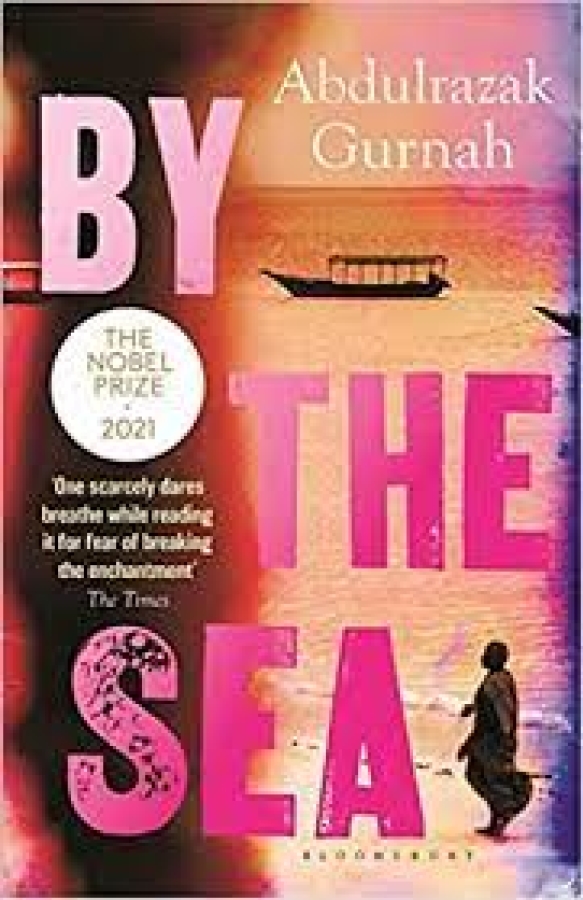
By the sea (on the seashore)
> My name is Rajab Shaaban. It is not my real name, but one I borrowed. (...) It belonged to someone I knew many years ago . Already from this sentence, which introduces one of the two protagonists, we can grasp several of the novel's hallmark traits: the lie, as both subterfuge and a relish for storytelling; destiny and absolution from sin, for Sha'ban is the eighth month of the year, > when the fortunes of the coming year are decided and the sins of the truly repentant are forgiven ; the flight from memory, > before it becomes so solid as to hold us in its grip and crowd out every other thought . We also stand before a crossroads of civilizations and languages: Shaaban is in England and speaks English—the place and language of the colonizer; he hails from Zanzibar and East Africa, yet the entire narrative is steeped in Arab culture and wondrous, neighboring India. Shaaban has pretended not to know English; an interpreter is needed, and Latif, a young literature professor also hailing from Zanzibar, is called upon. As it happens, Latif’s father is also named Rajab Shaaban; is it a mere coincidence, or does someone else lurk behind this name, perhaps even Saleh Omar, who brought his family to ruin? The lengthy conversation between Shaaban and Latif, indicatively titled "Silence," is preceded by two preparatory sections. The first, "Flotsam," recounts Shaaban's arrival in England, the divestment of his culture of origin and of his past, like an old piece of furniture, the useless relic of a life that is no more and can never return. One must not be misled by the subtly ironic portrait of English society, nor by the reflections on British colonialism: the true themes are dislocation and remembrance. In the squalid room of the reception centre hangs a mirror, > too wide for that small, dark room, (...) in that oppressive light, my reflection looked like that of a creature suspended in an encroaching gloom, the circle of light slipping into shadow, hanging over my shoulders like a loose noose . But the darkness was precious to him because it was full of "murmurs and whispers," whereas before, (the noises) had been so dreadfully obvious. (...) Moments slip through our fingers. Even as I tell them to myself, I can hear the echoes of what I am suppressing, of something I have forgotten to remember. > The second part is characterized right from its title by narrative realism: Latif is the name by which the young man is known in East Germany, where he went to study, fleeing his family's social and economic decline. Lucidly, almost detachedly, Latif recounts his family’s vicissitudes: the inept, naive father; the mother who uses her beauty to engage in scandalous love affairs; his affection for his older brother and the latter's descent into ruin up to his disappearance; and the figure of Hussein, a Mephistophelian character, manipulator, and rogue. It is a commercial society built on deals, trade, negotiations, ups and downs, where one must be shrewd and where reputation is paramount. A prosperous transit hub of trade between India and the Arab-Muslim world, Zanzibar is swept away and impoverished by oppressive, obtuse British rule; yet it endures, ever in search of new commerce and sources of wealth. It will not be the colonialists who destroy Latif's family, but familial rivalries, Hussein's deceit, and Saleh Omar’s lust for financial retribution—Saleh Omar being, in Latif's eyes, the true culprit. Yet, into this expansive social chronicle, something magical creeps in. In rationalist East Germany, in the cradle of Marxism-Leninism, Latif has been deceived: he believed he had an epistolary romance with a young German woman, only to discover that she is a fifty-year-old lady who concocted stories, eager to dream and recount something out of the ordinary. And here we come to the pivotal section of the novel. Latif visits Shaaban to understand what happened, to complete those missing stories, (...) like a child or something like that, when your parents tell you what you did and said, and you have no memory of it." Yet, "some things are not worth knowing." And why does Shaaban agree to tell his tale? "I needed to be released. Not to be forgiven and cleansed of my sins. (...) I needed to be released from the burden of events and stories that I had been unable to tell, and that in telling I would fulfill the strong longing I felt to be heard and understood > . Shaaban is not interested in telling the truth; on the contrary, his narration of events transforms him from culprit into victim, destabilizing Latif. Shaaban needs to tell stories, like the narrators of *One Thousand and One Nights* (see review on this site), like Herman Melville's *Bartleby, the Scrivener*, "the unshakeable authority of that man's defeat, of the noble futility of his life > : in short, a fabricator of words. As in the *Odyssey* (see review on this site), the reader no longer wonders whether Ulysses is telling the truth or lying shamelessly: one surrenders to the spell of the narrative, to a fascinating, magical world of family quarrels, love and betrayal, lost affections and vendettas, until poor Latif loses all certainty about his own past; only in this way is it possible to begin a new life, to forget to remember. It is a mistake to chase the plot, to make futile attempts to reconstruct the backstory, to bring order to the characters and their mutual ties. To appreciate the novel, one must allow oneself to be carried along by the fluidity of the prose, as when floating in a splendid, saline, deep sea, yielding to the currents, swimming only occasionally to regain one's bearings. As in Dino Campana's *Canti Orfici*, the narrative winds around itself again and again, abandons and resumes, views the same episode from different angles; only occasionally does it open a parenthesis on history and society, but that is not what matters; what the author is eager to explore are the charms and perils of remembrance, the necessity of abandoning memory—as a mere chronicle of what has been—to advance into the present. To this end, the lie is also useful. The novel's flaw is not confusion or fragmentation; it is that in the end it runs on so long as to become verbose and redundant. The contamination of the English language can occur in many ways. Think of Nadine Gordimer, the great Achebe (see the review of *Things Fall Apart*") and Chimamanda Adichie ("*Half of a Yellow Sun* > on this site), where indigenous tongues innervate the English language, which retains its composure while enriching itself with new lexicon; think of the talented NoViolet Bulawayo, who transitions effortlessly from Zimbabwean English to the slang of American teenagers (see *We Need New Names* > ), and finally the D'Annunzian Salman Rushdie, with his magnificent neologisms (see his masterpiece *Midnight's Children*" also on this site). In Gurnah we encounter an elegant, clean style, which finds in the very fluidity of its storytelling the imprint of Arabic and East African languages. Why read it? It is captivating to get swept up in, if a little too long.