Louis Robert Stevenson
Books by this author (2)
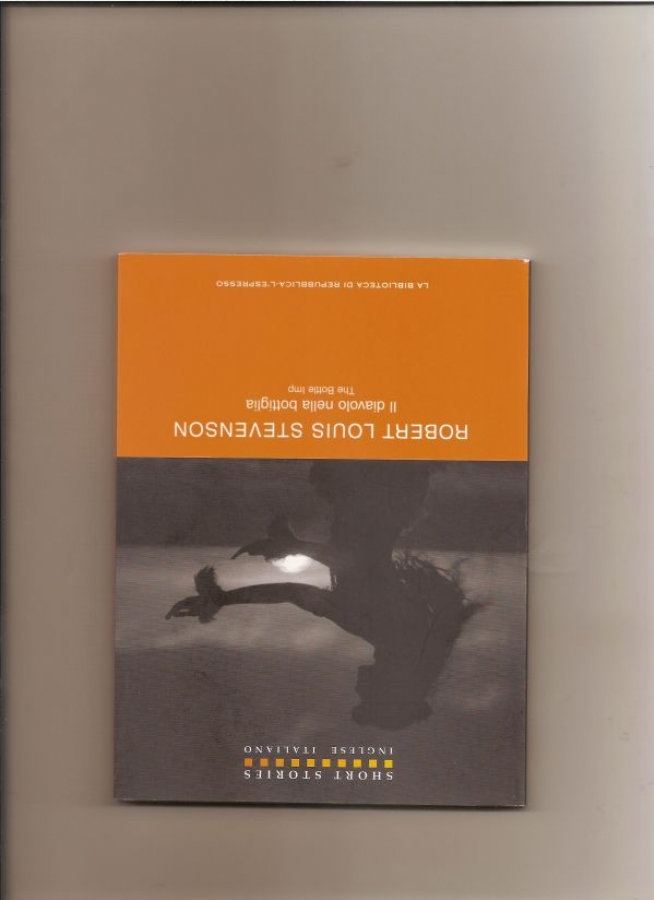
The Bottle Imp
*The Bottle Imp*, in Italian *Il diavoletto nella bottiglia*, is a short story that revolves around man’s ambiguous relationship with evil. Keawe, the protagonist, > was a poor man, brave and industrious; he could read and write like a schoolmaster, and was furthermore a first-rate sailor . One day, in San Francisco, he stops to admire a splendid house. When Keawe expresses his desire to possess such a home, the owner tells him that his entire fortune originated from a bottle in which an imp resides. Whoever purchases this bottle will have all their wishes granted. There are, however, drawbacks: one goes to hell if one dies while still in possession of the bottle, and it must always be sold at a price lower than its purchase cost. Keawe is torn, but ultimately agrees to buy the bottle for fifty dollars. His life swiftly undergoes a radical transformation: he becomes a wealthy man and can afford a magnificent home. He manages to sell the bottle and is thus able to live peacefully and happily, not least because he has since fallen in love with a young woman, Kokua, whom he intends to marry. One day, however, he discovers he has contracted leprosy and resolves to track down the bottle once more so that the imp may cure him. Thus begins a search that leads him to discover that the price of the bottle has been steadily falling, down to a mere two cents. Yet the bottle would then have to be bought for one cent—and how could it ever be sold afterwards, given that the cent is the smallest coin available? Keawe buys it nonetheless and marries Kokua, but finds no happiness, knowing that upon his death he will go to hell. Once she learns the terrible secret, Kokua decides to secretly purchase the bottle herself through an ingenious expedient: she travels to a French-held island where coins of lesser value than a cent are in circulation. Yielding to evil has created a sort of “reverse chain letter,” breeding further evil to the point where the two lovers become entangled in a paradoxical short-circuit, wherein the happiness of the one becomes the source of the other’s torment. Then, as in a fine fairy tale, comes the happy ending: Keawe manages to sell the bottle to a drunkard, ridding himself of it forever. The story mirrors the structure of a fable (the presentation of the initial situation, the hero confronting hardships until he successfully overcomes them) and also bears the hallmarks of a maritime yarn, unfolding as it does among ships and southern cities. The underlying concept, however, is the depiction of the trajectory of evil, played out entirely through its progressive loss of value. As if to say: the more one lives immersed in evil, the more one grows accustomed to it, to the point that the imp is worth less and less. Why read it? It is remarkably well written, if at times repetitive, but above all, the moral underpinning the tale remains profoundly relevant. In recent years, Italians have gradually accepted increasingly illegal, immoral, and vulgar behaviors, the cost of which drops ever lower because they have by now become part of the collective ethos. Beware! There is no end to the worst.
Treasure Island
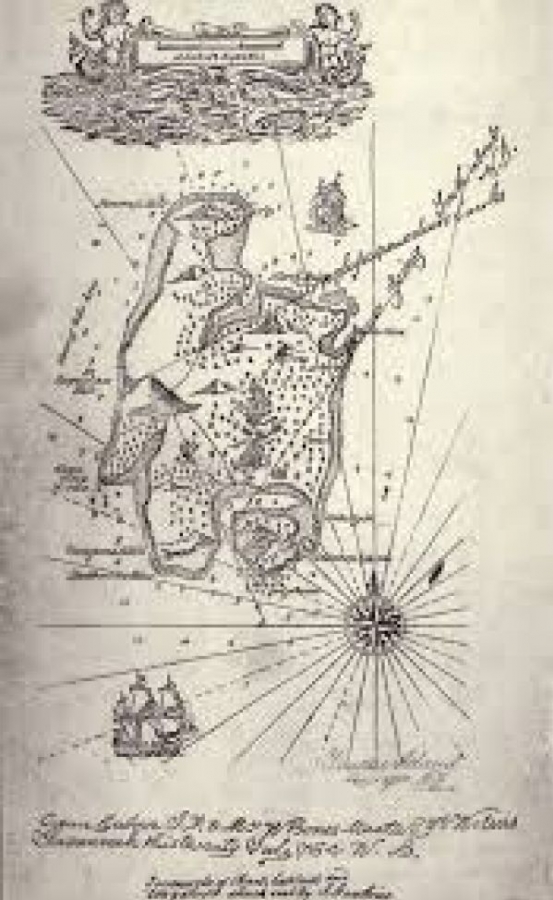
In the introduction, Stevenson addresses a “hesitating purchaser”, inviting him to buy the book, > if sailor tales (told) to sailor tunes, storm, adventure, heat and cold, if schooners, islands, and maroons, and buccaneers and buried gold, and all the old romance, retold exactly in the ancient way, can please the wiser youngsters of today, as they pleased me when I was a boy . These words, whose charm in the English language is difficult to express in Italian, encapsulate the essence of a masterpiece: a great adventure novel that also aims to be instructive for the young, drawn in by “entertaining hours” of reading. Entertainment and morality, fantasy and education, exotic voyages and bourgeois solidity converge admirably, achieving a literary feat never equalled by other writers. The balance would be perfect were it not for the meddling hand of the pirate Silver, the personification of the dark glamour of evil. The author imagines that the protagonist, a boy named Jim, is asked to recount, “keeping nothing back but the bearings of the island”, the events that led to the discovery of the treasure. And Jim does so from the very beginning, from the moment a brooding sea-dog, who went by the name of the captain, arrived at his father’s inn. A man of few words, when drunk he would tell dreadful tales of hangings, great storms, treachery, and sailors cast overboard as punishment (“walking the plank”, literally walking on a plank). Yet above all, what terrified young Jim were the verses the man loved to sing under his breath: > fifteen men on the dead man's chest, yo-ho-ho, and a bottle of rum! , a refrain that agitated the captain just as he was terrified by the thought that a seafaring man with “one leg” might turn up at the inn. Jim is still a child; his nights are haunted by nightmares born of the terrifying tales, the mysterious song, and the ominous one-legged man. Though terrified, he was forced to summon all his courage to save himself and his mother from a band of pirates attempting to steal the treasure map from the captain. On a stormy night, abandoned by the frightened neighbours, alongside the lifeless body of the captain, Jim displayed the qualities that would stay with him throughout the novel: audacity, intelligence, and presence of mind. Not only did he bring his mother to safety, but he also managed to secure possession of the map. The boy then recounts the expedition to Treasure Island. The carelessness of Jim’s friends—the village doctor and a country squire—results in a crew that is largely untrustworthy, made up of shady characters or weak personalities easily swayed by the prospect of easy riches: the fatal lure of evil. Worse still, Long John Silver is hired as ship’s cook—a man who, as fate would have it, has only one leg. Jim suspects he might be the very figure feared by the captain, but > I thought I knew what a buccaneer was like—a figure very different, in my eyes, from this clean and pleasant gentleman.... very tall and strong, with a face as big as a ham ( a face as big as ham > ), plain and pale, but intelligent and smiling... under his left shoulder he carried a crutch, which he managed with wonderful dexterity, hopping about upon it like a bird . From the outset, an ambiguous bond forms between Jim and Silver. The wordplay, the flattery, the professions of friendship, the anecdotes of ships and sailors—accompanied by knowledgeable and seasoned explanations—win over the boy, captivated by the harbour, the sea, and the maritime world. Be that as it may, Jim is shrewder than the heedless adults. En route to the island, he discovers Silver’s plot and reveals it to his friends, saving their lives. Then, boldly, he ventures inland and stumbles upon a man abandoned for years in this wild wilderness, far from civilization: a character who will prove pivotal in overcoming the pirates. Even more daringly, Jim sets out alone in a frail coracle to recapture the ship, which is poorly guarded by the pirates. The scenes of this exploit, which will forge the boy’s character forever, are among the finest in the novel. The stormy sea, the rocky coast teeming with giant shellfish, the depiction of the fierce buccaneers attempting—and failing—to kill Jim: all these elements evoke a hostile world while serving to highlight the boy’s steadfastness. The true peril for Jim is fear, which he continuously overcomes, growing steadily stronger and more mature. Yet the final ordeal he must face to achieve full adulthood is the most daunting. Taken prisoner by Silver—who nevertheless saves his life—Jim witnesses the pirate’s double game: on the one hand pledging loyalty to Jim’s friends (those who embody order and justice), while on the other ready to deceive and betray, just as he betrayed his fellow buccaneers whom he dragged into mutiny. The boy is fully aware that Silver is a cunning and insidious liar, yet he cannot help feeling a stir of affection for the cook. > Certainly he took no pains to hide his thoughts; and certainly I read them like print.... in the immediate nearness of the gold, all else had been forgotten... and I could not doubt that he hoped to discover where the treasure was, find it, and aboard the ship, under cover of night, cut the throat of every honest person... but my heart was sore for him, wicked as he was, to think on the horrid perils that surrounded him, and the shameful noose that awaited him . In the end, however, Silver saves himself, even making off with a small stash of the treasure. Jim and his friends are only too glad to be rid of him and to return, safe and wealthy, to civilization. > To my inexpressible joy, the highest mountains of Treasure Island dissolved into the blue curves of the sea . Alongside the theme of adventure, Stevenson’s tale is many other things: a *Bildungsroman* of the journey into adulthood; a “swan song” of maritime England, which, now secure in its empire, looks with distaste upon the perils of the sea that nonetheless granted it power and wealth; nostalgia for a tranquil world, identified with bourgeois, urban society; and the indulgence of a great writer trying his hand at a canting, somewhat archaic English. There is no doubt, however, that Stevenson returns to a theme dear to him: the fascination of evil. The virtuous gentlemen set off in search of a treasure that was the fruit of theft, plunder, and violence. Silver is villainous, yet he saves himself and ends up rich as well, while his comrades are killed or marooned on the island to die of privation; and this perhaps because the cook assumes the guise of the “clean and pleasant gentleman”, the educated man—after all, he could belong to the very same caste as the doctor and the squire. What lesson, then, does young Jim draw on his path to adulthood? The language, the vocabulary, and the syntax are an essential component of the book’s appeal, making it challenging to read in English and demanding to render effectively in translation. *Treasure Island* belongs to that category of great, somewhat timeless books that nevertheless risk slipping into oblivion, rather like our own Gadda. And yet it is the writing itself that makes it an “inexhaustible treasure” of discovery, suited to readers of all ages. Why read it? Read it, read it, read it—read it unceasingly.