Finished reading on: March 18, 2024
Borders no Borders
AI Translation Notice: This review was translated from the original Italian using artificial intelligence. Book quotes and excerpts are translated interpretations and will not match the author's original English phrasing or official published translations.
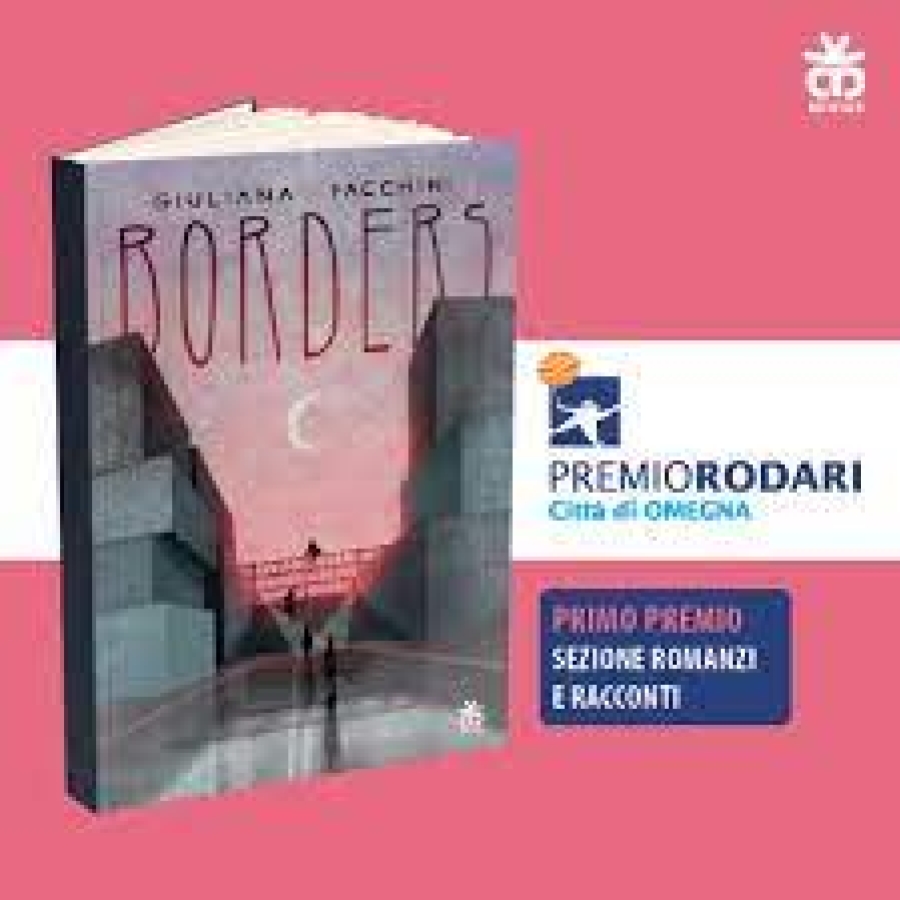
Borders (2022) and No Borders (2023) are two novels that develop the same story and must be read and reviewed together. The common thread can be identified in one of the many literary references found in both books: the short story The Seven Messengers by Dino Buzzati. The prince, having set out to explore his father’s kingdom, after years of travel recognizes that
there is no border, I suspect. (...) There are no separating walls, no dividing valleys, no mountains closing the pass. I will probably cross the boundary without even noticing, and I will keep going forward, unaware
(see the review of Buzzati’s Sessanta Racconti on this site). Borders are those between peoples, just as they are the barriers we erect between one another. Following an epidemic triggered by the environment’s revolt against human exploitation, the survivors built themselves a technological city, enclosed within high walls and surrounded by a vast desert of concrete. In this metropolis, called Magnolia to evoke the cruelty of Nature,
the past has been erased, and with it the literature of the past. (...) In Magnolia there is only one version of our history! With food and attentive care, they have turned citizens into faithful servants incapable of thinking! (...) everything is eco-sustainable, recyclable, and interconnected, where civil society is satisfied and the youth is confident in its own beliefs, disdainful of the beliefs of old. In this world where Utopia is forbidden, an elderly poetess continues to live, having adopted the metaphorical name of Olmo. She has taken in four young people. They bear the names of forgotten writers: Lindgren is a Black girl with a mass of bushy hair, and like Pippi Longstocking she looks at the world from her own perspective, wilful and stubborn; Dickens, like the English writer, is a great storyteller
but he is so charming that you forget about it
; Alcott, like the author of Little Women,
is so serious, always thoughtful yet always willing to listen
; Verne
sees beyond
, capable of envisioning the future in harmony with animals and plants. Between the four of them is a deep bond of brotherhood: they grew up together, feel different from their peers, and are guided by Olmo, the bard of a different world, of an Earth regenerated to new life, which she remains convinced still exists somewhere out there. And so, when Olmo urges them to leave Magnolia without her, the youths feel abandoned.
You want to make explorers out of us! Deep down, nobody cares about us. We are worth nothing. Then, they realize that they are
the children of Olmo, (...) Magnolia cannot tolerate the presence of four young people endowed with the strength and power of Olmo. (...) To be sure, they have absorbed all her knowledge, but would they know how to use it?. Like the protagonist of the film Poor Things, who must break away from her creator to claim the world for herself, Olmo's children feel they must leave. It is time to cross borders, to venture toward the unknown, retracing a journey once undertaken by the great explorers and, further back still, the Argonauts: the quest for a Promised Land, the pursuit of a Utopia. Lindgren, Dickens, Alcott, and Verne abandon the safety of Magnolia and take to the road, like the father and son in Cormac McCarthy's The Road (see review on this site); awaiting them is a desolate, deadly reality at first, followed by a lush, wild nature that has reclaimed the planet, and ultimately a community of men and women desperately striving to safeguard the past—books, for instance—despite living an existence regressed to primitive levels, devoid of technology and science. Which is better? The hyper-advanced city where everything is regulated and diseases no longer exist, or returning to the dawn of humanity, when one fought merely to survive and ensure the reproduction of the species? Here lies Utopia: fighting for a world where an equilibrium is struck between Technology and Nature, between Progress and Freedom, and where Poetry may once again become the driving force of Humanity.
Alongside the “Grand History” in which fundamental material and ideological forces contend, there is also the story of the four young people. Leaving the protective wing of Olmo and Magnolia leads them to encounter other youths, thus fracturing their bonds of kinship. Lindgren slowly discovers she has fallen in love with the very nephew of Magnolia’s Dictator, yet unlike The Black Corsair (see review on this site), she overcomes these barriers through a gradual journey of growing trust; Alcott meets a young woman who
walks straight as a queen, (...) uses unusual words, (...) raised by the characters of her novels
preserved in the great library of the Lighthouse where she lives in solitude; Dickens falls in love, without knowing why, with a girl who wishes to live in Magnolia, where women are not forced to bear children as in her primitive village; and finally Verne finds, within this society returned to a primitive state, that loving bond with animals he has always yearned for. At first, the intruders are received with mistrust and threaten to break the brotherhood; then, affection, the desire for mutual support, and understanding of the other lead them to evolve from a closed group into an open community, where borders are blurred and constantly shifting. As Dino Buzzati’s character puts it,
Tomorrow morning a new hope will draw me even further ahead....
One should not think that this is a novel dominated by philosophical digressions. The narrative is rich in adventure, even if a lyrical dimension prevails and consistently overshadows the plot. The narrative structure is akin to that of The Road: short, almost self-contained paragraphs, providing occasions for evocative descriptions of nature and psychological insights into the characters—analyses that remain, however, perpetually suspended; the dialogues, very well constructed, alternate with detailed yet fantastical representations of the setting: consider the allure of the Lighthouse on the coast of Brittany, one of the most intense moments of the entire novel. The author fails to create plot twists, dramatic turning points, or moments of genuine tension. Perhaps it is a book addressed more to adults than to young adults.
Why read it? Enjoyable, interesting, with a beautifully drawn figure in Lindgren.