
The Da Vinci Code
The novel is set in France and recounts the search for the Holy Grail—which purportedly points to the existence of a female apostle—and for a sect that has concealed and guarded this secret across the centuries, one of which Leonardo da Vinci was allegedly a member. Following the murder of the Louvre curator who was the custodian of the secret, his granddaughter and a scholar of medieval symbology set out in pursuit of the Holy Grail, while a high-ranking Opus Dei prelate is, in turn, hunting for the hidden secret. The novel enjoyed immense success, but it is, quite frankly, thoroughly dreadful from every perspective: the plot is tedious and implausible, narrative rhythm is nonexistent, and the prose is flat—opaque without being rich or complex. Why it could have achieved such widespread success remains a mystery. Despite my best efforts, I was unable to finish it.
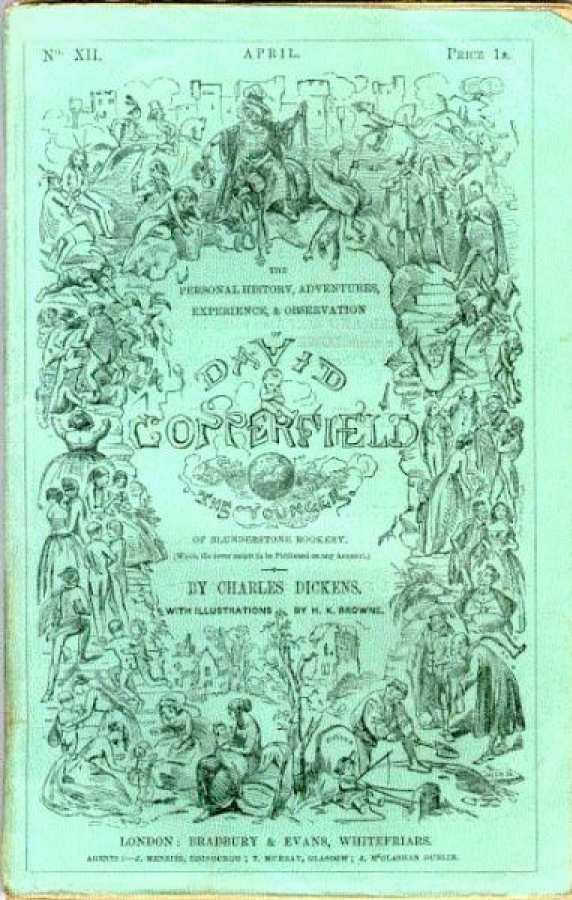
David Copperfield
The novel recounts the life of David Copperfield, who, after a happy childhood with his mother and a nurse, is persecuted by his stepfather. He is sent to a harsh, authoritarian school and, upon the death of his mother, is forced to work in a factory while still a child. He is subsequently taken in by an aunt, who provides him with comfort, an education, and the means for an apprenticeship at a law office. Over time, the young David grows into manhood, working hard, marrying, and gradually establishing himself as a writer. Upon his wife’s death, he embarks on a long journey, which allows him to realize his love for a childhood friend (Agnes), whom he marries upon his return to England. The novel is rich in characters and situations (grotesque, melodramatic, emblematic of contemporary society and widespread social injustice, representative of a harsh and hypocritical morality), such that David’s fortunes intertwine with other subplots, all culminating in happy endings, yet often encumbering the narrative and rendering it prolix, rambling, and fragmentary. Individual episodes stand out more vividly than the overarching plot, while the heightened exaggeration of the characters, for good or ill, comes at the expense of substance and depth in the portrayal of the figures' emotions and distinct idiosyncrasies. In truth, everything revolves around David and his representation of reality; the throng of other characters and the settings themselves constitute «background noise» or a frame within which the imagination of both author and protagonist unfolds. *David Copperfield* has been defined as an autobiographical novel, but this is only partially true. In fact, it is a novel of nostalgia for childhood and of return to a paradise, constituted precisely by the serene maternal sphere and by the figure of Agnes, ever cherished and sought after for her very tranquility and steadfastness. What prevails is a reality interpreted through a melancholic imagination: all events are seen through the eyes of a child, who narrates an unreal England, embellished (even amid its suffering and injustice) by the trusting, idealized vision typical of childhood. From this perspective, it is emblematic, and particularly evocative, how the author conceptualizes the ideal place of refuge: it is a boat, inside which one feels safe even as the waves swell and the wind rises outside, in that it ensures an emotional equilibrium and a peace that are ultimately destroyed by the arrival of adult betrayal and passion, and, metaphorically, by a storm that claims both the betrayer and the betrayed. The style features an exceptionally rich vocabulary and is characterized by a sentence structure that is often difficult to follow. The frequent use of dialectal forms further increases the difficulty of the reading experience.
Dear Life (Getting Out Alive)
The book brings together fifteen stories, the last four of which > form a separate unit, autobiographical in feeling, sometimes even in fact . To make overall sense of stories that might otherwise be viewed as episodes of a female condition devoid of evolution and without outlets ( > too late to do anything else. When it could be worse, much worse ), one should perhaps start from the final story, *Dear Life*, which also lends its title to the entire collection. > I lived when I was young at the end of a long road, or a road that seemed long to me. Behind me, as I walked home from primary school, (...) lay the real town with its businesses and sidewalks and streetlights for when it got dark. (...) Marking the end of town were two bridges..... the road divided, one part of it heading south toward a hill (...) to become a proper highway, and the other running around old abandoned fields to turn west. This western road was my road . Reading this effective depiction of a childhood suspended between town and countryside, in that urban and social void that now characterizes our spaces, one's mind inevitably turns to a poem by Pasolini: > poor as a Colosseum cat, I lived in a borgata all lime and dust, far from city and countryside... that borough bare to the wind, not Roman, not Southern, not working-class, was life in its most current light.... bone of daily existence, pure, for being all too proximate, absolute for being all too miserably human (Pier Paolo Pasolini, *Il pianto della scavatrice*). Munro draws a clear and vivid portrait of how strange, perilous, and important our life can be, so dear to us; all this, however, not in the abstract, nor within a prevailing gender dimension (female sensibility contrasted with male indifference), but within the specific social and almost anthropological context in which we all live. Let us take, for example, a few stories. In *Amundsen*, the protagonist arrives in a small town to teach in a sanatorium for children and adolescents suffering from tuberculosis. “The world beyond the lake and the forest had vanished”; life is lived in isolation from external reality; small things prevail: the chill of the houses, the narrow road running through the woods and near the sawmill, the bar frequented by lumberjacks waiting to be called up for service. The relationship between the protagonist and the sanatorium’s director is predictable and prosaic, unfolding without clamor or enthusiasm in flat, modest, squalidly petty-bourgeois settings, ending in an obvious way, without any real reason. Yet it is precisely the banality of the affair and the cramped context of the small town that lead the protagonist to say: “nothing really changes when it comes to love.” In *Corrie*, into the routine of an apparently solid marriage bursts an old flame of the husband. The protagonist reacts by fleeing, takes the car and seeks refuge in the anonymity of the big city, in a squalid motel, eating and drinking in a restaurant where she wonders whether “any man, any old man, would think of hitting on her.” She returns home only to be told by her husband: > it’s not so much the person. It’s like a kind of atmosphere. It’s a scent , a desire for transgression. > What a mix of rage and admiration I could feel, facing his will to do it. All our life together came to an end . Here too, one would fail to grasp the entire affair if the story did not proceed from > a non-life, but survival (...) in whose arcane orgasm there is no other passion than for daily labor (Pasolini, *Ceneri di Gramsci*). In the story *In Sight of the Lake*, a woman suffering from Alzheimer’s goes in search of a specialist. She has been given an address in a small town; hesitant, frail, the woman wanders through the town, getting lost and asking passers-by—themselves uncertain—where the doctor's office might be. She arrives at a clinic, deserted and isolated: she tries to leave, to escape, but the door has become immensely heavy. > She opens her mouth to call for help but it seems no cry will come . Suddenly she is safe. It is the story of a woman who feels she is losing her memory, but why does this vanishing of consciousness take place in a squalid urban landscape, and not among glittering skyscrapers bursting with life, or in a gentle, wondrous meadow filled with flowers? A refined and elegant writer, Munro unfortunately loses herself in slight, inconclusive stories. The characters are ostensibly delineated, yet it is sheer literary technique; there is no real psychological depth: everything remains suspended. An overarching impression of fatigue prevails, of stories already written, rewritten in a masterful style, yet devoid of passion. Only in the final stories does narrative power resurface, but it is too late. Why not read it? It is slight, inconclusive, and dull.
Death at La Fenice
The book is set in Venice and is a detective novel. A renowned conductor dies in his dressing room during an opera performance. A police inspector investigates, naturally suspecting homicide. In the end, it turns out to be suicide. The conductor had abused his wife’s daughter, who, by administering antibiotic injections, renders him progressively deaf. Driven by despair, the conductor killed himself. As a mystery, it unfolds slowly and even tediously. The author attempts to depict life in Venice and the dynamics within the inspector’s family: yet it all unfolds superficially and laden with stereotypes, ultimately ringing false.

Dirty Love
The bottom line is very simple: a wasted talent. Remarkable stylistic skill is placed at the service of tedious stories devoid of narrative development, inconclusive and cynical relationship dramas: in short, an unbearable book. In *Listen Carefully as Our Options Have Changed*, Mark has discovered that his wife, Laura, is cheating on him: he knows because he hired a detective to tail her and has proof on a video, which he watches obsessively. He is a successful project manager and thus wants to approach the problem according to the rational tenets of project management. > No, the project of saving his marriage appears to have failed, and he is faced with a new objective. This is not unusual. Some projects collapse for various reasons. (...) In this case, there was simply a change of heart. Or, more accurately, a shift from concealing love’s troubles to displaying them, though Mark was forced to acknowledge them, wasn’t he? (...) There was the cold politeness toward his mother. (...) There was Laura’s habit of getting the detailed grocery instructions Mark gave her wrong, (...) to the point that he had to drop everything and go to the supermarket himself. (...) There was Laura’s habit of watching banal detective shows late at night, her eyes glued to the screen, vacant like a child’s. There was her mediocre cooking, her preference for frozen, heavily salted foods, and unremarkable dishes she was not ashamed to serve with ketchup. And now she was deceiving him, making a fool of him, and betraying him. Uprooting their home from its foundations and hurling shards of boiling glass into Mark’s blood, his brain, and his heart: and all this intense pain for what? For her? Look at her; what was he losing anyway? But that was a question that died before it was even fully thought, because he loved her . Mark fails to understand the reasons behind the failure of his marriage, even when numerous signs should tell him that it is his very own cold, rational approach that has driven Laura away. His habit of judging, evaluating, and treating the people around him as though they worked for him. He does not understand, but he is a stubborn man: > he would not throw his wife out of his house. (...) He would step back, take no action, and let things run their course. He would let his wife’s mistake resolve itself . Hypocritical forbearance is the sole means to make a relationship survive. This is also the outcome of another story: *Marla*. She is a woman no longer young, very fat, a drab bank clerk destined to remain an old maid. It seems an inescapable fate, until she meets Dennis, an equally obese man, affectionate and kind. It is unexpected love. The two move in together, and cohabitation reveals traits in the man that Marla dislikes: an obsessive fixation with order, a preference for a repetitive and mundane life, the risk of slipping into a tedious routine. What is more, the man does not want children. Leave him? But that’s marriage, my dear, her friends tell her; children will come later, even if the husband doesn’t want them (just deceive him about your fertile days so he won’t wear a condom!). Now well on his way toward squalor, Dubus tackles the third story (*The Bartender*): two young people marry full of enthusiasm, she gets pregnant, and he cannot resist sleeping with a curvaceous coworker—quite a bitch, truth be told. In the seventh month, the wife discovers the affair and risks miscarrying; miraculously, both she and the baby girl survive. > He walked over beside her bed and stood still. (...) Soon she would open her eyes, (...) eyes he did not deserve but hoped to earn, eyes of dark hope . At this point, I should have tackled *Dirty Love*. I confess: I could not bring myself to do it, so grating did the reading promise to be. From the story, it is useful to quote a sentence to convey Dubus’s remarkable ability to sustain long periods through a masterful use of words—a succession of impressions not underpinned by punctuation or the unfolding of content (events, character descriptions, feelings), but anchored in a carefully and skillfully calibrated syntax. In Italian, much of this writing is undoubtedly lost, and a great translator would be required; nonetheless, I shall try. > Now everything is lined up, her feelings and the music in her head, and all of it keeps making her feel as if she were moving forward, gliding silently on an airport moving walkway, that time she was on one, back in the past when she was little and her mother and father seemed happy, or at least laughed together a lot, her mother still pretty or at least looking it because she took care of herself, heavy but still sexy, though Devon never thought about these things, she only sensed them, as if she were lying in a soft bed surrounded by cool, deep pillows and the scent of something sweet was in the air, and that day the three of them were boarding a plane to Disney World where everything was realer than real could ever be . Why not read it? Monotonous, ponderous, even superficial at times.

Disgrace
A literature professor is expelled from the university following a relationship—essentially sexual—with a female student. The man is over fifty and twice divorced. Accustomed to being courted by women, he now finds himself alone, reduced to seeking sex with prostitutes, and thus lets himself be drawn into the affair, in pursuit of his own vanity and his own eros. He moves to the countryside to stay with his daughter, who runs a smallholding and a dog shelter. He helps his daughter take her produce to market, meets a woman his own age who runs an animal clinic and puts surplus dogs to death, and works alongside Petrus, a Black man who helps his daughter run the farm. The man’s attitude, however, has not changed; his vanity continues to dominate even his relationship with his daughter, with whom he cannot achieve any genuine dialogue: neither recounting the events that led him to leave the university, nor understanding his daughter’s reasons for living in the country, so utterly isolated. An incident radically alters their lives: three Black men break into the house, ransack it, attempt to set the professor on fire, and rape his daughter. Even more shattering is the fact that the daughter does not report the crime and chooses, instead, to keep the child conceived through the assault and to marry Petrus to secure her existence in the countryside. The professor’s world dissolves—a world that had found its precise coordinates in the realm of imagination, poetry, and bourgeois conventions: as he had said at the beginning of the book when glossing a stanza by Wordsworth (the poet’s disappointment at the sight of Mont Blanc): > the great archetypes of the mind, the pure ideas, find themselves usurped by mere images that derive from the senses. Yet we cannot live every day in the world of pure ideas, sheltered from sense-experience... The question must be: How do we find a way for the two (imagination and reality) to coexist? Ideas of a narcissistic intellectual, to which his daughter replies that life is a concrete, simple matter. The man attempts to return to the city, but his former life has by now vanished. He therefore takes a room in the village near his daughter’s farm, works on a musical piece destined to center on the affair between Byron and his Ravenna mistress, Teresa, and helps run the animal clinic. The book draws to a close, bleakly, with the man’s decision to have a dog put down—a dog to which he had grown attached—because we must all make our way toward our end, toward death. It is a highly complex novel, one in which it is difficult to isolate a single narrative thread. Among the possible readings (the social fabric of South Africa, the clash between bourgeois European culture and the emerging values of the Black population, father-daughter relations, the acceptance of the codes of violence, animals and dogs in particular), the most compelling seems to me to be the theme of death and the awaiting of death. The former is addressed through the ordeal of the protagonist, who comes to terms with the passage of time: > he wanders aimlessly in the garden, a dreary feeling coming over him. It is not merely that he does not know what to do with himself. The events of the day before have shaken him to the core. The tremors, the weakness are merely the first, most superficial symptoms of shock. He has the sense that within him a vital organ has been bruised and abused, perhaps even his heart. For the first time he feels what it means to be an old man, tired in the bones, devoid of hope, devoid of desire, indifferent to the future. Sprawled on a plastic chair amid the stench of chicken feathers and rotting apples, he feels his interest in the world ebbing away from him drop by drop. It will take weeks, perhaps months before he is bled dry, but he is bleeding out. When all this is over, he will be like a fly enfolding itself in a web, brittle to the touch, lighter than a grain of rice, ready to drift away. The theme of waiting is embodied by Teresa, who spends her entire life waiting for the return of Byron, who has gone to Greece to die: > my Byron, she sings for the third time; and from somewhere within the caverns of the other world, a voice answers in song, wavering, disembodied, the voice of a ghost, the voice of Byron. Where are you? he sings, and then a word the woman did not want to hear: dry. It has dried up, the wellspring of all things. And finally, the harrowing conclusion of the novel, which epitomizes the protagonist’s despair, the end of life, of waiting: > bearing it (the dog) in his arms like a side of meat, he walks back into the surgery. I thought you wanted to save him for another week, Bev Shaw says: Are you giving him up? Yes, I am giving him up—or does the author, with the phrase *give up*, mean: "I surrender, I yield!"?

Disguises
*Disguises*—in Italian, *travestimenti*—is a short story centered on the theme of disguise as an ambiguous game leading to the distortion of reality and of the self. Henry, a ten-year-old boy, is orphaned and goes to live with his aunt, a former actress. The boy is made to undergo an evening ritual in which the two dress up and perform the roles inherent to their assumed appearances. It is a game that turns unsettling when the aunt forces the boy to dress as a girl and, met with her nephew's resistance, displays an authoritarian and aggressive temperament. As was to be expected, the boy makes friends and meets a girl his own age who invites him to her house. Henry is no longer a child; he is becoming an adolescent, and his aunt's inclinations grow increasingly intolerable. The aunt throws a costume party, and the story culminates in a crescendo of illusions, masquerades, and scenes either real or merely imagined, at a gathering where it is difficult to tell who is doing what: > now it came back to him, if you are dressed as someone else pretending to be them, you take the blame for what they have done, or for what you do being them... or that you did? It is a muddled story, tangling together several themes: disguise as play, the forging of identity in adolescence, and a conception of reality as illusion—an impression created by one's own senses rather than an objectively existing world. There are too many psychological and philosophical motifs for the story to remain intelligible; it seems merely an occasion to experiment with new subjects and cement stylistic virtuosity. Why not read it? It is difficult to read, inconclusive, and weighed down with literary preciousness.

Dreams in a time of war
Thiongʼo is a Kenyan writer, and in this book he recounts his youth in 1950s Kenya, torn apart by ruthless British repression. It is not a political or historical text, although references to figures and events in the history of the African nation are numerous. > Despite my dashed hopes, the events, even the arrival of British battalions, were largely abstract, happening in a misty land as far away as a story in a distant setting alternating between dreams and nightmares . And indeed, amid dramatic events and social upheavals, the young Thiongʼo pursues a stubborn desire for schooling and education, leading him from the seemingly sealed fate of a peasant to that of a writer. This is the profound core of the book: it is possible to keep dreams alive even in times of war. Thiongʼo was born into a typical Kikuyu family. His father is a small landowner with four wives and many children. The portrayal of this community, with its multitude of brothers and sisters, is the finest part of the book. The author offers a vivid, affectionate representation, rich in memory and steeped in nostalgia. It is a happy childhood anchored by a cornerstone, his mother, who wishes for her son to “always seek the best, whatever the difficulties and obstacles.” And it is by listening to peasant tales and songs that the child “begins to hear the music in words,” the magic of choice, arrangement, cadence—everything that makes a story so beautiful and endures so long in memory. Thiongʼo falls in love with words, both written and spoken, and from that moment on, his destiny is sealed. Family upheavals and national events leave a deep mark on the boy’s adolescence: his mother is repudiated by his father, the extended family disintegrates, and British repression brings death, injustice, and devastation. The educational path itself is fraught with obstacles, as schools must often shut down or conform to British dictates, which oppose the cultural advancement of the local population. In spite of everything, the boy masters English, even having to learn it from an absurd textbook describing two Oxford boys discovering London. He knows everything about the British capital and little to nothing about his own country! He devours the great classics of English and world literature, memorizes *Treasure Island*, and it is precisely thanks to this passion for Stevenson’s great novel that he brilliantly passes the entrance exam for secondary school. He is admitted to one of the finest educational institutions in Kenya. The entire community shares in the boy’s triumph, contributing collectively to pay his tuition and provide the young Thiongʼo with the necessary school kit. Indeed, everyone knows full well that > in our times, education and schooling are the path to bettering men and women . The narrative unfolds unevenly. The portrayal of childhood, of the large paternal family, as well as several observations on the school environment, are lively and engaging. The author holds them vividly in his memory and relishes returning to them. When he shifts to recounting the events of the nation—the independence struggle, the British repression—even when narrating dramatic episodes in which he was personally involved, the prose turns cold, resembling a historian’s report, a bystander’s chronicle. The narrative grows ponderous, loses its vitality, and leaves the reader bewildered by events and figures far removed from their familiarity. Nor, on the other hand, does a clear picture emerge of the events leading to independence, for everything remains fragmented, ill-defined, as though the author himself were incapable of reconstructing his country’s history. The English is textbook-like, elegant and precise, yet—at least on the surface—concedes nothing, in either vocabulary or syntactic construction, to the author’s native tongue. And this, too, contributes to an overarching impression of sterility and abstraction. Why read it? The first part of the book offers a highly interesting and intriguing glimpse into Kikuyu society.