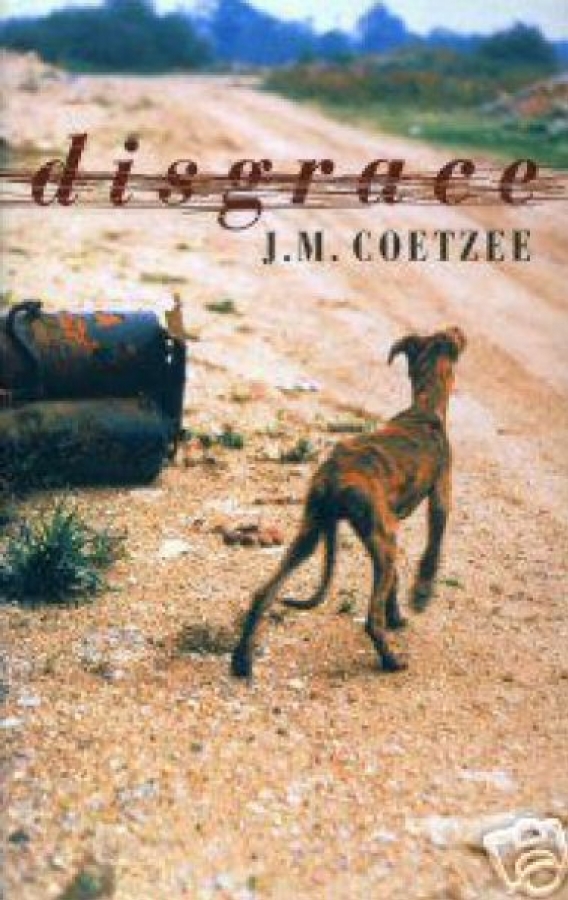
Finished reading on: August 06, 2007
Disgrace
AI Translation Notice: This review was translated from the original Italian using artificial intelligence. Book quotes and excerpts are translated interpretations and will not match the author's original English phrasing or official published translations.
A literature professor is expelled from the university following a relationship—essentially sexual—with a female student.
The man is over fifty and twice divorced.
Accustomed to being courted by women, he now finds himself alone, reduced to seeking sex with prostitutes, and thus lets himself be drawn into the affair, in pursuit of his own vanity and his own eros.
He moves to the countryside to stay with his daughter, who runs a smallholding and a dog shelter.
He helps his daughter take her produce to market, meets a woman his own age who runs an animal clinic and puts surplus dogs to death, and works alongside Petrus, a Black man who helps his daughter run the farm.
The man’s attitude, however, has not changed; his vanity continues to dominate even his relationship with his daughter, with whom he cannot achieve any genuine dialogue: neither recounting the events that led him to leave the university, nor understanding his daughter’s reasons for living in the country, so utterly isolated.
An incident radically alters their lives: three Black men break into the house, ransack it, attempt to set the professor on fire, and rape his daughter.
Even more shattering is the fact that the daughter does not report the crime and chooses, instead, to keep the child conceived through the assault and to marry Petrus to secure her existence in the countryside.
The professor’s world dissolves—a world that had found its precise coordinates in the realm of imagination, poetry, and bourgeois conventions: as he had said at the beginning of the book when glossing a stanza by Wordsworth (the poet’s disappointment at the sight of Mont Blanc):
the great archetypes of the mind, the pure ideas, find themselves usurped by mere images that derive from the senses.
Yet we cannot live every day in the world of pure ideas, sheltered from sense-experience...
The question must be:
How do we find a way for the two (imagination and reality) to coexist?
Ideas of a narcissistic intellectual, to which his daughter replies that life is a concrete, simple matter.
The man attempts to return to the city, but his former life has by now vanished.
He therefore takes a room in the village near his daughter’s farm, works on a musical piece destined to center on the affair between Byron and his Ravenna mistress, Teresa, and helps run the animal clinic.
The book draws to a close, bleakly, with the man’s decision to have a dog put down—a dog to which he had grown attached—because we must all make our way toward our end, toward death.
It is a highly complex novel, one in which it is difficult to isolate a single narrative thread.
Among the possible readings (the social fabric of South Africa, the clash between bourgeois European culture and the emerging values of the Black population, father-daughter relations, the acceptance of the codes of violence, animals and dogs in particular), the most compelling seems to me to be the theme of death and the awaiting of death.
The former is addressed through the ordeal of the protagonist, who comes to terms with the passage of time:
he wanders aimlessly in the garden, a dreary feeling coming over him.
It is not merely that he does not know what to do with himself.
The events of the day before have shaken him to the core.
The tremors, the weakness are merely the first, most superficial symptoms of shock.
He has the sense that within him a vital organ has been bruised and abused, perhaps even his heart.
For the first time he feels what it means to be an old man, tired in the bones, devoid of hope, devoid of desire, indifferent to the future.
Sprawled on a plastic chair amid the stench of chicken feathers and rotting apples, he feels his interest in the world ebbing away from him drop by drop.
It will take weeks, perhaps months before he is bled dry, but he is bleeding out.
When all this is over, he will be like a fly enfolding itself in a web, brittle to the touch, lighter than a grain of rice, ready to drift away.
The theme of waiting is embodied by Teresa, who spends her entire life waiting for the return of Byron, who has gone to Greece to die:
my Byron, she sings for the third time; and from somewhere within the caverns of the other world, a voice answers in song, wavering, disembodied, the voice of a ghost, the voice of Byron.
Where are you? he sings, and then a word the woman did not want to hear: dry.
It has dried up, the wellspring of all things.
And finally, the harrowing conclusion of the novel, which epitomizes the protagonist’s despair, the end of life, of waiting:
bearing it (the dog) in his arms like a side of meat, he walks back into the surgery.
I thought you wanted to save him for another week, Bev Shaw says:
Are you giving him up? Yes, I am giving him up—or does the author, with the phrase give up, mean: "I surrender, I yield!"?