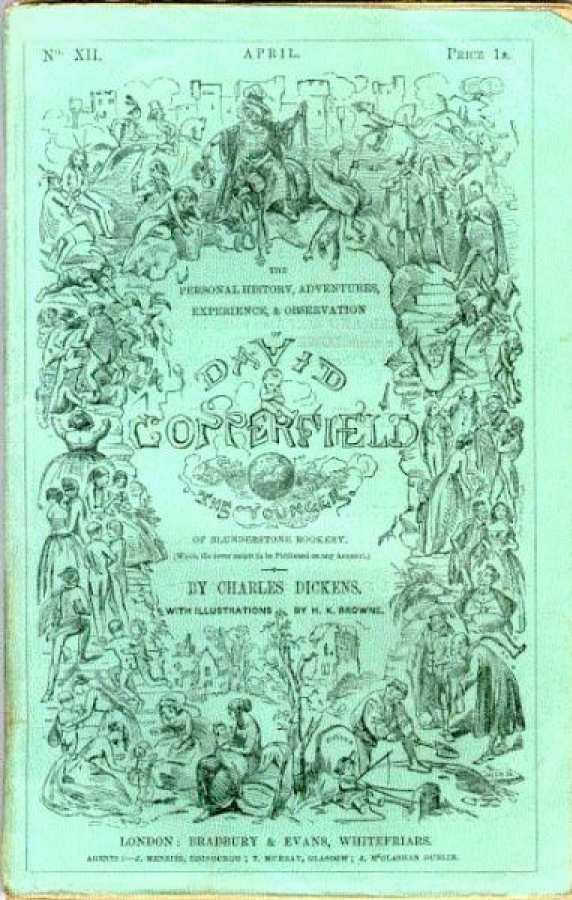
Finished reading on: December 24, 2008
David Copperfield
AI Translation Notice: This review was translated from the original Italian using artificial intelligence. Book quotes and excerpts are translated interpretations and will not match the author's original English phrasing or official published translations.
The novel recounts the life of David Copperfield, who, after a happy childhood with his mother and a nurse, is persecuted by his stepfather.
He is sent to a harsh, authoritarian school and, upon the death of his mother, is forced to work in a factory while still a child.
He is subsequently taken in by an aunt, who provides him with comfort, an education, and the means for an apprenticeship at a law office.
Over time, the young David grows into manhood, working hard, marrying, and gradually establishing himself as a writer.
Upon his wife’s death, he embarks on a long journey, which allows him to realize his love for a childhood friend (Agnes), whom he marries upon his return to England.
The novel is rich in characters and situations (grotesque, melodramatic, emblematic of contemporary society and widespread social injustice, representative of a harsh and hypocritical morality), such that David’s fortunes intertwine with other subplots, all culminating in happy endings, yet often encumbering the narrative and rendering it prolix, rambling, and fragmentary.
Individual episodes stand out more vividly than the overarching plot, while the heightened exaggeration of the characters, for good or ill, comes at the expense of substance and depth in the portrayal of the figures' emotions and distinct idiosyncrasies.
In truth, everything revolves around David and his representation of reality; the throng of other characters and the settings themselves constitute «background noise» or a frame within which the imagination of both author and protagonist unfolds.
David Copperfield has been defined as an autobiographical novel, but this is only partially true.
In fact, it is a novel of nostalgia for childhood and of return to a paradise, constituted precisely by the serene maternal sphere and by the figure of Agnes, ever cherished and sought after for her very tranquility and steadfastness.
What prevails is a reality interpreted through a melancholic imagination: all events are seen through the eyes of a child, who narrates an unreal England, embellished (even amid its suffering and injustice) by the trusting, idealized vision typical of childhood.
From this perspective, it is emblematic, and particularly evocative, how the author conceptualizes the ideal place of refuge: it is a boat, inside which one feels safe even as the waves swell and the wind rises outside, in that it ensures an emotional equilibrium and a peace that are ultimately destroyed by the arrival of adult betrayal and passion, and, metaphorically, by a storm that claims both the betrayer and the betrayed.
The style features an exceptionally rich vocabulary and is characterized by a sentence structure that is often difficult to follow.
The frequent use of dialectal forms further increases the difficulty of the reading experience.