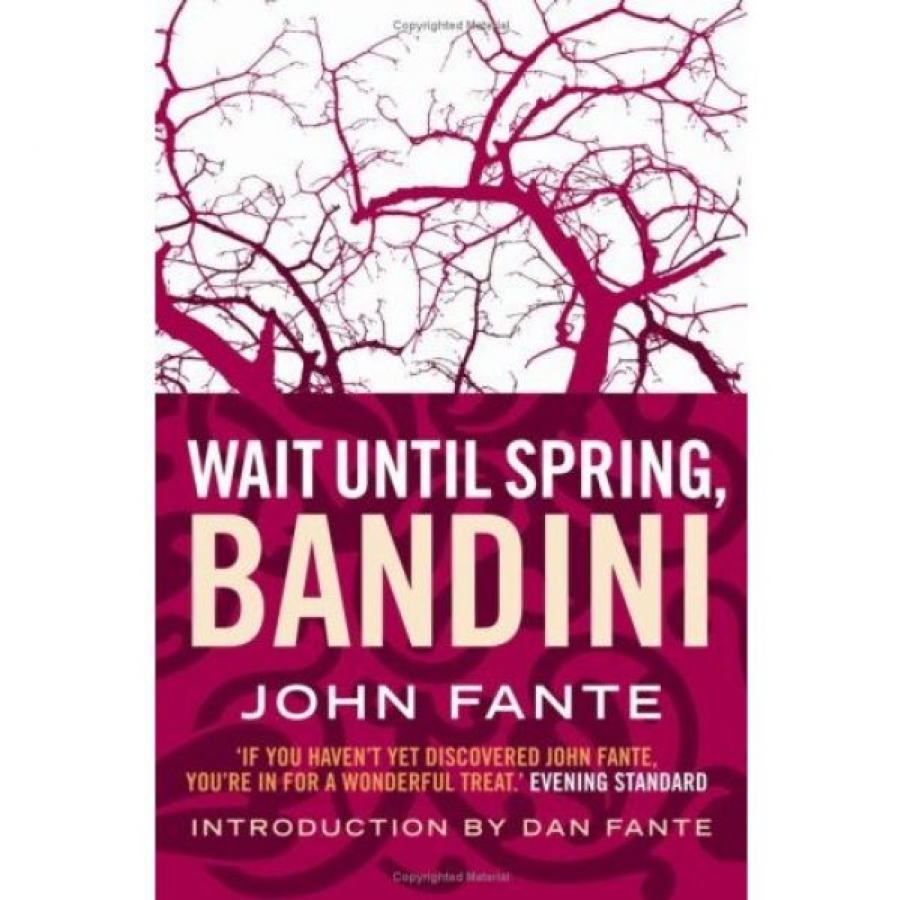
Wait until spring, Bandini
The story belongs to *The Bandini Quartet* saga, chronicling the fortunes of the Italian-American Bandini family, and of Arturo Bandini in particular. The setting is the family: a bricklayer father who is consequently unemployed during the long Colorado winters, a mother striving to maintain a sense of decency and a bare minimum of subsistence, and three sons, the eldest of whom, Arturo, must also shoulder the burden of his father’s frequent, drunken disappearances. In this already fraught domestic sphere, the father’s infidelity with a wealthy local woman triggers the mother’s breakdown; she sinks into prolonged bouts of depression and refuses to let her husband back into the home. It falls to Arturo to seek out his father and bring him back. The themes are those familiar to the author: family dynamics, the bond between son and parents, Catholic culture, and so forth. The narrative unfolds sluggishly, at times becoming tedious and verbose. The musical cadences that characterized the previous novel are absent here. Predictable tropes tied to Italian heritage and Catholicism often seem to dominate (for instance, guilt, recourse to confession, and rituals). The mother’s revolt—her defiance in the face of wounded dignity—emerges as a high point in the narrative and constitutes its finest pages. Another theme is Arturo’s coming-of-age, a journey inevitably accelerated by his mother’s fragility and his father’s absence.

The way home
Chris grew up in a respectable middle-class family. His father runs an installation business: hardworking, reserved, yet attentive to the family’s needs; like all parents, he is full of expectations regarding his son’s future. The mother is protective, affectionate, ready to indulge anything from her boy, so loved and desired. It is a peaceful and well-off household, yet how is it possible that Chris deals drugs, gets involved in petty theft and brawls? > He was not trying to hurt his parents, really. But in his mind there was this thought: they have unreasonable expectations of me. They do not understand who I am... I don't want to be their good boy and I don't want the things they want for me. If they do not understand, it is their problem, not mine . Charged with drug dealing, assault, and causing accidents while attempting to flee the police, Chris receives a severe sentence. He is committed to a juvenile correctional facility, predominantly populated by Black youths. Proving to possess greater resilience than anticipated, the young man manages to survive in an environment that should be hostile to him. Indeed, he establishes a series of friendships that endure beyond prison walls. His only friction is with an older, violent, and aggressive youth named Lawrence. The author does not, however, delve deeply into the prison environment, which resembles a boarding school more than a prison, even a juvenile one. Attention is entirely focused on depicting the relationship between Chris and his father: a cold, detached dynamic marked by mutual distrust. For the father, the disappointment was too profound to offer solidarity and affection to his son. The boy senses his parent's low esteem and withdraws into himself, bolstered by his new experience, which he regards as an achievement. Parent-child relations are fraught to such an extent that one is astonished when, in the novel’s second half, Chris is found working for his father. During an installation job in an apartment, Chris and Ben, a former fellow inmate, discover a bag of money under a floor. They do not steal the cash; they leave it where they found it, promising each other to keep quiet. Ben, however, mentions it to Lawrence over drinks one evening. Lawrence steals the money, unaware that it belongs to two dangerous criminals who stashed it away to retrieve upon their release from prison. The two thugs murder Ben in an effort to discover who has the cash. Chris reveals nothing to his father or the police, contacting Lawrence instead to seek mutual vengeance for their friend’s death. Such is the prison code of honor. To his girlfriend, who urges him against it, Chris replies that > there are two personalities in me, there is the person you know, and the one that is still inside me. The boy who did bad things and was locked up in prison. The one you have never met . It seems Chris is lost for good, yet it is Lawrence who saves him, ensuring Chris does not carry out the revenge, which falls solely upon himself, the bad seed. Indeed, destiny is sealed at birth: Chris was "born in a good suburb, raised in a loving home," while Lawrence > had never found that place ( where) they speak to you with kindness and patience instead of sarcasm and cruelty . The novel pursues several narrative threads: intergenerational conflict, the passage from adolescence to adulthood—which often finds positive resolution through sheer luck alone—and parents coming to terms with the fact that their children harbor their own aspirations and desires. The happy ending should not lead us into facile optimism regarding social change. Everything is already determined from birth: those who are white can be saved, even if they occasionally lose their way; those who are Black can only be dragged down, back into the world from which they desperately strive to rise. Compelling social and psychological themes are diluted by a sluggish narrative pace, devoid of action and at times mundane. Particularly in the depiction of prison life, the author seems eager to present a placid, reassuring vision of the so-called rehabilitation of juvenile offenders. The leap between the first part—the bad Chris—and the second—the good Chris—is so pronounced and thinly explored that it strains the credibility of the entire narrative. Finally, reviews often tout Pelecanos as a writer of noir, albeit with a social bent. From this vantage point, one is left disappointed by the dearth of action and suspense. Why read it? It makes for a pleasant read, but nothing more.