
Notes from Underground
In the preamble, the author himself divides the tale into two parts. In the first, entitled "Underground", > the character presents himself, his views, and seems to wish to elucidate the reasons why he appeared, and was bound to appear, in our midst, that is, how in the era of positivism and dominant reason, it was necessary to acknowledge a primordial force within man—one rising from the underground, driving one to be wicked, to debase oneself in abjection, making one cry out with self-satisfaction: > I am a sick man... I am a wicked man. It is thus a philosophical manifesto, a nihilistic culmination concerning human nature. In the second part, "Apropos of the Wet Snow" (a title one might expect from a Japanese novel), the protagonist narrates an episode from his life meant to explain the ideas and impressions voiced in the first part. It is as if the protagonist, forty years old at the moment he expounds his theories, returns in memory to when he was twenty and to an encounter that altered his life. If we liberate ourselves from the framework cunningly proposed by the author, we realize that Woman lies at the heart of the tale. A clear hint is already present in the verses quoted by Dostoevsky at the opening of the second part: "when, out of the darkness of error, /(...) you told me the story of what had been before me/and suddenly, covering your face with your hands,/overcome with grief and shame,/indignant and appalled,/ you wept..." (Nikolay Nekrasov, 1846). Here it is a young prostitute, Liza, whom the protagonist meets in a brothel and urges to turn her life around, offering his help. He had been captivated by her > fresh, young, rather pale face, with straight, dark eyebrows and a serious, somewhat astonished look. In making her this reckless promise of redemption, our protagonist is not moved by genuine empathy. > A sordid thought was born in my mind and crept through my whole body like an unpleasant sensation, akin to descending into a damp and musty cellar. (...) Now, however, the absurd idea—loathsome as a spider—of depravity became clear to me, which, without love, in a brutal and vulgar way, begins precisely with that: the crowning of true love. There is, as it were, a faint boundary between subjugation, the pleasure of humiliating, and sincere, pure affection for a Woman; between love as lust and Love without ifs or buts. And when Liza arrives at the protagonist's home, he pursues a cruel game of insults and spite, almost as if it were the poor girl's fault for having caught him in a shabby dressing gown— > filthy, wretched, disgusting, (...) a scoundrel, a rogue, a loafer, no longer the hero of their encounter at the brothel. And then *a strange thing happened*. Humiliated, insulted, in the face of abasement, Liza > had understood, above all, what a woman always senses before anything else, if she is truly in love: namely, that I was unhappy. (...) I had not even imagined that she had not come to hear pitiful words, but to love me, because for a woman all resurrection, all salvation from whatever ruin, and all rebirth lie in love alone, which cannot manifest itself except in love. Unfortunately, > we are stillborn, and for a long time now we have not been fathered by living fathers, and we like it more and more. We do not know how to recognize and accept Love. The tale is an existential, introspective, and philosophical analysis of an antihero, or rather of a split within the Self, between our self-representation in fantasy and literature and concrete life, in which we are no longer great men, but petty and wicked beings. I do not know whether D'Annunzio ever read *Notes from Underground*, but without doubt the novella's protagonist seems to foreshadow the characters of our writer's novels and plays: supermen in art and abject in life. It is not the protagonist-narrator who remains etched in our imagination; on the contrary, we ultimately grow weary of the redundant flood of words behind which he takes refuge. It is Liza who gradually emerges—from a wretched prostitute into a woman wounded in her betrayed love, in her proud refusal of a payment brutally thrust upon her. She is a dynamic, non-stereotypical figure, the only one to evolve within a static narrative where situations and characters seem pinned down in their functions, beginning with the protagonist. It is no accident that *Notes from Underground* did not achieve critical or popular success, precisely because it lacks plot and the development of human figures in their psychological and spiritual dimensions. Why read it? It is of great interest for understanding Dostoevsky's "philosophy".

Memoirs of an Ethiopian Princess
> When I was four years old, in my father's house, life tasted of true happiness, and before my siblings and me lay the opening of a fairy-tale existence . Memories, nostalgia, and a sense of one's own rank are the distinctive traits of this autobiographical novel, set in Ethiopia and Italy between 1925 and 1946. The author is the daughter of Dejazmach Nasibu Zamanuel, a prominent figure of the feudal aristocracy, a hero of the resistance against Italy, who was poisoned to death by mustard gas—a weapon the Italian army deployed extensively during the 1935 invasion. Martha was driven to write the novel “by a sense of duty”: to shed light on the events that devastated her family and to convey the > astonishing atmosphere that emanates from my country, evoking its colors, flavors, and customs, as well as the vitality of a refined, generous people who deeply respect the dictates of the Christian values upon which they founded their very existence (book presentation, Rome, July 17, 2006). The book is divided into two parts. The first recounts the author's childhood through her mother's stories and the wonder-struck eyes of a little girl. What emerges is a dazzling, sumptuous, magical world, remote from our time and from the reality of Ethiopia itself. These are vignettes of life centered around the figure of the father. At a grand social gathering of the feudal aristocracy, in the presence of the Emperor, Dejazmach Nasibu appears > draped in a diaphanous shamma with broad red silk borders, his broad shoulders cloaked in a blue velvet cape embellished with gold trim, (...) in the saddle of his magnificent white horse harnessed with rich trappings gleaming with gold ornaments. (...) In the cloud of dust kicked up by the tumultuous gallop, a young woman riding sidesaddle drew alongside him . She is Martha’s future mother, the daughter of a Russian prince, and love seems to blossom from the splendor of these two nobles and Ethiopian high society. It is pointless to ask inopportune questions, such as inquiring into what brutal exploitation lay behind such magnificence; we too, like Martha, are captivated by “very distant memories,” when one feels sheltered by parental love, games can go on indefinitely, and > no one would ever have foreseen that anything could disturb the course of our lives . On October 3, 1935, Italy invaded Ethiopia with a well-armed army of 350,000 men, supported by aviation. After a glorious yet futile resistance, ground down by the spraying of nerve gas, Ethiopia surrendered. The magic dissolves. > Memory, as if erased, fails to bring forth even the faintest recollection of those moments. Of what followed, nothing remained with me but a feeling of numbness . Augusto Graziani, appointed Viceroy of Ethiopia, consents to spare the hated family of Dejazmach Nasibu, but exiles them to Italy. We arrive at the second part of the book. The narrative sheds its fairy-tale qualities to become the painful chronicle of a wandering exile: after a stay in Naples, they are sent to Tripoli, then to an oasis in the Libyan desert, where Graziani perhaps hopes they will perish from hunger and disease. Brought back to Tripoli, they are sent to Rhodes, subsequently to Val di Fassa, and then to Florence, where they live until the city’s liberation amidst hardships, aerial bombings, and strict police surveillance. One might expect hatred toward the Italians; not in the least: not only the Italian populace, but the fascists themselves—the *federali* and government officials—seem to display a singular tolerance toward Nasibu’s family: in short, «*italiani brava gente*!». We cannot discern whether it is the adolescent Martha’s optimistic gaze that views events in a positive light, or if this benevolent attitude was genuine, perhaps owed to the family's princely status. It matters little: what is missing is Martha's inner lived experience, as she enters adolescence during exile; there are delightful episodes (such as the evacuation to San Giustino and her camaraderie with the children of the small village) and vivid, painterly depictions of nature through which we understand how the young Martha was captivated by Italy’s beauty. Our country must have left an indelible mark on the young princess’s maturation, given that, once back in Ethiopia, she would leave again for a new exile—because her deeply loved native land, in the end, felt too confining. On the other hand, “life is a story”: we remember only that which contributes to the depiction of ourselves. Let us detach ourselves for a moment from Ethiopia and from the crimes of Italian colonialism, rightly recalled by Angelo Dal Boca in his passionate preface to the book: let us dwell instead on the theme of remembrance. In a regrettably forgotten novel (*Il Giorno del Giudizio* > , reviewed on this site), Salvatore Satta, as death approaches, retraces the Nuoro of his youth through a gallery of portraits, and distant faces reappear (...) and perhaps as I think of their lives, because I write their lives, they feel me to be a ridiculous god who has summoned them on the day of judgment, to free them forever from their memory > . Martha's memoir is entirely different: even amid so many calamities, both of her country and her family, the characters and events resurface as if bathed in a bright, clear sky, beneath a canopy of stars, in vivid shades of bright azure. "How beautiful this world is, Mama, (...) It looks like paradise to me!," the child Martha exclaims at the sight of Naples from the sea. It is truly regrettable that the narrative failed to preserve in its second part the vividness and magic of the first. The drop in tension, the inability—or unwillingness—to evolve the narrative into a *Bildungsroman* and, why not, a work of social and political reflection, are all factors that compromise the overall quality of the story, ultimately rendering it verbose, banal, and tedious. Why read it? The first part is a splendid fresco of Ethiopian society, a magnificent cavalcade of memories.

The Merchant of Cursed Books
The inside back cover likens the book to Umberto Eco’s *The Name of the Rose* and Ken Follett’s *The Pillars of the Earth*. Nothing of the kind: if one insists on finding a literary reference, one might point instead to *The Da Vinci Code*. The setting is the Middle Ages. A merchant arrives at a monastery in the Polesine region. He is in search of a mysterious book, but also of a young novice who was raised among the monks. From here begins a sort of treasure hunt across Europe’s major monasteries (Santiago de Compostela, predictably, could not be omitted) to recover fragments of the mysterious text and piece together, through various clues, a puzzle of meanings and magical formulas. Throughout this quest, the merchant and his companions (the young novice and a valiant French knight) are pursued by the knights of the Sainte-Vehme, a mysterious and powerful chivalric order. What follows is a succession of ambushes, surprises, and dramatic turns. Naturally, the story has a happy ending, yet it leaves the reader disappointed, unable to understand what was so significant about the long-sought book in the first place: could it be just another sham? The novel is clearly a thriller, yet it lacks all the ingredients that could grant it depth and distinctive character. The medieval setting is pointless. Beyond the sequence of monasteries, there is no thorough or evocative world-building rooted in a genuine grasp of the customs and culture of the period. The characters are flat, and even the figure of the merchant, who might have possessed some allure, comes across as cold, incomprehensible, and superficial. The book is packed with plot twists, yet they are never preceded by an atmosphere of suspense; as a result, they remain entirely predictable, both in their unfolding and in their outcomes. It feels almost as if the author focused exclusively on the plot, only to become entangled in a tangle of episodes and circumstances. Why not read it? Unless one is thoroughly exhausted and in need of something requiring minimal concentration, it simply is not worth the time.
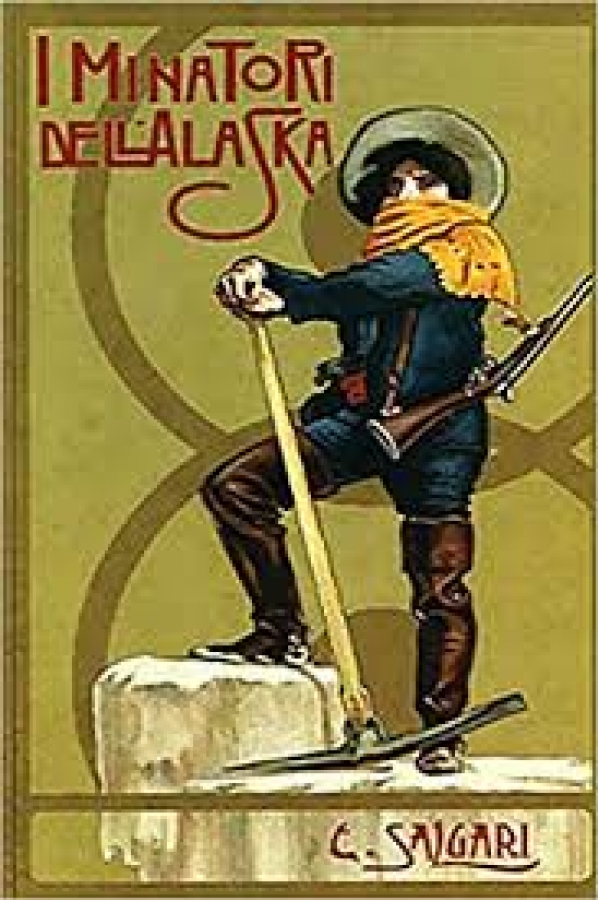
The Alaskan Miners
The true title of *The Miners of Alaska* ought to be *The Great Crossing of the Plains and the Rocky Mountains All the Way to Alaska*; indeed, the search for gold is marginal to the overall story, serving merely as an occasion for Salgari to depict the North American environment as it was related in the nineteenth century. To gain insight into the true history of the American West, and of the United States, I recommend Massimiliano Galanti’s book *La questione indiana* (Odoya, 2016). The formula is classic Salgari. There is the protagonist, Bennie the Great Hunter, described thus: > tall, muscular, with powerful arms, a broad chest, a forceful head covered with long, ringleted black hair that was already beginning to turn grizzled, with piercing eyes and a goatee trimmed to a point . In short, Buffalo Bill! Serving as sidekicks, in keeping with the traditional Salgarian mold, are: a Mexican companion of Bennie's ( > very dark-complexioned, chubby, (...) with pitch-black eyes, the true Hispanic-American type ) and two Italians, survivors of an Indian raid. Falcone has been scalped and miraculously survived; he has an intimate knowledge of the gold-rich mines of Alaska and possesses a crucial instrument for seeking the precious metal: a special sieve that allowed one to separate the gold from the dirt without wading into the water. Armando, Falcone's nephew, has only recently arrived in America, but will prove to be a skilled marksman and an excellent companion to Bennie in hunting and in clashes with the Indians. This group decides to set out for Alaska to capitalize on Falcone's knowledge and his useful implement. The long journey is a succession of adventures: not only escaping treacherous Indians, but also measuring oneself against a wild and mesmerizing nature. The pattern repeats itself with a certain monotony: Bennie and Armando wander away from camp to scout the surrounding area and track down game; they encounter treacherous terrain and must battle terrifying beasts, such as the great brown bear, wolf packs, and stampeding herds of bison. Everything is here: from mysterious dancing plants (tumbleweeds swept along by the wind) to accounts of cannibalism, all the way to the discovery of prehistoric animal remains. It is easy to smile at the travel accounts of nineteenth-century explorers, narratives from which Salgari drew copiously, naturally superimposing his own feverish and inexhaustible imagination. We must allow ourselves to be carried away by a fabulous century, steeped in prejudice and brimming with evocative charm: let us read our beloved author's descriptions of nature with relish. > The moon had set by then, and a dense darkness had fallen across the immense plain. (...) Bennie (...) gazed in all directions, tracking with his eyes the capricious fiery trails of the fireflies, and listening to the monotonous chirping of rejoicing crickets, the distant cries of coyotes, the lowing of cattle . If this reminds us all too much of our own landscape, what can be said of the > meadows formed of tiny mosses of a splendid emerald hue (...) the clearings were covered with expanses of stony, tenacious lichen, resembling dried mushrooms, or tall, pitch-black mosses, soaked with moisture . And from whom did Salgari draw this raw portrayal of the Alaskan miners? > More than human beings, they seemed beasts brutalized by hard labor and privation. They were all ragged, filthy, their shirts blackened by campfire smoke or soiled by mud from the pits, their trousers patched in a thousand ways, their boots worn through and leaving their toes exposed, hats defying description or hoods that had long since lost their fur: yet all wore belts bristling with revolvers and gleaming bowie knives . Were they not armed, they might well be our own miners from Mount Amiata or the mines of Porto Empedocle. What a contrasting attitude Salgari displays toward the redskins compared to the wretched souls prospecting for gold! The former treacherous, cruel, and superstitious; the latter greedy and desperate, yet not devoid of a kind of justice. A child of the nineteenth century, our beloved author could hardly avoid a touch of racism! Within Salgari's vast output, we are dealing with a minor novel, albeit sustained by the brisk pace of its adventures and the pursuit of the marvelous. Plot twists and gear shifts are lacking: the enemies are bound to succumb, pretty much all in the same manner—whether they be Indians, outlaws, or ravenous wolves: a rifle shot, an audacious and unexpected stunt, a prudent and shrewd strategy. Nor is there any dynamic between the characters: Bennie is a hero devoid of passion (did he ever have a sweetheart? did he suffer injustices?), and those who ought to serve as his foils are faded figures, lacking that vibrancy and irony that distinguish so many of Salgari’s minor characters. Why read it? It is packed with adventure; I particularly recommend the chapter recounting the wolf attack.