Finished reading on: May 20, 2020
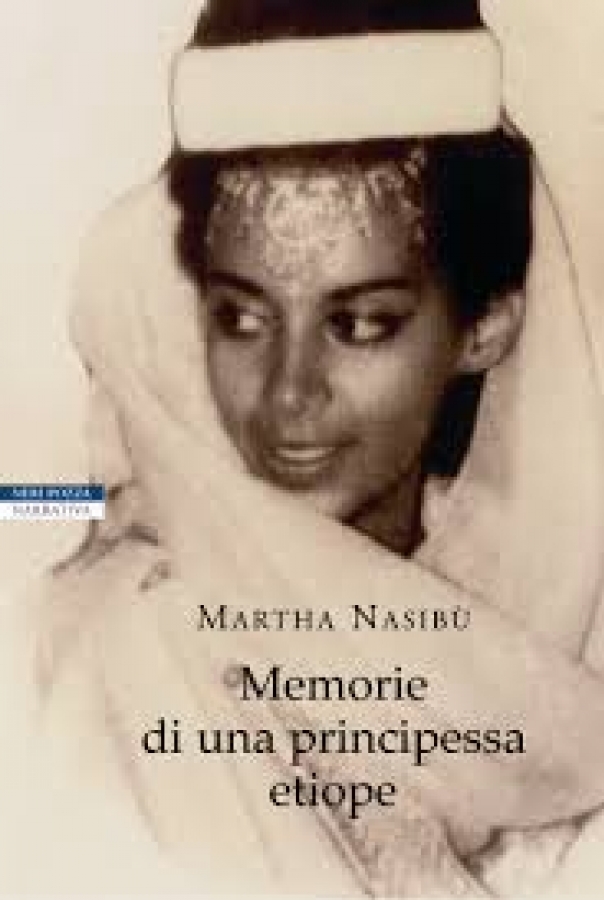
Memoirs of an Ethiopian Princess
Title of the original version reviewed: «Memorie di una principessa etiope»
AI Translation Notice: This review was translated from the original Italian using artificial intelligence. Book quotes and excerpts are translated interpretations and will not match the author's original English phrasing or official published translations.
When I was four years old, in my father's house, life tasted of true happiness, and before my siblings and me lay the opening of a fairy-tale existence
. Memories, nostalgia, and a sense of one's own rank are the distinctive traits of this autobiographical novel, set in Ethiopia and Italy between 1925 and 1946. The author is the daughter of Dejazmach Nasibu Zamanuel, a prominent figure of the feudal aristocracy, a hero of the resistance against Italy, who was poisoned to death by mustard gas—a weapon the Italian army deployed extensively during the 1935 invasion. Martha was driven to write the novel “by a sense of duty”: to shed light on the events that devastated her family and to convey the
astonishing atmosphere that emanates from my country, evoking its colors, flavors, and customs, as well as the vitality of a refined, generous people who deeply respect the dictates of the Christian values upon which they founded their very existence
(book presentation, Rome, July 17, 2006). The book is divided into two parts. The first recounts the author's childhood through her mother's stories and the wonder-struck eyes of a little girl. What emerges is a dazzling, sumptuous, magical world, remote from our time and from the reality of Ethiopia itself. These are vignettes of life centered around the figure of the father. At a grand social gathering of the feudal aristocracy, in the presence of the Emperor, Dejazmach Nasibu appears
draped in a diaphanous shamma with broad red silk borders, his broad shoulders cloaked in a blue velvet cape embellished with gold trim, (...) in the saddle of his magnificent white horse harnessed with rich trappings gleaming with gold ornaments. (...) In the cloud of dust kicked up by the tumultuous gallop, a young woman riding sidesaddle drew alongside him
. She is Martha’s future mother, the daughter of a Russian prince, and love seems to blossom from the splendor of these two nobles and Ethiopian high society. It is pointless to ask inopportune questions, such as inquiring into what brutal exploitation lay behind such magnificence; we too, like Martha, are captivated by “very distant memories,” when one feels sheltered by parental love, games can go on indefinitely, and
no one would ever have foreseen that anything could disturb the course of our lives
. On October 3, 1935, Italy invaded Ethiopia with a well-armed army of 350,000 men, supported by aviation. After a glorious yet futile resistance, ground down by the spraying of nerve gas, Ethiopia surrendered. The magic dissolves.
Memory, as if erased, fails to bring forth even the faintest recollection of those moments. Of what followed, nothing remained with me but a feeling of numbness
. Augusto Graziani, appointed Viceroy of Ethiopia, consents to spare the hated family of Dejazmach Nasibu, but exiles them to Italy. We arrive at the second part of the book. The narrative sheds its fairy-tale qualities to become the painful chronicle of a wandering exile: after a stay in Naples, they are sent to Tripoli, then to an oasis in the Libyan desert, where Graziani perhaps hopes they will perish from hunger and disease. Brought back to Tripoli, they are sent to Rhodes, subsequently to Val di Fassa, and then to Florence, where they live until the city’s liberation amidst hardships, aerial bombings, and strict police surveillance. One might expect hatred toward the Italians; not in the least: not only the Italian populace, but the fascists themselves—the federali and government officials—seem to display a singular tolerance toward Nasibu’s family: in short, «italiani brava gente!». We cannot discern whether it is the adolescent Martha’s optimistic gaze that views events in a positive light, or if this benevolent attitude was genuine, perhaps owed to the family's princely status. It matters little: what is missing is Martha's inner lived experience, as she enters adolescence during exile; there are delightful episodes (such as the evacuation to San Giustino and her camaraderie with the children of the small village) and vivid, painterly depictions of nature through which we understand how the young Martha was captivated by Italy’s beauty. Our country must have left an indelible mark on the young princess’s maturation, given that, once back in Ethiopia, she would leave again for a new exile—because her deeply loved native land, in the end, felt too confining. On the other hand, “life is a story”: we remember only that which contributes to the depiction of ourselves.
Let us detach ourselves for a moment from Ethiopia and from the crimes of Italian colonialism, rightly recalled by Angelo Dal Boca in his passionate preface to the book: let us dwell instead on the theme of remembrance. In a regrettably forgotten novel (Il Giorno del Giudizio
, reviewed on this site), Salvatore Satta, as death approaches, retraces the Nuoro of his youth through a gallery of portraits, and
distant faces reappear (...) and perhaps as I think of their lives, because I write their lives, they feel me to be a ridiculous god who has summoned them on the day of judgment, to free them forever from their memory
. Martha's memoir is entirely different: even amid so many calamities, both of her country and her family, the characters and events resurface as if bathed in a bright, clear sky, beneath a canopy of stars, in vivid shades of bright azure.
"How beautiful this world is, Mama, (...) It looks like paradise to me!," the child Martha exclaims at the sight of Naples from the sea.
It is truly regrettable that the narrative failed to preserve in its second part the vividness and magic of the first. The drop in tension, the inability—or unwillingness—to evolve the narrative into a Bildungsroman and, why not, a work of social and political reflection, are all factors that compromise the overall quality of the story, ultimately rendering it verbose, banal, and tedious.
Why read it? The first part is a splendid fresco of Ethiopian society, a magnificent cavalcade of memories.