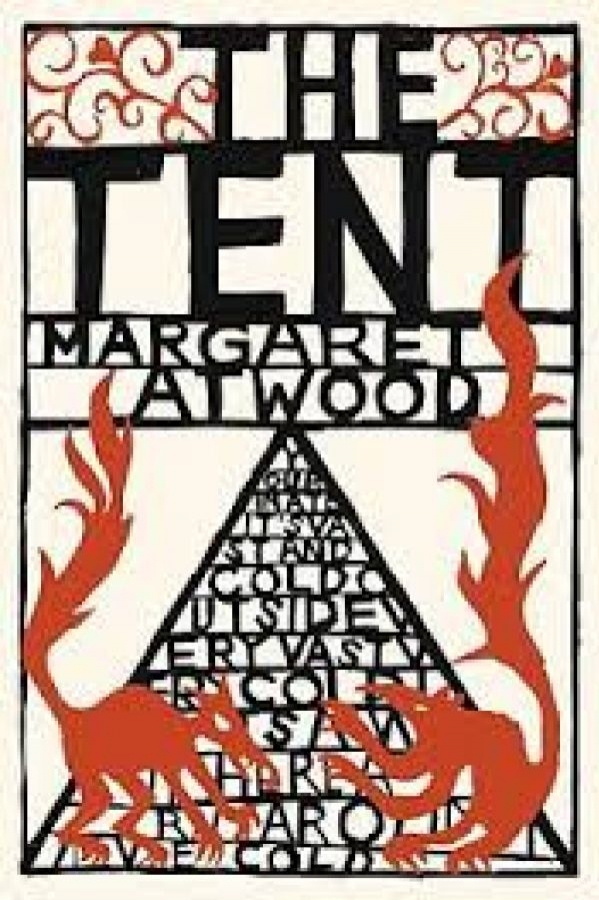
The Tent (Microfiction)
The book is a collection of minimal tales: hence the title *Microfiction* of the Italian edition, which nevertheless fails to convey the overarching meaning of the stories. From the very outset, the writer declares that > she is working on the story of her life, (but whoever) wanted a storyline should have asked for it earlier. (...) Before I discovered the virtues of scissors, the virtues of piecing together . These minimal tales are fragments of life, the expression of a reality that can no longer be reassembled. In the story *Horatio's Version*, Atwood takes Hamlet's tragedy as her starting point to arrive at a reflection on herself as a narrator of human affairs. > So I went back to the stories of individual facts. (...) The French Revolution, the Terror, the slave trade, (...) Vietnam, the Middle East, Cambodia, you name it. I was there. Sometimes I was a merchant of goods, sometimes a courier, sometimes a spectator, sometimes a dispenser of aid. (...) I spoke to victims of famine, war orphans, survivors of massacres and rapes, those who committed them—all sorts of people, with clean hands and dirty. (...) I think I am ready to speak. To tell how things are, now, in this world. Finally, I am ready to begin . But what can I truly say? > So shall you hear of carnal, bloody, and unnatural acts; of accidental judgments, senseless slaughters; of deaths perpetrated by force and deceit; and, in essence, mistaken ends devised by their creators' minds. All this can I truly deliver . Yet everything terrible that happens in the world is nothing more than a "magic mirror" of the human mind. > Look into the magic mirror, gentle reader. Look deep into the eternal desire for good. Ask yourself. But Atwood, like all of humanity, is lost in an "impenetrable forest," in which refuge can only be found in a tent—a metaphor for writing. > Why do you imagine this writing of yours, this graphomania in a fragile cave, this scribbling back and forth, up and down the walls of what is beginning to look like a prison, incapable of protecting anyone? It is an illusion, the conviction that your scribbling is a sort of armour—almost seductive, for no one knows better than you how fragile your refuge is . These minimal tales are not isolated fragments, stylistic gems of a great writer, but rather represent a meditation on the destiny of humankind and the function of the intellectual, of the writer. Can we still represent our era through a grand narrative? Or, just as conflicts, destruction, and deaths follow one another and overlap without reason, incapable of even being explained, must the writer inevitably take refuge in a tent, there to voice flashes of grief and rationality? It is no longer even possible to narrate; one can only evoke. As often happens, the virtues are also the shortcomings. Atwood creates poetry with the syntax and style of prose. The boundary between the two literary genres is tenuous; evocative impressions prevail over discourse. Without a narrative structure to provide synthesis and rhythm, each tale slips into paradox and repeated phrasing, often without any discernible meaning. Except for a few flashes, such as the exquisite *Impenetrable Forest* and *The Tent*, the whole comes across as prolix and ponderous. Why avoid reading it? It is tedious and intellectualistic.
Nobel's Will
Annika is a journalist, married to a dull, unpleasant civil servant. Their marriage is in crisis. By chance, Annika is the only person who caught a glimpse of the murderer—or rather, the murderess—of the chairwoman of the Nobel Prize selection committee. From this event branch numerous narrative threads, perhaps far too many: the rivalries and secrets of the Swedish scientific community, a series of heinous crimes committed to eliminate potential Nobel contenders, the abuses perpetrated by European governments to appease the CIA in the war on terror, the attempt to curb civil liberties by legalizing wiretapping, the crisis of journalism and the press, and the strain of a domestic life borne entirely by the woman. Woven into this tangle of events is also an allusion to a sixteenth-century tale (a young woman had brutally killed the father who was sexually abusing her): a story that had fascinated Alfred Nobel in his day, and which has inspired the killer, an ambitious and sadistic scientist. The diverse narrative threads overlap without ever reaching a true resolution—save for the unmasking of the culprit, as in any self-respecting noir. Yet the author manages neither to pace the events nor to create an atmosphere of suspense. The pages drag by, tedious and at times repetitive; the novel's finest moments are reduced to the opening scene—the murder of the committee chair—and the finale, in which the protagonist miraculously escapes an arson attack. Why not read it? It is long and seems written more to induce sleep than to captivate the reader.
Stick out your tongue
> The sky was so blue and transparent that it seemed there was no air. (...) In the distance, at the foot of a mountain, I could see the village (...). A hundred or so mud houses lined the slopes, and on every roof a prayer flag. Higher up, halfway to the summit, stood a small Buddhist temple with walls painted in red and white stripes and a band of blue beneath the eaves. (...) Everything that moved—clouds, sheep, dogs, prayer flags, women with children in their arms, and I, a drifting Chinese newly arrived from the east—did so in slow motion . The protagonist and narrator has undertaken the journey to Tibet in the hope of regaining the will to live, a renewed spiritual energy. But > in this sacred land, Buddha seemed unable to save even himself; how could I expect him to save me? Tibet reveals itself to be a nightmare, where > the people endure hardships that lie beyond the modern world’s capacity for comprehension. I write this story in the hope that I may begin to forget it . The book is a collection of stories, of such savage brutality as to leave the reader with “a foul, acrid regurgitation rising to the mouth.” Take the final story in the collection: our Chinese traveler recounts the tale of a young girl chosen to be the new living Buddha. Here we are confronted with the pinnacle of Tibetan religious spirituality. The girl grows into adolescence in the monastery, where she studies and prepares for her exalted station. Like any young girl, she feels the first stirrings of love—a youthful, romantic, modest love woven of glances, thoughts, and sensations. Yet the moment of initiation arrives, the Ceremony of Full Powers: what does it entail? First, she is raped by a monk before the entire community; then, according to ritual, she must meditate in the ice for three days before her Buddha-nature can manifest. The girl dies on the second night in the frozen river and becomes > a body of ice resting upon the ice. (...) Everyone looked at the organs floating inside the transparent body. (...) Now the skull rests on my desk. (...) I will accept any offer, so long as it is sufficient to cover the expenses of my travels to the northeast . Censorship is always to be condemned: one cannot ban the publication of a book, whatever its content and artistic merit. I share, however, the verdict of the Chinese authorities: the book is “vulgar and obscene.” While it is true that idealizing Tibetans “amounts to denying their humanity,” the author’s depiction of Tibetan customs excessively reflects the perspective of one who considers himself superior and makes no attempt to investigate the distinctiveness of a people, dwelling solely on the most brutal and incomprehensible aspects. Why not read it? It is useless for understanding Tibet and implicitly justifies the suppression of this civilization by the Chinese. It is a neo-colonialist book.
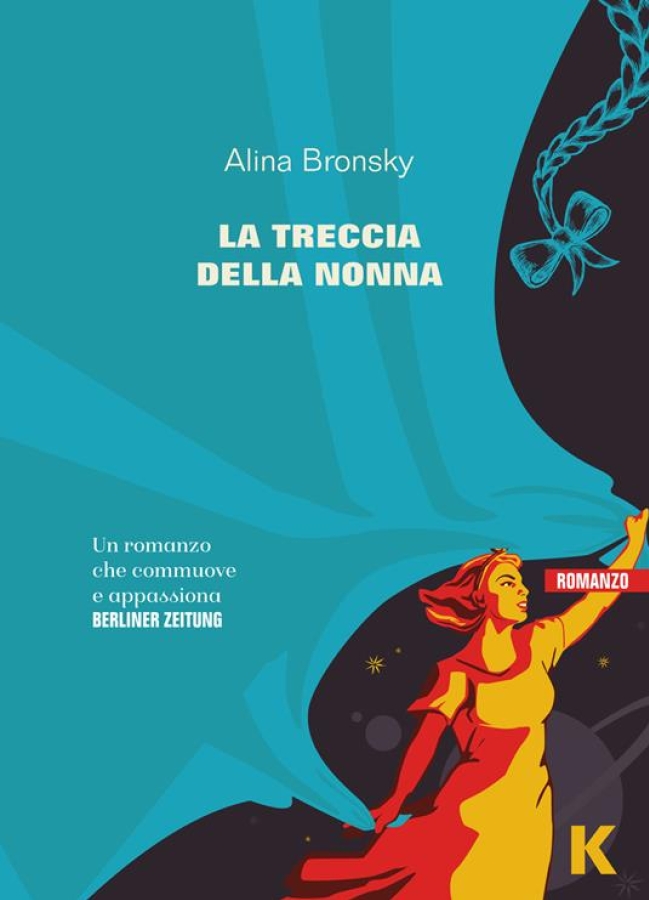
The Grandmother's Braid
The theme of this novel is closely akin to that of Domenico Starnone’s *Vita mortale e immortale della bambina di Milano*, recently reviewed on this site. Just as the Neapolitan writer’s narrative turns on the figure of the “servant grandmother” and her love—subsequently betrayed—for her grandson, here too a grandmother stands at the center of the story: a grandmother ready to place herself at the service of the young orphan—frail, sickly, somewhat dim-witted, and on that account a dead weight. > When we arrived in Germany, the first thing my grandmother did was take me to the pediatrician. In fact, she explained on the way, that was the real reason we had emigrated: so that a proper doctor could finally treat me, someone who might give us hope (...) that one day I would reach adulthood . The grandson nests comfortably beneath his grandmother’s maternal wing, establishing an affectionate relationship steeped in an unmentionable eroticism. And for this reason, it is the boy, still a child, who is the first to notice that the grandfather, the “handsome Asian,” has fallen in love with another woman. The novel opens with this discovery. > To me he was already an old codger (...) and his new, tender secret swept over me in a wave of admiration mixed with gloating , thus writes the boy, who serves as narrator and protagonist alongside the grandmother. If the story had explored the complex, perhaps incestuous relationship between an overbearing mother figure (authoritarian, intrusive, and overpowering) and a personality that could mature only through emancipation, the novel would undoubtedly have been intriguing and well worth reading. Instead, the author focuses on the figure of the grandmother to the point of turning her into a caricature. Confined to her matriarchal role, once she realizes her husband's infidelity, the woman does not fly into a rage, does not throw him out, nor does she even seem to suffer: everything is permitted to the “handsome Asian”—it is simply his nature. She goes further still. She takes charge of the child born of the man’s affair with a young woman; she takes in the young woman herself when she sinks into severe depression; she opens a dance studio and takes over the management of her husband’s company upon his death. It is all too much to remain plausible. Confronted with such excess, the grandson’s emancipation takes the form of betrayal. The boy cuts off his grandmother’s magnificent braid. > Wrap it in newspaper. Keep it as a keepsake. You’ll be leaving soon. I can smell traitors a kilometer away upwind. (...) She brought her face so close to mine that I could make out my reflection in her pupils. I can see it, she repeated vehemently, and pushed me away . Despite being well-written, fluid, and effortless, charming and witty (one need only think of the grandson’s embarrassment over his grandmother’s presence at school), the novel is insignificant. The author, for instance, fails to delve into the question of language: the grandmother who continues speaking Russian despite living in Germany, and the grandson whose emancipation is achieved partly through the acquisition of German—a fascinating theme of identity addressed by Starnone in the aforementioned novel, as well as by other authors: Jhumpa Lahiri’s *The Namesake* and NoViolet Bulawayo’s splendid *We Need New Names* come to mind (two books reviewed on this site). Here, by contrast, the social, political, and anthropological implications of language are developed in a superficial and trite manner. Why not read it? Insignificant.
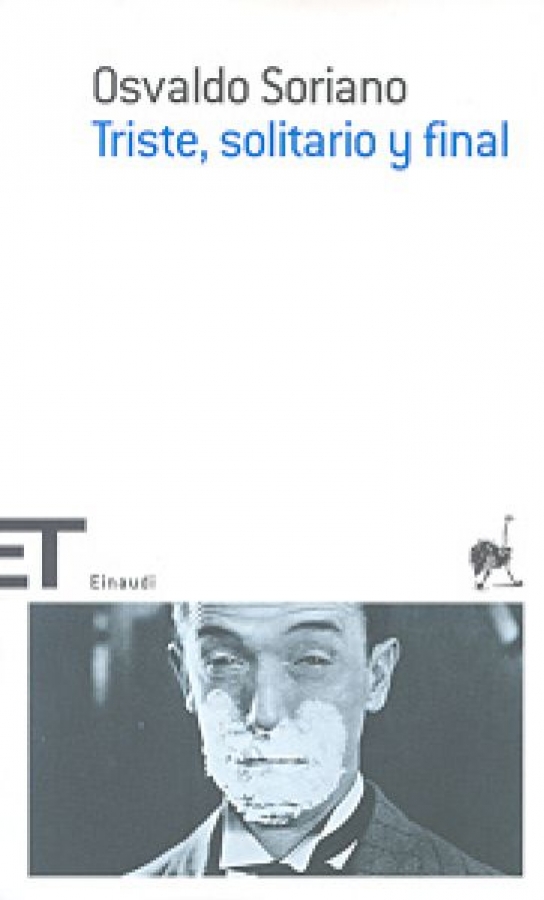
Sad, lonely and final
The novel chronicles Marlowe and Soriano’s investigation into the vicissitudes of Stan Laurel and Oliver Hardy. The style aspires to evoke that of Chandler, and the narrative is punctuated by frequent clashes in which the two protagonists invariably come off worst. The vision of society that emerges is one wherein interpersonal relations are consistently resolved through violence, most often at the hands of the police themselves. The result is a bleak pessimism regarding the prospects of civil coexistence.