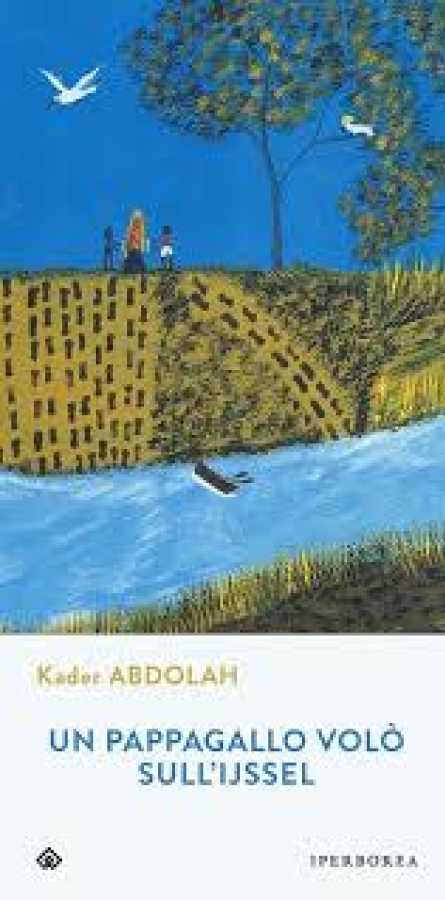
A parrot flew over the IJssel
In the first tale of *One Thousand and One Nights*, under the expressive title of *The Weaver of the Nights* (see review on this site), Scheherazade deceives the cruel sultan, bewitching him with wondrous and intriguing stories. It is the miracle of the word! Likewise, in this novel, Pari, an immigrant woman infatuated with the Dutch language, will save herself through writing. A Flemish healer entrusts her with the task of narrating the lives of immigrants. > Write the story of the people around you, the story of the foreigners arriving in the Netherlands. (...) Free yourself from your anguish by writing. (...) Perhaps this is your duty, now that destiny has led you to a foreign land. With the storytelling framework and the suffused lightness of the Arabic masterpiece, and in the country where > in every region the voice of the water is heard and feared with its eternal disasters , Pari is to narrate > the story of Mamed, of Catherina, of Lina, that of the colonel, of the colonel's wife, of Tala, of Mr. Rahimi, of the parrot, and your own story. They are all immigrants who could answer the question > what are you doing here? with a single word: > I live. Having placed Pari at the center should not suggest that she is the narrator or the sole protagonist: it is Abdolah who narrates from the vantage point of an invisible and neutral observer, just as the novel is crowded with numerous characters; my choice is justified by Pari's obstinacy in making the Dutch language her own, and by the fact that it is this woman's life, more than that of others, that bears witness to the precarious balance between integration and roots. Married while still a child, Pari followed her husband to the Netherlands. The man's long absences allow the woman to attend a school to learn Dutch. > She felt that something deep within her nature had been set in motion and wanted to destroy everything. (...) She realized that the words she looked up in the dictionary and the sentences she wrote in her new language were actually explosives she wanted to place under her family life, under her past, her present, and her entire existence. She begins publishing short stories in a local newspaper; she goes to live first with her Dutch teacher and then with a journalist: men who demand erotic-sexual games that are new to her yet offensive to her morals. *That is how it is done in Holland*, is the self-assured reply to her timid objections! Until one night her husband bursts in and stabs Pari, while the Dutchman flees without defending her. The past has violently returned. If in her husband's attempt to kill her the oppressive traits of an atavistic world re-emerge from her roots, it is Middle Eastern customs and liturgies that snatch her from death. > Twelve elders wrapped in long black coats, each with a rosary in hand , enter the hospital room where Pari lies in an irreversible coma. > Their sweet words danced like bees in the sunbeams, and the murmur of prayers enveloped Pari's head like a hum. (...) Suddenly the needle moved, tracing with a metallic sound a wavy line, a zigzag of life. As in the fabulous tales of *One Thousand and One Nights*, a parrot (an Angel?) flying over the IJssel saw > a young woman with long golden hair riding bareback on a bizarre white horse with a long mane, (...) a strange place populated by thousands of animals, great primordial elephants, giraffes, dinosaurs, camels, tigers, lions with aged manes, and also very small creatures: mallards, colorful parakeets, butterflies, golden insects. In Protestant, welcoming, and transgressive Holland, all the magic of the Orient had resurfaced to save Pari. The novel unfolds along two tracks: the difficulties of integration—cultural before political and institutional—and individual stories showing how each person faces assimilation differently. The Netherlands presents itself as a welcoming country, yet distrust, fears, and linguistic and cultural differences inexorably emerge. If at first it is intriguing to associate with a foreign man or woman—the former so passionate, the latter fascinating beneath the veil—later the Dutch woman withdraws in concern, and the man fails to show respect for traditions more reserved than those of Dutch society. Even within a framework of difficult assimilation, the individual stories, distinct and parallel, show how through this encounter everyone changes—both the Dutch and the immigrants—yet each in a different way. It is true that fate towers over us—may the will of the Almighty be done!—but each of us plays with destiny differently, carving out our own path; and therein lies the true change. For the parrot over the IJssel, for the Angel or the Almighty, there is nothing left to do but watch us. The novel is a collection of narrative modules that develop autonomously and then intertwine almost by chance; it is difficult to synthesize the various stories, except in a few pivotal passages: the grave of little Tala where everyone gathers to pray, the single public telephone used by the immigrants to call back home, the group of elders living as if they were still in the East, and the mysterious figure of the parrot, perhaps Frederick II's mythical "cockatoo," symbol of ancient Arabic culture. The writing is fairytale-like and realistic at once, never flattened into mere description or pointless political and sociological digressions, and for this reason rich in evocative power. Why read it? It is rambling, yet pleasant to read.
Johnny the Partisan
The events between 8 September 1943 and February 1945 form the historical backdrop of the novel. These are the years of the partisan war. An officer cadet in Rome, Johnny left the army, like so many others following the announcement of the armistice and the ensuing general chaos. He returned home, to Alba. A young intellectual passionate about English literature, he belongs to a lower-middle-class family. His parents would have him hide quietly, without exposing himself. But the young man decides to abandon > a fluid position, remediable from any fatal impact through pretense, subterfuge, or cunning , taking a stand instead > in the great dualism at the price of immediate, unquestionable execution . And then > he set out for the highest hills, the ancestral land that would aid him in its motionless possible, in the vortex of the black wind... in the name of the authentic people of Italy, to oppose fascism, to judge and execute, to decide militarily and civilly . He stumbles upon a Garibaldini brigade, tied to the communists. Like many of his comrades, political ideologies do not interest him; what matters is fighting fascism. He meets Tito, a shrewd young peasant, so far removed from him in culture and social origins, yet so close in partisan brotherhood. He was > happy and eager to mingle with the men, with all of them. They had fought with him, had been born and lived, each with their own origin... to find themselves together in that battle . He kills his first man: > the boy was dancing thirty meters away, blinded by his own courage... Johnny shot him without haste, without ferocity.... he propped himself up on his elbows in an ascensional suspension before his first dead man . The clash with the fascists breaks up the brigade, too poorly armed to resist. Johnny goes in search of another partisan formation and encounters the so-called *badogliani*, closer to his own political sensibilities. He finds a bourgeois environment more familiar to him, and it is with them, in the hill villages around Alba, that he spends the long stalemate of the winter of 1943–1944. Although better organized and equipped than the Garibaldini units, they are utterly unprepared to withstand the joint fascist and German offensive in the summer of 1944. The struggle is brutal and unequal. Johnny sees many of his comrades die and is reduced to a small core, including his friends Pierre and Ettore, with whom he takes refuge in a farmhouse. Yet Pierre flees to the city, where hiding is easier, while Ettore is captured along with the peasant woman who had sheltered and fed them. Desperate and alone, he faces the long, bitter winter of 1944–1945. He hides in the wildest reaches of the woods, in the ravines carved out by torrents, occasionally seeking food and shelter from the peasants, who are themselves exhausted and terrified. > His heart broke with longing for the ancient community, that factious, reproachable, at times repellent community, and for the old battlegrounds and the companionship of the living, the dead, the captured... He yearned to regroup, he would have given half his blood for it, Where is Nord (the partisan commander's nom de guerre)... January 31st is an absurd date to reunite. That morning you will rise and call out, but only the silence of the hills will answer you . By the end of the winter, very little remains of the naive, idealistic student. The loss of his dearest friends, the massacres he was forced to witness, the cold, the hunger, the squalor have turned him into a solitary fighter. When, in January 1945, the partisan ranks begin to reorganize and swell once more (with the Allies' final advance now drawing near), > Johnny was no longer at home there; that patch, far from fading, was widening. He could no longer endure fellowship or routine; he skirted collectivity, patrols, and sentry duty . The naive cry, “Long live us!, forever until the end of human history,” which he had voiced when feeling profoundly united with his comrades, has transformed into a sense of dissatisfaction, of disillusionment with others, driving him to disobey and seek a brave and solitary death. The novel is the ideal sequel to *Primavera di bellezza*, another of Fenoglio's masterpieces. While in that book the author chronicled the political maturation of a young man becoming aware of what fascism was and of the need to bear an individual witness of rebellion, in *Il partigiano Johnny* Fenoglio recounts a young man's partisan journey and how the events of the war and the harshness of the environment left an indelible, unpredictable imprint on his character. While remaining steadfast in his determination to “say no all the way,” never to surrender, by the war's end Johnny can no longer feel part of a broader community—the partisan army—desiring instead to fight the fascists alone, like a solitary hero. And as one reads on, both the language and the relationship between Johnny and his surroundings evolve. If at the beginning of the novel the prose is steeped in English words, as if to convey the protagonist's literary realm, the Anglo-Saxon terms gradually grow scarcer, until Johnny eventually betrays his beloved English tongue, rejecting the role of interpreter in favor of that of a combatant. Similarly, the hill country begins as a backdrop, only to take on an increasingly prominent role as protagonist as the story progresses, almost melding with Johnny's new persona. The woods, the ravines, the villages perched on the mountains, the fog and the frost, the peasant world with its livestock and its dogs, fierce or friendly, become the protagonist's new reality as, like a modern-day Robin Hood, he wages his solitary battle against the villains. In this respect, Fenoglio's book is a magnificent narrative of the Resistance—not the rhetorical one intended to exalt collective history and the emergence of a national consciousness. Paradoxically, the trajectory in the novel is reversed: from a civic and political vision, however naive and unrefined, the protagonist arrives at an individualistic and disenchanted conception of the idealized partisan war. Fenoglio's immense fascination lies in the expressive creativity of his language: > an ungrammaticalized language, ductile, capable of being dismantled and reassembled in its constituent elements with extraordinary fluidity... a magmatic language with which to collaborate creatively. The result is a prose incessantly yielding lexical, morphological, and syntactic neologisms (Dante Isella: *La lingua del partigiano Johnny*). It could have marked an intriguing direction of development for Italian literature. No one followed it, squandering the opportunity to inject fresh, original vitality into a language as stagnant as Italian had become. A weakness of the novel lies in its lack of compactness, leading to a narrative plot that is often sprawling. The relentless focus on the protagonist fails to provide dynamism and dialectic to the system of characters, who, in turn, lack sufficient depth and autonomy to counter the overbearing presence of Johnny's character. It is an epic and individualistic book *par excellence*. Why read it? It is a fascinating book, above all for its language.
The Little Masters
Questo autobiographical account of the Resistance shares the same beginning as other novels that chronicle the years of partisan warfare between 1943 and 1945: as in Fenoglio’s *Primavera di bellezza* or Lajolo’s *A conquistare la rossa primavera*, the protagonist is a young officer, waiting for heaven knows what. > Perhaps we will flicker out like this; then, once we are extinguished, the war too will die down little by little . Instead, the armistice arrives, “like a scream,” and one returns home on foot, amidst columns of German troops. University friends in Vicenza are sought out once again, old discussions are resumed, and one partakes in an > intoxicating collective feeling (...); one sensed the overwhelming power of things rising from below, of spontaneous things; one felt the warmth, the security of being immersed in this surge of the general will . One joins the Resistance, moving through the city and the villages of the Venetian plain, but by October 1943 one is already forced to head up into the mountains, into the Belluno area and onto the Asiago Plateau, the settings where the book largely unfolds. Unlike what happens in Fenoglio and Lajolo, the protagonist does not become a lone wolf, like *Partigiano Johnny*, nor does he acquire a political consciousness that leads him to take a partisan stand, even after the Liberation. The author writes an intentionally anti-heroic narrative, yet does so with trepidation, because > every so often I had the sense of touching a more perilous point, almost a breach in a levee; and it seemed to me that if I stirred it, a flood of chaotic personal, civic, and literary affections would come pouring down and carry me away . And > in the end, the meanings of words vanished as well—adjectives, nouns, those cowards of verbs; (...) Finally, only the I and the non-I remained alone . The progression of the narrative follows the typical phases of partisan history: the emergence of the bands, disorganized and isolated; the roundups of autumn 1943; the long winter that followed; the movement’s growth in the spring of 1944; and then the new Nazi-Fascist offensive, which forces the partisans down into the plains. The protagonist moves through these events without dwelling on acts of war, which consistently remain in the background, focusing his attention instead on the men and the landscape. He meets old friends, makes new ones, loses them (to firing squads or deaths in battle), grazes past fleeting romances, and desperately tries to discuss literature and philosophy, to keep his humanist culture close. He too, like Partisan Johnny, finds himself alone in the long winter of 1944: on the run, starving, shoeless, barely surviving—yet it all feels like a dream. > I walked, with the landscape emerging in bits and pieces, giving the impression of moving. (...) Then the moon makes a long fish-like leap across the sky, its tangerine-colored light settles; I am on my feet and I stay on my feet, I walk down the road between the houses of Frizzòn, I knock on the first door. (...) There is no one in this house. They are all dead. Open up, at least you! I’m dead too. (...) I’m waiting for the coffin to come take me away . Though abandoned (he will be saved by Rosina, a young peasant woman), the protagonist lives as if on a long journey, both real and ideal, across the Venetian mountains, on the brink of the hills and the plains. And often he is overcome by a sense of wonder, as when he looks down from above upon > the torrents, the roads, the villages recognizable one by one in a kind of great lake; everything was enamel and gold, (...) and for a moment a kind of emotion came over me that I had not expected, as if a traveler in China were to look out over a remote valley, and there below Thiene should appear, the smoke of Schio, and the small hills beneath which lies his village, his home . The subdued, delicate atmosphere is the novel’s fundamental virtue: it is the fruit of a deliberately pursued narrative style and approach. As for the former aspect, the writing bears a humanistic, traditional, cultured, and elite imprint; yet the typically Italian rhetoric is stripped of its frills, rendered frugal and essential, thereby enhancing the fluidity of the sentence structure and the richness of vocabulary and idiom. The novel is a sort of remembrance, and thus the author rightly does not intend to provide a chronicle of events, but seeks instead to narrate them through the lens of memory, which shapes individual fragments, viewing them from the perspective of one who sees them now far off, as if in a mist. with a feeling of tenderness, but also of mild detachment. And it is this peculiar trait that makes the novel fascinating. This choice, which prioritizes sensations over events, at times makes the narrative tedious, as it comes at the expense of pacing and character depth. Why read it? It is wonderful to lose oneself in its atmosphere.
The Port of Love
I do not know whether anything exists in our literature quite like Thomas Mann’s novella *Death in Venice* (see the review on this site). Comisso's short piece recaptures much of the atmosphere of the great German writer's masterpiece. One senses the same oneiric anticipation of decay, voluptuous and melancholy. We are in Fiume, between 1919 and 1920: the city, sweet with the fragrance of jasmine, was illuminated > by the glint of the sea, and on the slopes orchards gleamed with blossoms, (...) on the sea, a few sails caught the sun. (...) The warmth of the sun matched the languor of the body restored by good food. I indulged in indefinite pleasures... How can one not recall the “balmy nights” of Piazza San Marco and the “soft, luxurious sweetness” that held sway over the aging writer who went to die in Venice? Comisso recounts his brief Fiume adventure with languid nostalgia through a series of portraits, steeped in an “immense boredom” and in the D'Annunzian notion that “everything in the world yearns for love.” It is a metaphorical journey along the paths of youth: betrayed hospitality, male friendship, passion for the Croatian woman (“come with me, Italy is in love,” Comisso tells her), the murky attraction to the decaying woman ( > withered skin, wrinkles, sullen eyes, hooked hands, a misshapen figure, a parched mouth, and blackened teeth ) right down to the hunchback, a grotesque pimp > who smiled at our frenzy and took pleasure in driving it to an exasperating pitch. (...) I trembled with impatience. The thought of the woods, the moon, and this peasant girl easily yielded to love in the night confirmed for me that the finest dreams of adolescence were achievable in life . And just as Thomas Mann surrenders to fantastical visions, where Venice is > half fairy-tale, half snare for strangers, in whose miasmas a voluptuous luxuriance flourished, (...) notes soothing and caressingly languid , so too does a Karst cave draw Comisso > into an agonizing dreamscape; I imagined an unleashed surge of water crashing over me, crushing and suffocating me against the walls. (...) How could such perfection last, and how could we ever find its equal? (...) The ground was strewn with countless dead bees, and that slaughter felt like an omen of my own end, the consequence of a summer lived too greedily . The Italian army put an end to the Fiume adventure, leaving Comisso with nothing but nausea. > Life weighed heavily on us, and we had grown old along with our clothes, threadbare and steeped in perfume, dust, and sweat . In Comisso’s youthful novella, much recalls the Crepuscular poets; reading it brings to mind the verses of Guido Gozzano: > heart that never bloomed, in vain do you hasten / toward pure mirages in less mournful gardens; / you feel it serves man nothing to linger, / scattering dispersed dreams for a new life (From *I colloqui*, “Le due strade”). Far from being a harbinger of Fascism, the Fiume enterprise was an experiment in free love through which a bourgeois youth, scarred by the violence of the First World War, sought desperately to live, refusing to return to an opaque petty-bourgeois existence while pursuing a kind of revolution of mores and consciences. Comisso recounts this shattered dream: nothing remained but Fascism as a final illusion of breaking free from the prosaic Italy of Giolitti. *Il porto dell'amore* is a youthful work, “teeming with impatience for grammar,” as Rolando Damiani observes in the preface to the collected works of the author; and it is precisely in these grammatical improprieties that the secret of Comisso's charm lies. The author employs a language that blends elevated, classicizing, and elegant forms with incursions of spoken idiom and dialect. The result is a singular, alluring, and mysterious reading experience; as Montale put it, “an exact, light sound of words,” which yields an indecipherable sense of grace. Why read it? Wonderfully languid.