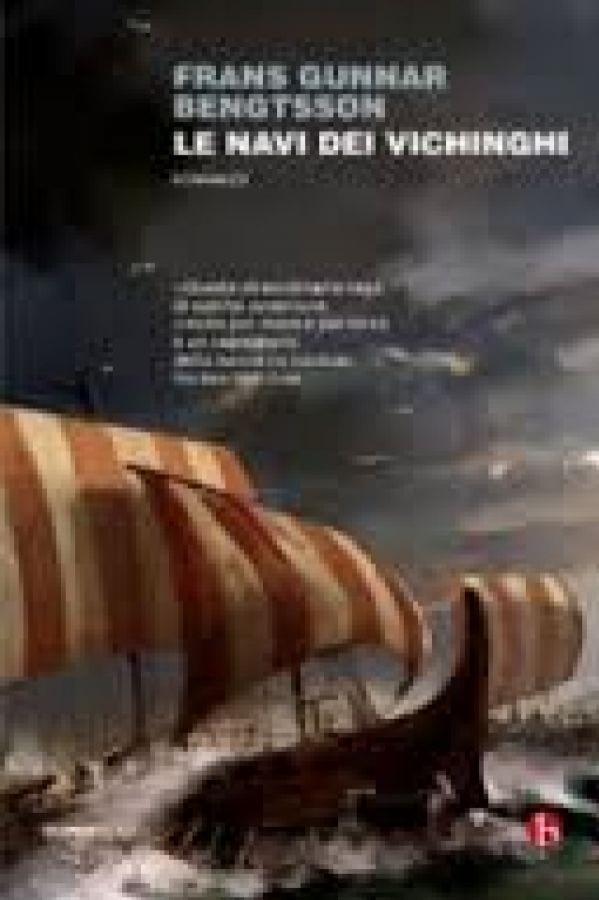
The Viking Ships
The year is 900 AD. The Vikings, a people native to Scandinavia, lived off crops, herring fishing, and, for the more restless among them, sea raids—chiefly toward England and Ireland, where they found fortune by the sword, and where many eventually settled. They were beginning to be touched by the preaching of priests, “shaven-headed men,” who sought to convert them to the Christian faith and to soften their customs, still crude and violent. The novel recounts the deeds of Red Orm: the youngest son of a wealthy farmer, who, as soon as > spring arrived and the smell of tar began to permeate the air , would turn his gaze toward the sea and, out of the sheer joy of setting out, “would even compose a verse or two.” Orm was his mother’s darling, and she did not want him sailing off with his father on perilous voyages, fraught with storms and enemies. Circumstances dictated otherwise. In an attempt to defend his flock, he was captured by a ship of Vikings sailing “southward,” toward the Frankish realm and wealthy Andalusia. Thus begins the first part of the book, recounting Orm’s long voyage. It was an expedition into worlds still unknown yet already dreamed of: rich lands ripe for plunder. The Vikings had no fixed destination, and thus the book is not a Nordic version of the *Argonautica*, as Michael Chabon suggests in his introduction. Events carried the voyagers along, and they displayed courage, vigor, a knack for seizing opportunity, and a thirst to discover new places and customs. The account of this long journey is also the story of Orm’s coming of age: from a spoiled, impulsive boy, he grew into a seasoned man and a leader of men. And so, upon returning home, Orm was fully an adult, claiming mastery over his own fate. The account of his homecoming opens with one of the most compelling chapters: the Christmas feast at the king’s court. The clash between tradition and Christianity, between ancestral values and new ideals, emerges with brutal clarity. The long banquet in honor of Christmas culminated in a series of bloody duels, in which Orm himself was embroiled, defending the necklace bestowed upon him by the Caliph of Cordova. And it was precisely during his prolonged convalescence that love blossomed between Orm and the king’s daughter—a love that spurred the now-mature youth toward further spiritual growth. To win the woman he loved, Orm chose to surrender the necklace and convert to Christianity. It was a momentous choice, for it forced him to take refuge near the great forests, > where kings never come. It is there that I shall build my church . Many interpretations can be ascribed to the novel: a hybrid of fantastical narrative and social chronicle; a chronicle of the transformation of Vikings into Normans, conquerors of England and key players in the late Middle Ages; the spread of Christendom and its attendant ethical and cultural dilemmas; nostalgia for Viking society, crude yet authentic; the wandering of young men in search of their destiny and the pursuit of the new; the portrayal of a man’s long and turbulent life. Yet the novel’s truest essence is adventure, seasoned with a healthy, dry irony—a detachment that keeps us from taking the heroic figures, incredible exploits, and wondrous discoveries too seriously. As Michael Chabon writes in the conclusion to his introduction, > adventure is a dish best consumed in the comfort of one’s own home . Why read it? The narrative is at times episodic, yet it remains a captivating, epic, and popular tale.
Plebeian Nymph
> I have a daughter, fair and coquettish,/an unwed maiden, fresh as a rose;/ever close, since she was a tot,/I’ve held her fast by my skirt. . Thus Nunziata would sing of her little girl, Miluzza, while picking lice from her head. And Miluzza was truly beautiful, and all the men in town > studied the slender ankles of a racehorse, the breasts budding like a posy of flowers, the dark charm of her fourteen-year-old head . What they wanted, Miluzza knew “by prenatal memory,” and also because she had been born and raised in a destitute family of the *bassi*: a crippled, impotent, and cuckolded father; a mother notorious for giving herself to every passing soldier, doing so with joy and passion like Fabrizio De André's *Bocca di Rosa*. Daughter of the neighborhood whore, Miluzza becomes acquainted with sex while still a child: whether with her playmate or the old shopkeeper, or instead the parish priest and the austere schoolmaster. It is not true carnal intercourse, but lascivious explorations of her young vagina; on the other hand, “one doesn’t walk around with such bare legs and without knickers.” It is possible that Miluzza would have met the same fate as her mother Nunziata, a whore tolerated by the small provincial town, had not the death of her parents (and the consequent collapse of the modest tailor's shop on which they lived) and her employment as a factory hand in a local cardboard manufacturer radically altered Miluzza's life. The factory owner becomes infatuated with the girl and shamelessly makes her his mistress. Hoping to conceal the affair and to dazzle Miluzza, he whisks her away to Naples, lodging her in grand hotels and taking her to the finest restaurants. Yet it is precisely the elegant life in the big city that leads Miluzza to realize her condition as a kept woman, as “Sisina, elegant Sisina, (...) and for a lira she does the zuchetuzù,” as an insolent vaudeville performer recites. Listening to him amid the general laughter, > Miluzza gave a cold laugh. (... The Neapolitan world, so unbuttoned, was the opposite of her mood . For her, sex is a natural, melancholy, understated, and delicate affair to be consummated in a discreet setting, among the neighborhood folk, without offending anyone. Indeed, Miluzza risks being engulfed by scandal, forced to shutter herself at home amid general reprobation, or compelled to leave the small town where she has always lived. To save her comes the war, and, like the angel of the Resurrection, a deserting soldier arrives. The happy ending clashes with the overall tone of the tale—precious and effervescent, yet ever steeped in a disconsolate pessimism. The life of the poor is and always will be thus: carving out spaces for survival and simple diversion amidst daily misery and toil. But is such a life truly so sorrowful, or does one instead forge ahead, serene and confident, as part of an exuberant and festive humanity? It is no coincidence that it takes the big city to lay bare the squalor, which previously went unnoticed within one’s own milieu. The writing is the story’s primary merit. Rea forges a new idiom, a blend of Italian and Neapolitan; in doing so, he lends brio and evocative power to the entire narrative, demonstrating as well how one can employ the “language of the speakers” without turning it into a coquettish gimmick or, worse still, a protected species. Why read it? Spirited and captivating.
The Night of the Comet
In the *Tuttolibri* supplement of *La Stampa* of January 18, 2021, Donatella Di Cesare reviews Giorgio Agamben's book *La Follia di Hölderlin*: a volume recounting the events that led the great poet to shut himself away in an asylum, from 1802 to 1846. Was it true madness or, as Schelling suspected, had his friend "assumed the outward manners of one who is mad"? Hölderlin was > torn, in an existential condition that seemed to push him outside and beyond his era . Sebastiano Vassalli seeks to answer the same question, retracing the life of Dino Campana through a biography that is both documented and fictionalized, as the writer himself describes it; in doing so, he dismantles the cliché that Campana's poetry stemmed from madness. Just as it is difficult to believe that Hölderlin, out of his mind, could have translated Sophocles into German, so we wonder whether a madman could have created an absolute masterpiece like *Genova* (from *Canti Orfici*): > Since the cloud came to rest in the skies/Far over the silent infinite/Seashore enclosed in distant veils,/And the departed soul returned/For all around it was arcane-/ly illuminated the garden's green/dream in the superhuman apparition/Of its flashing proud statues: Let us stop here, because one would be tempted to speak only of this poem, rather than of Campana's mournful life. Born in 1885 in Marradi. > Stocky, blondish, of medium height, (...) He had copper-blond hair, thick and curly, framing a face glowing with health: two small moustaches that stopped at the corners of his lips, and a thrifty goatee that did not stray too far from his chin Thus a friend describes him in 1912, when the young Campana, already deemed mad by his family and by the whole of Marradi, had been cast out several times: first by locking him up in the asylum of Imola, then shipped off to Argentina with a one-way ticket, later, upon his return, sent to the Florence asylum, and subsequently led to live in modest boarding houses across the Tuscan-Romagnolo Apennines. In 1914, Campana published *Canti Orfici* at his own expense, which brought him his first taste of renown and opened the arms of Sibilla Aleramo, with whom he would have a stormy love affair. Finally, in 1918, diagnosed with syphilitic dementia, he was committed to an asylum, where he died in 1932. Vassalli retraces Campana's human ordeal with the same passion and documentary commitment found in one of his masterpieces, *La Chimera*. The protagonist, a young woman exposed to village gossip because she was free and beautiful, was guilty of making love to a "wayfarer," at night under an old oak tree believed to be the devil's abode: for this, she was burned at the stake as a witch (see the review on this site). In *3012* > , also reviewed on this site, a young slacker from Fellinia wants to bring war back into a terrifying world where peace is imposed through repression: he preaches chivalric war and is killed by the guardians of peace, becoming the Prophet. Both were persecuted because they were "out of step," free yet fragile spirits. Thus was Dino Campana. The author writes: "I was looking for madmen: I found madmen. (...) Each madman told me his story. (...) Most of them were people who caused trouble. (...) People who had to be gotten rid of by sending them to America or Australia, or by interning them in an asylum. (...) By day, I lived among the mad; by night, in the hotel, I kept dreaming their stories." For them, "the asylum is a great sounding board/and delirium becomes an echo/anonymity a measure,/the asylum is Mount Sinai,/accursed, upon which you receive/the tablets of a law/unknown to men." (Alda Merini from *La Terra Santa*). And so, nothing remains for the alleged madmen but to sing with Campana: "I know not if among rocks your pale/Face appeared to me, or smile/Of unknown distances/(...) And still through tender distant skies clear running shadows/And still I call you I call you Chimera." (*La Chimera* from *Canti Orfici*). *La notte della cometa* dates from 1984; at the time it sparked controversy: some accused the author of inaccuracies if not outright falsehoods, accusations that stemmed from the disinformation generated by Campana's first biographer (suffice it to recall that as late as 1993, Alberto Asor Rosa, in his preface to *Canti Orfici*, still repeated the far-fetched tale of the poet landing in Odessa on his return from America and then walking to Antwerp, where he had in fact disembarked from the ship *Odessa*); others, such as Edoardo Sanguineti, read Vassalli's reconstruction superciliously, especially where the author sheds light on the relationship between Campana and Soffici (Sanguineti, in his anthology of twentieth-century Italian poetry, groups Campana among the "Vociani," even though Dino despised the journal *La Voce*); still others took offense and sued the writer, such as the municipality of Marradi, because Vassalli had exposed the rancor and malice of the Marradesi toward their great fellow citizen. These are all dated controversies, which flatten Dino Campana's unique and marvelous poetics down to his wretched life. The real question to ask today is another: where does Campana's poetry originate, who were his masters, how did he arrive, while still so young, at compositions so unusual and extraordinary for our literature? Perhaps Asor Rosa is right that > there is nothing left today but to reread him as an isolated and somewhat mysterious fruit of our deepest Italian viscera (Alberto Asor Rosa, preface to *Canti Orfici*, ed. L'Unità 1993); that is, somewhat like Grazia Deledda's *Canne al vento* (see review on this site). Is this sufficient, or is it time to investigate Dino Campana's poetry more deeply? With all due admiration for Sebastiano Vassalli, one must acknowledge the shortcomings of this fictionalized biography: fragmentary and at times muddled, repetitive and verbose, it strives for literary effect at the expense of the overall vision, and it neglects the poet's literary and intellectual formation by reducing it to a sort of solitary quest, thereby paradoxically endorsing the cliché of the "eccentric" poet: not mad, but odd. Why read it? It is a book that sheds light on Campana's life, and also on what the asylum truly was.
The Novellas
The book collects the short stories of Giovanni Verga, written between 1874 and 1894. The author feels the need for retreat from the intense social life of Milan, longing to “see again” his Sicily, > the immense hearth of the Pino farmstead, on the slopes of Mount Etna . From the urge to return to his roots stems the first story, which encompasses all the major themes of Verga’s fiction. Nedda, “la varanisa,” is a wretched girl; her fate is already sealed from birth: > the liveliest imagination could never have conceived that those hands, bound to the harsh toil of every single day, scraping through the frost, or the scorching earth, or the brambles and crevices, that those feet, accustomed to walking barefoot in the snow and upon sun-baked rocks, tearing against thorns or hardening upon stones, could ever have been beautiful; (...) poverty had crushed her from childhood with all the hardships that deform and harden body, soul, and intellect—so it had been for her mother, so for her grandmother, so it would be for her daughter . How distant from this immutable, cruel reality is the gaze of the privileged, who “carelessly” contemplates the enchanting Sicilian landscape and listens > with singular interest to the talk of those folk placed so far below at the foot of his towers .( *Le storie del Castello di Trezza* in the collection *Primavera ed altri racconti*). From this contradiction between the world of the humble and that of the privileged, between the romantic vision of nature and the harsh severity of the environment, originates Verga’s project, articulated clearly at the opening of the collection entitled *Vita dei Campi*: > I tried to decipher the modest, obscure drama that must have overwhelmed the plebeian actors we met together. A drama (...) whose crux must lie in this—that whenever one of those little folk, either weaker, or more reckless, or more selfish than the others, sought to detach himself from the group out of a vague longing for the unknown, or a craving for something better, or curiosity to see the world, the world, voracious fish that it is, swallowed him up, and his kith and kin along with him . It is striking that the author titled this sort of manifesto *Fantasticheria*, almost as if to imply that he himself did not believe in it completely. And indeed, as we venture into the many stories, we realize how they lose their narrative power whenever they move away from Sicily. The author is aware of this as well. In the closing story of *Novelle Rusticane*, under the emblematic title “Di là dal mare,” Verga recounts the departure of two lovers from the island and, > when the sweet sorrow of those memories assailed him, he would look back upon the humble actors of those humble dramas with a vague, unwitting longing for peace and oblivion . It is a watershed: on this side lie the collections *Vita dei Campi* and *Novelle Rusticane*, which radiate a pessimism that is undeniably deep yet transformed into social protest by the author’s profound involvement with his stories and characters; on the other lies a series of collections (*Per le Vie*, *Vagabondaggio*, *I ricordi del capitano dʼArce*, *Don Candeloro e C*), in which the depiction of the humble loses its vitality, deteriorating into pietism, commiseration, resignation, and defeat. The finest stories are those of *Vita dei Campi*. The characters are exceptional, deviating from the norm: Jeli, Turdiddu, Gramigna, La Lupa, Rosso Malpelo, place themselves > among so many madmen who had their brains in their heels, and did the exact opposite of what a Christian usually does when he wants to eat his bread in holy peace . (Verga in the first draft, later discarded, of *Pentolaccia*, quoted in the introduction by Carla Riccardi, p. XIII). Take the story of Jeli. It opens with the recollection of the childhood friendship between the naive horse herder and Alfonso, the master’s son. Between the two boys there are no differences of class or culture: together they revel in the wonders of a primordial nature. Yet, as he grows up, Jeli suffers the collision with reality, consistently tragic in a swift crescendo, culminating in the betrayal of the highest value: friendship. For it is Alfonso who takes his wife as a mistress. > His wife leaves him to rot outside the door, the neighbors said, while the thrush is in the house! But Jeli knew nothing, cuckold that he was. When, however, he sees that Alfonso, > with his fine curly beard, velvet jacket, and the gold chain across his waistcoat, took Mara (his wife) by the hand to dance, only then, as he saw him touch her, did he leap at him, and slit his throat in a single stroke, just like a kid goat . The blind, sudden violence of the humble man who has endured too much is often the denouement of these stories. It is so as well in the renowned story “La Lupa.” > She was tall, thin; she had only the firm, vigorous bosom of a brunette, though she was no longer young; she was pale as if she had malaria perpetually upon her, and against that pallor two eyes as big as this, and lips fresh and red, that devoured you . She is not a woman who submits; will and sensuality make her a master. To possess the man she loves, she gives him her daughter in marriage, in order to bed him under the same roof, defying all propriety. Then the man, to rid himself of her, > ceased hoeing the vineyard, and went to unhook the axe from the elm. La Lupa saw him coming, pale and wild-eyed, the axe gleaming in the sun, and she did not retreat a single step, did not cast down her eyes, but kept walking toward him, her hands full of bunches of red poppies, devouring him with her black eyes . It is an extraordinary, striking image that leaves the narrative unresolved: did the man kill her, or did he throw himself once more into the arms of the Wolf? In *Novelle Rusticane*, the storytelling hardens. The characters of *Il Reverendo*, *Cosʼè il Re*, *Don Lucciu Papa*, *Malaria*, *Libertà*, are nothing other than the embodiment of the laws governing Sicilian society. Ultimately, life is like that of Saint Joseph’s donkey in the eponymous story: rebellion is futile, and animals are not necessarily worse off than many human beings. The inescapable destiny of all the humble: > I’m only buying the firewood, because this is all the donkey is worth! And he kicked the carcass, which sounded like a burst drum . The stylistic and narrative quality of the stories is uneven, since > the trajectory of Verga the short-story writer can be defined as a series of stages leading toward the novels (Riccardi’s Introduction, p. XXIV). In the short stories, Verga hides less behind verismo, behind the apparent detachment from characters and situations: the novellas are a kind of workshop in which the author works > in multiple directions and simultaneously across several fronts, including theater (Riccardi’s introduction, p. XXV), yet he reaches his finest expression precisely where his engagement is most evident—his bond with his land and the implicit protest against the inhumane conditions of the Southern people. From this perspective, the stories, particularly those of *Vita nei Campi*, have an independent life compared to the novels and are often masterpieces. Why read it? *Nedda*, *Vita dei Campi*, and *Novelle Rusticane* are magnificent stories that offer a realistic, compelling vision of our South.