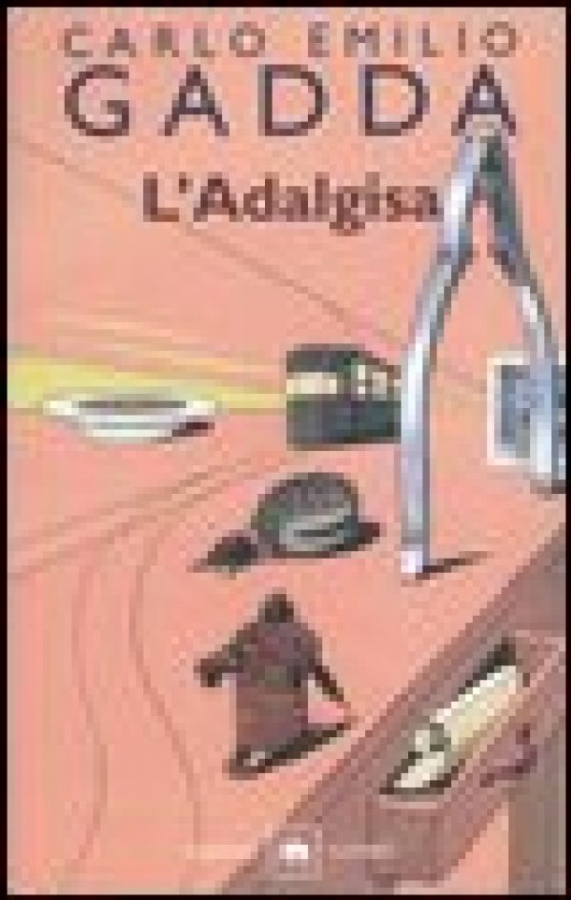
L'Adalgisa
Il libro è costituito da 10 racconti, che sono altrettanto bozzetti della vita della borghesia milanese degli anni ʼ30. Il tratto comune è una lieve ironia di una società soddisfatta di sè stessa, attenta ai soldi, ai buoni matrimoni, alle occasioni mondane, ma anche alla cultura tecnica, «allʼingegnere». Le scene della vita lombarda sono, poi, lʼoccasione per Gadda per una esplosione di parole, modi di dire, neologismi, sovrapposizioni di forme dialettali a italianismi, che confonde il lettore, il quale perde, spesso, il senso del racconto ma anche il filo del discorso. Sembra, quasi, che lo scrittore abbia lavorato in piena libertà con il linguaggio ed è, quindi, impossibile riferirsi ad una trama, a personaggi, ad episodi, ma la lettura si perde in una serie di impressioni, alcune felici, molte noiose e ripetitive. In uno dei racconti più briosi ( > *Quando il Girolamo ha smesso...*) Gadda racconta le vicende di una onorata ditta che fallisce in quanto ha dato i soldi ad un finanziere creativo: “per levar di tasca, a certi bamboloni con la bocca aperta, lʼanima di quei quattro ruspi o ovverosia sudati risparmi che gli son costati una vita; per spennarli a modino, sti cocchi di mamma, senza gli abbino a strillar troppo forte, e arrivare a farli finalmente contenti dʼun bellʼuscio chiuso, sigillato in piena regola dallʼautorità giudiziaria, per raggiungere questa suprema meta del credito e dellʼattività creditizia, si può bene ingegnarsi adoperare una Croce, la Patria, poi, neanche a parlarne”. In un bozzetto felicissimo sulle abitudini della borghesia milanese (*I ritagli di tempo*), lʼautore racconta il sonnellino durante la lettura del giornale: “bello è il vedere un ingegnere Caviggioni seduto, e quieto, una volta tanto, onninamente immemore del 263.890 e delle filettature normali (dei bulloni Withworth): seduto, dico, anzi nobilmente abbandonato sulla poltroncina del sabato, in attitudine pregustante, indi poco di poi assaporante”. In un altro racconto (*Un concerto di centoventi professori*), viene tratteggiata con benevole sarcasmo lʼabitudine a frequentare il teatro, dove > la società musogonica della città industre, aja di laboriosi pupilli, dopo le molte buone opere, sʼaduna a purgare le sue indigestioncelle farisaiche, i suoi peccatuzzi stitici, col porger orecchio a quegli altri peccati, un pò più cipperimerli per fortuna, di Luigi Dallapiccola e di Igor Strawinski . Perché non leggerlo? Singoli frammenti sono anche deliziosi, ma per gustarli bisogna soffrire per 284 pagine.

Adwa
The publisher presents the book as a novel with two voices, “that of a father and a daughter.” This summary is certainly accurate. Adua fled Somalia to escape an authoritarian father and to fulfill a dream: to work in cinema and become a famous actress. In reality, she managed to make only one film—a pornographic one. Twenty years later, she finds herself a mature woman, an “Old Lira,” as the new immigrants call “the women of the diaspora.” Partly out of compassion and partly for companionship, she marries an immigrant who > hung around drunk in many parts of Rome (...). But it was in Piazza dei Cinquecento (...) in that square that Italy had dedicated to soldiers who died in East Africa, that I concocted a papier-mâché love . Born to a strong and courageous woman, Asha the Daredevil, with a happy nomadic childhood among goats and camels, a sad adolescence in Magalo and Mogadishu, a desolate and mundane life in Rome—what has become of Adua’s dreams? > I wanted to be free to run in the wind. (...) I felt that the big city would devour all my purity, all my dreams . The author offers us glimpses of Adua’s life, but in truth she continually speaks of her disappointments, of her struggle to survive, nevertheless. Zoppe, the father, lives in another era, during Fascism and the ruthless colonialism of the Italians. He collaborates with the latter as a translator, makes himself a servant, witnesses the atrocities, the abuses, the racist and contemptuous conduct of our compatriots, in Italy as in Somalia. Here too, the narrative is made of slices of existence, important not so much for what they say as for what remains beneath the surface: self-contempt and, at the same time, the betrayed fascination with Italy and its language. Zoppe is nevertheless a traditionalist, who does not hesitate to subject his daughters to infibulation, because > afterwards there will only be the happiness of being pure, finally sealed as God commands . He is an authoritarian father; he disapproves of and disdains his daughter's aspirations, cynically and cruelly intent on severing the memory of Adua's mother, who died giving birth to her. > But enough, stop naming her. That woman is nothing, she is just a mistake . The two stories, Adua’s and Zoppe’s, run largely in parallel, like two straight lines that never meet—not because their lives unfold in different times and contexts, but because father and daughter do not speak to each other; they are too distant, both lacking the ability to express their love. > I like Rome in summer, especially its evening light at dusk; it is warm, and even the seagulls become gentler, making you want to hug them. They are the masters of the piazzas, but here you are, little elephant, and they dare not. Away, stay away from Piazza Santa Maria sopra Minerva! I feel safe near you. Here I am in Magalo, at home . Adua’s words “dissolve and are lost.” Look at the nigger, talking to herself”. And Zoppe walks through Fascist Rome and “the vision was still there to comfort him (...) The trees... the dome of Saint Peter’s... then the wisteria in bloom... the scent of the women... the walking sorbets... the martial tread of the soldiers... the rustle of rainbow skirts... their hopes painted blue > . This is what binds father and daughter: the love for Rome. Scego narrates a great deal about Somalia; the reader strongly perceives the desire to return ideally to the homeland, to reclaim the language, its sounds, and its imagery. Yet the novel speaks above all of a betrayal, of an Italy, a city—Rome—a language, and a history that, like beloved women too beautiful to be conquered, reject the courtships and overtures of the new Italians. I must say I was often tempted to abandon reading, and I carried on to the end solely out of sympathy and esteem for the author. It is difficult to write two parallel stories, but even more so if one relies on flashbacks,” dreamlike digressions, and trailing, opaque sentences. Without a plot to bring order to it all, a great confusion emerges, a crowding of thoughts and images that makes reading laborious. In this novel, Scego loses the gentle irony and subtle elegance that distinguish her writing. Perhaps she demanded too much of her abilities; a missed opportunity. Why not read it? It is confused and, in the end, tedious.

Almarina
> I will never be able to tell if it is Naples or if it is me. (...) Or if it is truly the sight of that ugly tenement on the other side of the gate, the swelling yellow wave, the domes beneath the clouds, architraves too heavy for a woman alone to bear. If reality is made of unreachable terraces, unreachable powers as they describe them... . With this opening, the reader is led to believe they are getting a foretaste of the surreal world of Anna Maria Ortese (see *Il mare non bagna Napoli* and *Il Cardillo Addolorato* > ); instead, one is confronted with a love story suspended in midair, swept away by a stream of consciousness that is unchecked precisely because it is entirely interior. A fifty-year-old mathematics teacher, Elisabetta Maiorano teaches in the juvenile prison of Nisida. Whoever crosses the threshold of a prison knows (and if they do not know it, they feel it) that they are crossing over to another side, irreconcilable with the promise made to us as children: that life would not be frightening, and we would never be left alone. Prison, instead, is fear and loneliness > . But is being incarcerated, living within a daily routine at once repetitive and protective, what creates a sense of isolation, or is it rather the recollections of a lifetime, the hopes and disillusions, the mistaken choices, and the misunderstood loves? Following the relentless outpouring of the protagonist-narrator, one begins to think that prison is merely a lockpick to unleash her interior world—and to indulge in self-pity: the unloved husband, the child desperately sought through artificial insemination and then through adoption requests, the tedium of teaching, advancing old age. We take these dossiers and store them in the furthest archive of memory, and then we hide the key. Our hope, I believe, is that on that day, now far off, when they have served their full sentence, this key will return to their hands, and from the flung-open archives blank sheets of paper with no more ink on them will take flight, immaculate, like laundry hung out on the terraces > . But if for the inmate—of whom the protagonist ostensibly speaks—there is the light of normal life, how can a person imprisoned within herself escape her own prosaic and mournful existence? Only if Love breaks in. I became attached to Almarina like that, while we were looking at the sea, and I told her that my husband was a magnificent swimmer. (...) I don't know how to swim, she told me, then.«Reading Valeria Parrella brings to mind Alda Merini, when she writes»and perhaps I will tear from the roots/the repressed hope of love,/I will remember that the fruit of every/human limit is absence of memory,/I will plunge entirely into becoming...". In both authors, one is in the presence of a restless and insatiable quest for a Love that allows memory to be removed, or at least suspended. Prison, much like the asylum for Merini, is a metaphor for the prison of the human soul, a moment of stillness, a place of unexpected encounters. Every page of Parrella's is a cameo, akin to a brief and intense poetic composition. But whereas in Merini the lyricism, speaking of oneself, the hinted-at sentiments, the lexical preciousness are in their proper place because they are typical of a sonnet, especially according to traditional Italian poetry, in Parrella these stylistic and narrative traits compromise the overall narrative, strip momentum from the story, desiccate the characters—particularly that of Almarina, who is, in fact, incomprehensible. The self-mirroring 'I' is ill-suited to the novel, which nonetheless requires a plot. Why not read it? An elegant outpouring, yet detached from a narrative structure.
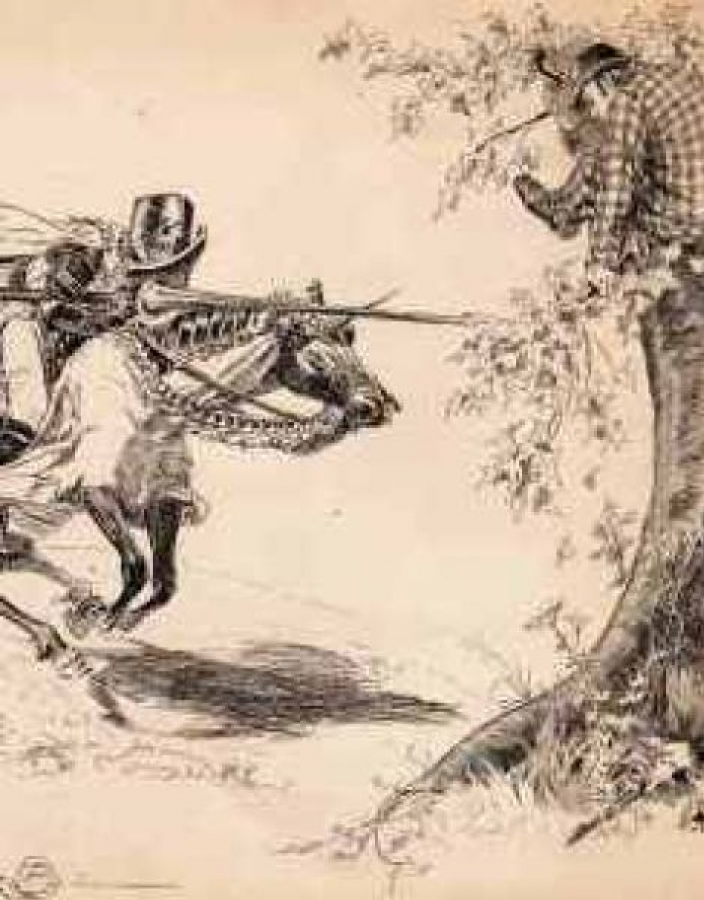
A Connecticut Yankee in King Arthur's Court
The book is a moralistic fable. A nineteenth-century industrialist finds himself hurled into King Arthur’s court. He attempts to introduce an industrial, capitalist culture, which the author regards as vastly superior—because more rational and efficient—to that prevailing in the Middle Ages. The attempt fails miserably due to the opposition of the Church and an enchantment by the wizard Merlin that casts the protagonist into a deep sleep. The story aspires to be entertaining, yet proves tedious and pedantic.
The Year of the Death of Ricardo Reis
Ricardo Reis is one of the many names under which Fernando Pessoa, the greatest Portuguese writer of the twentieth century, signed his works. The author imagines that a Ricardo Reis, after sixteen years spent in Brazil, returns to Lisbon in the very year of Pessoa’s death, 1935. It is pointless to seek a plot in the novel; as in Joyce’s *Ulysses*, the real subject of the narrative is the wanderings through 1930s Lisbon and the succession of thoughts on reality and on oneself: thoughts that never find an adequate expression in words. > Over the stark nudity of truth the diaphanous cloak of fantasy, the maxim seems clear, clear, neat and definitive, even a child will be capable of understanding it and repeating it in an exam without making a mistake, but this same child would understand and repeat with equal conviction a new sentence, Over the stark nudity of fantasy the diaphanous cloak of truth, and this sentence, yes, gives far more food for thought, and to imagine with relish, fantasy solid and nude, truth barely diaphanous, if overturned maxims became laws, what a world we would make of them, it is a miracle that men do not go mad every time they open their mouths to speak . In this deft literary inversion through which the certainty of reality turns into vagueness and imagination gains the upper hand, the novel’s fundamental theme is revealed: it is no longer possible to “read” the world, the interior one any more than the external context. Ricardo Reis walks through Lisbon as though in a labyrinth, unable to find an exit. He is partly “a spectator of the spectacle of the world” and partly overwhelmed by his own thoughts: it is not he > who is thinking these thoughts, nor one of those innumerable selves living inside him, perhaps it is thought itself that is thinking, or simply thinking, while he watches, surprised at the unravelling of a thread leading him through unknown streets and corridors... But is it Ricardo Reis who is confused, or is it reality itself that becomes representation rather than truth? The book’s most compelling pages concern the protagonist’s journey to Fátima and the description of a sort of war simulation staged by Salazar’s dictatorial regime: an urge to partake in the great slaughter of the 1930s (the Spanish Civil War and subsequently the world conflict). Faced with the shameless exploitation of hopes for a cure, with the petty and grand commerce surrounding the shrine, religion turns into superstition, an occasion for revelry, a contempt for spirituality. In the same way, the military parades, the celebrations of victories that never occurred, the false reports, the propaganda are the unsettling parody of a moral and physical disaster looming over Europe. The protagonist seeks, without much conviction, solid anchors for his life, both inner and political, but it is all in vain: > time drags on like a slow, viscous wave, a paste of liquid glass on whose surface lie myriads of sparkles that catch the eye and deflect meaning, while deep down the tawny and unsettling core shows through, an engine in motion (...) Ricardo Reis lacks a guide dog, a walking stick, a light ahead, for this world and this Lisbon are a dark fog where north and south, east and west are lost, where the only open path leads downward, and if a man lets himself go he plunges straight down, a dummy with neither legs nor head . It is hardly surprising, then, that when Pessoa’s ghost visits the protagonist, Ricardo Reis decides to follow him into the world of the dead, where reading is the first faculty to be lost. “Here (in Lisbon), where the sea has ended and the earth awaits.” Many interpretations can be offered for the novel: the narration of a progression toward death; the desire to evoke a Lisbon now vanished; the contrast between a yearned-for and idealized love (the figure of Marcenda, a notary’s daughter) and a sensual and concrete love (the liaison with the chambermaid Lídia); the subtle irony aimed at Portuguese society; and yet further meanings. The unifying thread of so many explanations is the shattering of the European conscience, aware and terrified yet inert and cowardly before the disaster toward which it moves, as though dragged along by an indecipherable and unstoppable fate. > We have all had a father and a mother, but we are children of chance and necessity, whatever this phrase may mean, Ricardo Reis thought it, let him clarify it . In reading the novel, one encounters sentences that are exceptional from a literary standpoint. One cannot help but feel envious, and captivated, by the following passage. > Only a vague inconsequential sorrow lingers a while at the door of my soul and after gazing at me for a moment passes on, smiling at nothing, he murmured (Ricardo Reis). Yet on the whole, the narrative style is cumbersome and tedious. The phrasing is complex, with frequent shifts of subject; the sentences are long, dominated by commas; the punctuation does not aid the reader; reflections, often philosophical in nature, prevail over plot, characters, and descriptions. There is a total absence of dialogue, which might otherwise lend breath and vitality to the narration. It is a *Ulysses* in which there is no Mr Bloom. Why not read it? It is tedious and prolix.

The Ring Finger
While in ancient Egypt embalming was practiced to preserve the deceased for eternity, the Shinto worldview and a certain measure of fetishism lead, in Japan, to the preservation and safekeeping of objects and living beings that are important in one's life. The novel speaks of a "specimen," and the technique employed is perhaps akin to that used for the wet preservation of fluid specimens using formaldehyde. In any case, the method is not explained in the book, perhaps to maintain a magical and mysterious atmosphere. This long preamble was necessary to frame the story. The protagonist is a young woman who left her job at a soft-drink bottling plant following a workplace accident: the gear of a machine severed the tip of her ring finger, > an image haunted me; that seashell-shaped piece of flesh, pink as a cherry petal, tender as the pulp of a ripe fruit, falling in slow motion into the iced soda, only to settle at the bottom, floating among the bubbles, (...) I had lost a part of my body. She goes to work in the city, in a semi-abandoned building. Here, Mr. Deshimaru prepares and keeps specimens of all kinds. > Everything about him was impeccable. The color of his skin, his hair, the shape of his ears, the length of his arms and legs, the line of his shoulders, his voice were all perfectly harmonious. (...) The sun's rays enveloped his white coat, sketching an aura of light around it. One day, Mr. Deshimaru puts new shoes on her and orders her to always wear them; then he undresses her, leaving the shoes on, and they make love. > He neatly unbuttoned my blouse from the top down and unzipped my flared skirt. (...) In the end, I found myself naked. I was wearing only the black leather shoes. (...) He held me tight in his large arms—not in a tender embrace to savor the sensation of our bodies—as if he wanted to press all of me flush against him. (...) I had the feeling of having been transformed into a specimen incorporated into him. From here, the story is a slow slide toward the inevitable question: > couldn't I entrust myself to you and become one of your specimens too? (...) The preserving fluid must have been warm and still. It was not cold and fizzy like the soda. It would have completely enveloped the ring finger, from the tip to the edge down to the faintest lines of the fingertip, while the cork stopper would have shielded it from dust and external noises. The story is disturbing if viewed as a realistic narrative; it becomes sustainable if considered as a metaphor for the deprivation of a part of the body. Having watched a small ring finger detach and vanish created a profound wound in the young woman's psyche. It is as if we were inside a dream, in which a kind of shaman, shadowy and luminous at once, draws the girl to himself, offering her a world that is protective and claustrophobic. Becoming a "specimen" is a way of escaping reality. The writing is limpid and simple, reflecting well the young woman's disorientation; pleasant and fluid, the style contributes to an overarching sense of implausibility that not even the eccentricity of Japanese culture can overcome. Everything remains on the surface; there is no psychological depth in a tale in which only physical contours and objects are delineated in detail, thereby acquiring a semblance of reality. The story flows far too linearly. Why not read it? It is simply too implausible.

Article 353 of the Penal Code
"A vulgar case of fraud, Your Honor, nothing more." Kermeur stands before the judge: he has confessed to killing a businessman, Antoine Lazenec. "We saw him sprout up like a mushroom at the foot of a tree," but in a quiet little town, lacking both ideas and jobs, > when someone like him arrives with such a determined expression on his face, (...) there is something about him that feels like an outstretched hand pulling our very soul out of us, with all those ideas of change, with all those grand schemes . People fall for it, starting with the mayor; the retiree Kermeur invests his severance pay, enthralled by the adventurer Lazenec's dreams of wealth. The beauty of it is that the swindler does not leave town after it has become blatantly obvious that the grand plans will never materialize, that he has pocketed the money, after the mayor has committed suicide; no, he stays right there, flaunting his lavish lifestyle, peddling optimism and falsehoods: > a man like that, Your Honor, a man like that, I realized later: if you don't make him disappear yourself, he will never disappear. He will come back . This is the motive for the murder: a poor man, ruined by a swindler, wound himself up like "an electric battery" and finally exploded, ridding himself and the entire town of a vainglorious scoundrel. What need is there for a lengthy interrogation? That is what we ask ourselves as well. In reality, the narrative is a slow soliloquy, in which Kermeur, the narrating "I," speaks with the "mirroring I," embodied by a laconic judge. It is like the mirror over the mantelpiece, before which the protagonist is accustomed to spending long hours. > And not because I want to see what is reflected in it, I told the judge, but I can't help myself, from staring at it I find myself tangled, as it were, in the thickness of the glass, my brain caught by the fog that could be mistaken for any hellish morning when the sun tries in vain to reflect within it, but made pale, as it were, or deceived by the opaque grain of the mirror . We thus learn the entirety of the retiree's life: his wife's abandonment, the raising of his son, from childhood to an adolescence prematurely marked by run-ins with the law, nostalgia for work and his few friends, a passion for fishing, and the setting of an Atlantic coastal town, where it seemed that > the pines and the ferns and the thick grass of the dunes (...) were in on a secret and whispered against me, beside me, proud to inhabit their peculiar world, a world without sentences and without malicious thoughts . It is, in short, the anatomy of a depression. There is nothing worse than expecting one thing and finding oneself confronted with another. Picking up the book, one hoped for a detective plot or an adroitly told provincial tale; instead, we ran headlong into a rambling spill of words—well-written, it must be said, at times offering intriguing insights, such as when the author observes that "a child is not programmed to feel compassion for you," a truth that we parents should keep firmly in mind! And yet, a sparkling, spirited style is not enough to save us; we are far removed from *Doctor Zhivago*, my dear Viel. The relentless succession of sentences, the lack of action, the excessive introspection, the overindulgent self-narration are all elements that render the novel utterly tedious and pedantic. Why not read it? It is unbearable.

Murder in the Central Committee
The novel chronicles the investigation of a private detective following the murder of the Secretary of the Spanish Communist Party during a meeting of the Central Committee. The narrative unfolds slowly, blending markedly disparate styles and narrative content: a succession of continuous "parentheses" on life in Madrid and the tribulations of the leftist milieu, with a sentence structure reminiscent of *The Pianist* and thus tedious and prolix; a Raymond Chandler-esque approach, particularly in the more action-driven scenes, where the protagonist is pursued, captured, and beaten by secret service operatives; and an articulation closer to the British mystery when the protagonist ultimately unmasks the killer. The overlapping of styles and the predominance of themes tied to the existential and political dilemmas of the Left make the book bad, tedious, and ponderous. It is, therefore, a dated novel that offers little stimulation regarding contemporary issues (or so one hopes!).
The Actor
Mario Soldati was defined as “the first, great media-man of Italian culture” (Aldo Grasso in *Corriere della Sera*, 2016). Indeed, he was a novelist, journalist, screenwriter, film director, and television author. His numerous novels (reviews can be read on this site: *A cena con il Commendatore*, *Lo smeraldo*, and *El Paseo dei Gracia*) reflect his vast experience as a cinematic author, both in style and in narrative content. For Soldati, each of us wears a mask, even without realizing it, because the disguise is part of our deepest consciousness; consequently, our relationships with others are ambiguous, often full of futile deceptions; we like to live as if in a dream, as though we were in a soap opera. In short, we live in a bubble. Unlike his other tales, this novel stems from an episode in the writer’s life that could well be real. Soldati, the narrator, meets an old friend, a modest actor whom he has not seen for many years. Enzo is in dire financial straits because his wife continues to lose substantial sums at the casino: he asks Soldati for work. Our writer attempts to find him a role in a television series, though the moment is hardly favorable as new executives have replaced the old ones with whom Soldati enjoyed an excellent rapport. To inform his friend of what he is doing, he travels to Bordighera, where Enzo lives with his wife. In doing so, Soldati finds himself ensnared in an intricate and ambiguous family dynamic: Enzo’s wife, once a beautiful woman, now obese and infirm, is jealous of her husband, whom she suspects of cheating on her with their maid; Giovanna, the maid, dominates both Enzo and his wife through her mysterious, seductive allure; and finally Enzo, who convincingly claims to love his wife yet plays the role of the unfaithful husband, blatantly attempting to conquer the elusive Giovanna, thereby exasperating his wife and driving her toward killing the maid. Why does Enzo pretend to betray his wife with Giovanna? And why do the others play along with the roles Enzo assigns them, as if on a theatrical stage, never interrupting this cruel and false soap opera? > Every man is, always, a bit of an actor,. (...) every human being must, sometimes, to feel alive, be able to imagine themselves a little . This novel met with great success upon its publication in 1970 and won the Premio Campiello that same year. In truth, the story is dull and trite; especially if approached from a psychological standpoint: the quality of the narrative falls far below that of Soldati’s other novels. What remain are the splendid descriptions, cinematic in their detail and colors. An example: > Giovanna is small, slender, sturdy, dark-haired. A strange, narrow face: dark, close-set eyes, thin and unpainted lips: a face with a closed, motionless, unfeeling expression, as if carved of stone. (...) She wore an amaranth velvet suit, rather vulgar in its elegance, and very loud. (...) She gazed at herself for a long time, admiring her reflection, pacing back and forth like a model, pulling and smoothing the jacket of the suit over her buttocks, turning once more to glance back over her shoulder. Why not read it? It pains one to say it: it is boring.