All Our Names
The protagonist is a young Ethiopian; the adolescent longing to leave his remote village behind drives him to choose a purpose and a city: to become a great writer in Kampala, which, despite being the capital of Uganda, like him «belonged to no one and no one could claim it». It is therefore a non-place, where the young man hides, forgets, or simply abandons the twenty-five names by which he was called in his village. In Kampala, he meets his friend. > Isaac and I became friends the way two stray dogs find each other following the same trail every day in search of food and companionship . Both are unversed in urban life, but Isaac projects confidence and takes the protagonist under his protective wing—naive, fragile, and too much of a dreamer to survive on his own in a violent and chaotic metropolis. Having no names left, Isaac gives the boy several nicknames (no fewer than thirteen), all tied to his air of an intellectual and a man of letters. At first, the two young men frequent the university campus, a kind of "oasis > in a country increasingly torn apart by clashes between opposing factions, which soon culminate in dictatorship and repression. If students were initially allowed to voice dissent, demonstrations are subsequently banned and smothered in blood. For the protagonist, the situation is particularly dire because he is a foreigner; Isaac must step in repeatedly to save him and hide him in safe places. The political struggle has degenerated into gang warfare. Isaac, growing ever more mysterious due to the life he leads and the company he keeps, enters the service of a clan leader. The protagonist watches in horror as violence, executions by firing squad, and outright massacres unfold. Yet above all, he is appalled by his friend’s transformation: from a slightly provocative, somewhat playful young man, Isaac reveals himself to be a cynical killer, a skilled manipulator of men, an unscrupulous opportunist, perhaps even a double-dealer. But who is Isaac, really? What do we know of him, of his past? The situation deteriorates rapidly, and Isaac provides the protagonist with a passport and a plane ticket to flee to the United States. In doing so, he also gives him a name: his own. The young man, now Isaac, holds a temporary visa as a political refugee and is monitored by social services, in particular by a young caseworker, Helen. A love affair begins, but can one truly love someone whose past remains unknown? During their troubled relationship, Isaac asks what he can do for her: yes, I told her, promise me you won’t disappear one day > . Yet so it will be, because this is the fate of migrants, placeless and nameless: all they can say, promising to return one day, is that no one will ever have loved each other more than we did. For the sake of clarity, the plot has been presented according to a possible logical sequence: first the events in Uganda, then the love affair in America. In truth, the author does not construct the novel this way; the narrative unfolds through two parallel storylines: in the first, the narrator is the protagonist and the subject is his friendship with Isaac; in the second, the narrator is Helen, recounting her relationship with the protagonist. Only in the final lines do the two narratives intersect, when we discover that the phrase the false Isaac utters to Helen at the moment of parting was written by the real Isaac on a slip of paper for the protagonist. One is left to wonder whether the love for Helen is cut from the same cloth as the friendship between the real Isaac and the false one: extraordinary bonds in an age when relationships between human beings are like those of two men who meet unexpectedly in the middle of a desert after traveling so long they have begun to believe the world is uninhabited > .. Yet what does this strange novel mean? It conveys a sense of rootlessness, that special loneliness that comes from having nothing that is truly yours«, which drives Helen to search Isaac’s room to »seek proof of his existence > . This rootlessness possesses a dark allure of its own because it offers us a world weightless«, allowing one to confront a reality that »breaks you into pieces slowly« and to overcome the fear of »what comes next. It is an interesting book. It is, however, marred by an excess of intellectualism, discernible in many passages of the novel and in its overarching design: the reliance on two parallel narratives fragments the story, weighing it down needlessly and causing it to lose both narrative momentum and emotional tension. The almost Pirandellian interplay of the two Isaacs is pushed to an exaggerated degree, yet fails to surprise the reader upon discovering that Helen’s Isaac is not the real Isaac. The author sought to pack too much substance into a storyline and its characters, when it would have been enough to narrate them in their spontaneity, in their real lives as migrants of the world". Why not read it? It is boring.
All the Pretty Horses (Wild Horses)
Two boys, sixteen-year-old Grady and seventeen-year-old Rawlins, rest on their saddle blankets after dismounting their horses. > The night was cold and clear and the sparks rising from the fire spread warmth and reddish glows among the stars. They could hear the trucks out on the highway and they could see the lights of the town reflected far in the desert fifteen miles to the north. What do you think you’ll do? Rawlins asked. I don’t know. Nothing , Grady replied. After three hundred pages—some of them arduous reading—to the same question (“where is your country?”), Grady answers: “I don’t know. I don’t know where it is. (...) He touched the horse with his spurs and moved on. He rode while the sun turned his face copper-colored and the reddish wind blew from the west across the evening plain and the small desert birds sang among the dry ferns; horse and rider advanced and their long shadows moved together as the shadow of a single being. They passed and paled into the evening plain, toward the world to come > There is nowhere to stop; nothing remains but to keep moving, with only two certainties: the horses and the great untamed plain. The novel recounts the adventure of an adolescent. profoundly alone and in search of himself across the vast expanses of a West now overtaken by modern American society. We are like the Comanches were two hundred years ago. We don’t know what will show itself come daylight. We don’t even know what color it will be > . So his father told him, almost as if urging Grady to leave, perhaps to flee. And the boy embarks on a long journey on horseback, together with Rawlins. They strike out into the great expanses toward Mexico, into a swarm of stars, so that they rode not under but among them (...), like thieves newly loosed in that electric black, like young thieves in a luminous garden, ill-equipped against the cold and ten thousand worlds to choose from > . Along the way they encounter Blevins, a thirteen-year-old boy on horseback, solitary, perhaps on the run. They realize he may be a source of trouble: he is impulsive, stubborn, devoid of judgment, still a child. They take him in, and after feeding him, Blevins began to take off his clothes and walk naked across the grass, and, passing by the horses, plunged into the water. (...) The horses watched him > . The kid gets drunk and lets his horse get stolen by a group of Mexicans; he then drags the two friends into an attempt to recover the animal, and the whole thing ends in a shootout and a pursuit, from which Grady and Rawlins barely escape, nonetheless losing all trace of Blevins. The two young men seem to find a safe haven and employment at a large hacienda > ; Grady earns esteem for his exceptional skills as a breaker of wild horses; he also meets the master’s daughter, with whom he has a love affair. It is a situation fraught with peril: a poor cowboy in love with a wealthy heiress. And indeed, Grady and Rawlins are arrested by the Mexican police and accused of being accomplices to Blevins, whom they meet again in prison and who has allegedly killed a man. During the transfer from the police station to the prison, Blevins is killed; in the horrific Mexican penitentiary, the two young men are attacked and stabbed, and only the intervention of the aunt of the girl Grady has fallen in love with saves them from the hell they have landed in. It would seem that we have reached the end of the adventure, but Grady insists on getting the horses back, and consequently the novel concludes with a gunfight in which the young man reclaims the animals. Then again, what is more beautiful and more true than a horse? That night he dreamed of horses in a high plain where the spring rains had made the grass and the wildflowers grow and the flowers spread all blue and yellow as far as he could see in the dream he was among the running horses and in the dream he himself could run with the horses (...) and they ran he and the horses together out on the high ground where the earth resonated under the galloping hooves (...) in a resonance that was like a music..." It is a circular story, one in which the plot lacks any genuine development, continually folding back on itself—namely, onto the figure of Grady, his loneliness and despair. The characters are sketched superficially; in some instances, they are incomprehensible. If one wishes to appreciate the novel, one must focus on the contrast between the austerity of the dialogues between Grady and Rawlins—spare, minimalist, and precisely for that reason expressive of their existential condition—and the descriptions of the horses and the magical landscapes of the great wild plain. Yet a level of minute detail consistently predominates, encumbering the narrative and wearying the reader. As for the disquisitions on Mexican history, let us draw a charitable veil over them. Why not read it? It is prolix, overlong, and rambling.
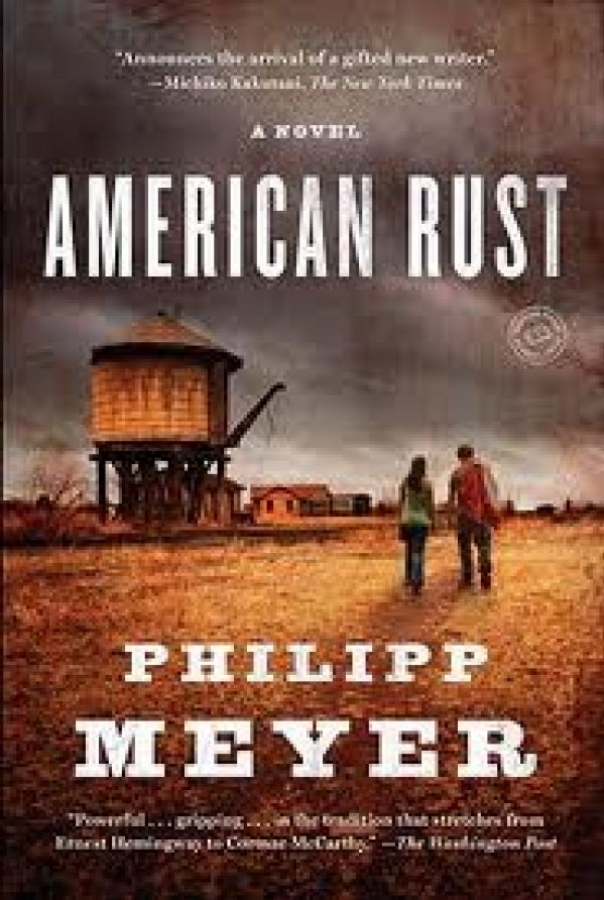
American Rust
Paul Krugman, the American Nobel laureate in economics, begins his recent book (*End This Depression Now!*) by recalling how unemployment is "an immense human disaster," not only because of the resulting financial hardships, but because the effects on one's dignity, self-respect, and sense of control over one's life can be devastating. One no longer feels like a protagonist, and a profound malaise sets in—born, as the author of *American Rust* puts it, "from the pain of watching the world change without you." With this novel, the author sets out to do precisely this: to narrate the deindustrialization of a steel town through the eyes of its victims—not so much the workers who found themselves unemployed, but rather their children, who have lost the social and psychological anchor their fathers once possessed. The novel's protagonists are two young men, Isaac and Poe. The former, intelligent and a dreamer, is the son of a retired technician who, after working for decades in steel mills, is now confined to a wheelchair following a severe industrial accident. Isaac has given up his aspirations (he would like to become an astrophysicist) to care for his father, while his sister, equally intellectually gifted, severed ties with the past, leaving town to become a successful lawyer. Poe, by contrast, was once a local hero, a football star, but has been reduced to scraping by at the expense of his mother—an impoverished woman who lives in a trailer and supports the household through precarious employment at a small tailor's shop. The setting is the decline of an industrial town, painted by the author in somber tones yet devoid of nostalgia, with descriptions that highlight the ruin of mills and buildings alongside nature's reclamation of a space no longer dominated by man. > The mill had been a small city... now it stood like an ancient ruin, its structures overwhelmed by wild vines.... tracks of deer and coyote crossed the grounds: there were only the human signs of occasional squatters . A theme dear to American literature—including contemporary writing—resurfaces: the myth of the wilderness, of a rural society where man finds for himself, in total freedom and autonomy, the means of survival. Isaac steals his father's savings and decides to run away to pursue his dreams, finally free from the past. Before departing, he meets with Poe, his best friend, who once saved his life by thwarting a suicide attempt. They decide to spend one last night together in an abandoned mill. There, however, they run into a gang of thugs, whom Poe provokes with his customary recklessness. To save his friend, who is in danger of being murdered or severely beaten, Isaac kills one of the assailants. The two young men take flight. Poe is accused of the murder, while Isaac flees on foot toward California. The paths of the two young men diverge, each unaware of the other's fate, yet both endure the violence of a disintegrating society. Poe experiences the ruthless law of prison, which does not tolerate anyone failing to belong to a gang, and for this he is assaulted and left on the brink of death. Isaac, naive and fragile, suffers the violence of the road: he is deceived, robbed, and forced in turn to steal to survive. All Poe would have to do is tell the truth—that it was Isaac who killed the man—yet he refuses, feeling guilty for what occurred and, above all, knowing that his friend would never survive prison life. Isaac, in turn, realizes that flight is not the answer: he must return and confess to the crime, and, above all, he must live where his roots lie. Friendship is the central theme of the book: it is, indeed, the profound bond that unites the two young men, as well as the novel's secondary characters, shielding them from the unraveling of society. Why does Poe not choose to turn his friend in rather than endure the brutality of prison? Why does Isaac return to surrender himself when he could escape to California? From the standpoint of dominant economic rationality (grounded in the pursuit of self-interest), their behavior is irrational, inexplicable; yet it is, instead, the primal force that holds society together. Delving deep into the impact of economic decline on human relationships, the author probes the inner workings of the human mind during a phase of social disintegration, finding a solid foundation in the bonds between individuals. Yet does this offer us hope for the future? The narrative is driven forward through a literary device. Each of the protagonists tells their own story across dedicated chapters, whose sequence apparently follows no order but seems random. Consequently, only the reader possesses knowledge of the overarching plot and must construct an overall picture for themselves. This approach, undoubtedly refined from a literary standpoint, asks too much of the reader. Left without a guide, one gets lost in the characters' analyses, which are often a bit too intellectualized and introspective. Everything remains as if suspended, merely sketched, failing to grip the reader, failing to captivate. Moreover, the novel is deficient in action, meaning that only the psychological introspection of the characters and the examination of their relationships could offer points of interest. Yet this is precisely what remains unresolved, as the exploration of the mind's inner workings appears endless, lacking any definitive development. If the author does not wish to be all-pervasive and intrusive like the great Dostoevsky, he fails—or refuses—to untangle the narrative threads and bring them to a resolution, as the Russian master does so brilliantly. Consequently, the sluggishness and thinness of the plot render the novel tedious and ponderous. Why not read it? It is boring.