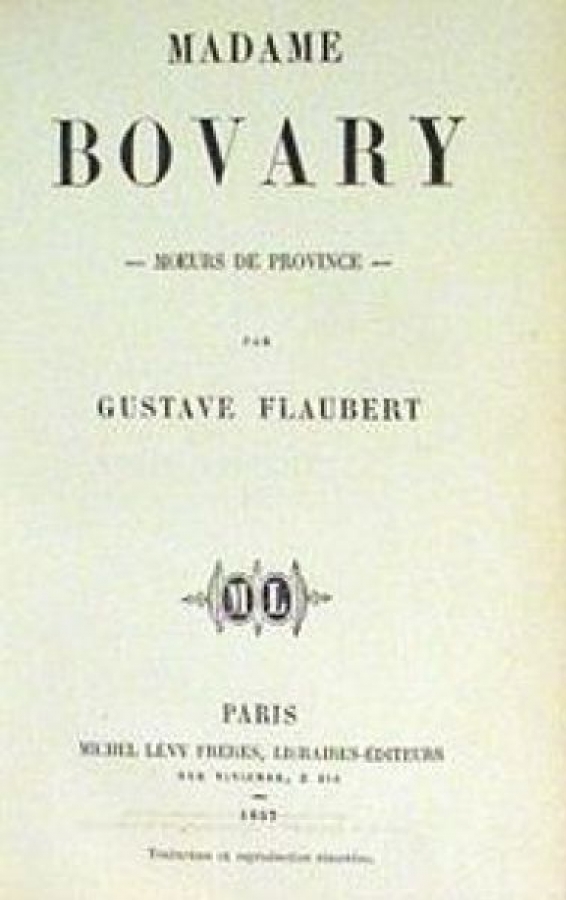
Madame Bovary
The novel recounts the fortunes of Madame Bovary, who, married to a provincial doctor, attempts to escape a prosaic and tedious existence by pursuing a series of affairs and leading an extravagant lifestyle—choices that ultimately lead her to financial ruin, emotional desolation, and, inevitably, suicide. It is a celebrated novel, widely considered the wellspring of nineteenth-century realism, which tackles the theme—subsequently taken up by numerous other authors—of the pettiness of bourgeois morality. At heart, Emma Bovary pursues a dream of happiness, striving not to be trapped within the mediocrity of everyday life. Surrounding her, by contrast, hypocrisy, the pursuit of money, social ambition, and the like prevail. In truth, Madame Bovary is herself a child of her time: there is no genuinely romantic sensibility within her, no sense of guilt, and she is willing to resort to any falsehood to achieve her ends—which are, in reality, modest, such as meeting her lovers, buying elegant dresses, and so forth. The third part of the book, unquestionably the finest, which portrays the events leading to Madame Bovary’s death, is conducted in an almost illustrative manner. The characters, in fact, emerge as cold and flat, devoid of even the slightest introspective probing into their motivations and feelings. Ultimately, this is a social novel that appears to have enjoyed a renown far exceeding its actual merits. It bears the heavy imprint of the nineteenth-century ethos and leaves little room, even in its style and narrative rhythm, for that lyricism so typical of our own day.
Michael Strogoff
Michel Strogoff > was tall, vigorous, broad-shouldered, deep-chested... he could endure to the utmost cold, hunger, thirst, and fatigue : an iron body and a heart of gold. In this manner, Verne introduces the protagonist right from the outset. The setting is Tsarist Russia, likely in the second half of the nineteenth century. An army of Tartars is overrunning Eastern Siberia and threatens to seize its capital, where the Grand Duke, brother to the Emperor, resides. At the head of this horde of "barbarians" stands a traitor, bent on presenting himself to the Grand Duke, winning his trust, and ultimately capturing him. Michel Strogoff is entrusted with the mission of warning the Grand Duke in time, journeying across a Siberia torn by war. It is an epic endeavor, an extraordinary mission. This adventurous undertaking can be divided into three parts. In the first, which is rather dull and predictable, Strogoff travels incognito as a merchant, crossing European Russia, the Urals, and then the first Siberian steppes. Right from the start of the journey, he encounters a young woman, Nadia, who must make the same trek to join her father. Strogoff decides to accompany the young woman, believing that doing so will make it easier to avert suspicion regarding his true mission. Here emerges a defining trait of the protagonist—dissimulation—which contrasts sharply with the loyalty and sincerity of the other characters who stand by him, particularly Nadia. A dramatic scene brings about a turning point that injects pace and intrigue into the narrative: Strogoff and the young woman are captured by the Tartars; the protagonist is forced to watch his mother about to be beaten to death, reveals himself as the Tsar's courier, and is subsequently blinded. From that moment on, Strogoff becomes dependent on Nadia, who serves as his guide. This section of the novel is the most compelling, as the protagonist's vulnerability makes him human, less of a superhero; moreover, amidst the ever-adventurous and dramatic developments, other characters appear, generous and eager to lend assistance. Finally, the third part is dominated by grand set pieces, where natural perils intertwine with the drama of battle. Strogoff and Nadia, along with other refugees, journey down an ice-choked river aboard a raft. By a stroke of fortune, they manage to reach the capital, besieged by the Tartars, where the traitor has already infiltrated—only to be slain by Strogoff. The story would be flawless were it not revealed at the end that Strogoff was never blind at all, but had feigned blindness so as to be left free to move, given that the Tartars would have deemed him harmless. Yet how could he lie even to his friends, and above all to Nadia, who had helped him asking nothing in return, out of pure love? In the preface, the commentator views this novel as an "obstacle course" in which "a hero above suspicion" overcomes every trial simply to achieve his goal. It is from this that a sense of coldness, contrivance, and determinism arises, where feelings have no place, relegated to the background in deference to duty and the assertion of one's own strength and will. It is the other characters who offer flashes of human richness, from which the author seems to swiftly retreat, taking refuge in stereotypes. The harsh, grim Siberian wilderness forms the backdrop of the novel—in a sense the true adversary of the superhero, Michel Strogoff. It is a pity that here, too, imagination is lacking; it is mere geography, without the description of Siberia ever sparking the reader's imagination. Why read it? The story is gripping, particularly in its second part. Certain scenes are mesmerizing, such as the Tartar feast with its exotic dances, the epic descent down the frozen river, and the final battle.
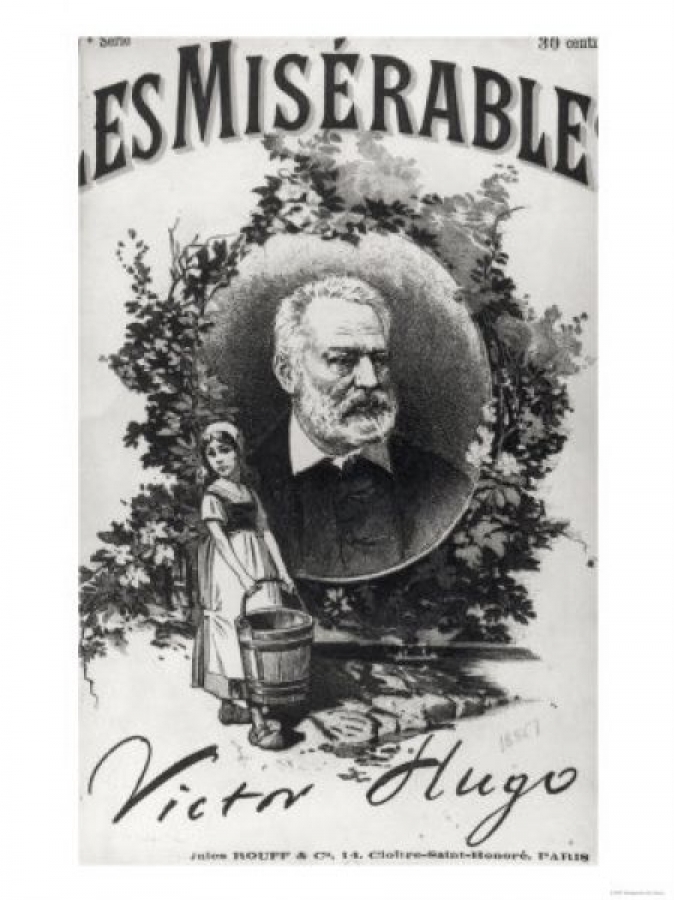
Les Misérables
The novel chronicles the life of Jean Valjean, a convict who, following an encounter with a bishop (a saint), is transformed into a good and righteous man: he first becomes a wealthy industrialist, then, returned to prison, escapes in order to save and raise a young girl, Cosette, who, upon reaching adulthood, falls in love with a young revolutionary. Jean Valjean rescues the young man from certain death (during the 1832 rebellion), and then chooses to disappear so as not to jeopardize the couple's future with his status as an escaped convict. Yet goodness triumphs and, as the author writes, “the night was starless and profoundly dark.” Doubtless in the shadows, some immense angel had come forth, with outspread wings, to await the soul from the supreme shadow to the supreme dawn. As Victor Hugo wrote: “the book which the reader has before his eyes at this moment is, from one end to the other, in its entirety and in its details, whatever its intermittences, exceptions, and lacunae, the march from evil to good. From the unjust toward the just, from the false to the true, from night to day, from appetite to conscience, from putrefaction to life; from bestiality to duty, from hell to heaven, from nothingness to God. Starting point: matter; destination: the soul. The hydra (evil) at the beginning, the angel at the end > This conception is based on faith in progress (which Hugo identifies with God, and therefore with a humanistic and Christian socialism) and on the uprising of the world of the wretched > driven by unstoppable social forces. From this point of view, the countless characters in the novel become archetypes > , representatives of a role to be fulfilled in the great transformation of the world, and thus devoid of any true depth: feelings and motivations are only ostensibly analyzed and explored; in reality, it is merely a succession of rhetorical devices (the interrogative form predominates) to illustrate contradictions and dilemmas that do not belong to the intimate sphere (and in this sense universal), but rather to a social and historical function. One need only think of the conversion > of Jean Valjean and the analysis of the crises of conscience the protagonist faces throughout the novel (the decision to appear at a trial to prevent an innocent man from paying for his crimes, and the decision to withdraw into the shadows so as not to jeopardize the young couple's happiness): in every case, one is confronted with a sort of divine illumination and moral imperative, while the depiction of the character's resulting misery (due to the loss of Cosette) is flat and schematic. Even more paradoxical and astonishingly devoid of any psychological or philosophical depth is one of the most dramatic episodes in the entire novel. Inspector Javert (Jean Valjean’s relentless persecutor) is caught in a vice between human law, which demands the arrest of the former convict, and his conscience, which compels him to release Jean Valjean, who had saved his life. His inability to break free from this dilemma drives him to suicide. It is clear that Hugo intends to attack bureaucratic, callous approaches to the enforcement of the law—a law that is often unjust because partisan (Javert’s final piece of writing, a mere list of recommendations for the chief of police, is incisive and remarkably effective). Yet one need only imagine what a Dostoevsky would have made of the contradiction between the human conscience and the imperatives imposed by institutional rules and norms to realize how far removed the French author is from the modern spirit, anchored as he is to a cold, moralistic vision of humanity and its struggles. His depiction of French history (from the French Revolution to the Citizen King) is likewise a series of epic events governed by Providence: the very defeat at Waterloo is attributed to a destiny bent on closing the Napoleonic era in order to inaugurate a new phase of social transformation that will lead to the great upheavals of 1848. Yet do individuals and social classes truly exist, or is everything already predetermined by an obscure, immanent force, at once religious and scientific: Progress? *Les Misérables* is a deeply dated work, enclosed within nineteenth-century culture, with little left to say to the man of postmodernism and globalization. As often happens with great authors (take Dante’s *Divine Comedy* itself), the most valuable parts involve components and approaches that cannot be traced back to the stated intentions. Victor Hugo is a Romantic author who ceaselessly pursues the grotesque and the visionary: stylistic traits that occasionally render the reading cumbersome, yet contribute to producing pages of great beauty and suspense. Consider the description of Cosette, an eight-year-old child sent to fetch water in the dead of night, watching the setting of Jupiter and feeling the surrounding nature seem to stir to capture her: the tall grasses swarmed beneath the north wind like eels. The rocks twisted like long claw-armed arms, seeking to seize prey…. > ; of the episode of the trap set by the criminals for Jean Valjean, so full of twists and unforeseen turns; and finally of the magnificent chapter ( Comment de frère on devient père > ) in which the two abandoned children seize the bread thrown to the swans to feed themselves. In a few pages, the author manages to capture the stillness of the Jardin du Luxembourg, the solitude of childhood, the solidarity among children, and the narrow-minded hypocrisy of bourgeois culture. The novel’s true masterpiece is the episode of the elephant: a striking, visually magnificent scene in which a monument built to glorify power becomes the sanctuary of three children. Then there is another protagonist of the novel: the city of Paris. The author’s toponomastic precision, the minute description of streets and houses (many of which had already vanished during Victor Hugo’s own lifetime), provide a romantic setting for the novel and its backdrop. This is prior to the grands boulevards, in the midst of a reticular city where it is easy to lose oneself and disappear. The pages devoted to the Parisian argot spoken among the wretched" are also of great interest, indicating an almost anthropological attentiveness on the author’s part. Yet is the idea of Progress truly authentic, or merely literary and political, concealing in truth a Romantic nostalgia for the Middle Ages and pre-revolutionary history? The novel is, on the whole, prolix, tedious in many stretches, and fundamentally a potboiler.
Monsieur Malaussène
In the neighborhood of Belleville lives the Malaussène tribe, and with them a myriad of characters. Belleville is a Parisian periphery, ravaged by the postmodernist manias of architects, the stupidity of politicians, and the greed of speculators; but it is also a magical place, a sort of Sherwood Forest, where Robin Hood is Benjamin Malaussène and the Sheriff is embodied by those who seek to evict long-standing tenants to demolish the old buildings and erect new ones for corporate offices and the wealthy bourgeoisie. > If one day you ask me what happiness looks like, and you will ask me, I will answer: like here In Belleville, where it is possible to screen the last film in the history of cinema (a film destined to be destroyed afterward) in a forgotten theater, where it is possible to tattoo all the streets of Belleville onto a person's body as a living testament to the neighborhood. In Belleville there is also an illusionist, who makes you see things that are not there; in Belleville > angels, who at times grow bored, are drawn toward us by the warmth and the surging of feelings and are personified in a detective nun. The novel features countless characters and a wealth of intertwining events: murders, disappearances, love affairs, bizarre twists of fate, persecutions. At the center, hero-like, stands Benjamin Malaussène, a fixed point in a magic lantern, in a kaleidoscope full of lights and illusions. There is no real plot, and the novel is difficult to follow. I must confess that I was unable to read it to the end, having lost my way among so many characters and so many words. Yet perhaps this was the author's very purpose: to demonstrate that no rationality governs existence, and that everything unfolds along a tenuous boundary between reality and imagination. Why not read it? Quite frankly, it is deeply muddled and verbose.
The Death of Belle
A teacher who has always led a quiet, monotonous life is thrown into turmoil by the murder of a young woman who had been staying with him for several months. One evening, in fact, the protagonist finds himself home alone, as his wife has gone out to play cards with friends. The girl returns home, gives an absent-minded greeting, and goes straight to her room. In the morning, she is found dead. The suspicions of the police, as well as those of the neighborhood, turn immediately toward the man. The protagonist sees his world collapse; he feels ostracized by the community, whose members felt bolstered listening to the pastor's words, writes Simenon: > they felt they were the law, they were justice, every new sentence uttered over their heads made them stronger, while Ashby, in their midst, grew weaker and more isolated . The police also delve into the protagonist’s past, discovering that his father was a drunkard who squandered the family fortune before committing suicide. This inquiry casts the protagonist back to the anguish of his youth—to the prospect, that is, of becoming like his father: > what struck him was not so much this or that particular vice, a definite danger; what drew him was something vague, belonging to certain quarters of big cities, to certain streets, certain lights, even certain smells . The fear of being inexorably drawn toward vice and depravity had driven him to seek security, peace, and order, to the point of marrying a woman for whom friendship prevailed over passion. Feeling unjustly accused, abandoned by friends and community alike, along with the resurfacing of his past, are elements that bring this fatal attraction back into the open, shattering the shell the protagonist had fashioned for himself. Inexorably, as if driven by a fateful force, the protagonist murders a young woman, committing the very crime of which he had been falsely accused. This is only ostensibly a detective story. In truth, Simenon masterfully outlines the falsehood of life within a hypocritical community that ambiguously casts out one of its members merely because he is suspected of a crime. To everyone, it seems only natural that Ashby had become infatuated with the girl and killed her in a fit of murderous passion. Yet Simenon’s skill also lies in crafting a protagonist torn between two opposing forces: social order and the lure of lust and violence. When the rules of social coexistence—in which the protagonist believed and which had served as a bulwark against his own impulses—dissolve and reveal their utter vacuity, he gives free rein to his true inclinations. A profoundly relevant theme is thus explored: the relationship between communal ties and the complexity of individual feelings and dispositions. The crime is nothing more than the catalyst for a polarity rooted both within society (solidarity versus hypocrisy and confinement) and within the individual (the pursuit of peace and stability versus the urge toward transgression).