Finished reading on: December 24, 2008
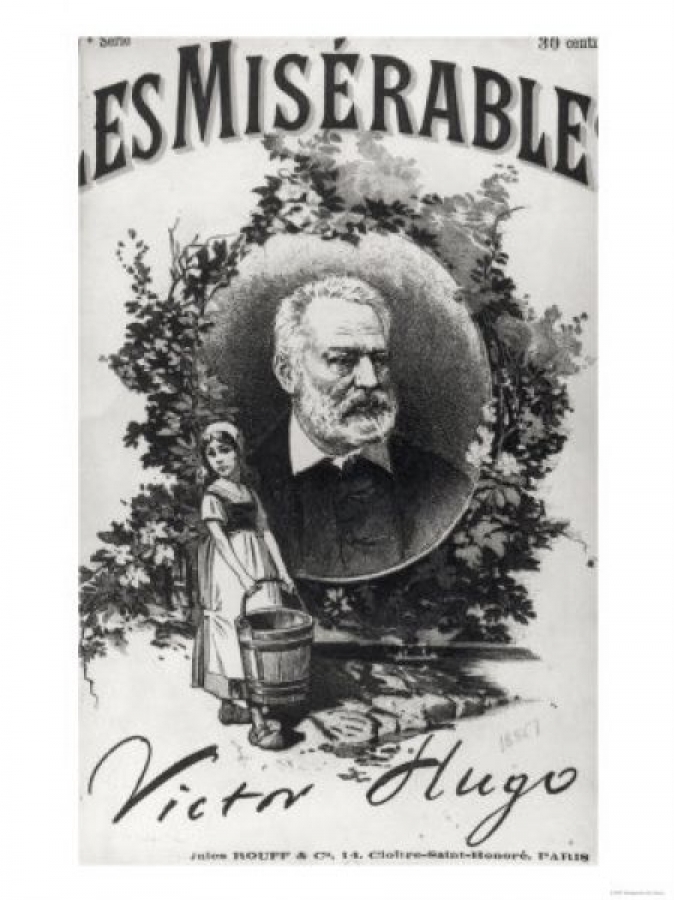
Les Misérables
AI Translation Notice: This review was translated from the original Italian using artificial intelligence. Book quotes and excerpts are translated interpretations and will not match the author's original English phrasing or official published translations.
The novel chronicles the life of Jean Valjean, a convict who, following an encounter with a bishop (a saint), is transformed into a good and righteous man: he first becomes a wealthy industrialist, then, returned to prison, escapes in order to save and raise a young girl, Cosette, who, upon reaching adulthood, falls in love with a young revolutionary.
Jean Valjean rescues the young man from certain death (during the 1832 rebellion), and then chooses to disappear so as not to jeopardize the couple's future with his status as an escaped convict.
Yet goodness triumphs and, as the author writes, “the night was starless and profoundly dark.”
Doubtless in the shadows, some immense angel had come forth, with outspread wings, to await the soul from the supreme shadow to the supreme dawn.
As Victor Hugo wrote: “the book which the reader has before his eyes at this moment is, from one end to the other, in its entirety and in its details, whatever its intermittences, exceptions, and lacunae, the march from evil to good.
From the unjust toward the just, from the false to the true, from night to day, from appetite to conscience, from putrefaction to life; from bestiality to duty, from hell to heaven, from nothingness to God.
Starting point: matter; destination: the soul.
The hydra (evil) at the beginning, the angel at the end
This conception is based on faith in progress (which Hugo identifies with God, and therefore with a humanistic and Christian socialism) and on the uprising of the
world of the wretched
driven by unstoppable social forces.
From this point of view, the countless characters in the novel become
archetypes
, representatives of a role to be fulfilled in the great transformation of the world, and thus devoid of any true depth: feelings and motivations are only ostensibly analyzed and explored; in reality, it is merely a succession of rhetorical devices (the interrogative form predominates) to illustrate contradictions and dilemmas that do not belong to the intimate sphere (and in this sense universal), but rather to a social and historical function.
One need only think of the
conversion
of Jean Valjean and the analysis of the crises of conscience the protagonist faces throughout the novel (the decision to appear at a trial to prevent an innocent man from paying for his crimes, and the decision to withdraw into the shadows so as not to jeopardize the young couple's happiness): in every case, one is confronted with a sort of divine illumination and moral imperative, while the depiction of the character's resulting misery (due to the loss of Cosette) is flat and schematic.
Even more paradoxical and astonishingly devoid of any psychological or philosophical depth is one of the most dramatic episodes in the entire novel.
Inspector Javert (Jean Valjean’s relentless persecutor) is caught in a vice between human law, which demands the arrest of the former convict, and his conscience, which compels him to release Jean Valjean, who had saved his life.
His inability to break free from this dilemma drives him to suicide.
It is clear that Hugo intends to attack bureaucratic, callous approaches to the enforcement of the law—a law that is often unjust because partisan (Javert’s final piece of writing, a mere list of recommendations for the chief of police, is incisive and remarkably effective). Yet one need only imagine what a Dostoevsky would have made of the contradiction between the human conscience and the imperatives imposed by institutional rules and norms to realize how far removed the French author is from the modern spirit, anchored as he is to a cold, moralistic vision of humanity and its struggles.
His depiction of French history (from the French Revolution to the Citizen King) is likewise a series of epic events governed by Providence: the very defeat at Waterloo is attributed to a destiny bent on closing the Napoleonic era in order to inaugurate a new phase of social transformation that will lead to the great upheavals of 1848.
Yet do individuals and social classes truly exist, or is everything already predetermined by an obscure, immanent force, at once religious and scientific: Progress? Les Misérables is a deeply dated work, enclosed within nineteenth-century culture, with little left to say to the man of postmodernism and globalization.
As often happens with great authors (take Dante’s Divine Comedy itself), the most valuable parts involve components and approaches that cannot be traced back to the stated intentions.
Victor Hugo is a Romantic author who ceaselessly pursues the grotesque and the visionary: stylistic traits that occasionally render the reading cumbersome, yet contribute to producing pages of great beauty and suspense.
Consider the description of Cosette, an eight-year-old child sent to fetch water in the dead of night, watching the setting of Jupiter and feeling the surrounding nature seem to stir to capture her:
the tall grasses swarmed beneath the north wind like eels.
The rocks twisted like long claw-armed arms, seeking to seize prey….
; of the episode of the trap set by the criminals for Jean Valjean, so full of twists and unforeseen turns; and finally of the magnificent chapter (
Comment de frère on devient père
) in which the two abandoned children seize the bread thrown to the swans to feed themselves.
In a few pages, the author manages to capture the stillness of the Jardin du Luxembourg, the solitude of childhood, the solidarity among children, and the narrow-minded hypocrisy of bourgeois culture.
The novel’s true masterpiece is the episode of the elephant: a striking, visually magnificent scene in which a monument built to glorify power becomes the sanctuary of three children.
Then there is another protagonist of the novel: the city of Paris.
The author’s toponomastic precision, the minute description of streets and houses (many of which had already vanished during Victor Hugo’s own lifetime), provide a romantic setting for the novel and its backdrop.
This is prior to the grands boulevards, in the midst of a reticular city where it is easy to lose oneself and disappear.
The pages devoted to the Parisian argot spoken among the
wretched" are also of great interest, indicating an almost anthropological attentiveness on the author’s part.
Yet is the idea of Progress truly authentic, or merely literary and political, concealing in truth a Romantic nostalgia for the Middle Ages and pre-revolutionary history? The novel is, on the whole, prolix, tedious in many stretches, and fundamentally a potboiler.